
Field Pansy (Viola bicolor)
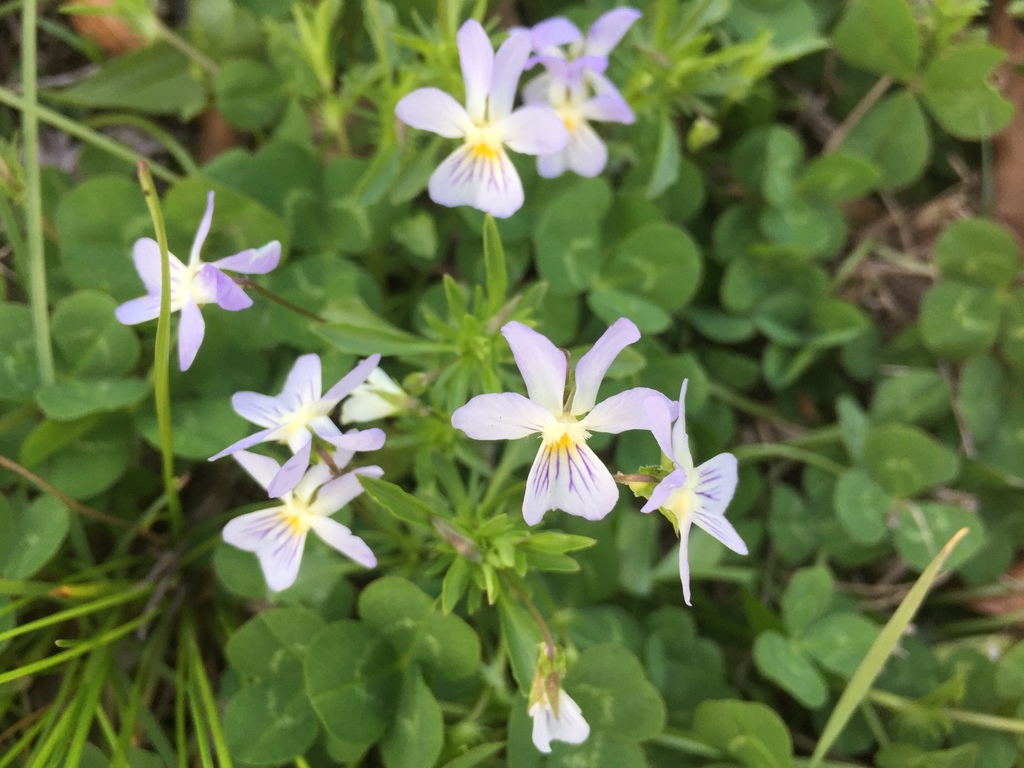
Viola bicolor, the Field Pansy or American field pansy (also known as wild pansy and Johnny-jump-up), is a small, early-spring annual violet of fields, lawns, pastures and roadsides. It usually stands 2 to 8 inches tall and in March and April carries small, pansy-faced flowers about half an inch across, pale blue-violet to creamy white, with a yellow throat and dark purple lines on the lower petal. In many southern and midwestern lawns, it blooms by the thousands alongside bluets and spring beauties.
Field pansy is the only member of the pansy group of violets (section Melanium) generally considered native to North America. Like garden pansies and Johnny-jump-ups, it has branching leafy stems and large, deeply lobed, leaf-like stipules where the leaves join the stem, quite unlike the familiar stemless blue and white violets of woodlands. It is often listed as Viola rafinesquei, the name used by many botanists and field guides; USDA PLANTS uses Viola bicolor.
Because it lives only from fall to late spring, field pansy fits easily into lawns, meadows and other open ground without competing with summer plants. Its flowers serve early bees, and its leaves feed fritillary butterfly caterpillars. This guide covers identification, range, wildlife value and how to encourage it in your landscape.
Identification
Field pansy is easy to recognize as a pansy once you look closely at its stems and stipules. The main challenge is telling it apart from two European pansies that have escaped from cultivation in North America.
Growth Habit & Stems
Field pansy is a winter annual. Seeds germinate in fall, and young plants overwinter as small rosettes. In spring the plant produces one to several slender, upright to sprawling, often branched stems, usually 2 to 8 inches tall, smooth or with a few fine hairs. Plants die after setting seed in late spring or early summer.
Leaves & Stipules
The lowest leaves are small, rounded to spoon-shaped and long-stalked, about half an inch long. Upper leaves are narrower, oblong to oblanceolate, up to about an inch long, with shallow, rounded teeth. At the base of each leaf stalk is a pair of large, leafy stipules divided into several narrow, finger-like lobes; the middle lobe is often leaf-like. These stipules give the stem a ruffled, almost fern-like look.
Flowers
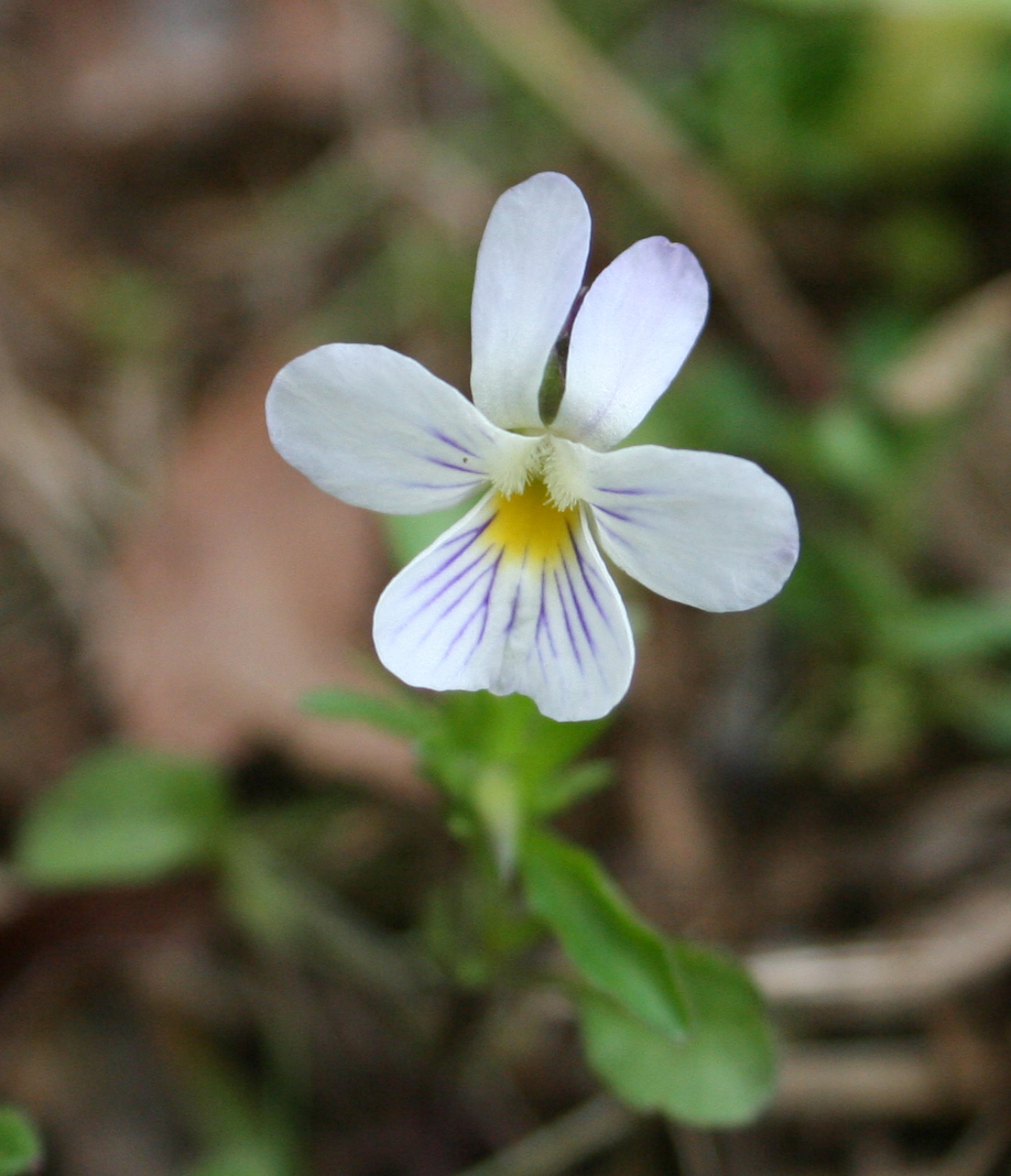
Flowers are borne singly on slender stalks from the leaf axils. They are about a third to two-thirds of an inch across, with five petals arranged like a small pansy face: two upper petals, two side petals with small tufts of hairs (beards) at their bases, and a broader lower petal with a short spur. Petals are pale blue to lavender or cream-white, often bluer toward the tips, with a yellow patch at the throat and dark violet veins on the lower petal. The petals are clearly longer than the narrow green sepals.
Fruit & Seeds
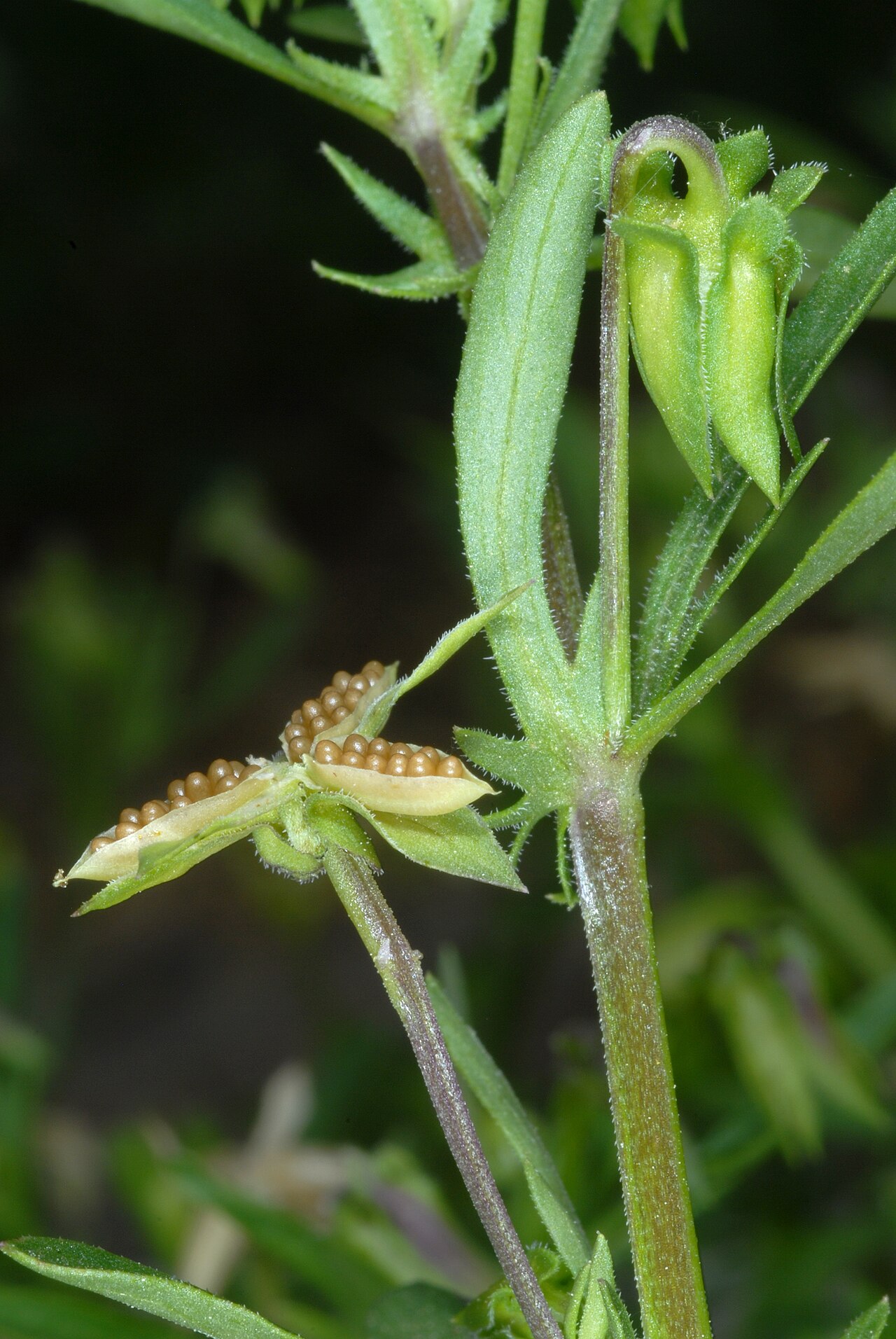
After flowering, the plant forms a small, oval, three-valved capsule. When ripe it splits open, and as the valves dry and fold inward they squeeze out the small, tan seeds, throwing them a short distance. Ants may carry some seeds farther. Seeds are dormant over summer and germinate in fall.
Similar Species
European field pansy (Viola arvensis), a naturalized weed, has cream to pale yellow flowers whose petals are shorter than or about as long as the sepals. Johnny-jump-up (Viola tricolor), a garden escape, has larger flowers with purple, yellow and white markings. Field pansy has pale blue to white flowers with petals noticeably longer than the sepals.
Quick Facts
| Scientific Name | Viola bicolor Pursh (syn. Viola rafinesquei, V. kitaibeliana var. rafinesquei) |
| Family | Violaceae (violet family) |
| Plant Type | Winter annual wildflower |
| Mature Height | 2–8 in |
| Mature Spread | 2–6 in per plant; spreads by self-sowing |
| Growth Rate | Fast; completes its life cycle in one cool season |
| Sun Exposure | Full sun to partial shade |
| Water Needs | Low to moderate; moist in fall through spring |
| Soil Type | Sandy, loamy, clay or rocky soils, including limestone; tolerates disturbed and compacted ground |
| Soil pH | Slightly acidic to slightly alkaline (about 5.5–7.5) |
| Bloom Time | March–May (from February in the Deep South) |
| Flower Color | Pale blue to lavender or cream-white, with yellow center and violet veins |
| Fall Color | None; plants die back after setting seed |
| Fruit | Small three-valved capsule with tan seeds |
| Deer Resistant | Generally yes; too small to attract much browsing |
| USDA Hardiness Zones | 4–9 (as a self-sowing winter annual) |
Native Range
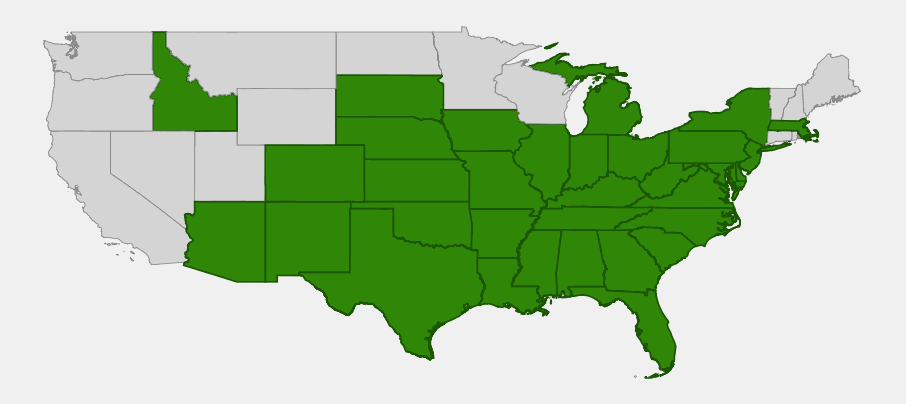
Field pansy is widespread across the eastern and central United States. USDA PLANTS records it as native in 33 states and the District of Columbia, from New York, Massachusetts and Michigan south to Florida and Texas, and west across the Great Plains to South Dakota, Nebraska, Kansas, Oklahoma and Colorado, with scattered populations in New Mexico, Arizona and Idaho. USDA also lists it for Ontario, Alberta, Saskatchewan, British Columbia and the Northwest Territories in Canada, where it is much more local.
It is most abundant in the Southeast, the lower Midwest and the southern Great Plains, especially from the Carolinas and Tennessee west to Missouri, Arkansas, Oklahoma and Texas. There it can be one of the most common early-spring wildflowers of pastures, old fields, lawns and roadsides. Toward the north and west it becomes uncommon.
Botanists have long debated whether field pansy is truly native or an early introduction from the Old World. A 1964 study by Jens Clausen and colleagues showed that its chromosome number differs from European pansies and concluded that it is the only Melanium violet native to North America. Most current floras, including USDA PLANTS and the Flora of North America, treat it as native. Its natural habitats include prairies, glades, open woods, rocky outcrops and sandy or limestone soils, but today it is most often seen in disturbed, open places.
📋 Regional plant lists featuring Field Pansy: New York, Pennsylvania & Northern New Jersey · Idaho, Eastern Oregon & Eastern Washington · Ohio & Indiana · Michigan, Wisconsin & Eastern Minnesota · Kentucky & Tennessee · Nebraska, Kansas & Eastern Colorado · Connecticut, Massachusetts & Rhode Island · New Hampshire, Maine & Vermont · Maryland, Virginia & West Virginia · Delaware, Southern New Jersey & Long Island · Arizona & New Mexico · Illinois, Iowa & Missouri · Alabama, Georgia & Mississippi · North & South Florida
Growing & Care Guide
Field pansy is rarely sold as a plant, but it is easy to encourage. In most of its range it will appear on its own in lawns and meadows that are not heavily fertilized or treated with herbicides. Once present, it sustains itself by self-sowing year after year.
Light
It grows best in full sun to partial shade from late winter into spring. Because it blooms before trees fully leaf out, it also does well under deciduous trees.
Soil & Water
Field pansy is adaptable and grows in sand, loam, clay and rocky or limestone soils. It needs moisture during its fall-to-spring growing season, which rainfall usually supplies, and it avoids summer drought by spending it as seed. Lean, thin soils keep competing grasses from smothering it.
Planting Tips
Collect ripe seed (with permission) in late spring, just as capsules begin to split, and scatter it in early fall on bare or thinly vegetated soil. Press it lightly into the surface; do not bury it deeply. It combines nicely with other spring annuals such as tiny bluet in flowering lawns and meadow openings.
Pruning & Maintenance
Delay mowing in spring until plants have finished flowering and released their seeds, usually by mid-May in the South and late May or June farther north. Avoid broadleaf herbicides and pre-emergent weed killers in areas where you want it. No other care is needed.
Propagation
Propagation is by seed. Seeds need a warm summer after ripening before they can germinate in cool fall weather, so sowing in late spring or early fall reproduces the natural cycle. Plants self-sow freely once established.
Landscape Uses
- Flowering lawns: an early-spring accent in thin turf that is mowed after mid-spring
- Meadow and prairie openings: fills bare ground early in the season before taller natives grow
- Butterfly gardens: a native larval host for fritillary butterflies
- Rock and gravel gardens: grows in thin soils and between stones
- Children’s and nature gardens: a tiny native “pansy” that is fun to discover and compare with garden pansies
Wildlife & Ecological Value
Field pansy is small, but as one of the first flowers of spring and a host plant for butterflies it plays a useful role in lawns and open habitats.
For Pollinators
The flowers are visited by small native bees, including mining bees and sweat bees, and by bee flies and early butterflies. The dark veins on the lower petal act as nectar guides, leading insects into the short spur.
For Birds
The seeds are small but are eaten occasionally by ground-feeding birds such as sparrows, juncos and mourning doves. Field pansy is not a major bird food plant.
For Mammals
Rabbits and other small herbivores may nibble the foliage. It is too small and short-lived to be important food for larger mammals.
Ecosystem Role
Violets are the larval host plants for fritillary butterflies, and caterpillars of the variegated fritillary (Euptoieta claudia) have been photographed feeding on field pansy. Ants carry off some of the seeds, a dispersal method common among violets. As a winter annual, it also covers bare, disturbed soil during the cool season, helping reduce erosion.
Cultural & Historical Uses
Frederick Pursh named the plant Viola bicolor in his 1814 Flora Americae Septentrionalis. Later botanists confused it with European pansies, and it was known for a time as Viola tenella and Viola kitaibeliana var. rafinesquei. Edward Lee Greene named it Viola rafinesquei in honor of the eccentric 19th-century naturalist Constantine Samuel Rafinesque, a name many botanists still use.
The Cherokee are recorded as using field pansy medicinally, applying a poultice of the leaves to relieve pain and drinking a tea of the plant for coughs, colds and digestive complaints. These are historical uses, not recommendations, and no one should use wild plants as medicine without expert guidance.
Today field pansy is best known as a lawn wildflower. Gardeners who want lower-maintenance, more diverse lawns increasingly welcome it alongside bluets, spring beauties and violets, as an early-spring source of color and a resource for pollinators and butterflies.
Frequently Asked Questions
Is field pansy native or a weed?
Field pansy is generally considered native to North America and is the only pansy-type violet that is. It is often confused with European field pansy (Viola arvensis), which is a naturalized weed with cream to yellowish flowers and shorter petals.
Is field pansy the same as Johnny-jump-up?
Field pansy is sometimes called Johnny-jump-up, but that name usually refers to Viola tricolor, a European garden plant with larger, purple-and-yellow flowers. Field pansy has smaller, pale blue to white flowers.
When does field pansy bloom?
It blooms in early spring, from February or March in the South to April and May farther north. Plants die back by early summer after releasing their seed.
Does field pansy help butterflies?
Yes. Like other violets, it serves as a larval food plant for fritillary butterflies, and variegated fritillary caterpillars have been observed feeding on it. Its flowers also provide early nectar for small bees.
How do I get field pansy in my yard?
Scatter seed collected from local plants in early fall on open, sunny ground, stop fertilizing and using broadleaf herbicides, and delay spring mowing until the plants have set seed. Once established, it will reseed on its own.

Looking for a nursery that carries Field Pansy?
Browse our native plant nursery directory: Alabama, Arizona & Arkansas · Colorado, Delaware, Florida & Georgia · Idaho, Illinois, Indiana, Iowa & Kansas · Kentucky, Louisiana, Maryland, Massachusetts, Michigan, Mississippi & Missouri · Nebraska, New Jersey, New Mexico, New York, North Carolina, Ohio & Oklahoma · Pennsylvania, South Carolina, South Dakota, Tennessee, Texas & Virginia · West Virginia