
Spreading Dogbane (Apocynum androsaemifolium)
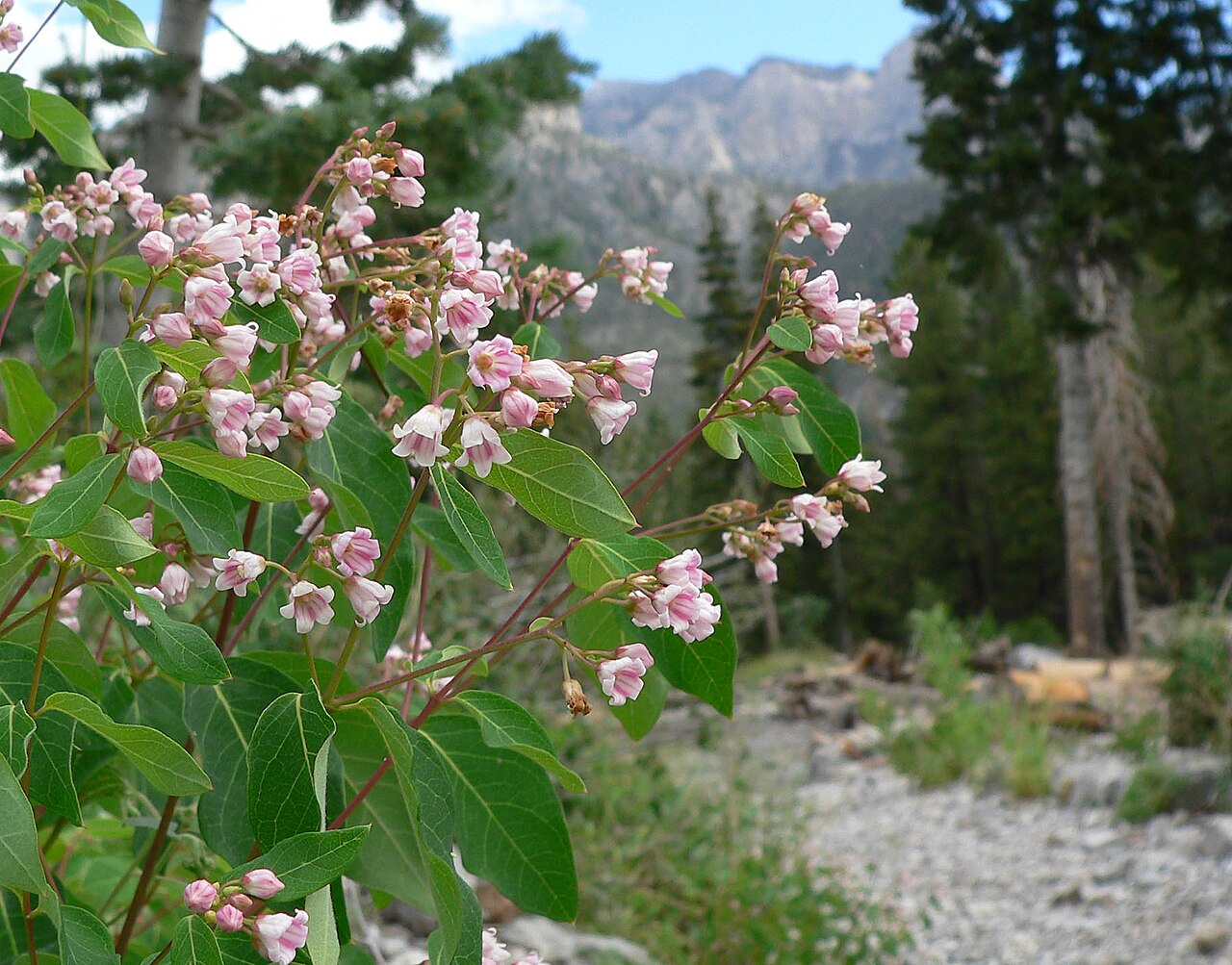
Apocynum androsaemifolium, known as Spreading Dogbane, is a bushy, branching native perennial with reddish stems, paired oval leaves that droop slightly, and clusters of small, pink, bell-shaped flowers that smell faintly of lilac. It spreads by creeping underground rhizomes into low colonies 1 to 2 feet tall, and it is one of the most widespread wildflowers in North America, growing from Alaska and the Yukon to Newfoundland and south to Georgia, Texas, Arizona and California.
Dogbanes belong to the dogbane family (Apocynaceae), which also includes the milkweeds, and they share several milkweed traits: milky sap, long, slender paired seed pods, and silk-tufted seeds that blow away in the wind. Like milkweeds, dogbanes contain toxic cardiac glycosides, which make them bitter and poisonous to livestock and people. The name “dogbane”, meaning poisonous to dogs, refers to that toxicity.
Safety note: all parts of spreading dogbane are poisonous if eaten, and its milky sap can irritate skin. It is an excellent plant for dry, sunny, wild areas, where it feeds many bees and butterflies, but it should not be planted where livestock graze or where young children and pets may chew on plants. This guide covers identification, range, growing tips, wildlife value and the plant’s long cultural history.
Identification
Spreading dogbane is often confused with its close relative hemp dogbane (Indian hemp, Apocynum cannabinum) and sometimes with young milkweeds. Look for its widely branching, forking habit, its drooping leaves, and its pink, bell-shaped flowers with flared tips. The two dogbanes also hybridize, producing intermediate plants called Apocynum × floribundum.
Stems & Roots
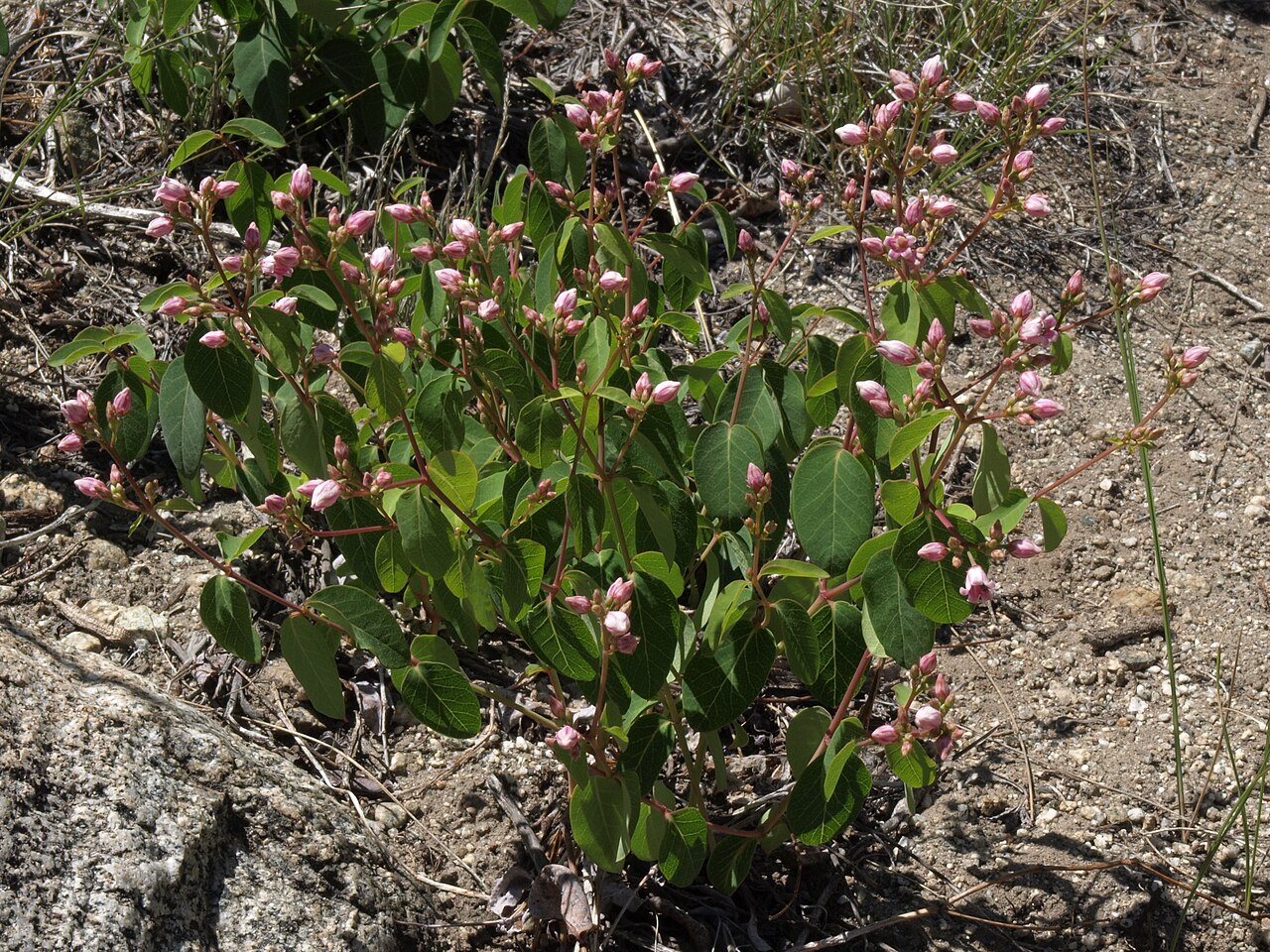
Spreading dogbane grows from deep, branching rhizomes that send up new stems around the parent plant, forming colonies. The stems are slender, smooth, usually reddish, and repeatedly fork into a bushy, rounded plant 8 inches to about 2 feet tall, rarely to 3 feet. Every part of the plant contains milky, bitter sap that oozes when a leaf or stem is broken.
Leaves
The leaves are opposite, oval to egg-shaped, 1 to 4 inches long, and short-stalked, with smooth edges and a small sharp tip. They are dark green above and paler, sometimes hairy, below, and they usually droop or hang down from the stems, giving the plant a slightly wilted look. In fall they turn bright yellow to golden orange.
Flowers
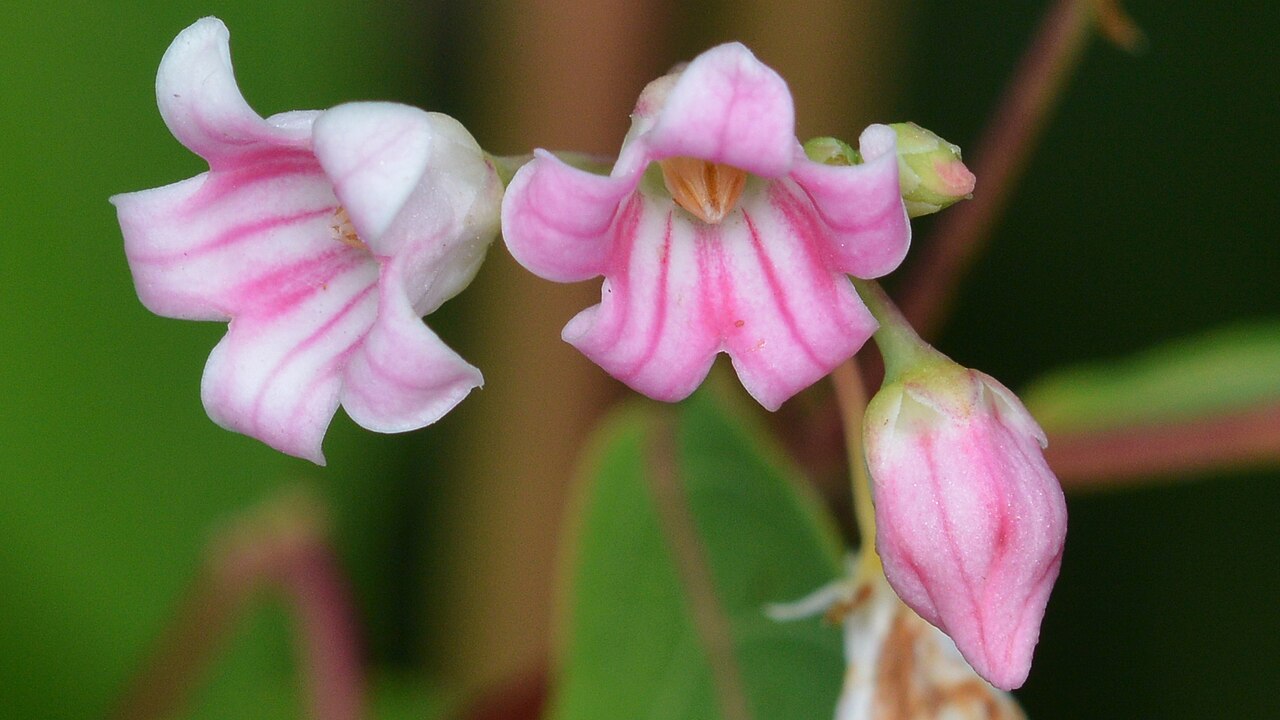
From about June to August, small clusters of flowers open at the branch tips and in the upper leaf axils. Each flower is a nodding, bell-shaped cup about ¼ to ⅜ inch long with five flared, rolled-back lobes. They are pale to bright pink (occasionally nearly white), with deeper pink stripes inside, and have a sweet, lilac-like fragrance. Hemp dogbane, in contrast, has smaller, greenish-white flowers with upright lobes.
Inside the flower, the anthers form a cone over the stigma, with narrow slits between them. Insects that probe for nectar may get their tongues or legs caught in these slits. Larger insects pull free with pollen attached, but small flies and other weak insects are sometimes trapped and die, which has earned the plant the nickname “flytrap dogbane”.
Fruit & Seeds
Pollinated flowers form paired, very slender, pencil-like seed pods (follicles) 3 to 8 inches long that hang from the stems. In late summer and fall they turn reddish brown and split along one side, releasing many small seeds, each with a tuft of silky white hairs that carries it on the wind.
Quick Facts
| Scientific Name | Apocynum androsaemifolium L. |
| Family | Apocynaceae (dogbane family) |
| Plant Type | Herbaceous perennial (forb) spreading by rhizomes |
| Mature Height | 1–2 ft (8 in to 3 ft) |
| Mature Spread | 2–4 ft per plant; spreads into colonies |
| Growth Rate | Moderate to fast once established |
| Sun Exposure | Full sun to part shade |
| Water Needs | Low; drought tolerant |
| Soil Type | Dry, well-drained sand, gravel, rocky or loamy soil |
| Soil pH | About 5.0–7.5 |
| Bloom Time | June–August |
| Flower Color | Pink, striped deeper pink inside; occasionally white |
| Fall Color | Yellow to golden orange |
| Fruit | Paired, long, slender pods with silky-tufted seeds |
| Deer Resistant | Yes; the toxic, bitter foliage is rarely eaten |
| USDA Hardiness Zones | 3–9 |
Native Range
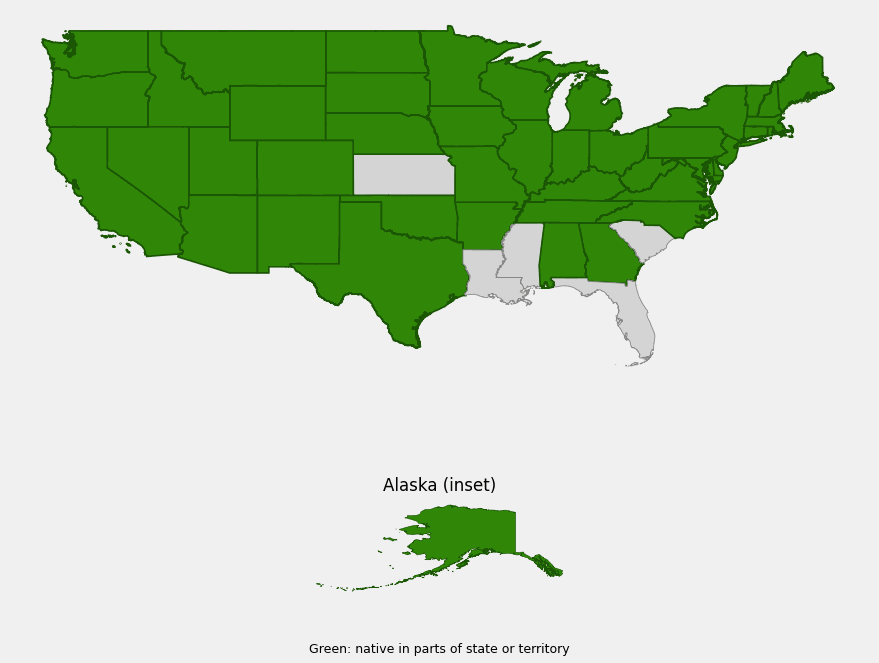
Spreading dogbane has one of the largest ranges of any North American wildflower. USDA PLANTS records it as native in 44 states and the District of Columbia, including Alaska, and in every Canadian province plus the Yukon and Northwest Territories, from British Columbia east to Newfoundland. In the lower 48 states it is absent only from Florida, South Carolina, Mississippi, Louisiana and Kansas, and from Hawaii.
In the East it is a plant of the north and the mountains, common in New England, New York, Pennsylvania and the Great Lakes states and following the Appalachians south to northern Georgia and Alabama. Farther south and on the Coastal Plain it becomes rare. In the West it grows throughout the Rocky Mountains, the Great Basin ranges, the Cascades and the Sierra Nevada, reaching about 10,000 feet in the southern mountains, and it extends into the mountains of Arizona, New Mexico and west Texas.
Its typical habitats are dry and open or lightly shaded: open pine, oak and aspen woods, forest edges and clearings, rocky slopes, sandy plains and dunes, prairies and meadows, burned areas, roadsides and railroad banks. It responds strongly to disturbance and fire. In western forests it is often one of the first plants to resprout after a burn.
📋 Regional plant lists featuring Spreading Dogbane: New York, Pennsylvania & Northern New Jersey · Idaho, Eastern Oregon & Eastern Washington · Ohio & Indiana · Montana & Wyoming · Michigan, Wisconsin & Eastern Minnesota · Kentucky & Tennessee · Nebraska, Kansas & Eastern Colorado · Utah & Western Colorado · Connecticut, Massachusetts & Rhode Island · New Hampshire, Maine & Vermont · Maryland, Virginia & West Virginia · Delaware, Southern New Jersey & Long Island · Arizona & New Mexico · Illinois, Iowa & Missouri · Alabama, Georgia & Mississippi · Alaska
Growing & Care Guide
Spreading dogbane is easy to grow in dry, sunny, lean soil, and once established it needs almost no care. Its main drawback is its spreading habit: its rhizomes run widely, and it can overwhelm small beds. It is best used in meadows, dry banks, rock gardens with room to roam, and naturalized areas rather than formal borders.
Light
Full sun to part shade. It flowers best in sun or the bright, dappled shade of open pine and aspen woods.
Soil & Water
It prefers dry to medium, well-drained soil, especially sand, gravel or rocky loam, and it tolerates poor, acidic and nutrient-poor ground. Once established it is very drought tolerant and needs no watering except in extreme drought. Avoid heavy, wet soils, where it may rot.
Planting Tips
Plant potted plants or rhizome divisions in spring or fall, spacing them 2 to 3 feet apart. Give it a site where its spread is welcome, or contain it with a deep edging or between paths and pavement. It is a good choice for stabilizing dry, sandy banks.
Pruning & Maintenance
There is little to do beyond controlling its spread. Pull or cut unwanted shoots, and cut stems to the ground in late fall or early spring. Wear gloves and avoid getting the milky sap in your eyes or on broken skin, as it can cause irritation.
Propagation
Divide rhizomes in early spring or fall, or take root cuttings. Seed can be collected from ripe pods in fall before the seeds blow away; give it about 30 days of cold, moist stratification and sow it on the surface in spring.
Safety
Spreading dogbane contains cardiac glycosides (including cymarin) that affect the heart. Eating it can cause vomiting, diarrhea, an irregular heartbeat and, in larger amounts, serious poisoning. Livestock usually avoid it because of its bitterness but can be poisoned if they eat it in hay or when other forage is scarce. Do not plant it in pastures, keep children and pets from chewing on it, and wear gloves when handling broken stems. If someone eats it, call Poison Control (1-800-222-1222 in the United States) or a veterinarian.
Landscape Uses
- Pollinator meadows: long summer bloom for bees, butterflies and other insects
- Dry banks and slopes: rhizomes help hold sandy or gravelly soil
- Woodland edges and clearings: fills open, dry shade under pines and oaks
- Post-fire and disturbed-site restoration: an early resprouter that covers bare ground quickly
- Fall color: golden yellow foliage in autumn
Wildlife & Ecological Value
Despite its toxicity, spreading dogbane is very valuable to insects. Its fragrant flowers feed a wide range of pollinators, and a number of specialized insects have adapted to its chemistry.
For Pollinators
The flowers are visited by bumble bees, honey bees, small native bees, butterflies and moths, flies and beetles. They attract butterflies such as fritillaries, skippers and hairstreaks. Spreading dogbane is the larval host plant for the dogbane tiger moth (Cycnia tenera) and the snowberry clearwing (Hemaris diffinis), a bumble bee–like hawk moth. The iridescent dogbane leaf beetle (Chrysochus auratus) feeds on the leaves, and its larvae feed on the roots.
For Birds
The seeds are not an important bird food, but the plant supports many insects that birds feed to their young.
For Mammals
Mammals generally avoid eating it because of its bitter, toxic sap. Deer browse it only lightly, if at all.
Ecosystem Role
Spreading dogbane is a classic disturbance-adapted plant. Its deep rhizomes survive fire, and in western conifer forests it is often one of the most abundant plants to resprout after a burn. Its colonies help stabilize soil while trees and shrubs recover. Its cardiac glycosides also provide chemical defense for specialist insects such as the dogbane leaf beetle.
Cultural & Historical Uses
Dogbanes were among the most important fiber plants for Native peoples across North America. The tough outer fibers of the stems were stripped, cleaned and rolled into strong, fine cordage, which was used for thread, fishing lines, nets, snares, bags and clothing. Women of several tribes rolled the fibers on their thighs to make twine. Hemp dogbane, with its taller stems, was the most widely used, but spreading dogbane was also used where it was common.
The plant was also used medicinally by several Native peoples and later by European American herbalists, especially its bitter root, which was used as an emetic, a heart and kidney medicine and a treatment for various ailments. Because it contains powerful heart-affecting glycosides, such use is dangerous and is not recommended today.
Linnaeus named Apocynum androsaemifolium in 1753. Apocynum comes from Greek words meaning “away from dogs”, and the species name means “with leaves like Androsaemum“, an old name for a St. John’s wort with similar oval leaves. The flytrap behavior of its flowers has fascinated naturalists since at least the nineteenth century.
Frequently Asked Questions
Is spreading dogbane poisonous?
Yes. All parts contain cardiac glycosides and are toxic to people, pets and livestock if eaten. The milky sap can also irritate skin and eyes. It is safe to grow in naturalized areas away from pastures and young children, but it should never be eaten or used as an herbal remedy.
What is the difference between spreading dogbane and hemp dogbane?
Spreading dogbane is shorter and more branched, with drooping leaves and pink, bell-shaped flowers with flared lobes. Hemp dogbane (Apocynum cannabinum) is taller, with more upright leaves and tiny greenish-white flowers with erect lobes. It also grows in moister soils. The two sometimes hybridize.
Is spreading dogbane a milkweed?
No, but it is closely related. Both are in the dogbane family and have milky sap, slender pods and silky-tufted seeds. Monarch caterpillars do not feed on dogbane, so it is not a substitute for milkweed as a monarch host plant, though adult monarchs and many other butterflies visit its flowers.
Does spreading dogbane spread aggressively?
It spreads steadily by rhizomes and can form large colonies in light, sandy soil. That makes it excellent for meadows and banks but a poor choice for small, formal beds unless it is contained.
Why do insects get stuck in dogbane flowers?
The anthers form a cone with narrow slits between them. When insects probe for nectar, their tongues or legs can slip into the slits and become caught. Strong insects pull free and carry pollen away, while small, weak insects sometimes stay trapped.

Looking for a nursery that carries Spreading Dogbane?
Browse our native plant nursery directory: Alabama, Alaska, Arizona & Arkansas · California · Colorado, Connecticut, Delaware & Georgia · Idaho, Illinois, Indiana & Iowa · Kentucky, Maine, Maryland, Massachusetts, Michigan, Minnesota, Missouri & Montana · Nebraska, Nevada, New Hampshire, New Jersey, New Mexico, New York, North Carolina, North Dakota, Ohio & Oklahoma · Oregon · Pennsylvania, Rhode Island, South Dakota, Tennessee, Texas, Utah, Vermont & Virginia · Washington · West Virginia, Wisconsin & Wyoming