
American Hog-Peanut (Amphicarpaea bracteata)
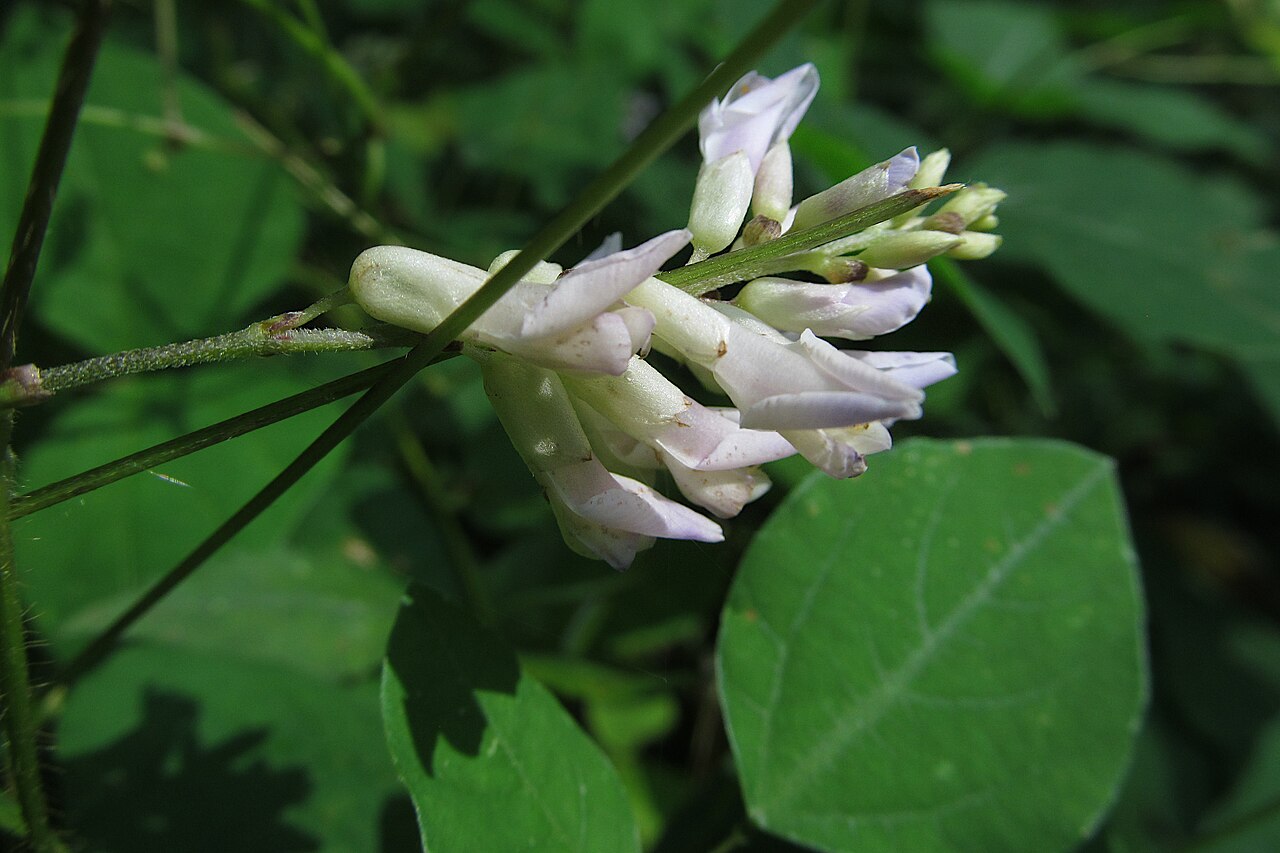
Amphicarpaea bracteata, known as American Hog-Peanut (USDA: American hogpeanut), is a delicate, twining vine of the pea family (Fabaceae) found in woodlands and thickets across eastern and central North America. Its slender stems wind over low plants, shrubs and fallen branches, and in late summer it bears small clusters of pale lilac to white pea flowers among three-part leaves.
Hog-peanut’s name points to its most remarkable feature: it produces two different kinds of flowers and fruit. The showy flowers on the climbing stems produce small, flat pods with a few seeds. At the same time, threadlike runners near the base of the plant carry tiny flowers without petals that pollinate themselves, often underground, and develop into a single large, fleshy, bean-like seed in the soil. These underground “peanuts” were dug by hogs that foraged in the woods, and they were a valued food for Native American peoples.
This guide covers how to identify American hog-peanut, its range and habitat, how to grow it in a woodland or wildlife garden, and its role in nitrogen-poor forest soils and as a host plant for butterflies.
Identification
Hog-peanut is common, but it is easy to overlook among other woodland plants. Look for a thin, twining vine with three-part leaves, especially in late summer when it is flowering.
Stems & Growth Habit
The stems are thin, wiry, twining and covered with fine, backward-pointing hairs. They climb over other plants, typically 1 to 5 feet long and occasionally longer, and often form loose tangles or low mats on the forest floor. Most plants are annuals, renewed each year from seed, though they behave much like a perennial colony because the plants reseed in the same spot every year.
Leaves
Leaves are alternate and compound, with three broadly ovate to diamond-shaped leaflets 1 to 4 inches long, with smooth edges and pointed tips. The end leaflet has a longer stalk than the two side leaflets. Small, leafy stipules sit at the base of each leaf stalk. The leaves are thin and soft, and often slightly hairy beneath.
Flowers
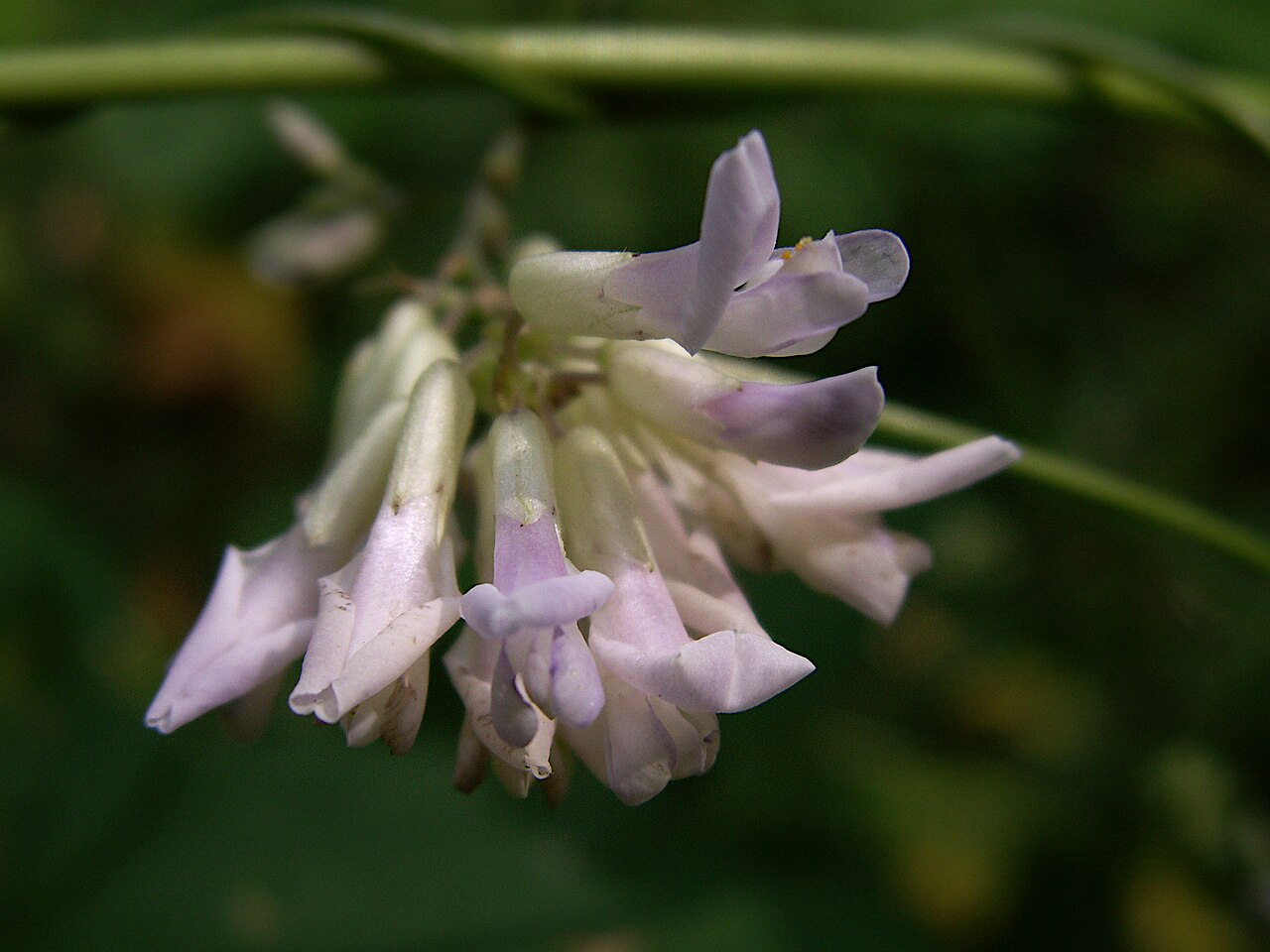
The upper, open (chasmogamous) flowers appear from late July through September in short, drooping clusters of about 2 to 15 in the leaf axils. Each flower is about 1/2 inch long, a typical pea flower with a banner, wings and keel, pale lilac, pink or white. The lower, closed (cleistogamous) flowers are tiny, lack petals and are produced on threadlike runners that creep along or just under the soil surface. They pollinate themselves without opening.
Fruit & Seeds
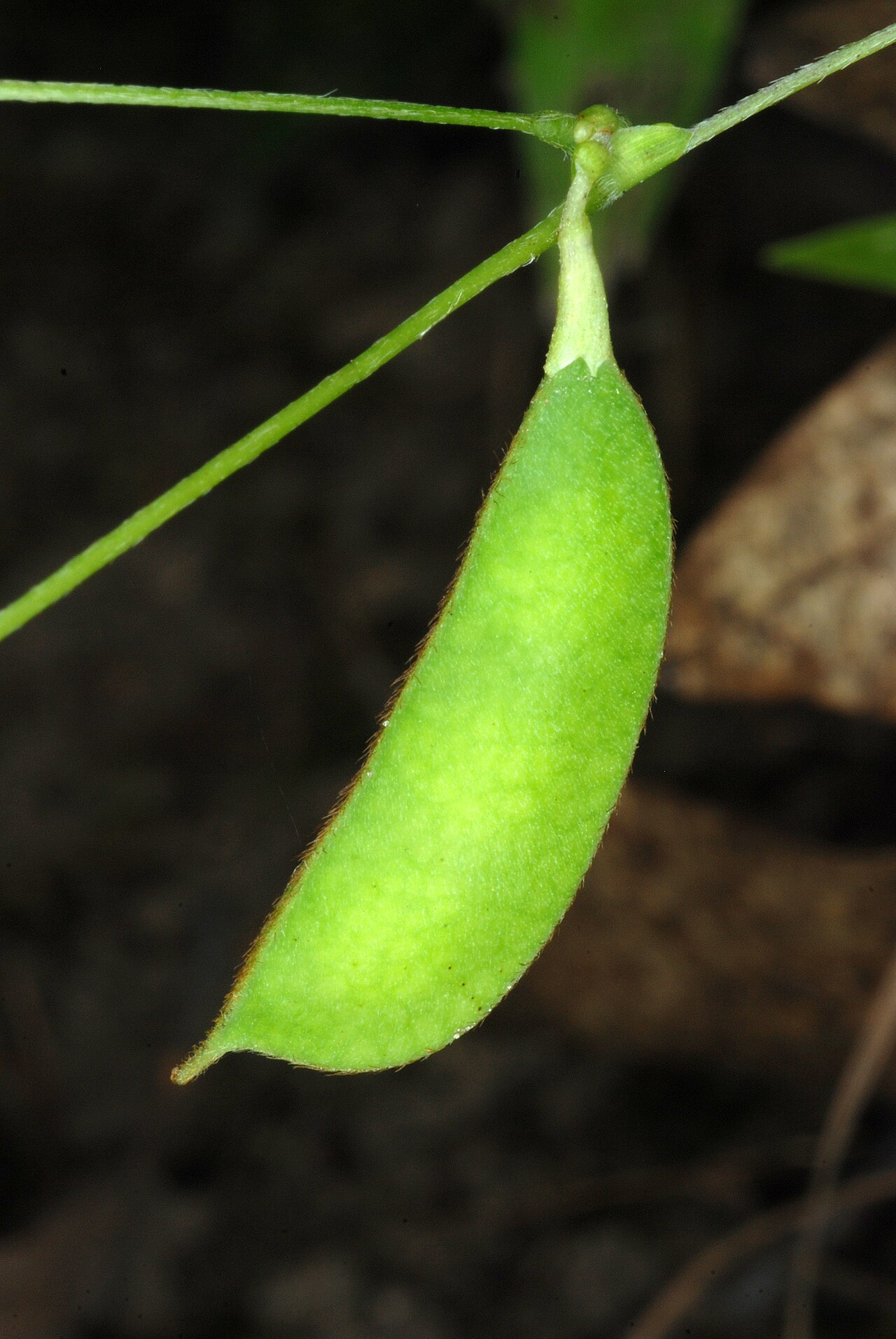
The upper flowers produce flat, oblong pods about 1 inch long that hold three or four small, mottled seeds. When dry, the pod halves twist and fling the seeds a short distance. The underground flowers produce a different fruit: a rounded, fleshy pod about 1/2 inch across containing a single large seed. These buried seeds are larger, have more stored food and germinate close to the parent, while the aerial seeds spread farther. The two strategies help the plant both hold its ground and colonize new sites.
Look-alikes
American groundnut (Apios americana) is a twining legume with five to seven leaflets and showy maroon flowers. Wild beans (Strophostyles) and milk peas (Galactia) have three leaflets but pink to purple flowers and grow in sunnier, drier sites. Tick-trefoils (Desmodium) have similar leaves but are upright, not twining, and produce sticky, segmented pods.
Quick Facts
| Scientific Name | Amphicarpaea bracteata (syn. Falcata comosa, Amphicarpaea monoica) |
| Family | Fabaceae (pea or legume family) |
| Plant Type | Twining herbaceous vine; usually annual, reseeding |
| Mature Height | Stems 1–5 ft long, climbing or trailing |
| Mature Spread | 1–3 ft; forms loose mats and tangles |
| Growth Rate | Fast |
| Sun Exposure | Part shade to shade; tolerates sun with moisture |
| Water Needs | Medium; moist soil |
| Soil Type | Rich, loamy woodland soil; tolerates sand and clay |
| Soil pH | About 5.5–7.5 |
| Bloom Time | July–September |
| Flower Color | Pale lilac, pink or white |
| Fall Color | None; leaves yellow and wither |
| Fruit | Flat aerial pods with 3–4 seeds; single-seeded underground pods |
| Deer Resistant | No; deer browse the foliage |
| USDA Hardiness Zones | 3–9 |
Native Range
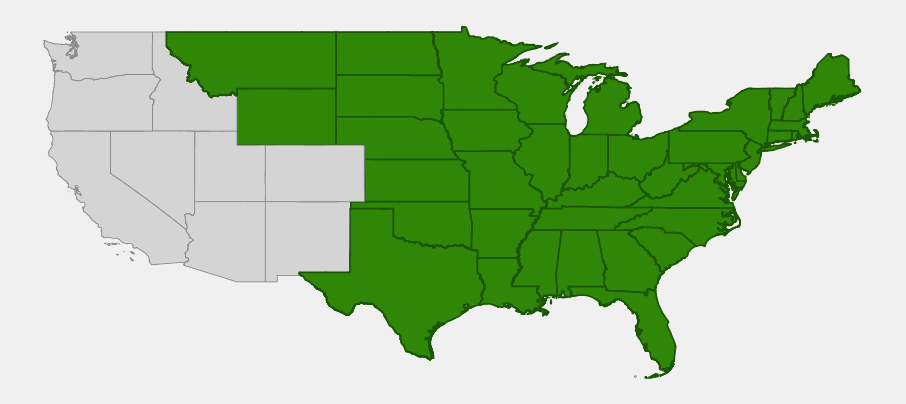
American hog-peanut is native across the eastern two-thirds of the United States and southern Canada. The Lady Bird Johnson Wildflower Center describes its range as Manitoba east to Nova Scotia, south to Florida, west to Texas, and north to North Dakota and Montana. USDA PLANTS records it from 39 states and the District of Columbia, and in Canada from Manitoba, Ontario, Quebec, New Brunswick and Nova Scotia.
It is most common in the Northeast, the Appalachians, the Ohio Valley and the Midwest, where it is a familiar plant of moist deciduous woods, woodland edges, thickets and stream banks. In the Southeast it is more scattered, mostly in rich hardwood forests and floodplains, and it reaches only northern Florida. On the Great Plains it is confined to wooded river valleys and ravines, extending west along rivers into the Dakotas, eastern Montana and Wyoming.
Botanists have long debated whether the eastern plants represent one variable species or several. Older works separate var. comosa, a larger, hairier form, from var. bracteata. USDA PLANTS treats them as one species.
📋 Regional plant lists featuring American Hog-Peanut: New York, Pennsylvania & Northern New Jersey · Idaho, Eastern Oregon & Eastern Washington · Ohio & Indiana · Montana & Wyoming · Michigan, Wisconsin & Eastern Minnesota · Kentucky & Tennessee · Nebraska, Kansas & Eastern Colorado · Connecticut, Massachusetts & Rhode Island · New Hampshire, Maine & Vermont · Maryland, Virginia & West Virginia · Delaware, Southern New Jersey & Long Island · Illinois, Iowa & Missouri · Alabama, Georgia & Mississippi · North & South Florida
Growing & Care Guide
American hog-peanut is rarely planted on purpose, but it is a useful native for woodland gardens, shady wildlife areas and food-forest plantings. It is easy once established, reseeds itself each year, and adds nitrogen to the soil.
Light
It grows best in part shade or dappled light under deciduous trees and at woodland edges. It tolerates fairly deep shade and also full sun where the soil stays moist.
Soil & Water
Hog-peanut likes moist, rich, loose soil with plenty of leaf litter, such as the soil of a floodplain or hardwood forest. It tolerates sandy and clay soils and short dry spells. Like most legumes it forms root nodules with nitrogen-fixing bacteria, so it needs no fertilizer.
Planting Tips
Sow seeds in fall or early spring where you want plants to grow, about 1/2 inch deep, or set out small plants in spring. Give it something low to climb: shrubs, brush piles, a fence or other wildflowers. It is light and rarely smothers sturdy neighbors, but it can cover small spring wildflowers that have gone dormant.
Pruning & Maintenance
Very little maintenance is needed. Pull out vines in late summer where they are unwanted before they set seed. Leave the leaf litter in place in fall so the underground seeds stay moist and protected over winter.
Propagation
Grow it from seed. Aerial seeds have hard seed coats and germinate better after scarification (nicking or sanding the coat) or a soak in warm water. Underground seeds germinate readily if planted fresh and kept moist. Seed is occasionally offered by native seed suppliers.
Landscape Uses
- Woodland and shade gardens: a light, native groundcover vine that twines over shrubs and brush
- Wildlife plantings: seeds feed birds and small mammals; foliage hosts butterfly caterpillars
- Soil improvement: nitrogen-fixing legume for nutrient-poor woodland soils
- Forest restoration: a common understory component of moist deciduous forests within its range
- Edible landscapes: underground seeds are edible when cooked
Wildlife & Ecological Value
American hog-peanut supports wildlife both above and below ground. Its seeds feed small mammals and birds, its leaves feed caterpillars, and its roots enrich forest soils with nitrogen.
For Pollinators
The upper flowers are visited mostly by bees, especially bumblebees, and occasionally by skippers and other butterflies. The Lady Bird Johnson Wildflower Center lists it as a larval host for the silver-spotted skipper (Epargyreus clarus) and the northern cloudywing (Thorybes pylades), whose caterpillars fold leaves into shelters.
For Birds
Wild turkeys, ruffed grouse and northern bobwhite eat the seeds, and smaller ground-foraging birds pick up the aerial seeds. The tangled vines provide light cover near the ground.
For Mammals
Mice, voles and chipmunks gather and store the underground seeds, which are rich in starch and protein. Wild and domestic pigs root them up, which gave the plant its common name. Deer and rabbits browse the leaves and stems.
Ecosystem Role
As a legume, hog-peanut hosts nitrogen-fixing bacteria in root nodules, adding nitrogen to forest soils. Its two kinds of seeds give it a flexible strategy: buried seeds secure the next generation in a good site, while aerial seeds can disperse to new openings. It has been studied by ecologists as a model plant for understanding the trade-offs between self-pollination and cross-pollination.
Cultural & Historical Uses
The underground seeds of hog-peanut were an important food for several Native American peoples of the Great Plains and Great Lakes, including the Dakota, Lakota, Omaha and Ponca. They were boiled or roasted and eaten like beans. Ethnobotanist Melvin Gilmore recorded in the early twentieth century that Dakota women gathered the seeds from the caches of meadow voles, which collect and store them in large quantities, and that they often left corn or other food in return rather than leave the voles without winter stores.
Early European settlers called the plant hog-peanut because free-ranging pigs rooted the seeds from the woods. The genus name Amphicarpaea comes from Greek words meaning “fruit of both kinds,” and bracteata refers to the small bracts beneath the flowers. Older books often use the name Falcata comosa.
Today hog-peanut attracts interest from foragers, permaculture gardeners and plant breeders as a native, nitrogen-fixing, shade-tolerant legume with edible seeds. The underground seeds should be cooked before eating, as with most beans, and only small quantities should be gathered from wild populations.
Frequently Asked Questions
Is American hog-peanut edible?
The underground seeds are edible when boiled or roasted and were an important food for several Native American peoples. Aerial seeds are small and tough. As with most wild legumes, cook them before eating and be certain of your identification.
Why does hog-peanut have two kinds of flowers?
The showy upper flowers can be cross-pollinated by bees and produce small seeds that spread farther. The tiny petal-less lower flowers pollinate themselves underground and produce larger seeds that sprout near the parent. Producing both helps the plant both persist and spread.
Is hog-peanut a weed?
It is a native vine that can spread through a shady garden by reseeding, but it is lightweight and rarely smothers larger plants. Pull it before seed set where it is not wanted.
Does hog-peanut fix nitrogen?
Yes. Like most legumes, it forms root nodules with nitrogen-fixing bacteria, which add nitrogen to the soil.
Which butterflies use hog-peanut?
It is a larval host for the silver-spotted skipper and the northern cloudywing. The caterpillars make shelters by folding or tying leaves with silk.

Looking for a nursery that carries American Hog-Peanut?
Browse our native plant nursery directory: Alabama & Arkansas · Connecticut, Delaware, Florida & Georgia · Illinois, Indiana, Iowa & Kansas · Kentucky, Louisiana, Maine, Maryland, Massachusetts, Michigan, Minnesota, Mississippi, Missouri & Montana · Nebraska, New Hampshire, New Jersey, New York, North Carolina, North Dakota, Ohio & Oklahoma · Pennsylvania, Rhode Island, South Carolina, South Dakota, Tennessee, Texas, Vermont & Virginia · West Virginia, Wisconsin & Wyoming