
Western Horsenettle (Solanum dimidiatum)
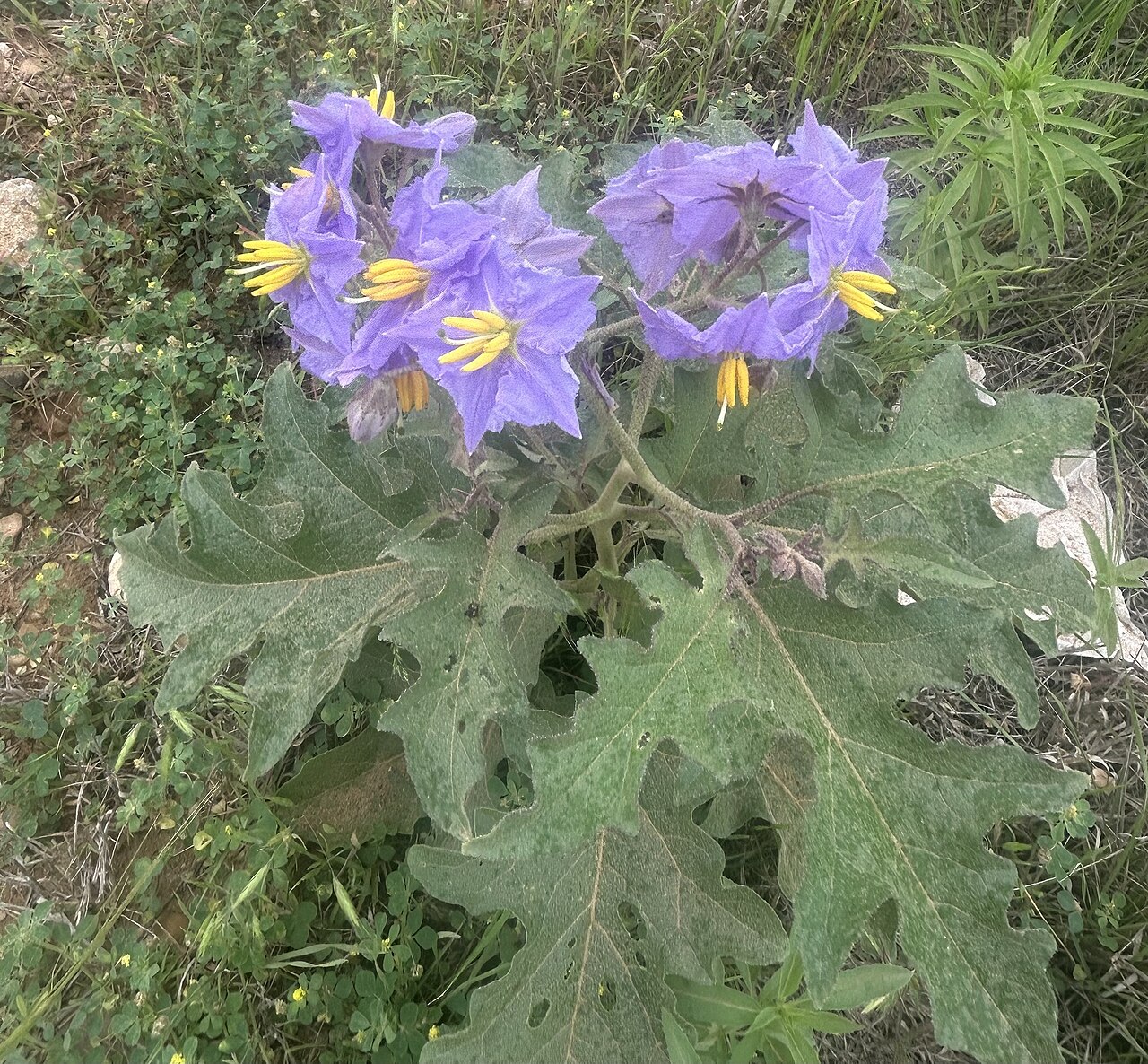
Solanum dimidiatum, known as Western Horsenettle, is a tough, prickly perennial of the nightshade family (Solanaceae) native to the prairies, pastures and roadsides of the southern Great Plains. From late spring through summer it bears clusters of large, star-shaped violet or lavender flowers, each with a bright yellow cone of anthers, above big, wavy-lobed, prickly leaves. The flowers are followed by round yellow berries that look like small tomatoes.
It is also called Torrey’s nightshade and robust horsenettle, and older books list it as Solanum torreyi. It closely resembles the more widespread Carolina horsenettle (Solanum carolinense) but is larger in every part, with bigger flowers, broader leaves and larger fruit.
Western horsenettle is not a typical garden plant. It spreads by deep rhizomes, its stems and leaves are armed with sharp yellow prickles, and its foliage and fruit are poisonous to people, pets and livestock. Still, it is a native wildflower that feeds bumblebees and other native bees, and it is worth recognizing in prairies and wild areas. This guide covers how to identify it, where it grows, and how to manage it safely.
Identification
Western horsenettle is a coarse, upright plant, usually 1 to 3 feet tall, that often grows in loose patches connected by underground rhizomes. Its large lobed leaves, yellow prickles and big violet flowers make it easy to spot in summer.
Stems
The stems are erect and branched, up to about 2½ feet tall, and covered with straight yellow prickles and small star-shaped (branched) hairs that give the plant a slightly grayish look. New shoots come up each spring from long, deep rhizomes.
Leaves
The leaves are alternate, oval in outline and up to about 6 inches long, with five to seven wavy, often deeply cut lobes. Prickles run along the midrib and leaf stalk on both sides of the leaf. Carolina horsenettle has smaller, less deeply lobed leaves, and silverleaf nightshade (S. elaeagnifolium) has narrow, silvery leaves.
Flowers
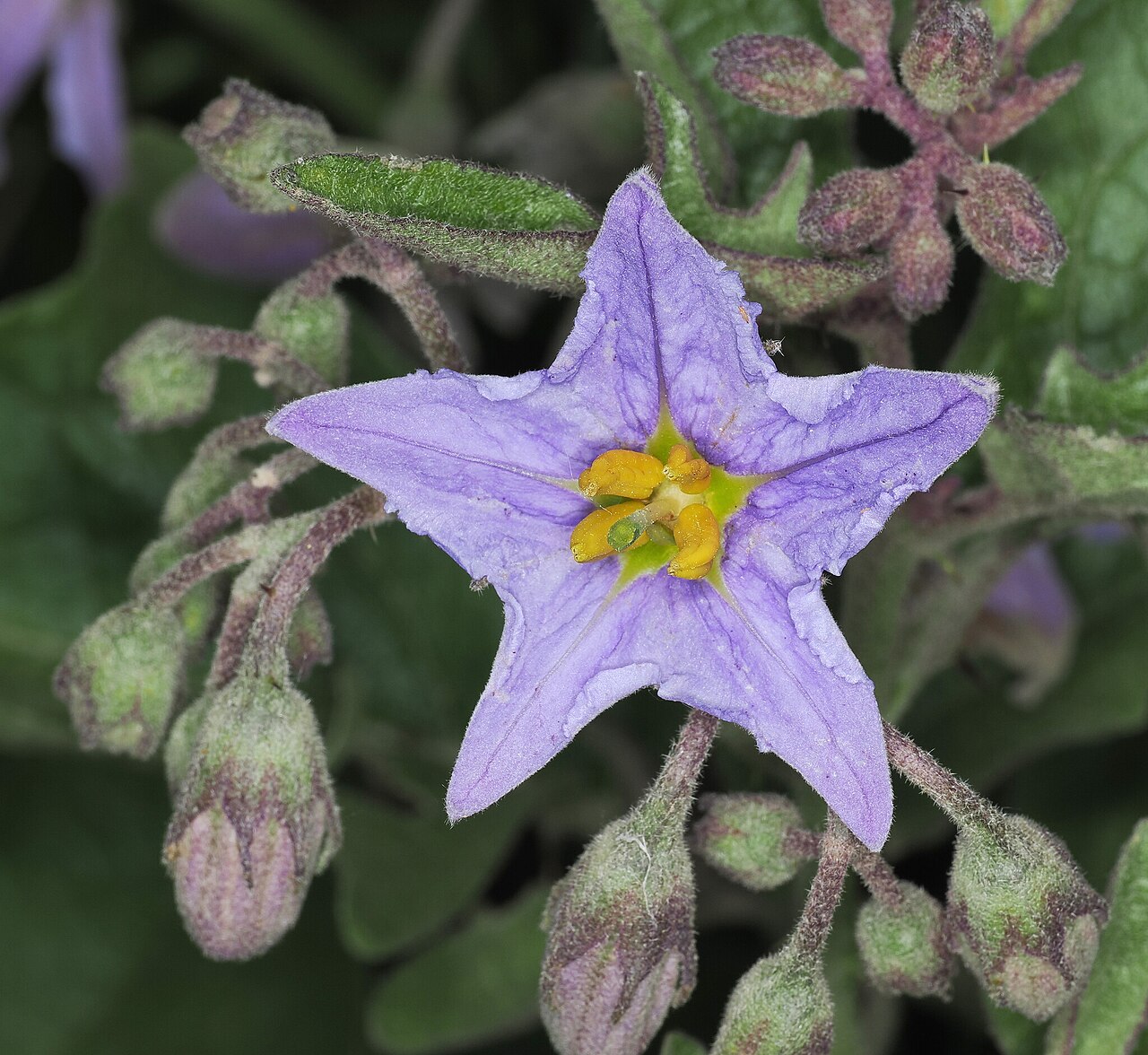
Flowers grow in branched clusters at the ends of the stems from May through August, and sometimes later. Each flower is a five-pointed star or shallow bell about 1¼ to 2 inches across, violet to lavender or occasionally white. The five large yellow anthers, about ⅜ inch long, form a cone in the center. Carolina horsenettle’s flowers are smaller, usually under 1¼ inches across.
Fruit
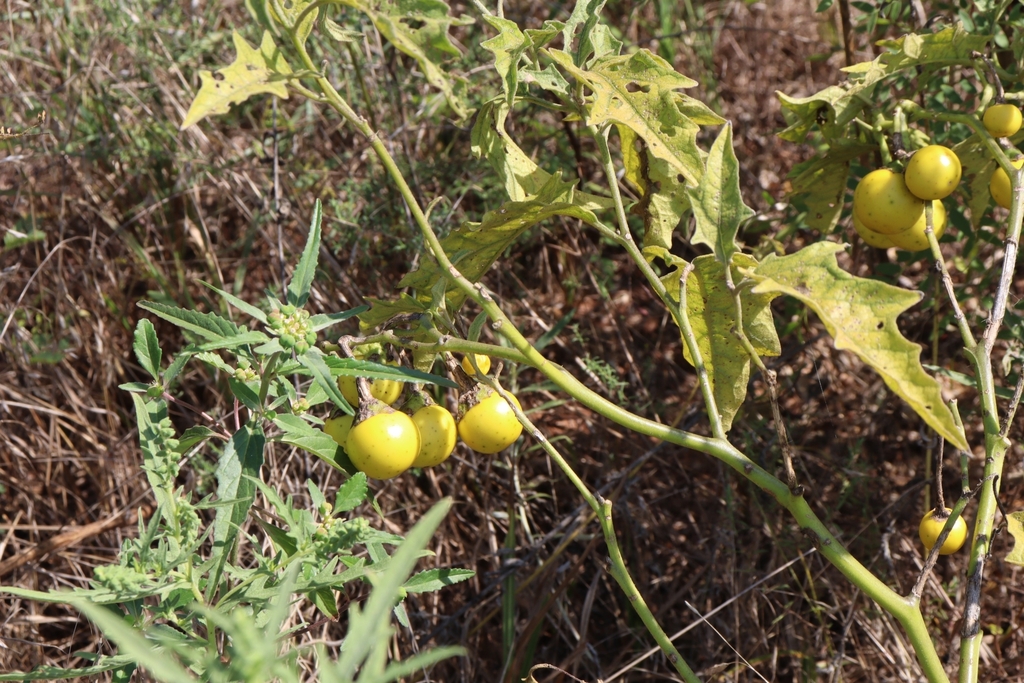
The fruit is a smooth, round berry ¾ to 1½ inches across. It ripens from green to bright yellow and wrinkles as it dries, often hanging on the dead stems into winter. Each berry holds many flat seeds. All parts of the fruit are poisonous.
Quick Facts
| Scientific Name | Solanum dimidiatum (syn. S. torreyi) |
| Family | Solanaceae (nightshade family) |
| Plant Type | Rhizomatous perennial wildflower |
| Mature Height | 1–3 ft |
| Mature Spread | 1–2 ft per stem; spreads into patches by rhizomes |
| Growth Rate | Moderate to fast |
| Sun Exposure | Full sun to light shade |
| Water Needs | Low; drought tolerant |
| Soil Type | Sandy, loamy or clay soils; tolerates disturbed and compacted ground |
| Soil pH | About 6.0–8.0 |
| Bloom Time | May–August, sometimes into fall |
| Flower Color | Violet to lavender, occasionally white, with yellow anthers |
| Fall Color | None; stems die back and yellow berries persist |
| Fruit | Round yellow berry, ¾–1½ in (poisonous) |
| Deer Resistant | Yes; prickly and toxic, rarely browsed |
| USDA Hardiness Zones | 6–9 |
Native Range
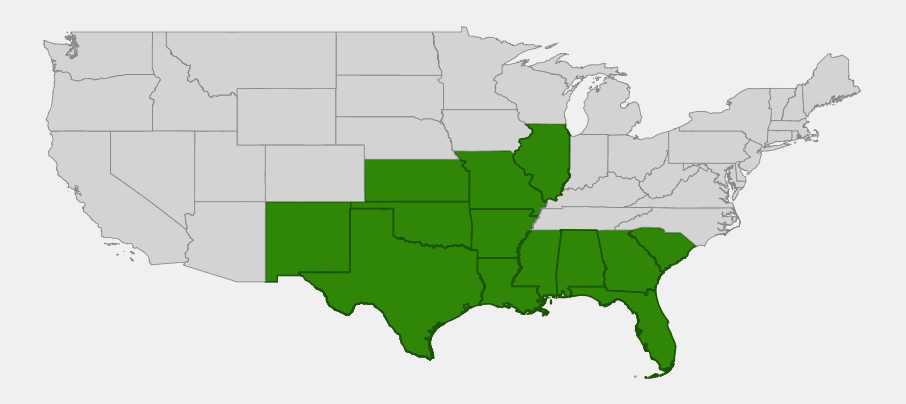
Western horsenettle is native to the south-central United States. Its heartland is Texas, Oklahoma and Kansas, where it is common in prairies, pastures, old fields and roadsides, and it extends into New Mexico, Arkansas, Louisiana and Missouri. The Lady Bird Johnson Wildflower Center lists it in plantings at the Fredericksburg Nature Center and the University of Texas Brackenridge Field Laboratory.
USDA PLANTS also records it farther east, in Illinois, Mississippi, Alabama, Georgia, Florida and South Carolina. In these states it is much less common and usually found on disturbed ground such as roadsides, fields and rail lines. In California it is not native; it was introduced there and is treated as a noxious weed, so California is not included on this page’s range map.
Typical habitats include tallgrass and mixed-grass prairie, overgrazed pastures, fencerows, field edges, vacant lots and roadsides. It grows in a wide range of soils and is especially conspicuous on disturbed or heavily grazed land, where its prickles and bitter foliage protect it from livestock.
📋 Regional plant lists featuring Western Horsenettle: Nebraska, Kansas & Eastern Colorado · Illinois, Iowa & Missouri · Alabama, Georgia & Mississippi · North & South Florida · North & South Carolina · Arkansas, Louisiana, Eastern Oklahoma & Eastern Texas · South & West Texas
Growing & Care Guide
Western horsenettle is rarely planted on purpose, and most gardeners will not want it in beds or lawns. It is best left in prairies, pastures and wild corners, where its flowers feed native bees. Safety note: all parts of the plant, especially the unripe and ripe berries, contain toxic glycoalkaloids (including solanine). Keep children and pets away from the fruit, wear gloves when handling it because of the prickles, and don’t let livestock graze heavily infested pasture.
Light
It grows best in full sun and also tolerates light shade along woodland edges. In shade it becomes leggy and flowers less.
Soil & Water
It is drought tolerant and grows in almost any well-drained soil, from sand to heavy clay, including poor, compacted and disturbed ground. No watering or fertilizer is needed. Rich, well-watered soil only makes it spread faster.
Planting Tips
If you want it in a prairie planting or wildlife area, sow seed from ripe yellow berries in fall, or let existing plants be. Give it room away from paths, play areas and pet runs. Because it spreads by rhizomes, don’t plant it in mixed borders or near vegetable gardens.
Pruning & Maintenance
Cut stems to the ground after flowering if you don’t want fruit to form. To reduce a patch, cut or mow it repeatedly through the growing season to weaken the rhizomes; pulling usually breaks the roots, and each piece can resprout. Wear thick gloves when handling the stems.
Propagation
It reproduces by seed and by spreading rhizomes. Seed collected from fully ripe, yellow berries can be cleaned, dried and sown in fall. Root cuttings also root easily, which is why tilling tends to spread it.
Landscape Uses
- Prairie and pasture edges: a native summer wildflower for wild, open ground
- Bee habitat: buzz-pollinated flowers for bumblebees and other native bees
- Wildlife areas: deer- and livestock-resistant cover on dry, poor soil
- Wildflower identification: a common prairie plant worth knowing and handling carefully
Wildlife & Ecological Value
Western horsenettle’s prickles and toxins keep most browsers away, but its flowers are an important pollen source for native bees, and several insects depend on nightshades.
For Pollinators
Like tomatoes and other nightshades, its flowers are buzz-pollinated. Bumblebees, carpenter bees and other native bees grip the anther cone and vibrate their flight muscles to shake out the pollen, which honeybees cannot do. The flowers offer pollen rather than nectar.
For Birds
Birds make little direct use of it, though a few may peck at the old berries in winter. Its main value to birds is indirect, through the bees and other insects it supports, and the low cover its patches provide in open grassland.
For Mammals
Deer, cattle and horses usually avoid it, because the foliage is prickly and the plant, especially the fruit, is poisonous. Some small mammals eat the berries and may help spread the seeds.
Ecosystem Role
Western horsenettle is a host plant for insects that feed on nightshades, including several flea beetles and tortoise beetles. In grazed or disturbed prairie, it is one of the native plants that quickly colonizes bare ground.
Cultural & Historical Uses
The species was named by the eccentric naturalist Constantine Samuel Rafinesque. The epithet dimidiatum is Latin for halved. The synonym Solanum torreyi honors the American botanist John Torrey, and it is the source of the common name Torrey’s nightshade.
The name horsenettle refers to the plant’s prickly, nettle-like stems, although it is not related to true nettles and does not sting. Western horsenettle and Carolina horsenettle are sometimes confused in older references, and western horsenettle is often described as the larger, western counterpart of the eastern species.
Nightshade-family plants have long been known for their toxic glycoalkaloids. Livestock poisonings from horsenettle berries and foliage are reported in agricultural literature, which is one reason ranchers regard it as a pasture weed.
Frequently Asked Questions
Is western horsenettle poisonous?
Yes. All parts, especially the berries, contain toxic glycoalkaloids such as solanine. The yellow fruits look like small tomatoes but should never be eaten. Keep children, pets and livestock away from them.
How is western horsenettle different from Carolina horsenettle?
Western horsenettle is larger: it has broader, more deeply lobed leaves, flowers 1¼ to 2 inches across, and berries up to 1½ inches across. Carolina horsenettle has smaller leaves, flowers usually under 1¼ inches, and smaller berries.
Is western horsenettle native?
Yes. It is native to the south-central United States, especially Texas, Oklahoma and Kansas. It is not native to California, where it was introduced and is considered a noxious weed.
How do I get rid of western horsenettle?
Repeated cutting or mowing through the growing season gradually weakens the deep rhizomes. Pulling and tilling usually break the roots and can spread it. Wear thick gloves to protect against the prickles.
What pollinates western horsenettle?
Bumblebees, carpenter bees and other native bees that buzz-pollinate. They vibrate the flower to release pollen from the yellow anther cone.

Looking for a nursery that carries Western Horsenettle?
Browse our native plant nursery directory: Alabama & Arkansas · Florida & Georgia · Illinois & Kansas · Louisiana, Mississippi & Missouri · New Mexico & Oklahoma · South Carolina & Texas