
Carolina Ponysfoot (Dichondra carolinensis)
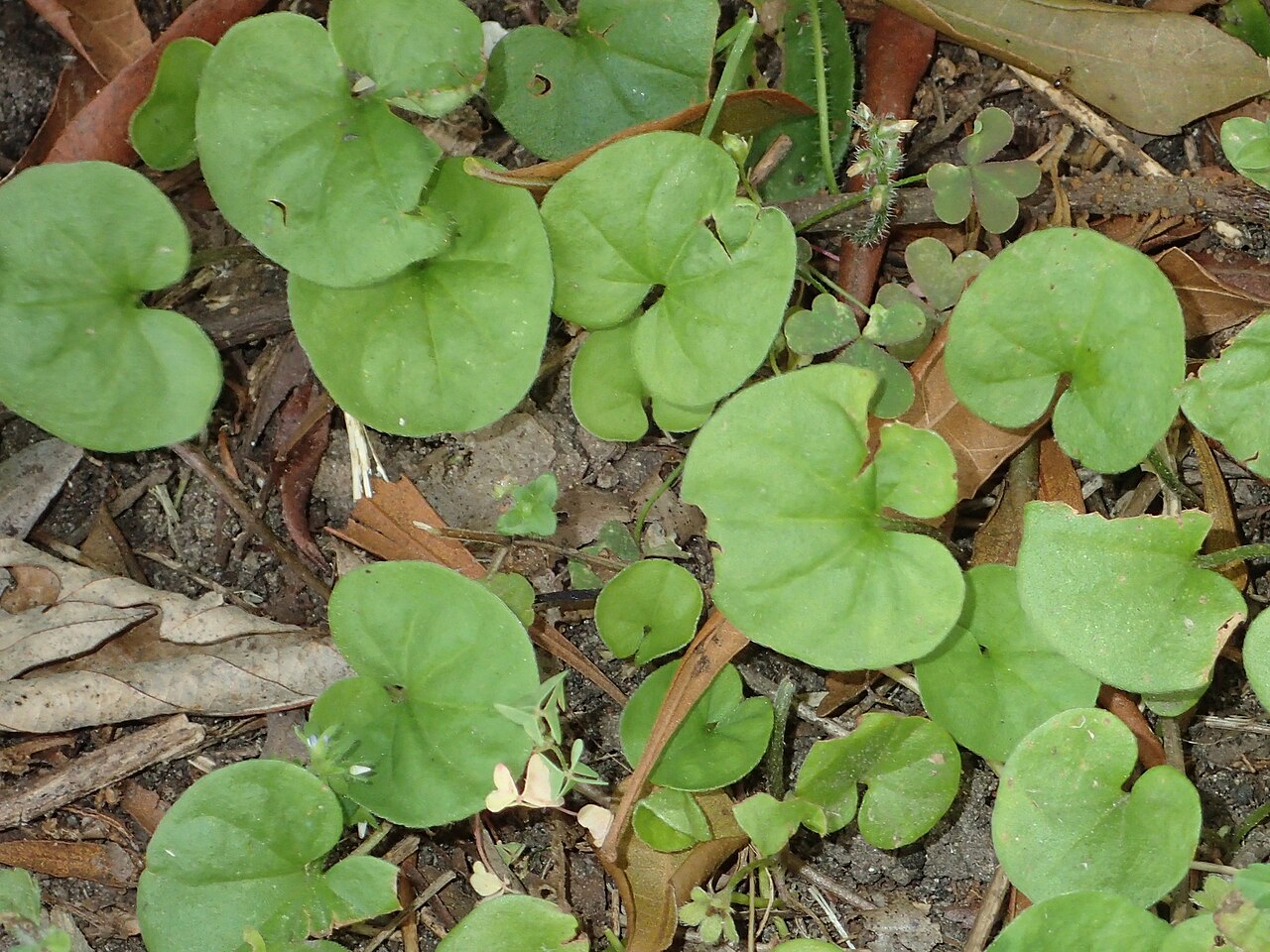
Dichondra carolinensis, known as Carolina Ponysfoot or Carolina dichondra, is a tiny, creeping native groundcover of the southeastern United States. It forms low mats only an inch or two tall, made up of rounded, kidney-shaped leaves on slender stalks that rise from stems running along the ground and rooting at the joints. The leaves, about the size of a fingernail to a nickel, are said to resemble the print of a pony’s hoof, which gives the plant its name.
Carolina ponysfoot belongs to the morning glory family (Convolvulaceae), even though it looks nothing like a vine. Its flowers are tiny, creamy white to greenish, and usually hidden under the leaves. It grows in moist, open woods, pine flatwoods, floodplains, ditches, stream banks and, very often, in lawns, where it creeps between grass blades.
Many people first notice it as a “weed” in a southern lawn, but it is a native plant, and gardeners increasingly use it as a low, walkable groundcover or lawn alternative in moist, partly shaded spots. This guide covers how to identify Carolina ponysfoot, where it grows natively, how to grow it, and its place in southeastern ecosystems.
Identification
Carolina ponysfoot is easiest to recognize by its creeping habit and small, rounded, kidney-shaped leaves on erect stalks. Its tiny flowers and two-lobed fruits confirm the identification.
Growth Habit
It is a low perennial with slender, hairy stems that creep along the ground and root at the nodes, forming loose to dense mats. The plants are usually 1 to 2 inches tall and may spread a foot or more across, knitting together into larger patches over time.
Leaves
The leaves are alternate, on erect stalks up to 2 inches long. The blades are kidney-shaped to nearly round, ⅜ to 1 inch wide, with a notch at the base where the stalk attaches and smooth edges. They are medium green and lightly covered in fine, flat-lying hairs, especially when young, giving them a soft feel.
Flowers
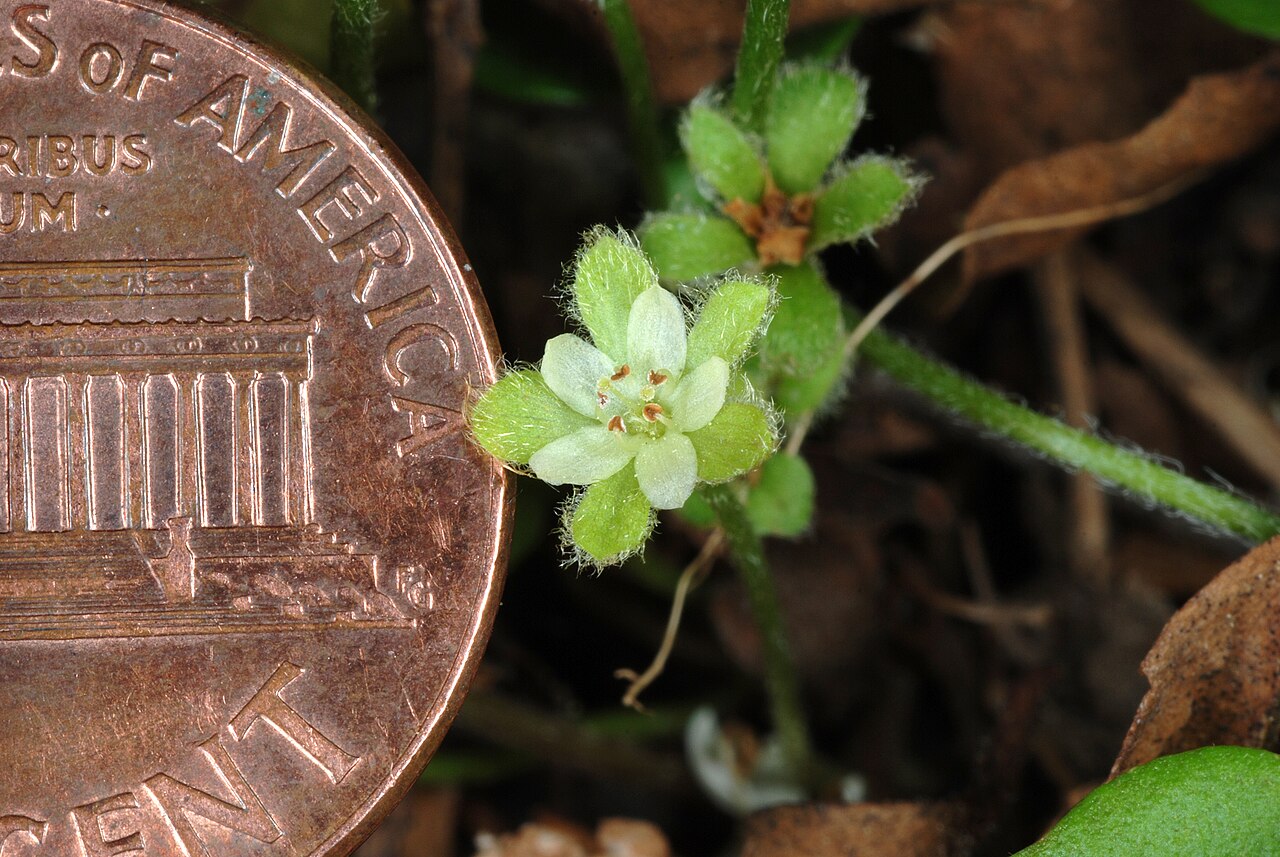
The flowers are borne singly in the leaf axils on short stalks, usually below the leaves. Each is only about ⅛ inch across, with five creamy white to greenish petals and five hairy, green sepals. They appear mostly from early spring into summer, with occasional flowers later in mild weather.
Fruit & Seeds
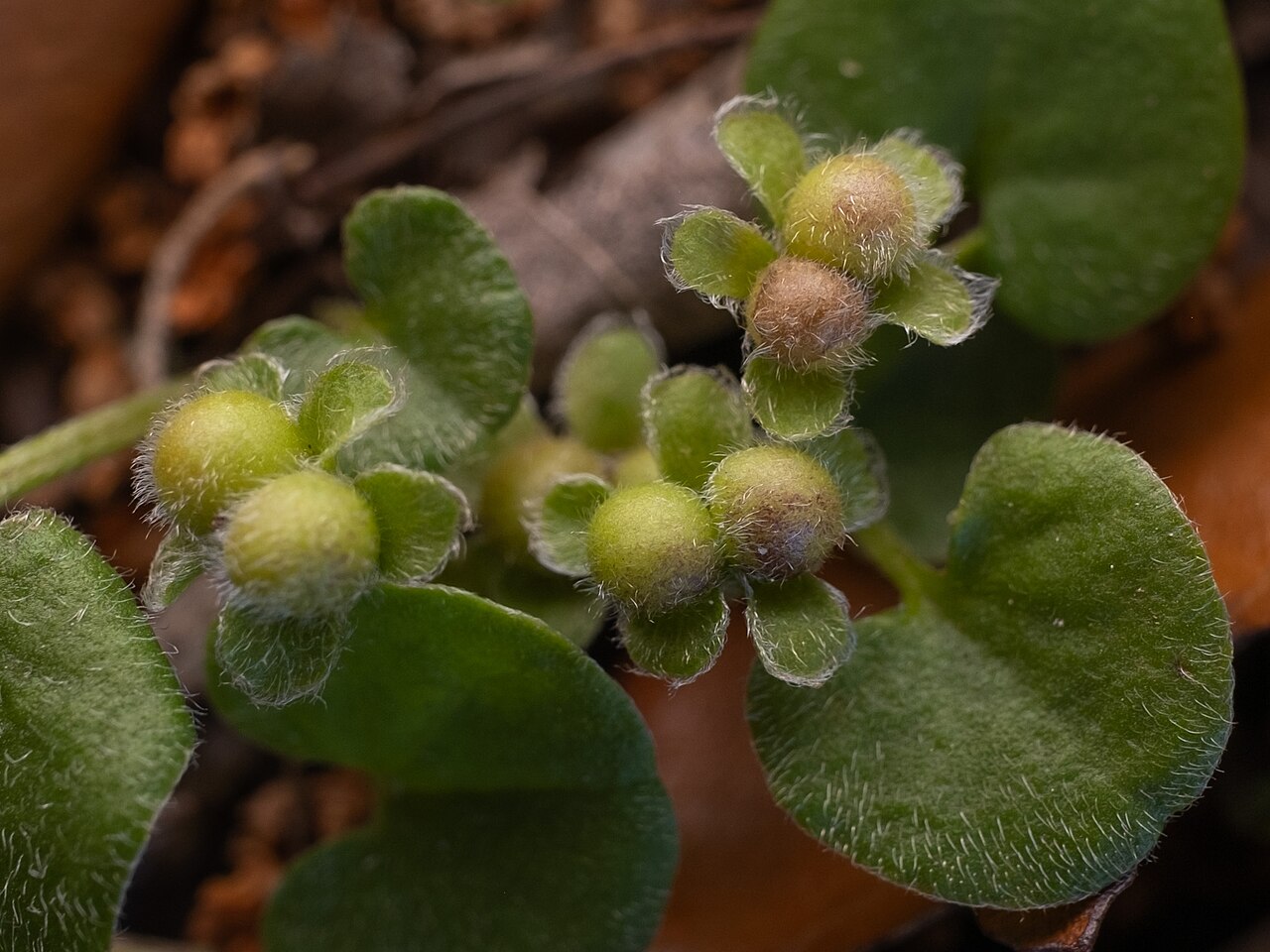
The fruit is a small, hairy capsule divided into two round lobes, each usually holding one seed. It sits in the persistent green sepals and is easy to spot by lifting the leaves.
Look-alikes
Pennyworts (Hydrocotyle species) have round leaves, but the stalk attaches in the center of the leaf (umbrella-like) or the leaves are scalloped, and their flowers are in small clusters. Ground ivy (Glechoma hederacea), an introduced weed, has scalloped leaves on square stems and purple flowers. The silver dichondra (Dichondra argentea) of the Southwest has silvery, hairy leaves, and the lawn dichondra sold in California (Dichondra micrantha) is a non-native Asian species.
Quick Facts
| Scientific Name | Dichondra carolinensis |
| Family | Convolvulaceae (morning glory family) |
| Plant Type | Creeping herbaceous perennial groundcover |
| Mature Height | 1–2 in |
| Mature Spread | 1 ft or more; spreads by rooting stems |
| Growth Rate | Moderate |
| Sun Exposure | Full sun to part shade |
| Water Needs | Medium; moist soil |
| Soil Type | Moist sandy or loamy soils |
| Soil pH | About 5.0–7.0 |
| Bloom Time | March–September, mostly spring |
| Flower Color | Creamy white to greenish |
| Fall Color | Evergreen in mild climates |
| Fruit | Small hairy two-lobed capsule |
| Deer Resistant | Moderate |
| USDA Hardiness Zones | 7–10 |
Native Range
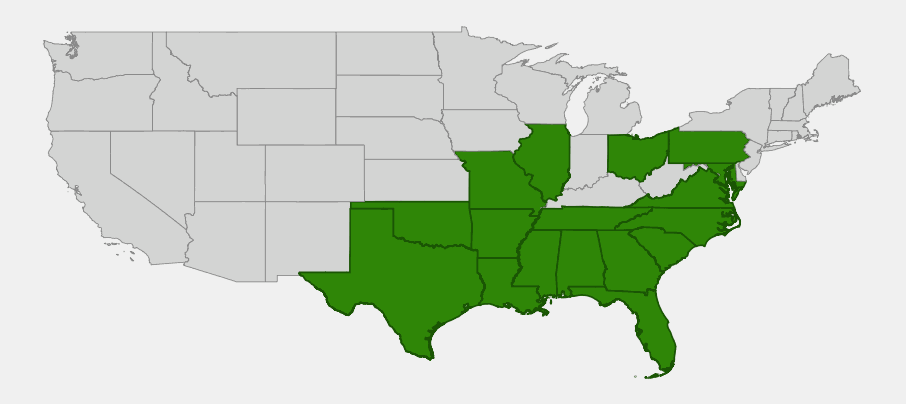
Carolina ponysfoot is native to the southeastern United States and Bermuda. USDA PLANTS records it in 17 states. Its main range follows the Atlantic and Gulf Coastal Plains and the Piedmont from Virginia and Maryland south to Florida and west through Georgia, Alabama, Mississippi and Louisiana to eastern Texas, Arkansas and Oklahoma, with records inland in Tennessee.
It is most common in Florida and along the Gulf Coast, where it grows in moist pine flatwoods, hammocks, floodplain woods, river and stream banks, wet ditches and roadside swales, and in lawns and other mowed areas. It tolerates both periodic flooding and regular mowing, which helps it thrive in managed landscapes.
USDA also lists scattered records farther north, in Missouri, Illinois, Ohio and Pennsylvania. These are outlying records well away from the main coastal plain range, and some may have arrived with lawn seed or sod.
📋 Regional plant lists featuring Carolina Ponysfoot: North & South Florida · Alabama, Georgia & Mississippi · North & South Carolina · Maryland, Virginia & West Virginia · Kentucky & Tennessee · Arkansas, Louisiana, Eastern Oklahoma & Eastern Texas · Illinois, Iowa & Missouri · Ohio & Indiana · New York, Pennsylvania & Northern New Jersey
Growing & Care Guide
Carolina ponysfoot is an easy, low-growing native groundcover for the Southeast. Use it where you want a soft, green carpet that tolerates light foot traffic, such as between stepping stones, under trees, or as part of a lawn alternative in moist ground.
Light
It grows in full sun to part shade. In hot, dry, sunny sites it needs regular moisture; in partial shade it stays greener with less watering. It is one of the few native groundcovers that tolerates the dappled shade under southern trees.
Soil & Water
It prefers moist, sandy or loamy soil and tolerates brief flooding. In dry soil, the leaves shrink and the mats thin out, then recover after rain. Water new plantings regularly until they knit together.
Planting Tips
Plant plugs or small divisions 6 to 12 inches apart in spring or fall. Keep weeds pulled while the stems spread and root. It can be added to an existing lawn, where it will grow in between grasses on moist ground.
Pruning & Maintenance
It needs no pruning and tolerates occasional mowing at a high setting. Avoid broadleaf herbicides used on lawns, which will kill it. In cold snaps it may brown, but it recovers in spring.
Propagation
Divide mats or cut rooted pieces of stem and replant them; they establish quickly in moist soil. It can also be grown from seed sown on the soil surface and kept moist.
Landscape Uses
- Lawn alternative: a low, soft, walkable groundcover for moist, partly shaded spots
- Between stepping stones: fills gaps with fine-textured green
- Under trees: grows in the light shade where turf struggles
- Rain gardens and swales: tolerates periodic flooding and moist soil
- Native lawn mixes: blends with low native grasses and sedges in the Southeast
Wildlife & Ecological Value
Carolina ponysfoot is a tiny plant, but its mats provide cover at ground level and its flowers are part of the early-season food supply for small insects.
For Pollinators
The tiny flowers are visited by small bees, such as sweat bees, and by small flies. Because they bloom in early spring in the Deep South, they offer some of the first food of the year for these insects.
For Birds
Birds make little direct use of it, though ground-feeding birds such as sparrows may forage among the mats for seeds and insects.
For Mammals
Rabbits occasionally nibble the leaves, but it is low enough to escape most browsing.
Ecosystem Role
Its low mats protect bare soil from erosion on stream banks and in moist woods, and provide humid cover for small invertebrates such as spiders, ground beetles and springtails.
Cultural & Historical Uses
The genus name Dichondra comes from the Greek words for “two” and “grain,” referring to the two-lobed fruit. The species name carolinensis means “of Carolina,” where the type specimens were collected. The plant was described by the French botanist André Michaux in his 1803 Flora Boreali-Americana.
Dichondras became popular lawn plants in Southern California in the mid-1900s, but the species used there is non-native. In the Southeast, the native Carolina ponysfoot has long grown in lawns on its own, and native-plant gardeners now encourage it as part of a more diverse, low-input lawn.
The name “ponysfoot” comes from the shape of the leaf, which resembles a small hoofprint. The plant is not known to be edible or medicinal, and like most wild plants it should not be eaten.
Frequently Asked Questions
Is Carolina ponysfoot a weed?
It is a native plant. It often grows in lawns, which leads some people to call it a weed, but many gardeners welcome it as a low, soft, native groundcover.
Can Carolina ponysfoot replace a lawn?
In moist, partly shaded areas of the Southeast, it can form a low, walkable carpet that needs little mowing. It does not handle heavy traffic or very dry sun as well as turf grass.
How do I tell Carolina ponysfoot from pennywort?
Ponysfoot leaves are kidney-shaped with the stalk attached at a notch on the edge. Pennywort leaves are often round with the stalk attached in the center, or are deeply scalloped.
Does Carolina ponysfoot flower?
Yes, but the flowers are tiny, creamy white and usually hidden under the leaves. Look for them in spring.
Where does Carolina ponysfoot grow best?
In moist, sandy or loamy soil in full sun to part shade across the Southeast, especially on the Coastal Plain.

Looking for a nursery that carries Carolina Ponysfoot?
Browse our native plant nursery directory: Alabama & Arkansas · Florida & Georgia · Illinois · Louisiana, Maryland, Mississippi & Missouri · North Carolina, Ohio & Oklahoma · Pennsylvania, South Carolina, Tennessee, Texas & Virginia