
Prairie Tea (Croton monanthogynus)
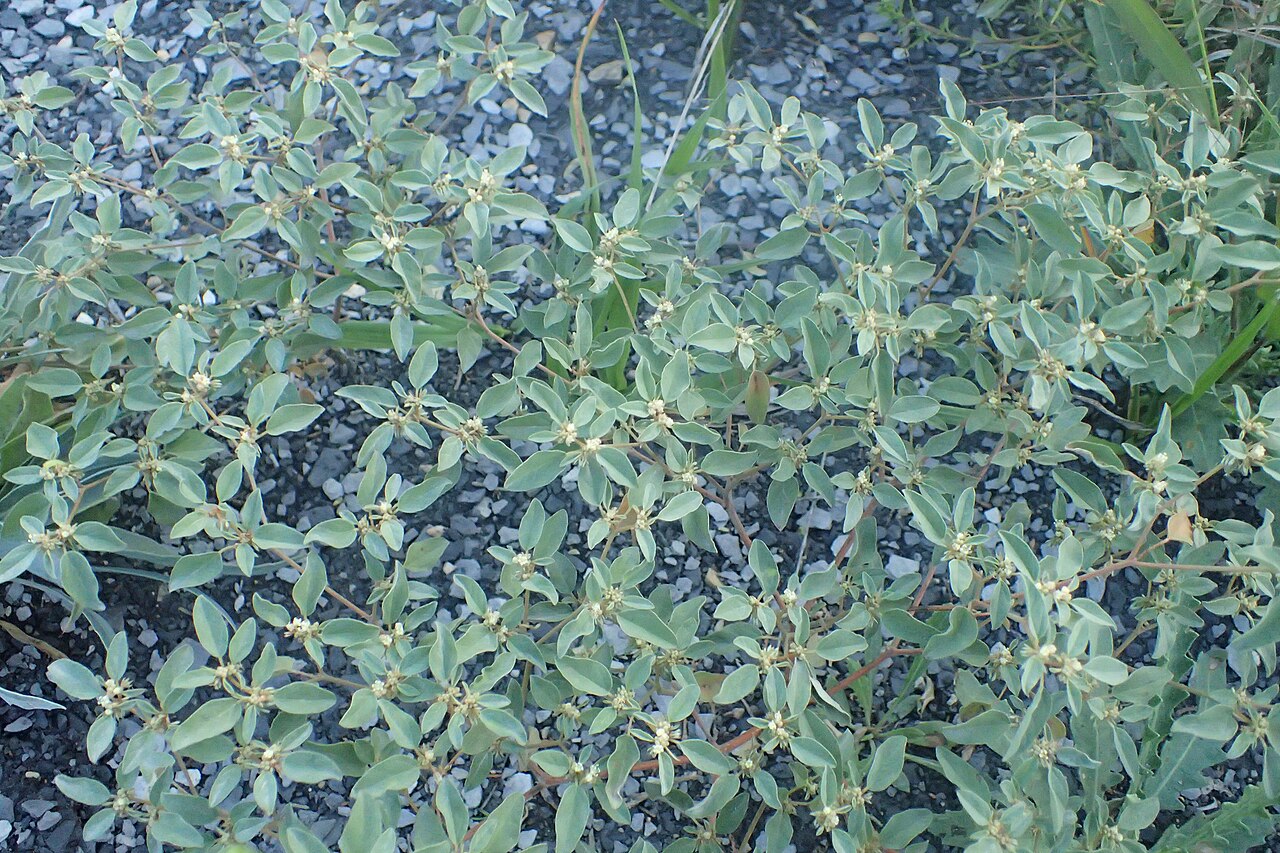
Croton monanthogynus, known as Prairie Tea, one-seed croton, dove weed or prairie goatweed, is a small, aromatic annual of the spurge family (Euphorbiaceae). It grows in dry, sunny, rocky places across the southern and central United States, from Texas and Oklahoma east to the Carolinas and north into the Ohio Valley and lower Midwest. In late summer, its low, rounded clumps of gray-green leaves are a common sight on limestone glades, dry prairies, pastures and roadsides.
Prairie tea is not showy. Its flowers are tiny and pale, and the whole plant is usually less than 2 feet tall. It is a valuable wild plant all the same. Its seeds are an important food for mourning doves, quail and wild turkeys, which is why hunters and wildlife managers have long called it dove weed. Its leaves are the food of the caterpillars of the goatweed leafwing butterfly. When crushed, the leaves release a pleasant, sweet aroma, and the common name comes from the mild tea that people have steeped from them.
This guide covers how to identify prairie tea, where it grows, how to let it establish in a dry meadow or wildlife planting, and why it matters to birds and butterflies. Like other crotons, it also deserves some caution, which is covered below.
Identification
Prairie tea is easy to recognize once you notice its forked branching, softly hairy gray-green leaves and pleasant smell. Several other crotons grow in the same region, and they differ in size, hairiness and seed number.
Stems & Growth Habit
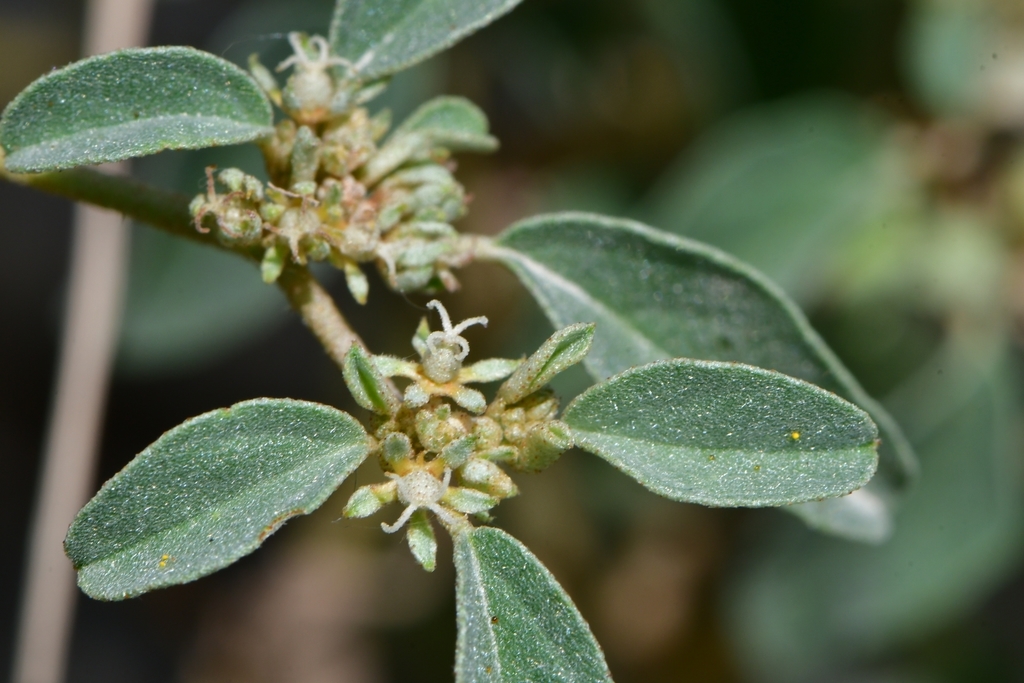
Prairie tea grows from a taproot and is usually 6 to 24 inches tall. The stem branches repeatedly in pairs (dichotomously), forming a bushy, rounded or flat-topped plant. Small plants on very poor soil can flower at only a few inches tall. Stems and leaves are covered with tiny star-shaped (stellate) hairs, which give the plant a grayish, felted look.
Leaves
The leaves are alternate, oval to elliptic, ½ to 1½ inches long, with smooth edges and a short stalk. They are gray-green above and paler, more silvery below because of their dense star-shaped hairs. When crushed they have a sweet, pleasant scent.
Flowers
Prairie tea is monoecious: male and female flowers are separate but grow on the same plant. The tiny flowers are clustered at the forks of the branches. A few male flowers, with pale sepals and stamens, sit above a single female flower, the feature behind the species name monanthogynus (Greek for “one female flower”). The flowers have no showy petals and are easy to overlook. The Lady Bird Johnson Wildflower Center lists bloom from April to September, with most flowering in summer.
Fruit & Seeds
Each female flower develops into a small, round, hairy capsule containing a single seed, hence the name one-seed croton. When ripe, the capsule splits and the smooth, dark seed drops or is flung a short distance. Seeds ripen from summer into fall.
Similar Species
Woolly croton (Croton capitatus) is a larger, densely woolly plant with seeds in three-seeded capsules. Tropic croton (Croton glandulosus) has toothed leaves and glands at the base of the leaf blade. Texas croton (Croton texensis) grows in sandy soils farther west, and its male and female flowers are on separate plants. Bush Croton is a woody shrub of Texas and the Southwest.
Quick Facts
| Scientific Name | Croton monanthogynus Michx. |
| Family | Euphorbiaceae (spurge family) |
| Plant Type | Annual herb from a taproot |
| Mature Height | 6–24 in |
| Mature Spread | 6–18 in; bushy and rounded |
| Growth Rate | Fast |
| Sun Exposure | Full sun |
| Water Needs | Low; very drought tolerant |
| Soil Type | Dry, thin, rocky or gravelly soil; often calcareous |
| Soil pH | About 6.0–8.5 (neutral to alkaline) |
| Bloom Time | April–September (mainly summer) |
| Flower Color | Whitish to greenish (inconspicuous) |
| Fall Color | Gray-green foliage may turn tan or bronze |
| Fruit | Small, hairy, one-seeded capsule |
| Deer Resistant | Yes; the aromatic, hairy foliage is rarely browsed |
| USDA Hardiness Zones | Annual; grows wild in zones 5–9 |
Native Range
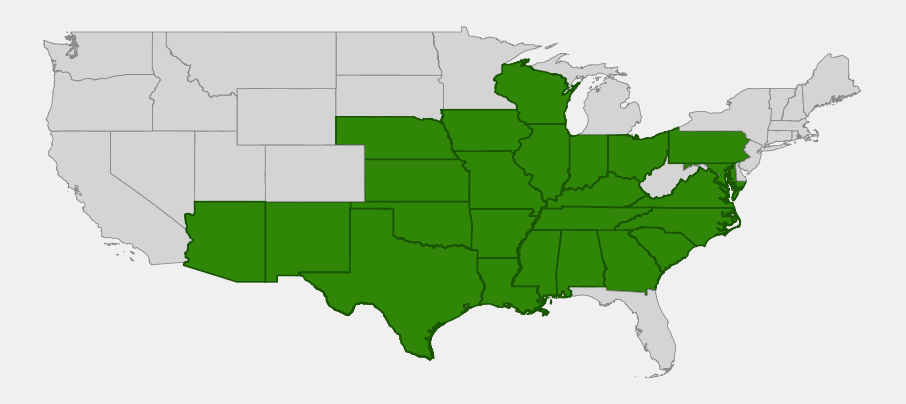
Prairie tea is native to the south-central and southeastern United States. USDA PLANTS records it from Texas, Oklahoma, Kansas, Nebraska, Iowa, Missouri, Arkansas and Louisiana east through Illinois, Indiana, Ohio, Kentucky, Tennessee, Mississippi, Alabama and Georgia to Virginia, Maryland, North Carolina and South Carolina, with outlying western records in New Mexico and Arizona and northern records in Wisconsin and Pennsylvania. NatureServe also reports it as native in Florida.
Its heartland is the southern Great Plains and the limestone country of the Ozarks, the Ohio Valley and the Interior Low Plateaus. The Lady Bird Johnson Wildflower Center notes that it grows on dry prairies and limestone throughout Texas except the western Panhandle. In Kentucky and Kansas it is ranked secure (S5), and in Kentucky and Tennessee it is a typical plant of cedar glades and other rocky, open limestone ground. To the north and east it becomes uncommon, and it is ranked rare in Iowa.
Some northern records are thought to be introductions that arrived along railroads and roads. NatureServe treats it as non-native in Michigan and West Virginia, so those states are not shown on the map; the records in Wisconsin and Pennsylvania are best regarded as outlying. Typical habitats include dry prairies, limestone and sandstone glades, rocky hillsides, open woodlands, pastures, roadsides, railroad ballast and other dry, disturbed ground.
📋 Regional plant lists featuring Prairie Tea: South & West Texas · Arkansas, Louisiana, Eastern Oklahoma & Eastern Texas · Nebraska, Kansas & Eastern Colorado · Illinois, Iowa & Missouri · Ohio & Indiana · Kentucky & Tennessee · Alabama, Georgia & Mississippi · North & South Carolina · Maryland, Virginia & West Virginia · New York, Pennsylvania & Northern New Jersey · Michigan, Wisconsin & Eastern Minnesota · Arizona & New Mexico
Growing & Care Guide
Prairie tea is rarely sold as a garden plant, but it is easy to establish from seed in dry, sunny wildlife plantings, and it often appears on its own in disturbed, gravelly ground. It is best suited to meadows, glades and wildlife food plots rather than formal beds.
Light
Full sun. Prairie tea does not tolerate shade and quickly disappears where taller plants or shrubs close in.
Soil & Water
It grows best in thin, dry, well-drained soil, especially rocky or gravelly limestone soils, and it tolerates poor, compacted and disturbed ground. Once seedlings are up it needs no watering, and rich or irrigated soil only encourages competing weeds. Do not fertilize.
Planting Tips
Sow seed on bare or lightly disturbed soil in fall or early spring, pressing it into the surface. It does best where competition from sod grasses is low, such as on glades, gravel paths, the edges of wildlife food plots and in sparse native meadows with little bluestem and grama grasses.
Pruning & Maintenance
As an annual, prairie tea needs no pruning. Leave the plants standing until seeds have dropped in fall, so it can reseed. Light soil disturbance, such as occasional raking, disking at the edge of a food plot or prescribed fire, helps keep the open ground it needs. Wear gloves when handling large amounts of the plant.
Propagation
Propagate by seed only. Collect ripe capsules in late summer or fall before they split. Seeds can be sown outdoors in fall and will germinate the following spring when the soil warms. Once established, plants reseed reliably in suitable sites.
Landscape Uses
- Wildlife food plots: seeds are a favored food of doves, quail and turkeys
- Glade and prairie restoration: part of the native annual flora of dry, rocky openings
- Butterfly gardens: caterpillar food plant for the goatweed leafwing
- Dry meadows and gravel areas: fills bare, poor ground in full sun
- Erosion control on disturbed sites: a quick-growing native cover on bare, rocky soil
Wildlife & Ecological Value
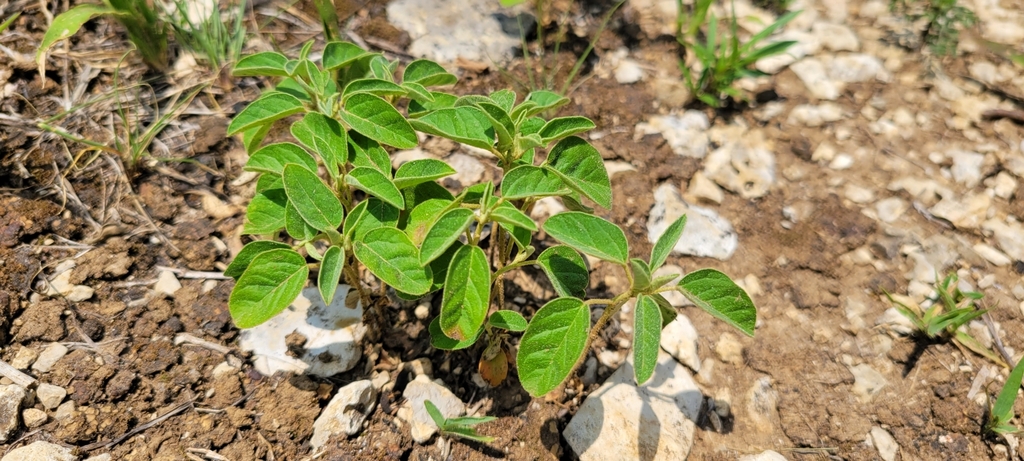
Prairie tea may look like an ordinary roadside weed, but it is one of the most important native seed plants for game birds in the southern Plains and Midwest.
For Pollinators
The tiny flowers attract small bees, flies and wasps, but prairie tea’s main value to insects is as a caterpillar host. The goatweed leafwing (Anaea andria), a striking orange butterfly whose wings look like a dead leaf when closed, lays its eggs on crotons, including prairie tea, and its caterpillars feed inside rolled leaves.
For Birds
The seeds are an important food for mourning doves, northern bobwhite and wild turkeys, and are also eaten by greater prairie-chickens, sparrows and other seed-eating birds. The Lady Bird Johnson Wildflower Center describes the seeds as important dove and quail food, and the plant’s common name dove weed reflects this.
For Mammals
Mammals rarely browse prairie tea because of its hairy, aromatic foliage, but rodents eat the fallen seeds.
Ecosystem Role
As a fast-growing annual of open, rocky ground, prairie tea quickly covers bare soil after disturbance, fire or drought. It is part of the annual flora of limestone glades and dry prairies, which provide seeds for wildlife through fall and winter. Its seeds persist in the soil, allowing it to reappear after disturbance.
Cultural & Historical Uses
André Michaux described Croton monanthogynus in 1803 in his Flora Boreali-Americana, one of the first floras of eastern North America. The genus name comes from the Greek kroton, a tick, because the seeds of some species resemble ticks.
The common name prairie tea comes from the practice of steeping its leaves. The Lady Bird Johnson Wildflower Center notes that a very mild tea can reputedly be made from them, and some sources mention using the fragrant leaves like an herb. Use caution, however. Many plants in the genus Croton and the spurge family contain irritant or purgative compounds; the related tropical Croton tiglium is the source of the notoriously toxic croton oil. Some people react to the sap or foliage with skin irritation or allergies. Prairie tea should not be eaten or drunk in quantity, should not be given to children or pets, and should not be used as a medicine.
For generations of rural families in the South and Midwest, dove weed has been well known as the plant where doves and quail gather in late summer. Wildlife managers still encourage it in food plots and field edges by light disking, which creates the bare ground it needs to germinate.
Frequently Asked Questions
Can you really make tea from prairie tea?
A very mild tea has reputedly been made from the leaves, which is how the plant got its name. Crotons as a group contain irritant compounds, though, and some people are sensitive to them, so it is safest to enjoy prairie tea as a wildlife plant rather than a beverage.
Why is it called dove weed?
Because mourning doves, quail and wild turkeys eat its seeds. Hunters and wildlife managers have long recognized it as one of the best native seed plants for doves.
Is prairie tea poisonous?
It is not considered highly toxic, but it belongs to a genus and family known for irritating sap and purgative seeds. Avoid eating it, wear gloves if your skin is sensitive, and keep children and pets from sampling it.
Which butterfly uses prairie tea?
The goatweed leafwing (Anaea andria) uses crotons, including prairie tea, as caterpillar food plants. Its larvae feed and rest in rolled leaves.
Is prairie tea a perennial?
No. It is an annual that grows from seed each year. It reseeds readily in dry, open, disturbed ground.

Looking for a nursery that carries Prairie Tea?
Browse our native plant nursery directory: Alabama, Arizona & Arkansas · Georgia · Illinois, Indiana, Iowa & Kansas · Kentucky, Louisiana, Maryland, Mississippi & Missouri · Nebraska, New Mexico, North Carolina, Ohio & Oklahoma · Pennsylvania, South Carolina, Tennessee, Texas & Virginia · Wisconsin