
Smallflower Desert-Chicory (Pyrrhopappus pauciflorus)
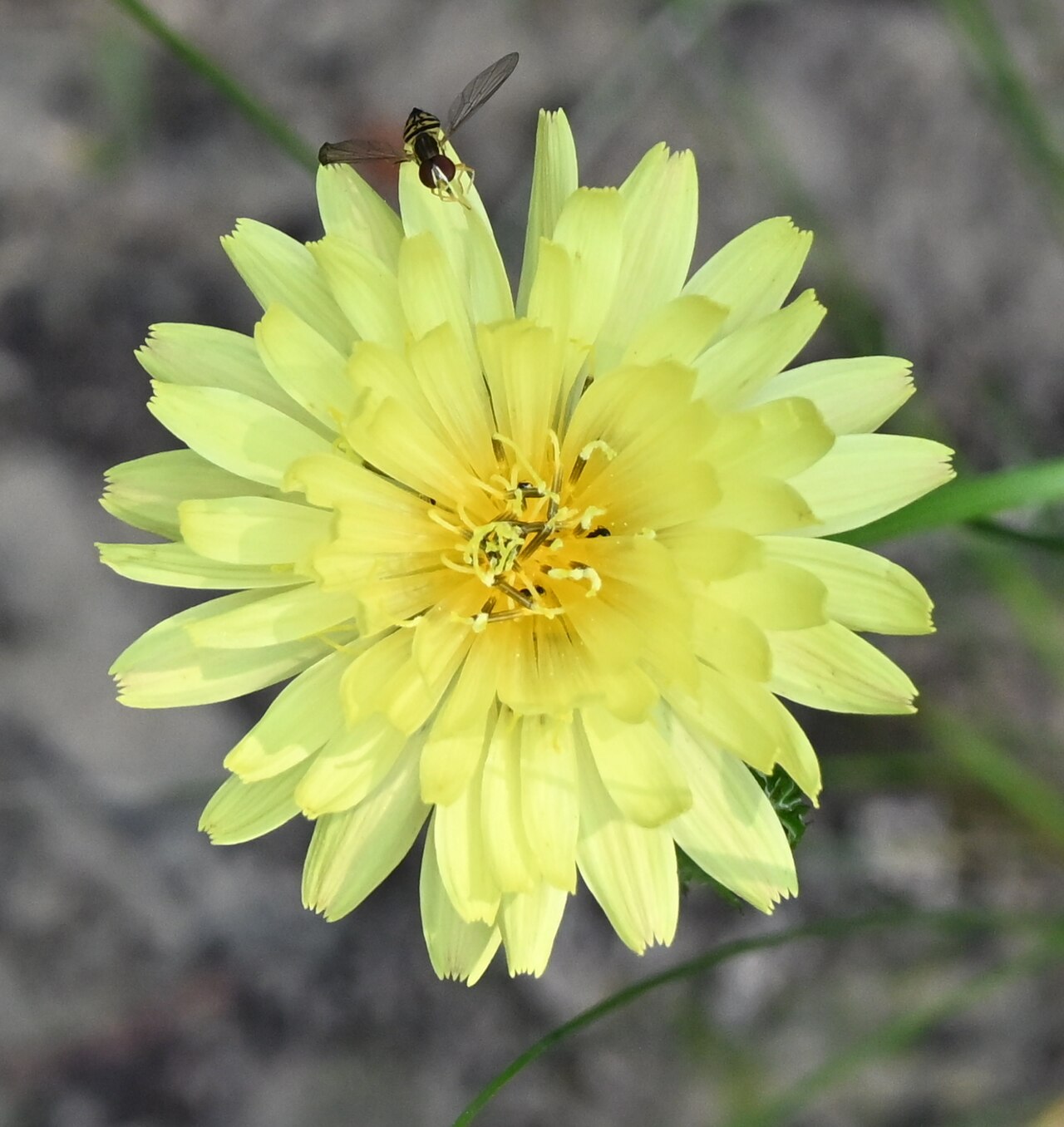
Pyrrhopappus pauciflorus, known as Smallflower Desert-Chicory (USDA: smallflower desert-chicory), and widely called Texas dandelion or Texas false dandelion, is a native wildflower of the aster family (Asteraceae). It grows as an annual or short-lived perennial from a taproot. For many years it was known as Pyrrhopappus multicaulis, and you will still find that name in older field guides, seed lists and herbarium labels.
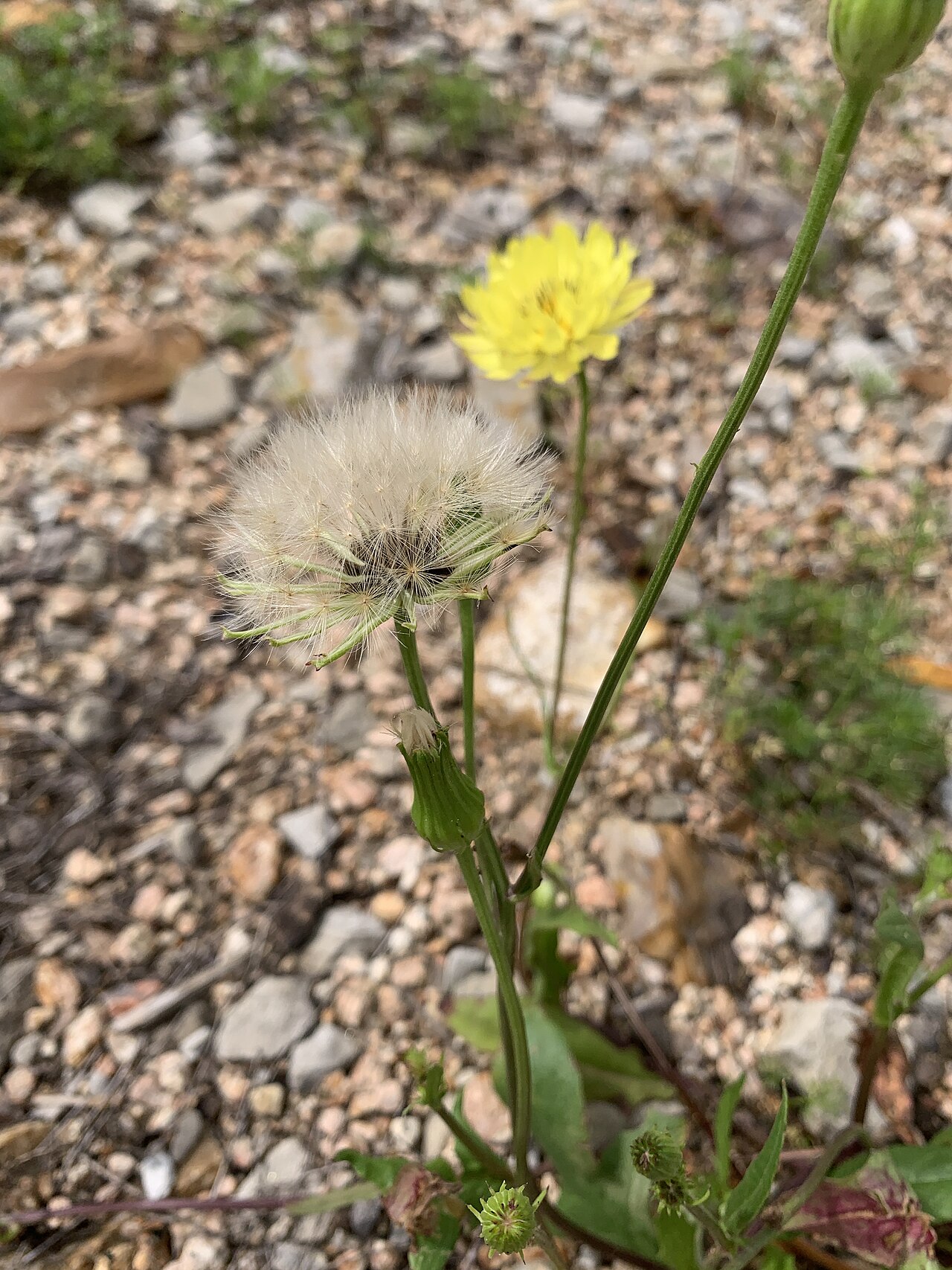
In spring it sends up branched, leafy stems 6 to 20 inches tall, tipped with soft, lemon-yellow flower heads about an inch across. Like a dandelion, each head is made entirely of strap-shaped florets, and the stems bleed milky sap when broken. The heads open in the morning and close by early afternoon. After flowering they form round, fluffy seed heads. The genus name means “fiery pappus,” for the reddish-brown tinge of the bristles that carry each seed on the wind.
Smallflower desert-chicory is one of the most familiar spring wildflowers in Texas, where it grows in prairies, oak and juniper openings, roadsides, pastures, vacant lots and lawns. It is often dismissed as a weed, but it is a true native that feeds early bees and flies and seed-eating birds. It is easy to welcome in a meadow, a mowed native lawn or a wild corner of the garden.
Identification
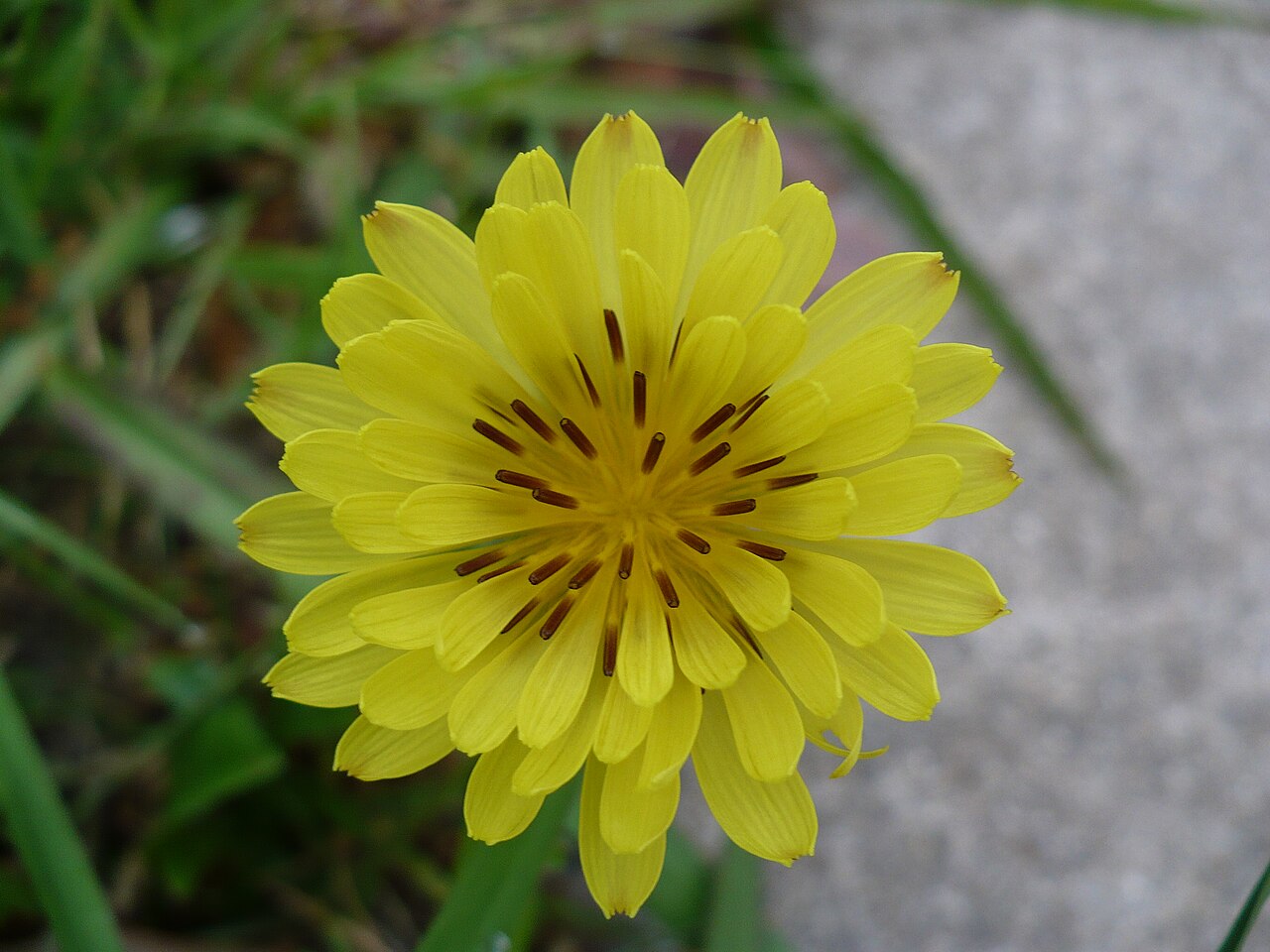
Smallflower desert-chicory is easy to confuse with the common European dandelion, but a few features separate them at a glance: its flowering stems are branched and leafy, its heads are a softer yellow, and its seed bristles are tinged reddish-brown rather than pure white.
Growth Form & Roots
Plants grow from a slender to stout taproot and usually form a loose basal rosette in winter. In spring one to several stems rise 6 to 20 inches tall, occasionally taller in rich soil. The stems are branched above and carry a few leaves, and they are usually somewhat hairy, especially near the base. All parts contain a milky latex.
Leaves
The basal leaves are 2 to 8 inches long and very variable: some are lance-shaped with a few teeth, while others are deeply cut into narrow lobes, much like a dandelion leaf. The upper stem leaves are smaller, clasp the stem at the base, and are often divided into two or three pairs of narrow, linear lobes.
Flowers
The flower heads are 1 to 1-1/2 inches across and are borne singly at the tips of the branches, so a plant may carry a few to many heads over the season. Each head contains dozens of pale to bright yellow ray (ligulate) florets with finely toothed tips; there are no separate disk florets. The dark anther tubes and yellow styles give the center a speckled look. Below the head is a cup of narrow green bracts with a ring of much shorter bractlets at the base. Flowering peaks from March to May, with scattered blooms into summer and again after fall rains.
Fruit & Seeds
Each floret produces a slender, ribbed, brown seed (cypsela) with a long, thread-like beak. The beak carries a parachute of soft bristles that are tinged reddish-brown. Together they form a round seed head 1 to 1-1/2 inches across that breaks apart on the wind.
Look-alikes
Carolina false dandelion (Pyrrhopappus carolinianus), more common to the east, has mostly smooth stems and blooms a little later. Its range overlaps in eastern Texas, Oklahoma and the Gulf states. Large-flower false dandelion (P. grandiflorus) grows from a small tuber and has usually unbranched stalks with a single larger head. The common dandelion (Taraxacum officinale) has leafless, hollow, unbranched flower stalks and white seed bristles. The native dwarf dandelions (Krigia) are much smaller, with orange-yellow heads.
Safety
Smallflower desert-chicory is not known to be toxic. Its milky sap is bitter and can irritate sensitive skin. Cattle and deer browse it, and foragers eat the young leaves and roots, but only eat wild plants you have identified with certainty and that come from unsprayed ground.
Quick Facts
| Scientific Name | Pyrrhopappus pauciflorus (formerly P. multicaulis) |
| Family | Asteraceae (aster family) |
| Plant Type | Annual or short-lived perennial wildflower with a taproot |
| Mature Height | 6–20 in (occasionally to about 2 ft) |
| Mature Spread | 6–12 in |
| Growth Rate | Fast |
| Sun Exposure | Full sun to part shade |
| Water Needs | Low to moderate; tolerates drought |
| Soil Type | Clay, loam, sandy loam, gravel; tolerates disturbed soil |
| Soil pH | About 6.0–8.0 (slightly acidic to alkaline) |
| Bloom Time | February–June, peak March–May; occasional later blooms |
| Flower Color | Pale to bright yellow |
| Fall Color | None; plants die back after seeding |
| Fruit | Beaked seeds with reddish-brown bristles in a round, fluffy head |
| Deer Resistant | No; browsed by deer and livestock |
| USDA Hardiness Zones | 7–10 (grows as a cool-season annual) |
Native Range
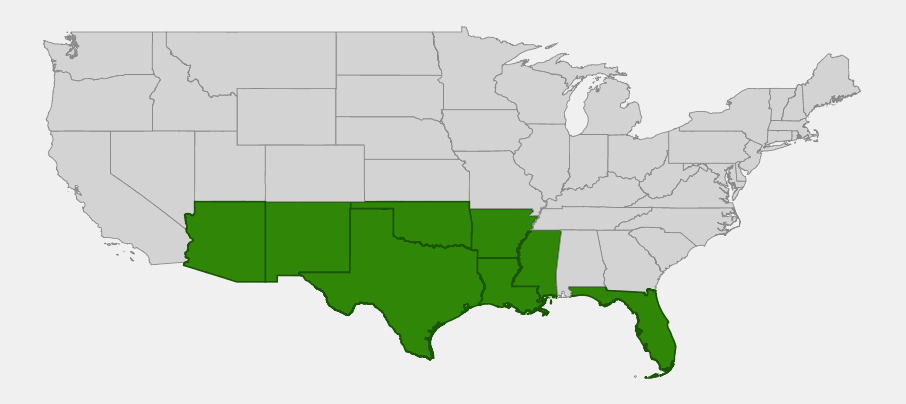
Smallflower desert-chicory is native to the south-central and southwestern United States and northern Mexico. USDA PLANTS lists it as native in the lower 48 states and records it from Arizona, New Mexico, Texas, Oklahoma, Arkansas, Louisiana, Mississippi and Florida. Its stronghold is Texas, where the Lady Bird Johnson Wildflower Center describes it as occurring throughout the state, and it is common across Oklahoma and in southern New Mexico and Arizona.
Records from Arkansas, Mississippi and Florida lie at the eastern edge of its range and are much more scattered. Treat those as outlying records; in the Southeast the similar Carolina false dandelion is far more common, so careful identification matters there.
It grows in open grasslands and prairies, in the openings of oak and juniper woodlands, on rocky and gravelly slopes in the desert grasslands of the Southwest, and very commonly in disturbed ground: roadsides, pastures, fields, lawns, vacant lots and sidewalk cracks. It favors dry to moderately moist clay or sandy loam soils.
📋 Regional plant lists featuring Smallflower Desert-Chicory: Arizona & New Mexico · Alabama, Georgia & Mississippi · North & South Florida · Arkansas, Louisiana, Eastern Oklahoma & Eastern Texas · South & West Texas
Growing & Care Guide
Smallflower desert-chicory is rarely sold as a garden plant because it seeds itself so readily. That same habit makes it an easy, low-cost native for meadows, prairie plantings and naturalized lawns in Texas and the Southwest. Let existing plants go to seed, or scatter seed collected from your own plants or bought from a native seed supplier.
Light
It flowers best in full sun and also grows in part shade, such as the dappled light under oaks and junipers. In deeper shade the stems become lanky and bloom less.
Soil & Water
It grows in almost any well-drained soil, including heavy clay, caliche, rocky ground and sandy loam. It needs no fertilizer. Winter and spring rains are enough for the cool-season growth period; once established, plants tolerate dry spells and simply set seed and die back early in a drought year.
Planting Tips
Sow seed on the soil surface in fall, ideally just before cool-season rains, and press it in lightly. Seedlings form rosettes over winter and flower the following spring. In a mixed meadow it fills gaps between bunchgrasses and other spring wildflowers such as bluebonnets and Indian blanket.
Pruning & Maintenance
In a native lawn, delay the first spring mowing until most plants have bloomed and set seed, usually by late May or June. If you do not want it spreading into beds, deadhead the flowers before the seed heads open. Pull unwanted plants while young, before the taproot deepens.
Propagation
Grow it from seed. Collect seed heads when they turn fluffy and the seeds pull away easily, and sow them in fall. Plants usually reseed on their own, and a few plants left to seed will maintain a patch for years.
Landscape Uses
- Spring meadows and prairie plantings: fills gaps with soft yellow early-season color
- Native lawns and mowed areas: blooms between spring mowings and feeds early pollinators
- Pollinator gardens: an early nectar and pollen source for small bees and flies
- Wildlife plantings: seeds for birds and browse for deer
- Restoration of disturbed ground: a fast-growing native for roadsides and old fields
Wildlife & Ecological Value
Smallflower desert-chicory is a small but useful early-season food source across the southern plains, feeding insects, birds and browsing mammals.
For Pollinators
The open, flat heads give easy access to pollen and nectar for small native bees such as sweat bees and mining bees, as well as hoverflies and other flies, beetles and honey bees. Because the heads open in the morning, the best time to watch visitors is between sunrise and noon.
For Birds
The seeds are eaten by finches, sparrows and other seed-eating birds. In Texas, Rio Grande wild turkeys are reported to eat the seeds as well.
For Mammals
White-tailed deer and cattle eat the leaves and stems, and rabbits graze the rosettes.
Ecosystem Role
As a fast-growing native annual, it quickly covers bare or disturbed ground and holds the soil until longer-lived prairie plants establish. It also supports a range of small insects early in the year, when few other flowers are open.
Cultural & Historical Uses
The species was first described by the Scottish botanist David Don in 1830 as Chondrilla pauciflora, and was later moved to Pyrrhopappus by Augustin Pyramus de Candolle. For much of the 20th century most North American botanists called it Pyrrhopappus multicaulis, a name meaning “many-stemmed.” Recent treatments use the older name P. pauciflorus, so both names refer to the same plant.
Like its relative the common dandelion, Texas dandelion is a familiar plant to foragers. The young leaves are eaten as a cooked green, usually boiled to reduce their bitterness, and the roots are sometimes roasted for a coffee substitute or used as a bitter flavoring. Only harvest plants you have identified with certainty and that come from ground free of herbicides and roadside pollution.
Because it blooms so freely in lawns and along sidewalks, Texas dandelion is one of the first native wildflowers many Texans notice. It is a good example of a native “weed” worth keeping: it costs nothing, needs no care and supports early pollinators.
Frequently Asked Questions
Is smallflower desert-chicory the same as a dandelion?
No. It belongs to the same family and tribe as the common dandelion and looks similar, but it is a native North American plant. Its stems are branched and leafy, its heads are a softer yellow, and its seed bristles are reddish-brown rather than white.
Is Pyrrhopappus multicaulis a different plant?
No. Pyrrhopappus multicaulis is an older name for this species, which is now called Pyrrhopappus pauciflorus. You will still see the old name in many references.
Why do the flowers close in the afternoon?
The heads open in the morning and usually close by early afternoon, especially on hot, sunny days. This is normal and helps protect the pollen. The best time to see them is in the morning.
Is it an annual or a perennial?
It usually behaves as a winter annual: seeds germinate in fall, plants overwinter as rosettes, bloom in spring and die after setting seed. Some plants live for more than one season.
Will it take over my garden?
It spreads by wind-blown seed and can pop up in beds and lawns, but it is easy to pull while young. To limit spreading, deadhead the flowers before they go to seed.

Looking for a nursery that carries Smallflower Desert-Chicory?
Browse our native plant nursery directory: Arizona & Arkansas · Florida · Louisiana & Mississippi · New Mexico & Oklahoma · Texas