
Common Fiddleneck (Amsinckia menziesii)
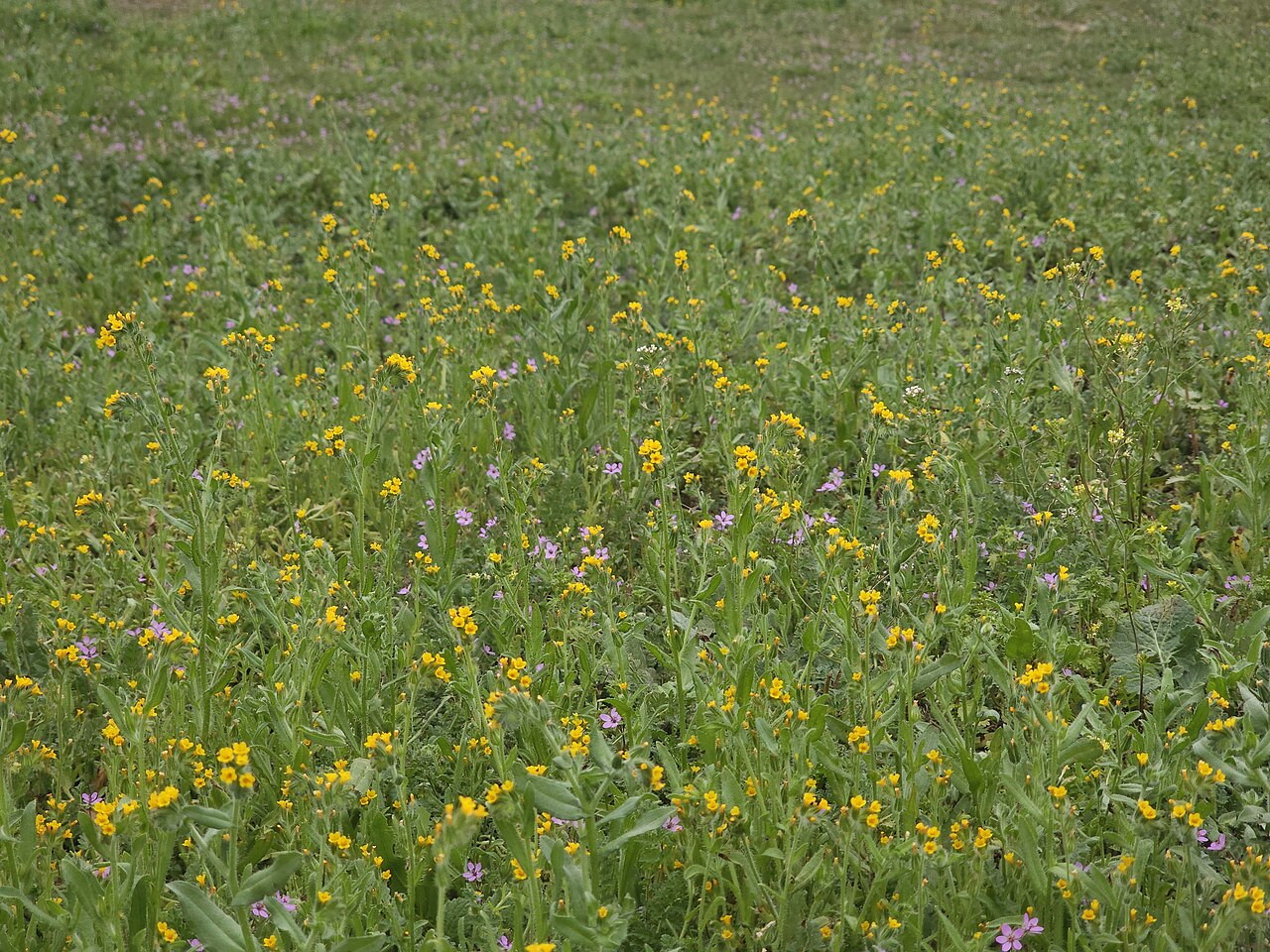
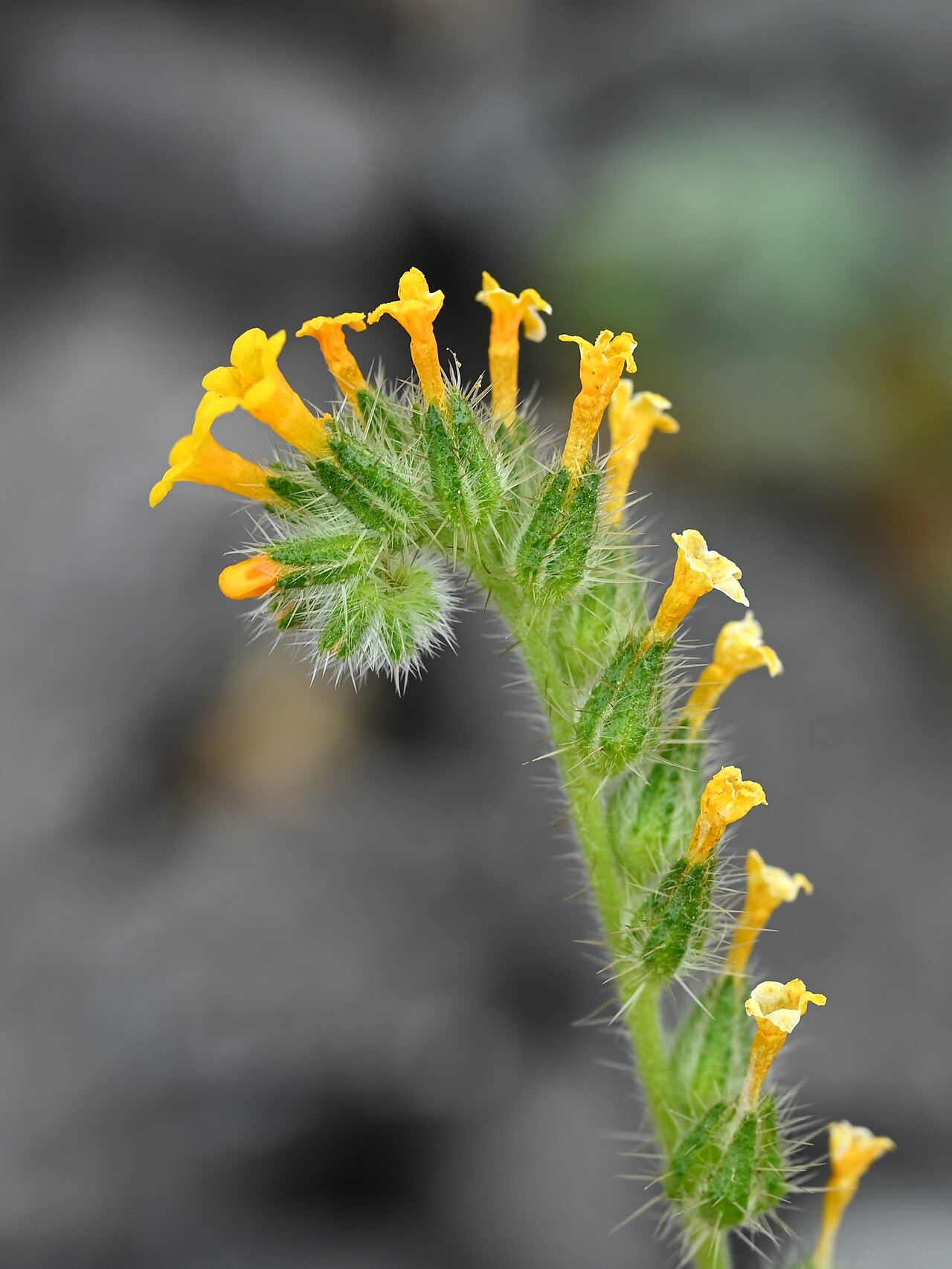
Amsinckia menziesii, known as Common Fiddleneck (USDA: Menzies’ fiddleneck; also rancher’s fireweed), is one of the most widespread spring annual wildflowers of the western United States. It belongs to the borage family (Boraginaceae). Its small yellow to orange flowers open along bristly, coiled spikes that curl at the tip like the scroll of a fiddle, and in wet years it colors grasslands, orchards and roadsides orange-yellow.
It is a bristly annual 8 inches to about 3 feet tall, blooming from March to June. Most botanists now include the larger-flowered, orange “intermediate fiddleneck” (Amsinckia intermedia) within this species as var. intermedia, alongside the small-flowered, pale yellow var. menziesii. It is native from British Columbia and Alberta south through the West to Arizona and Baja California, and it is an important early nectar source for bees and butterflies.
Safety note: common fiddleneck is toxic to livestock. It contains pyrrolizidine alkaloids that cause cumulative, often fatal liver damage in horses, cattle and pigs, especially when its seeds contaminate hay or grain, and it can also accumulate nitrates. Its stiff, bristly hairs can irritate bare skin. Do not eat any part of it, and keep it out of pastures and hay fields.
Identification
Look for a bristly, upright annual with narrow leaves and small yellow to orange tubular flowers on coiled, fiddlehead-shaped spikes, in open grassland, sandy ground, fields and roadsides in spring.
Stems & Habit
Common fiddleneck is an annual, usually 8 to 32 inches (20 to 80 cm) tall, sometimes taller, with one main stem or several branches. The stems are covered with stiff, spreading, white bristles that have swollen bases, mixed with shorter hairs.
Leaves
The leaves are narrow, linear to lance-shaped, 1 to 6 inches (2.5 to 15 cm) long, with smooth or slightly wavy edges. Lower leaves form a loose rosette early in the season. Both surfaces are rough with bristly hairs.
Flowers
The flowers are borne in one-sided, coiled spikes (scorpioid cymes) that unroll as they bloom, like the neck of a fiddle. Each flower is a small, tubular trumpet with five flaring lobes. In var. menziesii they are pale yellow and only about 1/8 to 1/4 inch (4 to 7 mm) long; in var. intermedia they are deeper yellow-orange, up to about 1/2 inch (11 mm) long, often with small red-orange spots in the throat. Bloom time is March to June.
Fruit & Seeds
Each flower produces four small, hard, wrinkled or bumpy nutlets, about 1/8 inch (2 to 4 mm) long, held in the persistent bristly calyx. The nutlets are easily spread in soil, on equipment and in grain and hay.
Look-alikes
Other fiddlenecks, such as bristly fiddleneck (Amsinckia tessellata) with broad, overlapping sepals, and seaside fiddleneck (A. spectabilis) of coastal dunes, are similar. Puccoons such as Narrowleaf Puccoon have larger yellow flowers with fringed lobes and are perennials. Popcorn Flower has similar coiled spikes but white flowers.
Safety & Conservation
All parts, especially the seeds, contain pyrrolizidine alkaloids, which cause chronic liver disease (“walking disease” or hard liver disease) in horses, cattle and pigs that eat contaminated hay, grain or pasture over time. It can also contain toxic levels of nitrates. Wear gloves when pulling it, since the bristles irritate skin. It is common and secure in the West, and it is weedy in cultivated fields; populations in the eastern United States, Europe and elsewhere are introductions.
Quick Facts
| Scientific Name | Amsinckia menziesii |
| Family | Boraginaceae (borage family) |
| Plant Type | Spring annual wildflower |
| Mature Height | 8–32 in |
| Mature Spread | 6–18 in |
| Growth Rate | Fast |
| Sun Exposure | Full sun |
| Water Needs | Low; relies on winter and spring rain |
| Soil Type | Sandy, gravelly or loamy soils; tolerates disturbed ground |
| Soil pH | About 6.0–8.0 |
| Bloom Time | March–June |
| Flower Color | Pale yellow to yellow-orange |
| Fall Color | None; annual, dies after seeding |
| Fruit | Four small, rough nutlets |
| Deer Resistant | Yes; bristly, toxic foliage is avoided |
| USDA Hardiness Zones | Annual; grows where zones 4–10 occur |
Native Range
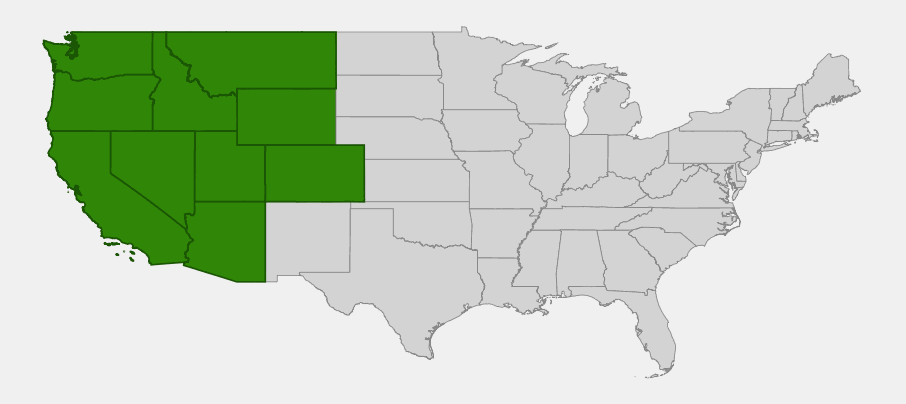
Common fiddleneck is native across much of western North America. USDA PLANTS lists it as native in Arizona, California, Colorado, Idaho, Montana, Nevada, Oregon, Utah, Washington and Wyoming, and in Canada in British Columbia, Alberta, Saskatchewan, Manitoba and the Yukon. It also grows in Baja California, Mexico. Records from Alaska, Hawaii and many eastern states are introductions, and it has also been introduced to Europe and Australia.
It is most abundant in California’s Central Valley, foothills and coastal grasslands, and in the dry interior of Washington, Oregon and Idaho, where it is common in the Columbia Basin and Palouse. It also grows west of the Cascades in open, dry sites, and east through the Great Basin, the Rocky Mountain states and the deserts of Arizona.
It grows in open, sunny places: grasslands, sagebrush steppe, oak savanna, desert washes, sandy flats, fields, orchards, vineyards and roadsides, often on disturbed ground. Because it thrives where soil is disturbed, it can be a weed of grain fields and rangeland.
📋 Regional plant lists featuring Common Fiddleneck: Idaho, Eastern Oregon & Eastern Washington · Montana & Wyoming · Utah & Western Colorado · Arizona & New Mexico · Western Oregon & Western Washington · California & Nevada
Growing & Care Guide
Common fiddleneck is rarely planted on purpose. It is a valuable wild native annual for pollinators, but its toxicity to livestock and weedy habit mean it should not be sown near pastures, hay fields or grain crops.
Light
Full sun.
Soil & Water
It grows in almost any well-drained soil, including poor, sandy and disturbed ground. It relies on winter and spring rain and needs no summer water.
Planting Tips
If you want it in a wildflower meadow far from livestock, scatter seed in fall on bare, raked soil. Mix it with California poppies, lupines and goldfields for a spring display. Do not plant it near horses, cattle or pigs, or where hay is cut.
Pruning & Maintenance
No pruning is needed. To control spread, pull or mow plants before the nutlets ripen, wearing gloves and long sleeves.
Propagation
Seed only. It self-sows readily and the nutlets can survive in the soil for several years.
Landscape Uses
- Wild pollinator habitat: early nectar for bees and butterflies
- Wildflower viewing: orange-yellow spring displays in wet years
- Native meadows away from livestock: fast, self-sowing annual color
- Ecological education: a classic example of a toxic native range plant
- Disturbed-ground cover: quickly covers bare, sunny soil
Wildlife & Ecological Value
Common fiddleneck is a major early-season nectar plant across the grasslands and deserts of the West.
For Pollinators
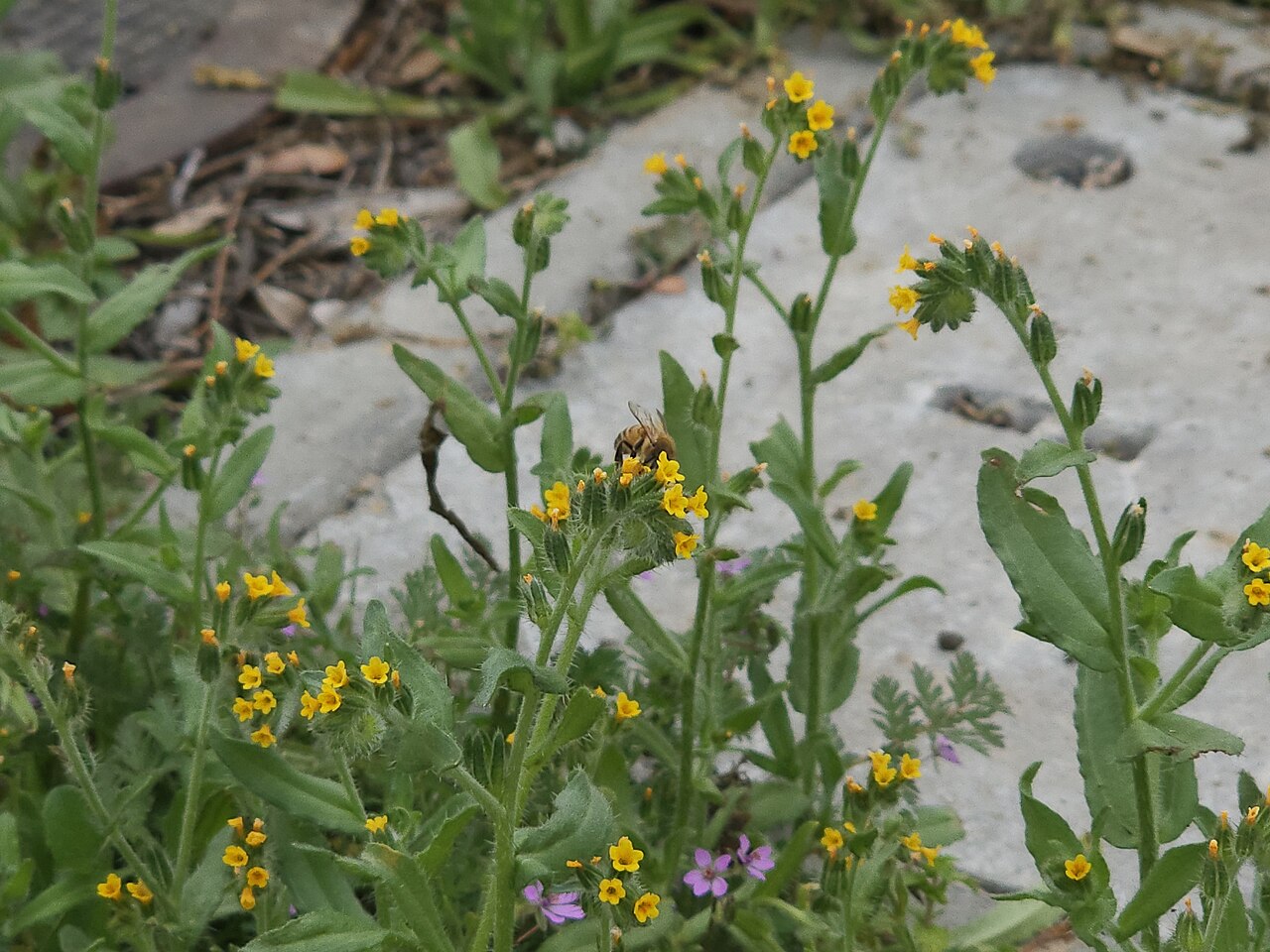
Native bees, honey bees, bee flies and butterflies visit the flowers. It is a known nectar plant for butterflies such as painted ladies, whose spring migrations often coincide with fiddleneck bloom.
For Birds
Finches, sparrows, doves and quail eat the nutlets.
For Mammals
Most mammals avoid the bristly, toxic plants. Rodents may eat some seeds.
Ecosystem Role
As a fast-growing native annual, it covers bare and disturbed soil, supports pollinators early in the year and leaves a large seed bank. In grain-growing regions it is also an agricultural weed.
Cultural & Historical Uses
The genus Amsinckia honors Wilhelm Amsinck, a patron of the Hamburg Botanic Garden in the early 1800s. The species name honors Archibald Menzies, the Scottish surgeon and naturalist on George Vancouver’s voyage to the Pacific Northwest (1791–1795), who collected many western plants.
Ranchers have long known common fiddleneck as a cause of livestock poisoning. Its pyrrolizidine alkaloids cause slow, cumulative liver damage, so animals may show signs weeks or months after eating contaminated feed.
Despite its bad reputation with farmers, it is a native wildflower and a key part of the spring superblooms in California and Arizona. Related borage-family plants on this site include Popcorn Flower and Panamint Cryptantha.
Frequently Asked Questions
Is common fiddleneck poisonous?
Yes, to livestock especially. It contains pyrrolizidine alkaloids that cause cumulative liver damage in horses, cattle and pigs, and it can contain high nitrate levels. People should not eat it either.
Why is it called fiddleneck?
The flower spike curls at the tip like the scroll of a violin, and it uncoils as the flowers open.
Is common fiddleneck native?
Yes, in western North America. It is native from British Columbia and Alberta south to Arizona and Baja California, but it has been introduced to the eastern United States and other continents.
Is it good for pollinators?
Yes. Bees and butterflies, including migrating painted ladies, visit the flowers for nectar in early spring.
How do I control it?
Pull or mow it before the nutlets ripen, wearing gloves, and keep it out of pastures and hay fields.

Looking for a nursery that carries Common Fiddleneck?
Browse our native plant nursery directory: Arizona · California · Colorado · Idaho · Montana · Nevada · Oregon · Utah · Washington · Wyoming