
Narrowleaf Puccoon (Lithospermum incisum)
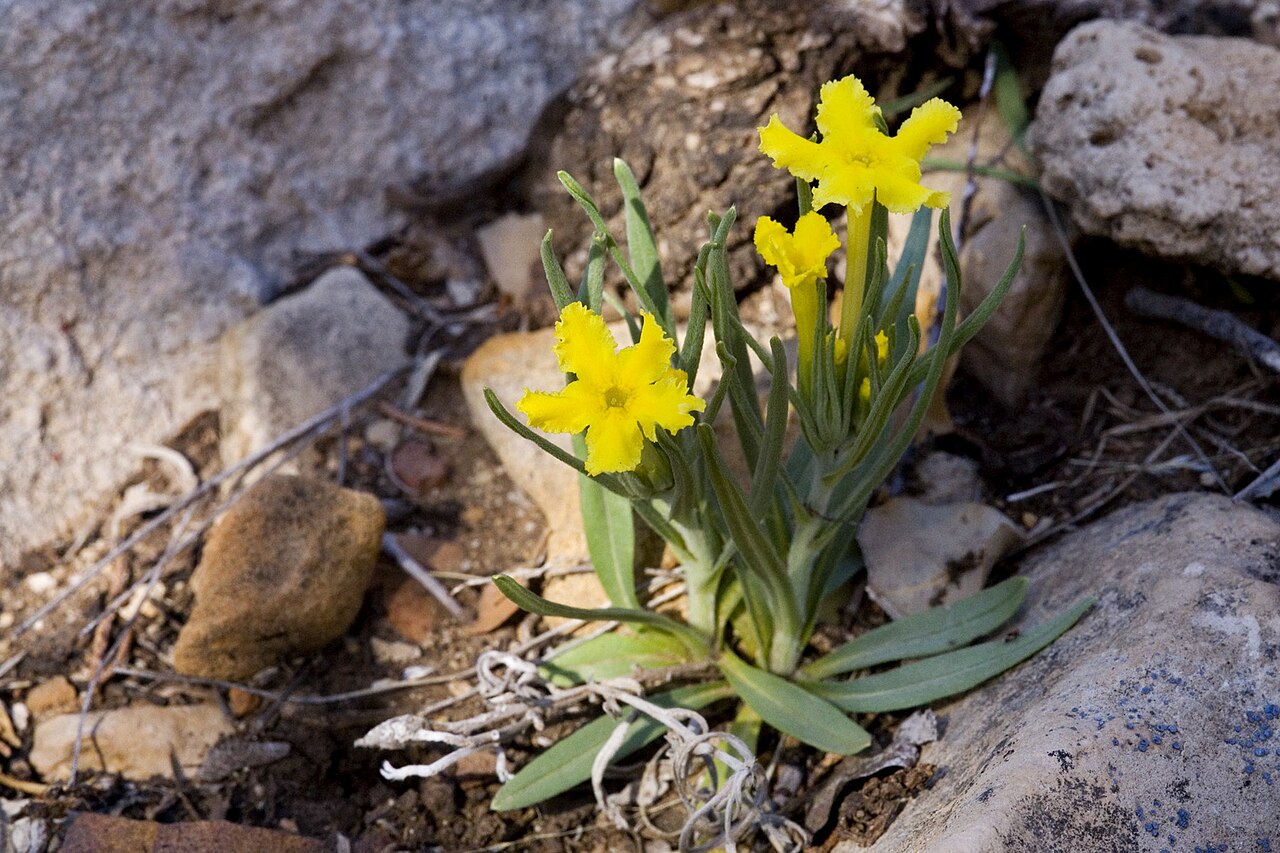
Lithospermum incisum, known as Narrowleaf Puccoon (USDA: narrowleaf stoneseed; also fringed puccoon or narrowleaf gromwell), is one of the first bright wildflowers of spring on the Great Plains. It belongs to the borage family (Boraginaceae). From a deep, woody taproot it sends up clumps of stems 4 to 16 inches tall, lined with narrow, grayish-green leaves and topped by clusters of lemon-yellow trumpet flowers whose petal lobes are ruffled and toothed, as if cut with pinking shears.
It has an unusual double flowering habit. In spring it produces long-tubed, showy flowers that are pollinated by insects. Later in the season it makes small, inconspicuous flowers that never open and pollinate themselves, producing most of the plant’s seed. The seeds are hard, shiny white nutlets, the “stones” in the names stoneseed and Lithospermum (Greek for “stone seed”).
Narrowleaf puccoon grows in dry prairies, plains, open woods and rocky slopes from southern Canada to Texas, New Mexico and Arizona, and west into the Great Basin. It is a long-lived, drought-tolerant plant for sunny prairie, rock and xeric gardens. Its deep taproot makes it hard to transplant, so start it from seed or buy nursery-grown plants.
Identification
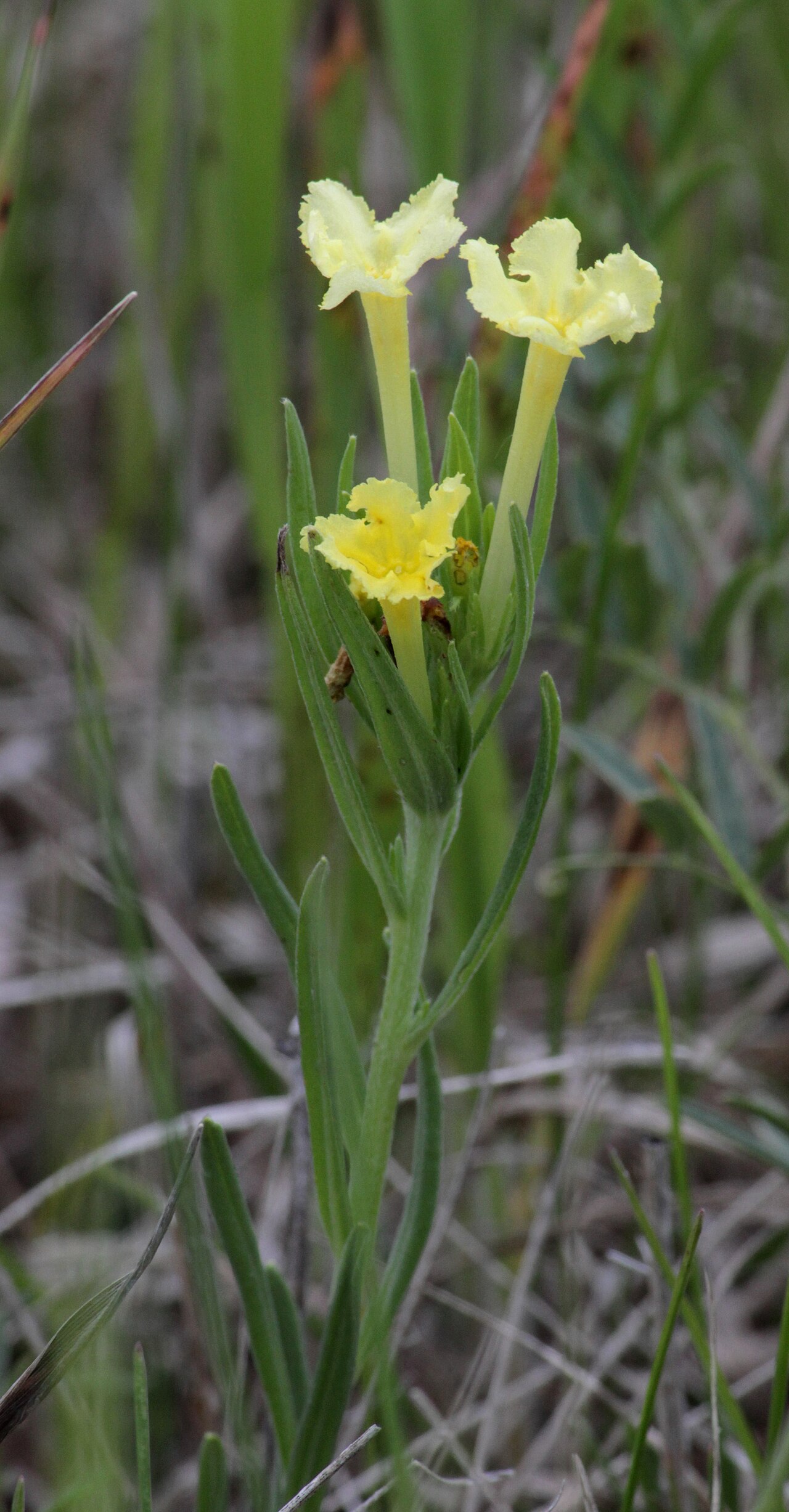
In spring, look for low clumps of narrow-leaved stems topped with bright yellow, long-tubed flowers with crinkled, toothed edges, on dry, sunny prairie or rocky ground.
Roots & Stems
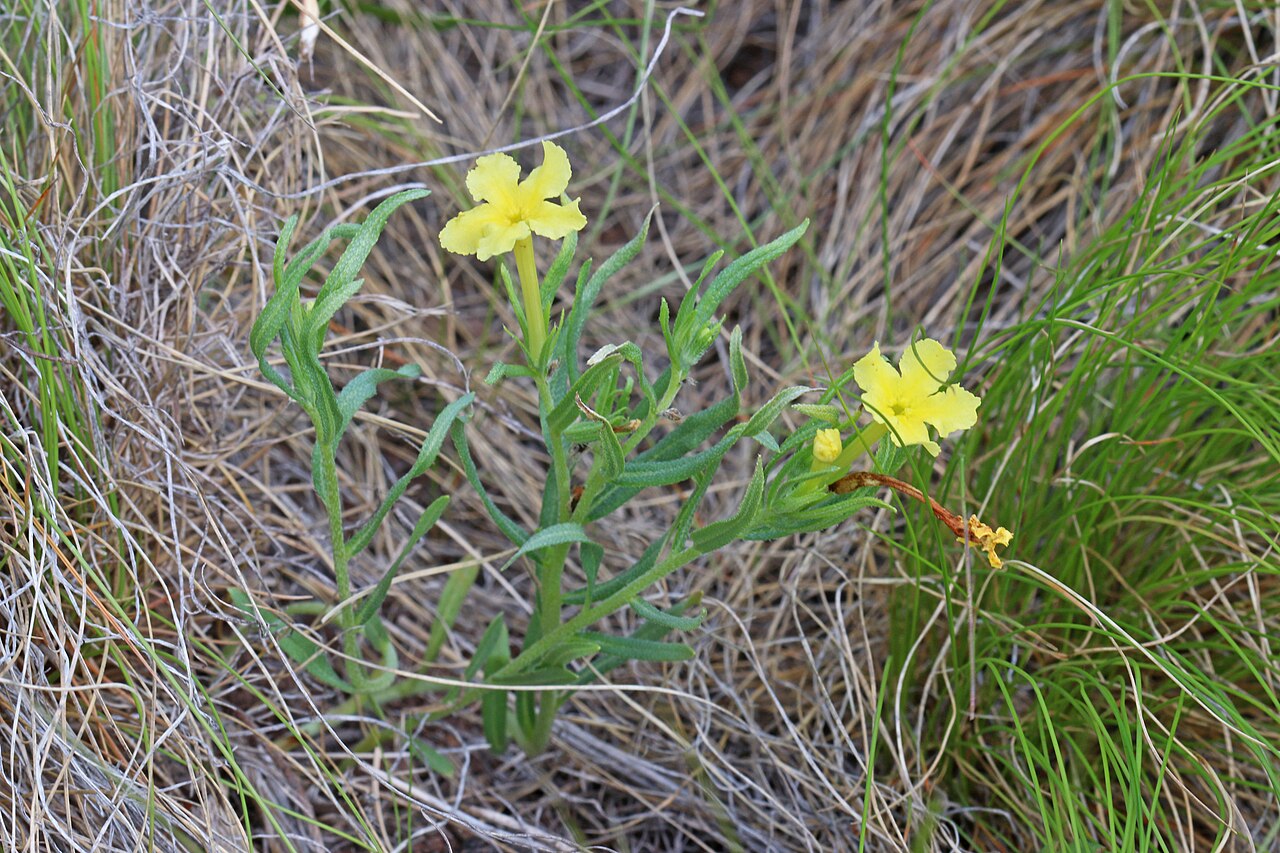
The plant grows from a stout, deep, woody taproot that can be stained reddish-purple. One to many stems rise from the crown, 4 to 16 inches tall, unbranched at first and branching above on older plants. The stems are covered with short, stiff, flat-lying hairs.
Leaves
The leaves are alternate, stalkless, linear to narrowly lance-shaped, about 1 to 4 inches long, with edges slightly rolled under. They are rough with short, stiff hairs and grayish-green. The lower leaves are often larger and may be withered by flowering time.
Flowers
In spring, from about March in the south to June in the north, the stems end in leafy clusters of lemon-yellow flowers. Each flower has a slender tube 3/4 to 1 1/2 inches long that flares into five rounded lobes about 1/2 to 1 inch across, with ruffled, irregularly toothed or fringed margins. Later in spring and summer the plant produces small, closed (cleistogamous) flowers on the upper stems and branches that pollinate themselves without opening.
Fruit & Seeds
Each flower can produce up to four nutlets, which are hard, smooth, glossy white to gray and about 1/8 inch long. Most seed comes from the closed summer flowers. The nutlets are heavy and fall near the parent plant, though ants and small animals may move them.
Look-alikes
Hoary puccoon (Lithospermum canescens) has orange-yellow flowers with smooth lobes and short tubes, and soft, gray-hairy leaves. Fringeless or hairy puccoon (L. caroliniense) has larger, deep yellow-orange flowers without fringed edges and grows on sandy soils. Narrowleaf puccoon’s long, slender tubes and ruffled, toothed lobes are distinctive. Yellow-flowered members of the mustard family, such as wallflowers, have four separate petals, not a five-lobed tube.
Safety & Conservation
Narrowleaf puccoon is not known to be dangerous to touch, but like many borage-family plants it may contain pyrrolizidine alkaloids, so it should not be eaten or used as a home remedy. It is common across most of the plains. At the edges of its range it is rare: NatureServe ranks it critically imperiled in California, Louisiana and Indiana, imperiled in Arkansas and Nevada, and possibly extirpated in Michigan. Don’t dig wild plants.
Quick Facts
| Scientific Name | Lithospermum incisum |
| Family | Boraginaceae (borage family) |
| Plant Type | Taprooted herbaceous perennial |
| Mature Height | 4–16 in |
| Mature Spread | 6–12 in |
| Growth Rate | Slow |
| Sun Exposure | Full sun |
| Water Needs | Low; very drought tolerant once established |
| Soil Type | Dry sandy, gravelly, rocky, loamy or clay soils; well drained |
| Soil pH | About 6.0–8.5 |
| Bloom Time | March–June (showy flowers); closed flowers into summer |
| Flower Color | Lemon yellow |
| Fall Color | None notable |
| Fruit | Hard, glossy white nutlets |
| Deer Resistant | Yes; rough-hairy leaves are seldom browsed |
| USDA Hardiness Zones | 3–9 |
Native Range
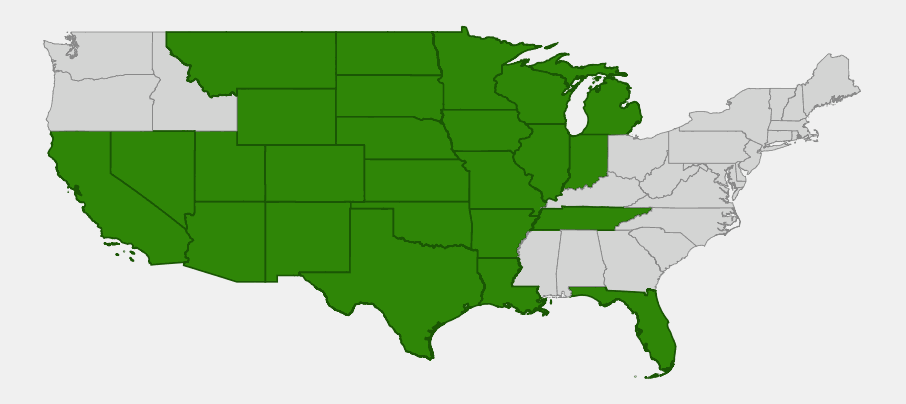
Narrowleaf puccoon has a wide range in central and western North America. USDA PLANTS lists it as native in 25 states (Arizona, Arkansas, California, Colorado, Florida, Illinois, Indiana, Iowa, Kansas, Louisiana, Michigan, Minnesota, Missouri, Montana, Nebraska, Nevada, New Mexico, North Dakota, Oklahoma, South Dakota, Tennessee, Texas, Utah, Wisconsin and Wyoming) and in Alberta, British Columbia, Manitoba, Ontario and Saskatchewan. The Lady Bird Johnson Wildflower Center summarizes its range as southern Ontario to southeastern British Columbia, south to Kentucky, Arkansas, Texas and Arizona. It also extends into northern Mexico.
Its heartland is the Great Plains, from the Canadian prairies through the Dakotas, Nebraska, Kansas, Oklahoma and Texas, and west across the Rocky Mountain foothills, the Colorado Plateau and parts of the Great Basin. East of the Mississippi it is scattered and local in sand prairies and dry openings in Illinois, Wisconsin and Indiana. The records from Michigan, Tennessee and Florida are outlying: Michigan’s population is considered possibly extirpated, and the Florida and Tennessee records are far from the main range.
It grows in dry, sunny places: shortgrass and mixed-grass prairie, sand prairies and hills, rocky slopes, open pinyon-juniper and pine woodland, roadsides and other open ground, from low elevations to about 8,000 feet in the West.
📋 Regional plant lists featuring Narrowleaf Puccoon: Idaho, Eastern Oregon & Eastern Washington · Ohio & Indiana · Montana & Wyoming · Michigan, Wisconsin & Eastern Minnesota · Kentucky & Tennessee · Nebraska, Kansas & Eastern Colorado · Utah & Western Colorado · Arizona & New Mexico · Illinois, Iowa & Missouri · North & South Florida · Arkansas, Louisiana, Eastern Oklahoma & Eastern Texas · South & West Texas · North Dakota, South Dakota & Western Minnesota · California & Nevada
Growing & Care Guide
Narrowleaf puccoon is a tough, long-lived plant for dry, sunny gardens, but it is slow and particular about drainage. It is at its best in prairie plantings, rock gardens and xeriscapes where it is not crowded or overwatered.
Light
Full sun. In shade it flowers poorly and becomes leggy.
Soil & Water
It needs well-drained soil: sandy, gravelly or rocky soils are ideal, and it tolerates loam and some clay where water does not stand. Once established it needs no watering in most of its range. Overwatering and rich, wet soil lead to root rot.
Planting Tips
Plant seed or small nursery plants where they can stay. The deep taproot makes it difficult to move. Combine it with short native grasses such as blue grama and sideoats grama and other low prairie flowers, so it is not shaded out.
Pruning & Maintenance
Very little care is needed. Do not fertilize. Leave the stems standing after flowering so the summer flowers can produce seed, and avoid heavy mulch around the crown. In prairie plantings, it tolerates periodic burning or mowing in late winter.
Propagation
Grow it from seed. The hard nutlets have deep dormancy: sow them outdoors in fall, or give them several months of cold, moist stratification. Germination is often slow and irregular, and seedlings may take two or three years to flower. Stem cuttings are rarely successful.
Landscape Uses
- Prairie and meadow plantings: an early-spring flower among short grasses
- Rock gardens and xeriscapes: compact, drought-proof color for sunny, gravelly sites
- Pollinator gardens: early nectar for butterflies, moths and bees
- Restoration: native forb for dry prairie and rangeland seed mixes
- Slopes and banks: its deep taproot helps hold dry, sandy or gravelly soil
Wildlife & Ecological Value
Narrowleaf puccoon’s long-tubed flowers are adapted for insects with long tongues, and its tough foliage and seeds play a small part in prairie food webs.
For Pollinators
The showy spring flowers are visited by butterflies, day-flying moths, hawk moths and long-tongued bees that can reach the nectar at the bottom of the long tube. Because insect visits are unreliable in early spring, the closed summer flowers act as a backup, guaranteeing seed even in poor years.
For Birds
Ground-feeding birds such as prairie grouse and quail may eat the hard seeds, and the plant grows in grasslands used by many prairie songbirds.
For Mammals
Rodents and other small mammals may collect the nutlets. Deer and livestock generally avoid the rough, hairy foliage.
Ecosystem Role
As a long-lived, deep-rooted perennial, it helps hold dry soils and survives drought and fire by resprouting from its taproot. Its early flowers are an important resource for insects emerging in spring, before most prairie plants bloom.
Cultural & Historical Uses
The word puccoon comes from an Algonquian word for plants used to make dyes. The roots of several Lithospermum species contain red to purple pigments, and Plains peoples used puccoon roots to make dyes for skins, feathers and other materials.
Narrowleaf puccoon also had medicinal and ceremonial uses among several Plains peoples. Related species, especially western stoneseed (Lithospermum ruderale), are known for traditional uses connected with contraception, which later drew scientific interest. These uses should not be tried at home.
The species was described by the German botanist Johann Georg Christian Lehmann in 1818. Its cleistogamous summer flowers have made it a classic example in botany of a plant that combines cross-pollination and self-pollination to ensure reproduction.
Frequently Asked Questions
Why does narrowleaf puccoon have two kinds of flowers?
The showy spring flowers attract insects for cross-pollination. Later, small closed flowers pollinate themselves and produce most of the seed, a strategy called cleistogamy that guarantees seed even when pollinators are scarce.
What does puccoon mean?
It comes from an Algonquian word for plants used to make dyes. Puccoon roots contain red to purple pigments.
Can I transplant narrowleaf puccoon?
Rarely successfully. Its deep taproot is easily damaged. Grow it from seed or buy small nursery-grown plants.
Is narrowleaf puccoon edible?
No. Like many borage-family plants it may contain toxic pyrrolizidine alkaloids. Admire it, but do not eat it or use it as a remedy.
How is it different from hoary puccoon?
Narrowleaf puccoon has lemon-yellow flowers with long tubes and ruffled, toothed lobes. Hoary puccoon has shorter, orange-yellow flowers with smooth lobes and softer, gray-hairy leaves.

Looking for a nursery that carries Narrowleaf Puccoon?
Browse our native plant nursery directory: Arizona & Arkansas · California · Colorado & Florida · Illinois, Indiana, Iowa & Kansas · Louisiana, Michigan, Minnesota, Missouri & Montana · Nebraska, Nevada, New Mexico, North Dakota & Oklahoma · South Dakota, Tennessee, Texas & Utah · Wisconsin & Wyoming