
Pacific Coralroot (Corallorhiza mertensiana)
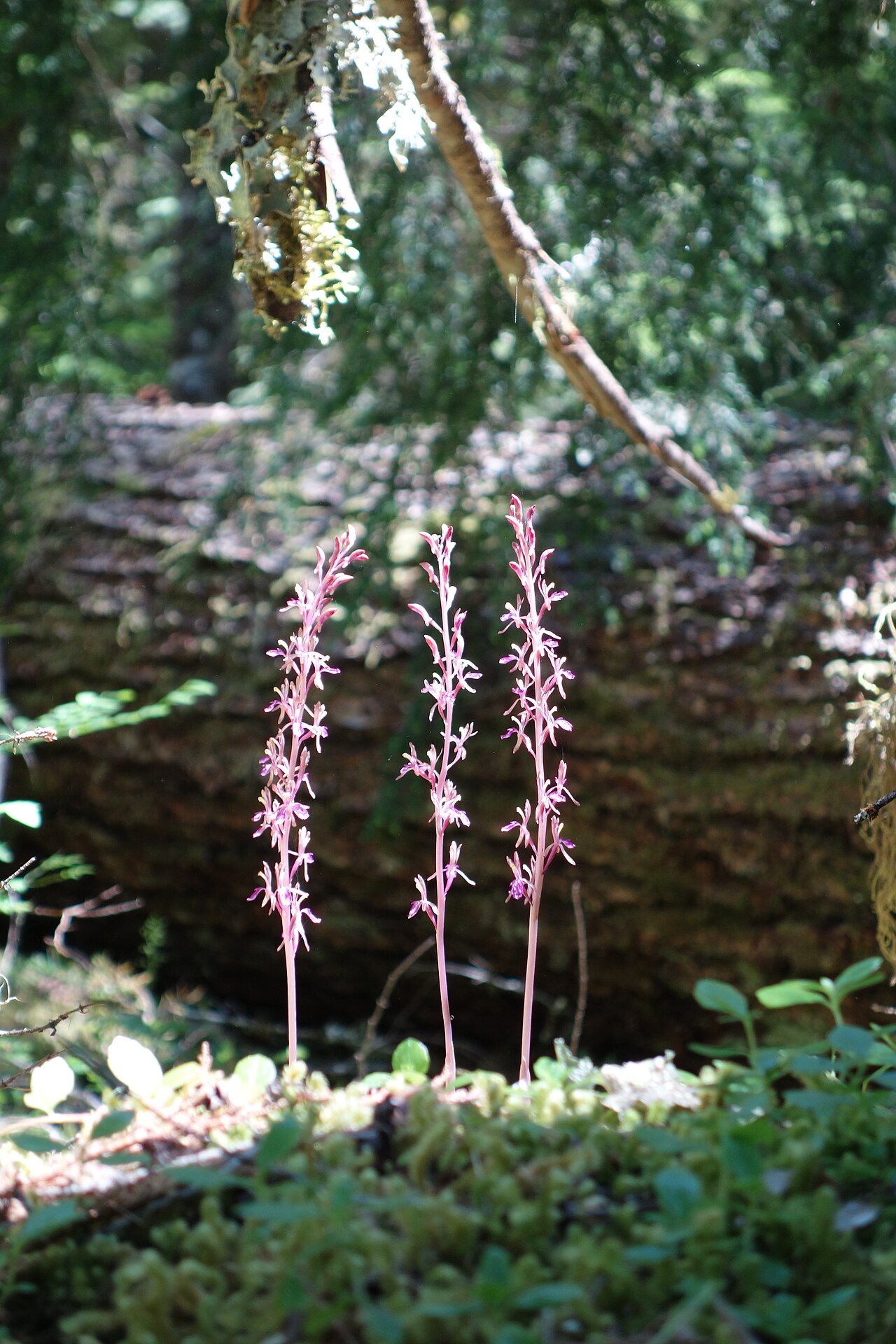
Corallorhiza mertensiana, known as Pacific Coralroot (also western coralroot or Mertens’ coralroot), is a leafless native orchid of the shady conifer forests of the Pacific Northwest, northern California and the northern Rocky Mountains. In summer it sends up slender, pink to reddish-purple stems lined with small, delicate orchid flowers, standing out against the dark forest floor.
Pacific coralroot has no green leaves and makes almost no food from sunlight. Instead it is mycoheterotrophic: it takes its sugars and nutrients from soil fungi that are themselves connected to the roots of nearby trees. Its underground stem is a branched, coral-like rhizome, the source of the name coralroot. The flowering stems, 8 to 20 inches tall, are the only part of the plant most people ever see.
Pacific coralroot cannot be grown from nursery stock, and it should never be dug up or transplanted. It depends completely on its fungal partners and on healthy forest, and it dies when removed. This page is a guide to identifying and appreciating it in the wild.
Identification
Look for leafless, pink to reddish-purple stems 8 to 20 inches tall with 10 to 35 small, widely spaced orchid flowers, each with a broad, pinkish-purple lip, in shady conifer forest in early to mid summer.
Stems & Habit
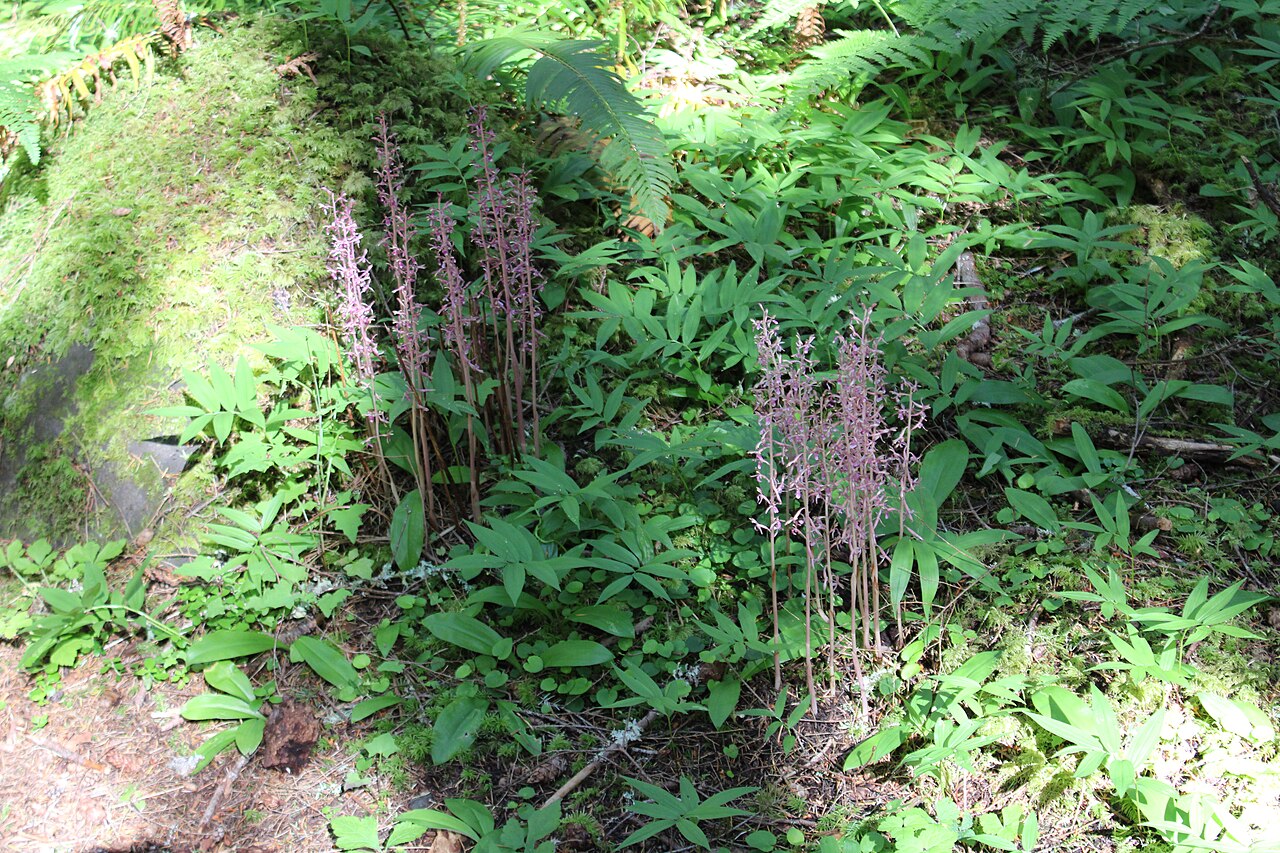
The plant shows above ground only as one to several flowering stems, often in small clumps. The stems are smooth, pink to reddish-purple or brownish, and 8 to 20 inches (20 to 50 cm) tall, with a few papery sheaths near the base instead of leaves.
Flowers
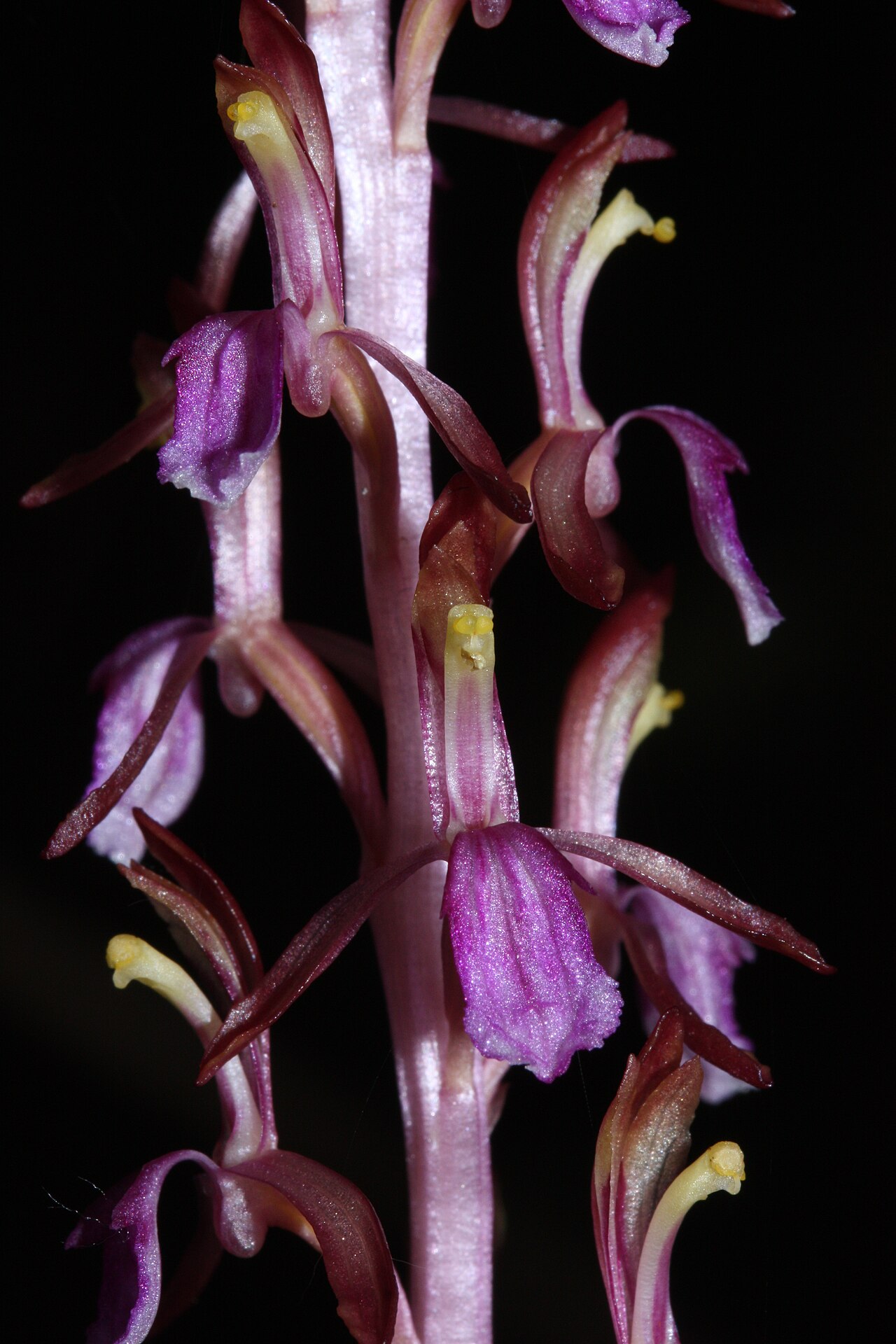
Each stem bears about 10 to 35 flowers in a loose raceme. The sepals and petals are narrow and reddish-purple, often with darker lines. The lip is broad, tongue-shaped and drooping, pink to reddish-purple with darker veins or a darker central stripe, and is usually unspotted. At the base of each flower the fused sepals form a small chin-like projection (mentum) that sticks out along the ovary, a helpful field mark. Bloom is from about June to August.
Fruit & Seeds
The flowers develop into hanging, ellipsoid capsules about 1/2 to 3/4 inch long that release thousands of dust-like seeds in late summer. The dry stems with their capsules often stay standing into fall.
Underground Parts
Below ground, Pacific coralroot has no true roots. It grows from a branched, fleshy, coral-like rhizome that is packed with fungal threads. Studies have found that coralroots like this one form close partnerships with specific mycorrhizal fungi, many of them in the Russula family, which are also linked to the roots of conifers.
Look-alikes
Spotted Coralroot (C. maculata) has a white lip with red to purple spots. Striped coralroot (C. striata) has larger, pinkish flowers boldly striped with dark red-purple. Pacific coralroot is recognized by its unspotted, pink-purple lip with darker veins, its slender, widely spaced flowers and the projecting chin at the base of each flower. Non-orchid mycoheterotrophs in the same forests include Woodland Pinedrops and Indian Pipe, which have nodding, bell-shaped or pipe-shaped flowers.
Quick Facts
| Scientific Name | Corallorhiza mertensiana |
| Family | Orchidaceae (orchid family) |
| Plant Type | Leafless, mycoheterotrophic perennial orchid |
| Mature Height | 8–20 in |
| Mature Spread | Clumps of a few stems |
| Growth Rate | Slow; depends on fungal partners |
| Sun Exposure | Shade; does not need sunlight |
| Water Needs | Moist forest soil; draws water and food through fungi |
| Soil Type | Humus-rich conifer forest soil with deep litter |
| Soil pH | Acidic, about 4.5–6.5 |
| Bloom Time | June–August |
| Flower Color | Pink to reddish-purple |
| Fall Color | None; dry stems may persist |
| Fruit | Hanging capsules with dust-like seed |
| Deer Resistant | Not applicable; rarely browsed |
| USDA Hardiness Zones | Not cultivated; wild in zones 3–8 |
Native Range
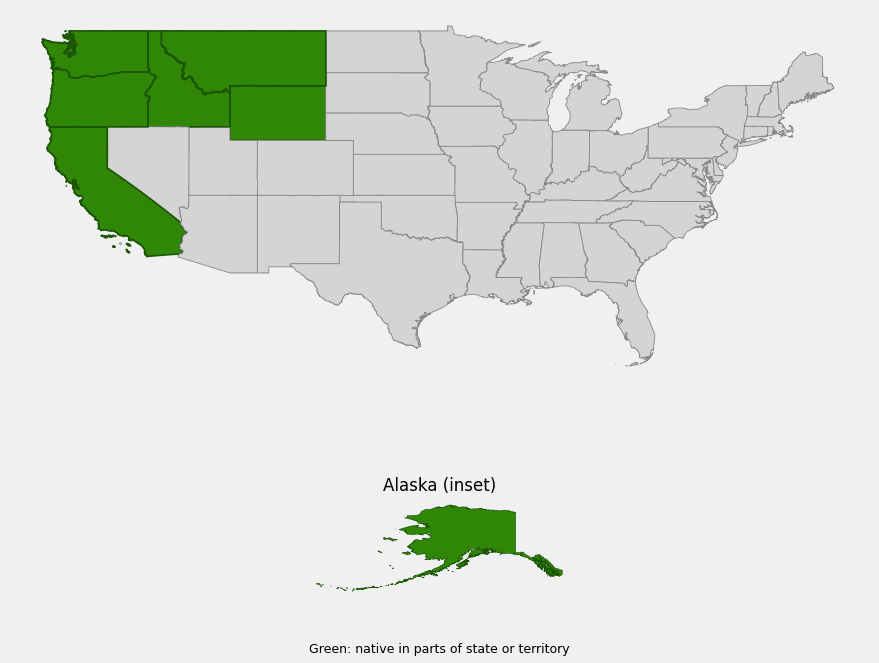
Pacific coralroot is native to western North America. USDA PLANTS lists it as native in Alaska, California, Idaho, Montana, Oregon, Washington and Wyoming, and in British Columbia and Alberta in Canada.
Its center is the Pacific Northwest: the Cascades, Olympic Mountains and Coast Range of Washington and Oregon, and coastal and interior British Columbia. It reaches north into southeastern Alaska, south into northern California (the North Coast Ranges, Klamath Mountains and northern Sierra Nevada), and east through northern Idaho and western Montana to northwestern Wyoming.
It grows in moist to fairly dry, shady coniferous forests from low elevations to the subalpine zone, typically under western hemlock, Douglas-fir, Pacific silver fir, grand fir, mountain hemlock and lodgepole pine, in deep needle litter and humus. It is often found in mature and old-growth forest.
📋 Regional plant lists featuring Pacific Coralroot: Idaho, Eastern Oregon & Eastern Washington · Montana & Wyoming · Alaska · Western Oregon & Western Washington · California & Nevada
Can You Grow It?
No. Pacific coralroot cannot be grown in gardens. No nursery propagates it, and plants that are dug up die, because they are cut off from the fungi that feed them. Never dig, transplant or buy wild-collected plants. The best way to enjoy it is to find it in the forest and protect its habitat.
Light
It does not need sunlight to grow. Look for it in shaded forest under a closed canopy of conifers rather than in clearings. Its pink-purple stems can be surprisingly easy to spot in dim light once you know what to look for.
Soil & Water
It grows in acidic, humus-rich soil with a thick layer of needles and rotting wood. Flowering stems are more numerous after a moist spring. Avoid trampling or compacting the forest floor where it grows, and leave the litter and logs in place.
Planting Tips
Do not try to plant, transplant or sow Pacific coralroot. If it grows on your land, protect the surrounding trees and soil, since its fungal partners depend on the living tree roots.
Pruning & Maintenance
None is needed. Do not pick the flowering stems; each one carries the plant’s seed crop for the year.
Propagation
It reproduces by dust-like seed, which can germinate only with the right fungus, and by slow branching of its rhizome. There is no practical way to propagate it. Keeping mature forests and their soils intact is the best way to help it.
Where to See It
- Forest trails: often seen along shady trails in the Cascades and Olympics in early summer
- National parks: common in Mount Rainier, Olympic and other northwestern parks
- Macro photography: the delicate flowers reward a close look
- Orchid study: one of the most common native orchids in Pacific Northwest forests
- Forest ecology education: a vivid example of a plant fed by fungi linked to trees
Wildlife & Ecological Value
Pacific coralroot is a visible sign of the hidden network of fungi that links trees and the forest floor.
For Pollinators
The flowers are thought to be visited by small bees and flies. Like many coralroots, it may also self-pollinate, and many flowers set seed.
For Birds
Birds make little direct use of it.
For Mammals
Small mammals may occasionally nibble the stems. The fungi it depends on also form mushrooms and truffles eaten by squirrels and other forest mammals.
Ecosystem Role
By drawing carbon from fungi that are partnered with trees, Pacific coralroot is part of the underground “wood-wide web.” Its presence indicates healthy, intact forest soil with an active community of mycorrhizal fungi.
Cultural & Historical Uses
The genus name Corallorhiza means “coral root,” for the branched, coral-like rhizome. The species name honors the German naturalist Karl Heinrich Mertens (1796–1830), who collected plants on the Pacific coast of North America during a Russian expedition.
Coralroots were long described as saprophytes that fed on decaying matter. Later research showed that they actually get their food from living mycorrhizal fungi, which in turn are connected to trees. Pacific coralroot and spotted coralroot have been used in studies of how specialized these partnerships can be.
Because it cannot be cultivated, every Pacific coralroot you see is a wild plant. Leave it where it grows, and share photos instead of stems. On this site, related species include Spotted Coralroot, and other mycoheterotrophs include Woodland Pinedrops and Indian Pipe.
Frequently Asked Questions
Can I grow Pacific coralroot in my garden?
No. It depends entirely on specific soil fungi that are linked to living trees, so it cannot be grown from nursery stock, and dug-up plants die. Enjoy it in the wild and never dig it up.
Why does Pacific coralroot have no leaves?
It is mycoheterotrophic: it gets its food from fungi in the soil instead of making it through photosynthesis, so it does not need green leaves.
How do I tell Pacific coralroot from spotted coralroot?
Pacific coralroot has a pink-purple lip with darker veins and no spots, and a chin-like projection at the base of each flower. Spotted coralroot has a white lip with purple spots.
When does Pacific coralroot bloom?
From about June to August, depending on elevation and latitude.
Where can I see Pacific coralroot?
In shady conifer forests from southeastern Alaska to northern California and east to Idaho, Montana and northwestern Wyoming, for example along trails in Mount Rainier and Olympic national parks.

Looking for a nursery that carries Pacific Coralroot?
Browse our native plant nursery directory: Alaska · California · Idaho · Montana · Oregon · Washington · Wyoming