
Large-leaved Avens (Geum macrophyllum)
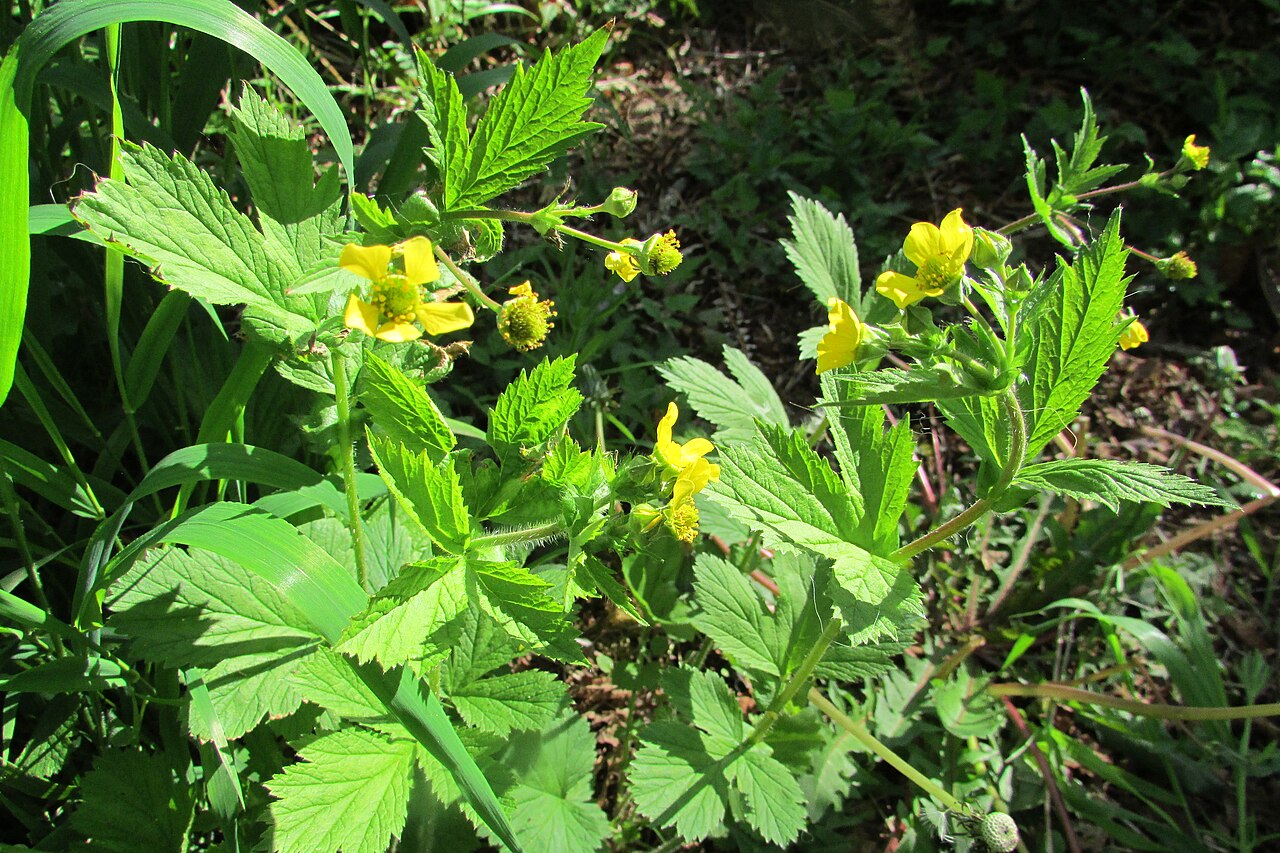
Geum macrophyllum, known as Large-leaved Avens (USDA: largeleaf avens), is a widespread perennial wildflower of moist meadows, stream banks and open woods across northern and western North America. It belongs to the rose family (Rosaceae). It is named for its large basal leaves, which have a big, rounded, lobed leaflet at the tip and several much smaller leaflets below.
From late spring through summer it sends up branching stems 1 to 3 feet tall with small, bright yellow, buttercup-like flowers. These are followed by round, bristly seed heads whose hooked seeds hitchhike on animals and clothing. It grows from Alaska and across Canada south through the western mountains to California, Arizona and New Mexico, and east across the Great Lakes to northern New England and New York.
It is an easy, adaptable plant for moist, partly shaded native gardens, rain gardens and stream-side plantings, where its flowers feed small bees and flies and its seeds feed birds. It self-sows readily in damp soil.
Identification
Look for a clump of basal leaves with one big, rounded, lobed and toothed end leaflet and a few tiny side leaflets, and branched stems carrying small yellow five-petaled flowers and later round, bristly burr-like seed heads, in moist meadows, stream banks and woodland edges.
Stems & Habit
Large-leaved avens is a herbaceous perennial from a short, thick rootstock, usually 12 to 40 inches (30 to 100 cm) tall. The upright stems are hairy and branch near the top. A leafy basal rosette stays green much of the year in mild climates.
Leaves
The basal leaves are 4 to 18 inches (10 to 45 cm) long and pinnately compound in a distinctive lyre-shaped pattern: a large, round to kidney-shaped terminal leaflet, often 2 to 5 inches wide, shallowly to deeply lobed and toothed, with several pairs of much smaller, unequal leaflets along the stalk below. Stem leaves are smaller, usually three-lobed, with leafy stipules at the base.
Flowers
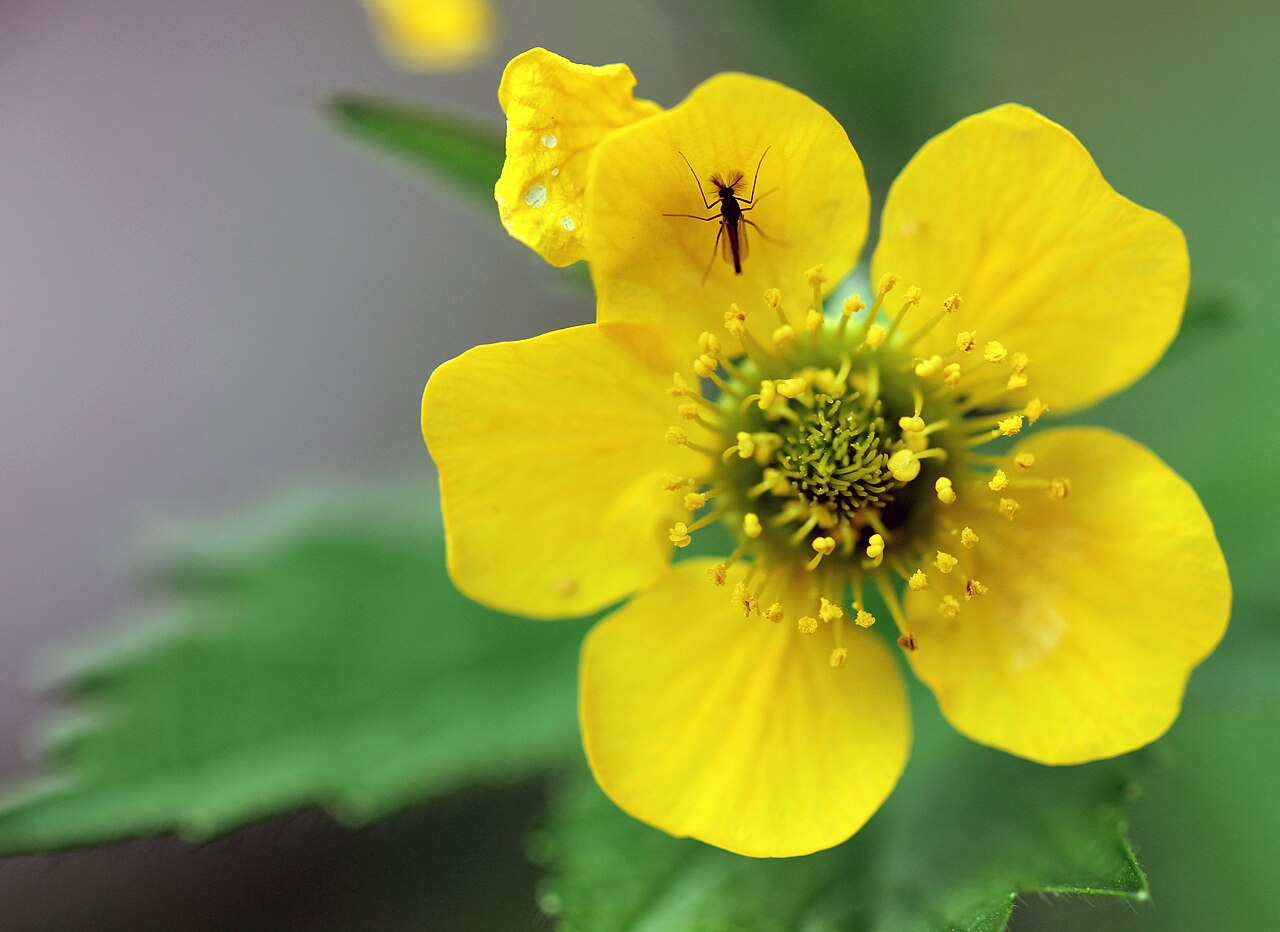
The flowers are borne a few together at the branch tips. Each is about 3/8 to 5/8 inch (1 to 1.5 cm) across, with five rounded, bright yellow petals, five green sepals that bend back, many stamens and a central dome of pistils. Bloom time is mainly May to August, varying with latitude and elevation.
Fruit & Seeds
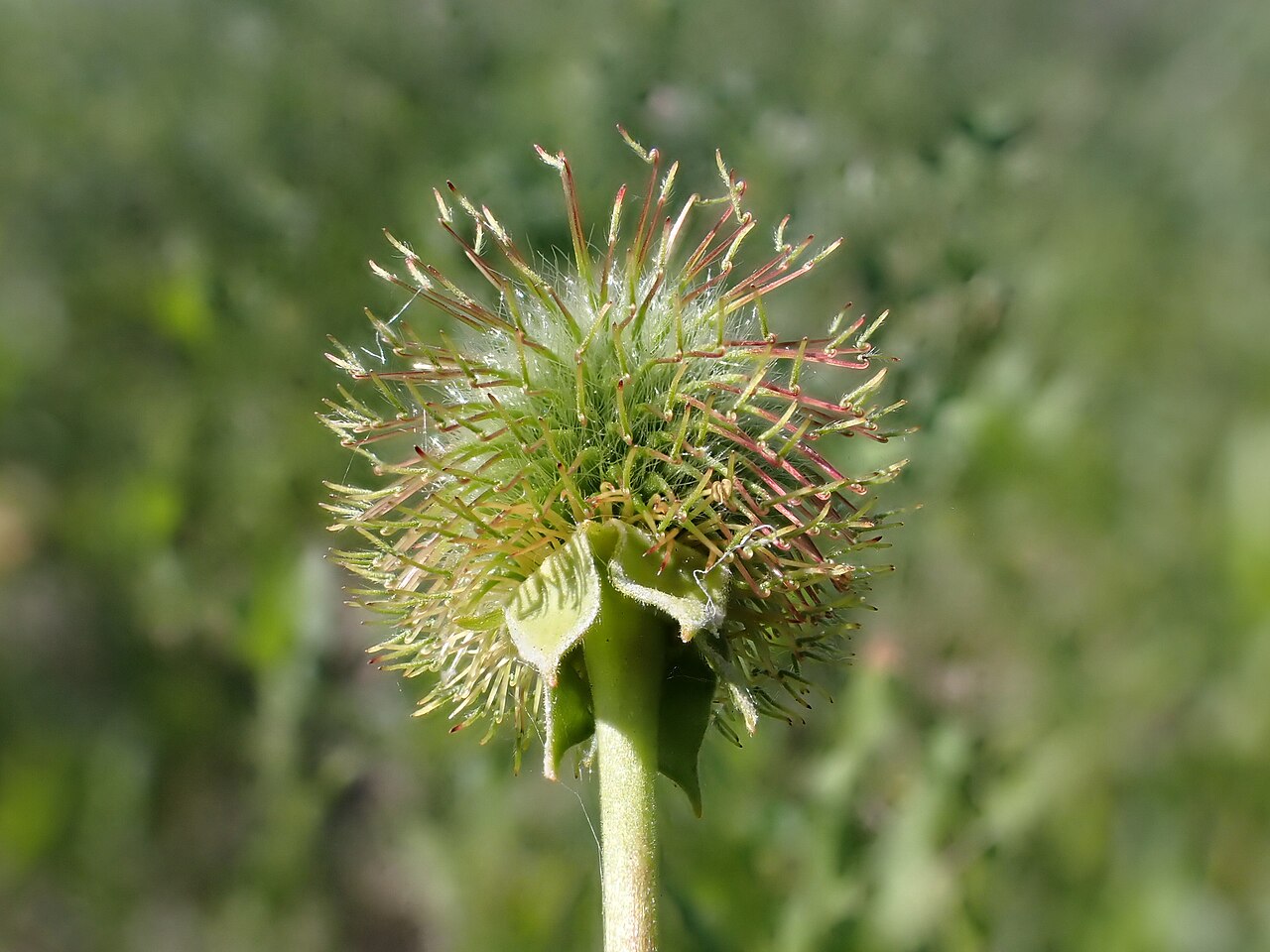
The fruit is a round head about 1/2 to 3/4 inch (1.5 to 2 cm) across, made of many small achenes. Each achene carries a persistent style that is jointed and hooked at the tip; the upper segment falls away, leaving a tiny hook that clings to fur, feathers and clothing.
Look-alikes
Yellow avens (Geum aleppicum) is very similar but its terminal leaflet is not much larger than the others, and it has more deeply cut leaves. White Avens (G. canadense) has white flowers. Prairie Smoke has nodding pink flowers and feathery seed heads. Cinquefoils such as Graceful Cinquefoil have similar yellow flowers but palmate leaves and no hooked seeds. Buttercups such as California Buttercup have glossy petals and no burr-like seed heads. Two varieties are recognized: var. macrophyllum, with a shallowly lobed end leaflet, and var. perincisum (sometimes treated as Geum perincisum), with a deeply cut end leaflet.
Safety & Conservation
No significant toxicity is reported. The hooked seeds can be a nuisance on pets and socks. The species is common and secure across most of its range, though it is uncommon near its southern edge in the Northeast.
Quick Facts
| Scientific Name | Geum macrophyllum |
| Family | Rosaceae (rose family) |
| Plant Type | Herbaceous perennial wildflower |
| Mature Height | 12–40 in |
| Mature Spread | 12–24 in |
| Growth Rate | Moderate |
| Sun Exposure | Full sun to part shade |
| Water Needs | Moderate to high; moist soil |
| Soil Type | Moist loam, clay or humusy soils; tolerates seasonal wetness |
| Soil pH | About 5.5–7.5 |
| Bloom Time | May–August |
| Flower Color | Bright yellow |
| Fall Color | Basal leaves may turn reddish or purplish |
| Fruit | Round burr-like head of hooked achenes |
| Deer Resistant | Moderate; occasionally browsed |
| USDA Hardiness Zones | 2–8 |
Native Range
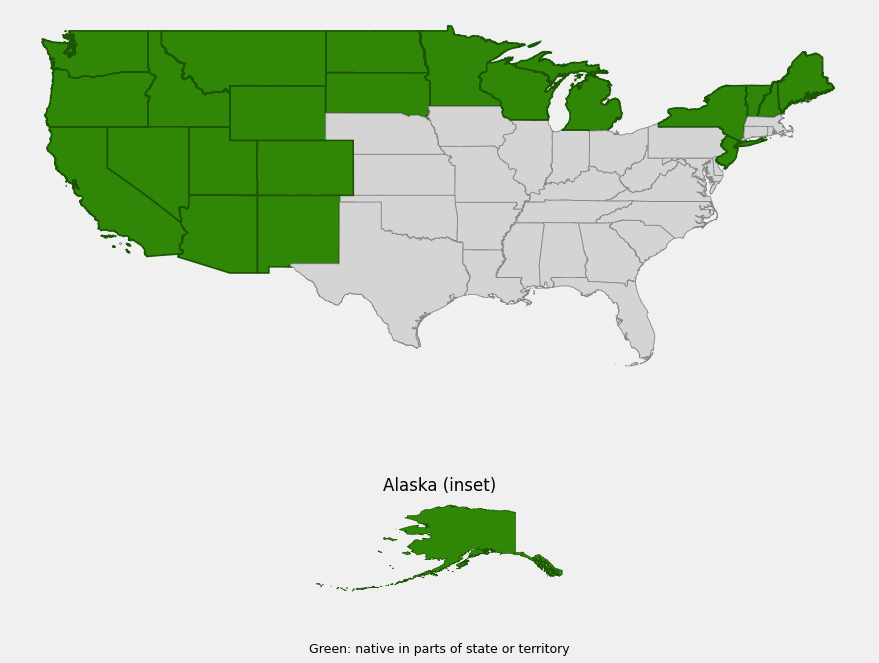
Large-leaved avens has a broad northern and western range. USDA PLANTS lists it as native in Alaska, Arizona, California, Colorado, Idaho, Maine, Michigan, Minnesota, Montana, Nevada, New Hampshire, New Jersey, New Mexico, New York, North Dakota, Oregon, South Dakota, Utah, Vermont, Washington, Wisconsin and Wyoming. It grows across nearly all of Canada, from Yukon and British Columbia to Newfoundland and Labrador, as well as in Saint Pierre and Miquelon. A closely related variety also grows in northeastern Asia.
It is most common in the Pacific Northwest, Alaska, the Rocky Mountains and the boreal forest. In the West it grows on both sides of the Cascades and through the mountains of California, Nevada, Utah, Arizona and New Mexico. In the Dakotas it grows mainly in the Black Hills and wooded northern areas. Eastward it extends across the upper Great Lakes to northern New England and New York, and the New Jersey records are outlying at the southern edge of its eastern range.
It grows in moist, open to partly shaded places: wet meadows, stream banks, seeps, thickets, aspen groves, open forests, clearings and forest edges, from sea level in the Northwest to subalpine meadows in the Rockies.
📋 Regional plant lists featuring Large-leaved Avens: New York, Pennsylvania & Northern New Jersey · Idaho, Eastern Oregon & Eastern Washington · Montana & Wyoming · Michigan, Wisconsin & Eastern Minnesota · Utah & Western Colorado · New Hampshire, Maine & Vermont · Delaware, Southern New Jersey & Long Island · Arizona & New Mexico · Alaska · North Dakota, South Dakota & Western Minnesota · Western Oregon & Western Washington · California & Nevada
Growing & Care Guide
Large-leaved avens is an easy, long-lived perennial for moist native gardens across the northern and western United States.
Light
Full sun to part shade. In hot, dry areas it does best with afternoon shade.
Soil & Water
It prefers moist, fertile soil and tolerates clay and seasonally wet ground. Water during dry spells; it wilts and goes dormant early in prolonged drought.
Planting Tips
Plant in spring or fall, 12 to 18 inches apart, along streams, rain gardens, pond edges or woodland borders. Combine it with western columbine, red-osier dogwood and native sedges. It self-sows, so plant it where a few seedlings are welcome.
Pruning & Maintenance
Cut back flower stems after seeding if you want to limit self-sowing or keep seeds off pets. Leave the basal rosette in place.
Propagation
Grow from seed sown outdoors in fall or after a few weeks of cold, moist stratification; seed germinates readily. Clumps can also be divided in spring.
Landscape Uses
- Rain gardens and stream banks: thrives in moist, seasonally wet soil
- Woodland edges: for partly shaded borders and clearings
- Pollinator gardens: long bloom for small bees and flies
- Wildlife gardens: seeds for birds and small mammals
- Restoration: native forb for riparian and meadow projects
Wildlife & Ecological Value
Large-leaved avens supports many small insects and seed-eating animals in moist northern and mountain habitats.
For Pollinators
Small native bees such as sweat bees, syrphid flies and other flies visit the open flowers for pollen and nectar.
For Birds
Sparrows, juncos and other ground-feeding birds eat the seeds.
For Mammals
Deer, elk and moose graze the foliage lightly, and the hooked seeds are spread on the fur of passing mammals.
Ecosystem Role
Its hooked seeds are dispersed by animals, letting it colonize clearings and stream banks. It helps hold moist soils in riparian areas and is a common part of wet meadow and forest-edge plant communities.
Cultural & Historical Uses
The genus name Geum is an old Latin plant name used by Pliny. The species name macrophyllum means “large-leaved,” for its big basal leaves. Avens comes from a medieval name for the European herb bennet (Geum urbanum).
Several Indigenous peoples of the Pacific Northwest and Alaska used large-leaved avens as a medicine, for example applying the leaves to sores and boils or using leaf preparations for other ailments.
Its hooked seeds are a classic example of animal dispersal: the jointed style breaks to leave a perfect little hook. Other avens on this site include White Avens and Prairie Smoke.
Frequently Asked Questions
How do I recognize large-leaved avens?
Look for basal leaves with one large, rounded, lobed end leaflet and tiny side leaflets, small yellow five-petaled flowers and round, bristly seed heads with hooked seeds.
Where does large-leaved avens grow?
Across Alaska and Canada, through the western mountains south to Arizona and New Mexico, and east across the Great Lakes to northern New England, New York and New Jersey, in moist meadows, stream banks and open woods.
Why do its seeds stick to my socks?
Each seed has a tiny hook at the tip of its style, which catches on fur and fabric so animals carry the seeds to new places.
Is it good for gardens?
Yes, in moist, sunny to partly shaded spots such as rain gardens and stream banks. It is easy to grow and self-sows.
Is large-leaved avens the same as yellow avens?
No. Yellow avens (Geum aleppicum) is similar, but its end leaflet is not much bigger than the side leaflets. Large-leaved avens has a distinctly large, rounded end leaflet.

Looking for a nursery that carries Large-leaved Avens?
Browse our native plant nursery directory: Alaska & Arizona · California · Colorado · Idaho · Maine, Michigan, Minnesota & Montana · Nevada, New Hampshire, New Jersey, New Mexico, New York & North Dakota · Oregon · South Dakota, Utah & Vermont · Washington · Wisconsin & Wyoming