
Spotted St. John’s Wort (Hypericum punctatum)
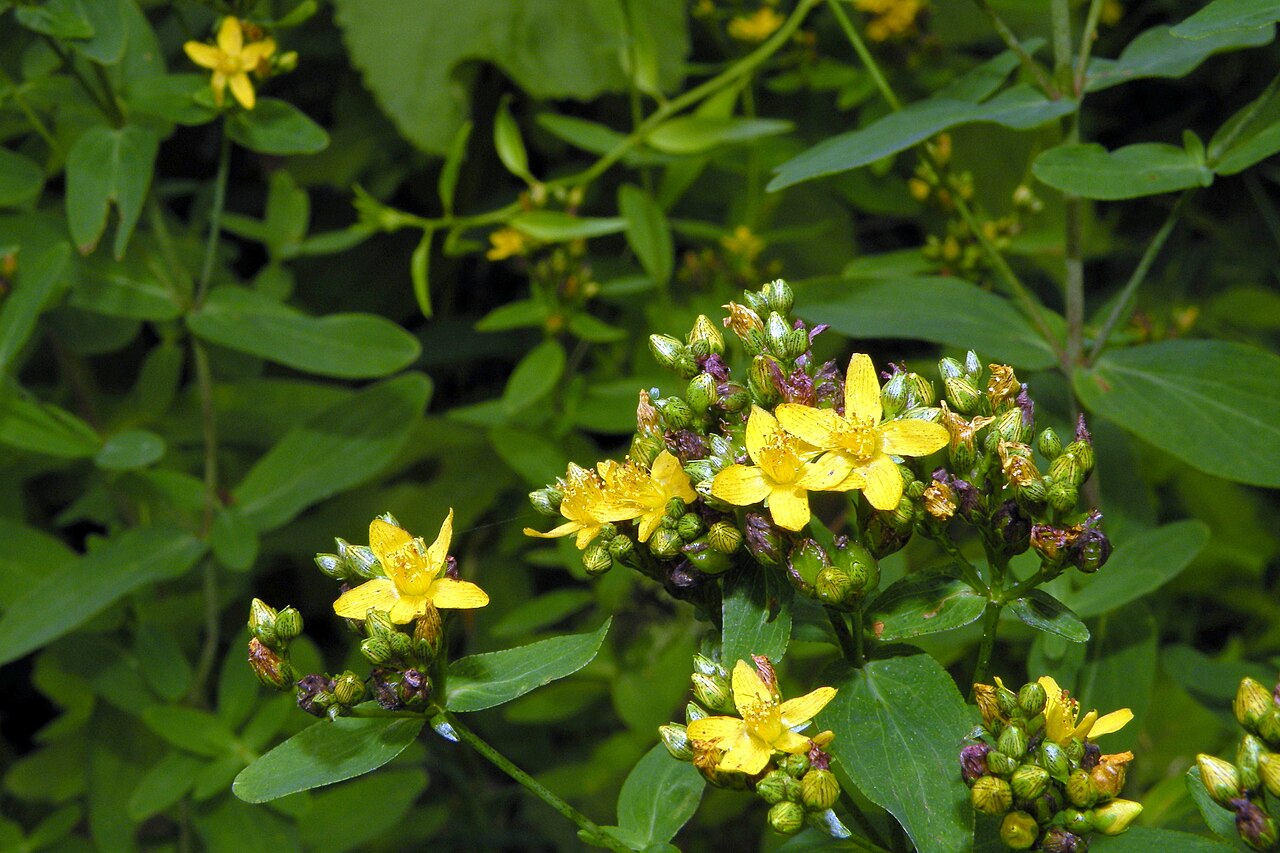
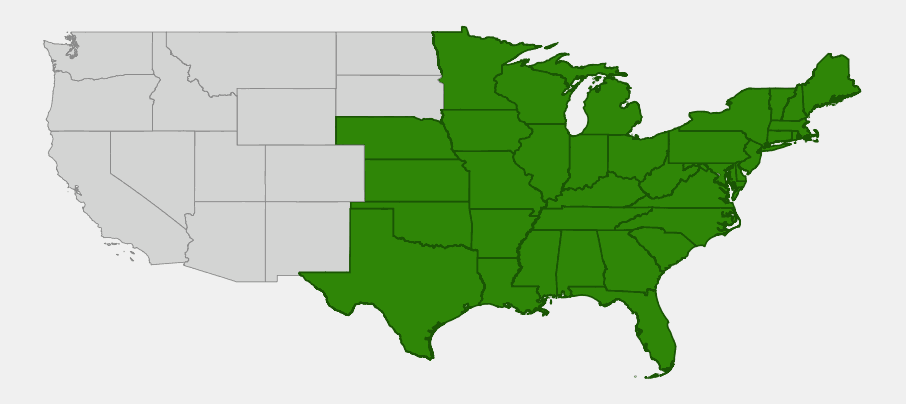
Hypericum punctatum, known as Spotted St. John’s Wort (USDA: spotted St. Johnswort), is an upright herbaceous perennial of the St. John’s wort family (Hypericaceae). It is the most widespread native St. John’s wort of eastern North America, found from Nova Scotia, Quebec and Ontario south to Florida and west to Minnesota, Nebraska, Kansas, Oklahoma and East Texas.
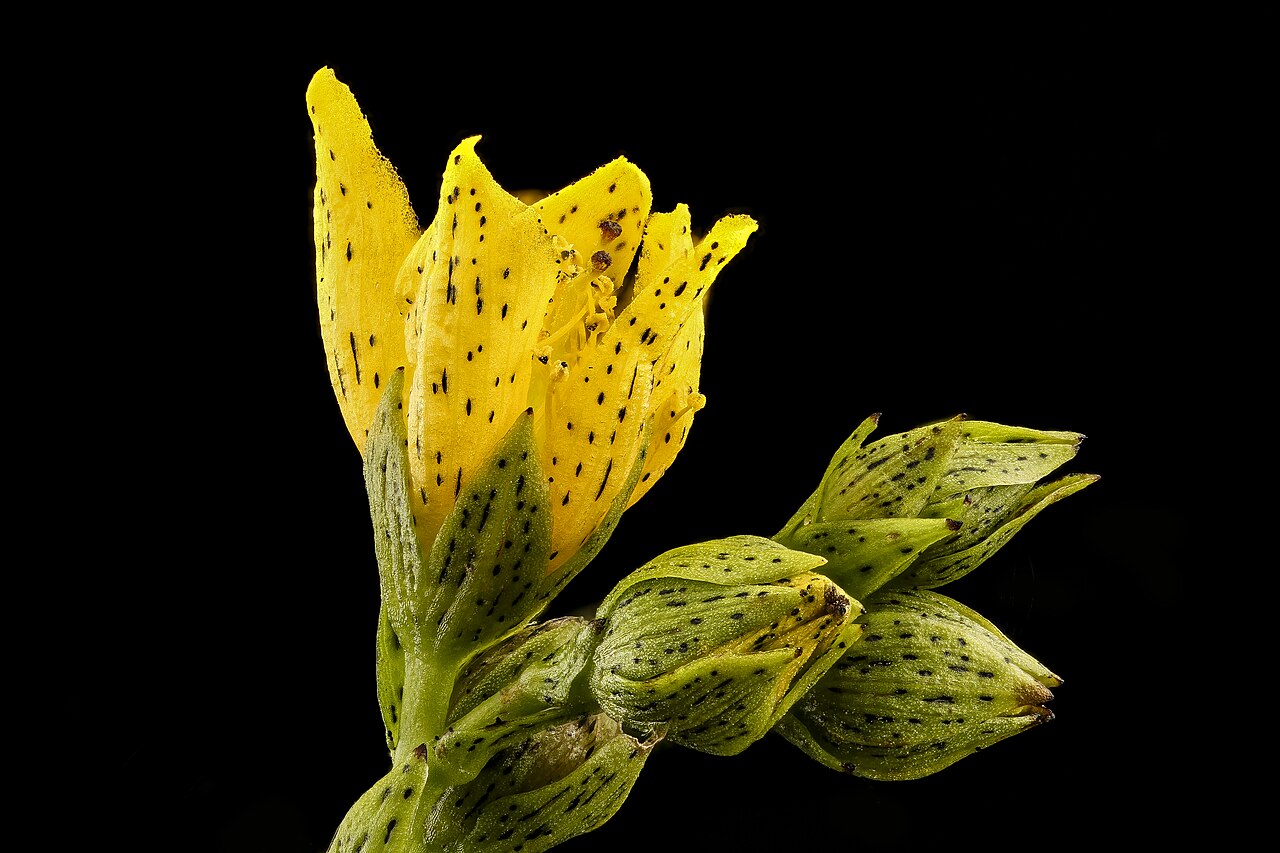
Its unbranched or few-branched stems grow 1 to 3 feet tall, with pairs of oblong leaves, and in mid to late summer they end in dense, flat-topped clusters of small, bright yellow, five-petaled flowers with a brush of stamens. The petals, sepals, leaves and stems are all peppered with tiny black dots and streaks, the glands that give the plant its common and scientific names (punctatum means “dotted”).
Spotted St. John’s wort grows in open woods, woodland edges, old fields, meadows, prairies, thickets and roadsides, on both moist and fairly dry soils. It is easy to grow in sunny or lightly shaded native gardens, and its pollen-rich flowers are busy with bumble bees, sweat bees and hover flies. Unlike the European common St. John’s wort, it is a native plant that is not invasive.
Identification
Spotted St. John’s wort is best told by its many black dots: on the petals, the sepals, the leaves and even the stems. Its flowers are smaller than those of most other upright St. John’s worts.
Growth Form
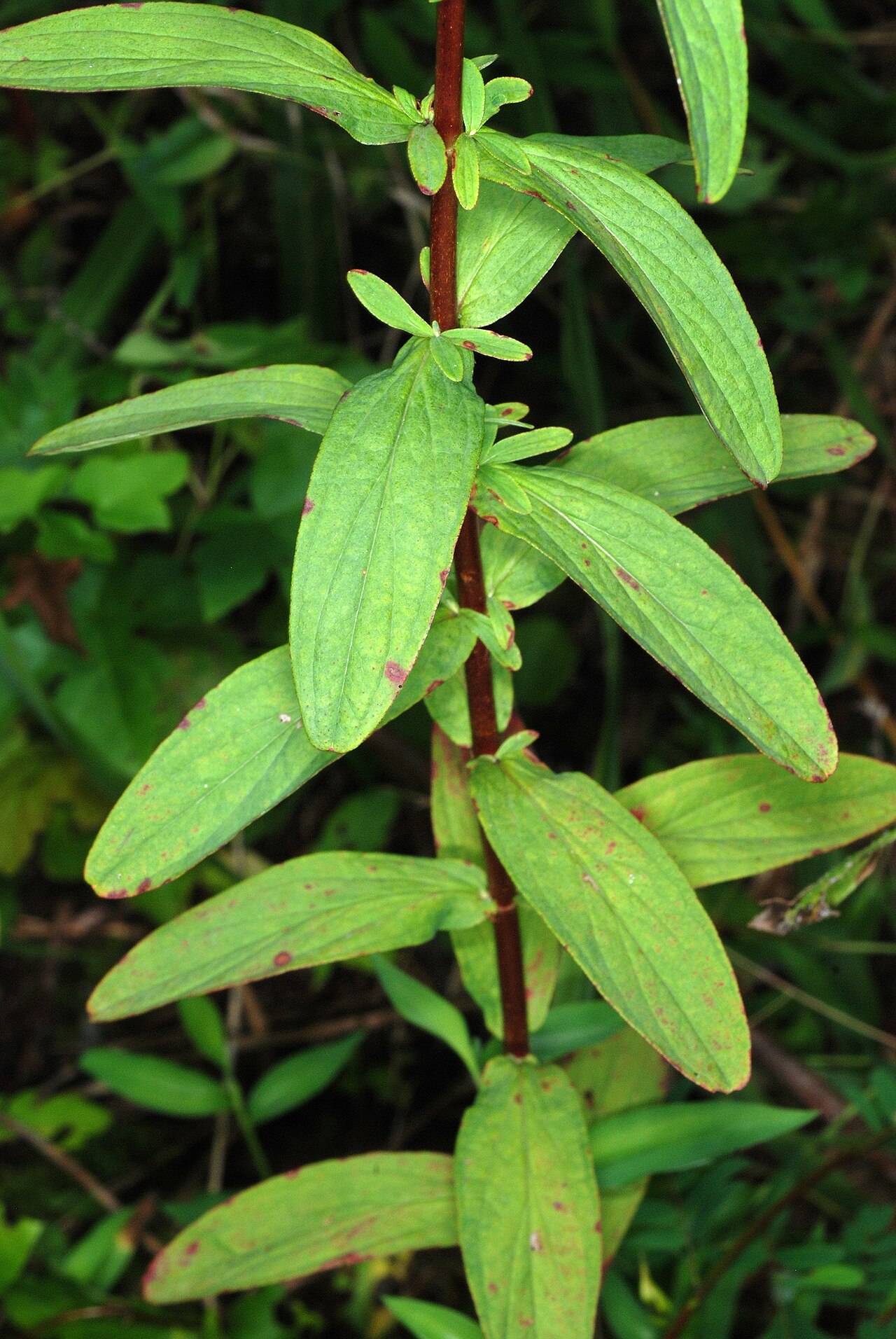
An erect, clump-forming perennial, 1 to 3 feet tall, with one to several stems from a short, woody base. The stems are round, smooth, often reddish and usually unbranched below the flower clusters.
Leaves
Leaves are opposite, stalkless, oblong to elliptic, about 1 to 2 1/2 inches long, with rounded tips and smooth edges. They are covered with tiny translucent and black dots, best seen by holding a leaf up to the light, and are sometimes slightly clasping at the base.
Flowers
The flowers are borne in crowded, branched, flat-topped to rounded clusters at the tops of the stems. Each flower is about 1/2 inch across, with five narrow yellow petals streaked and dotted with black, five small sepals that are also dotted, and a central brush of many stamens. Flowers open a few at a time from about June to September.
Fruit
The fruit is a small, egg-shaped capsule, about 1/4 inch long, covered with dark glandular streaks and topped by three short styles. It turns brown in fall and splits to release many tiny, dark seeds. The dry stems and capsules often stand through winter.
Look-alikes
Common St. John’s wort (H. perforatum), a European plant that is invasive in much of North America, is more branched, with narrower leaves and larger flowers whose black dots are mostly along the petal edges. Great St. John’s Wort (H. ascyron ssp. pyramidatum) is much taller, with large flowers 1 1/2 to 2 inches across. Shrubby St. John’s Wort (H. prolificum) is a woody shrub with narrow leaves. Spotted St. John’s wort’s very small, heavily dotted flowers in dense clusters set it apart.
Safety
Like other St. John’s worts, spotted St. John’s wort contains hypericin, a red pigment that can make grazing animals sensitive to sunlight (photosensitization), causing skin irritation and sunburn-like lesions in livestock that eat large amounts. Keep it out of pastures where animals might graze it heavily. It is not a food plant for people, and herbal products made from its relatives can interact with prescription medicines, so do not use it medicinally without a doctor’s advice.
Quick Facts
| Scientific Name | Hypericum punctatum |
| Family | Hypericaceae (St. John’s wort family) |
| Plant Type | Herbaceous perennial |
| Mature Height | 1–3 ft |
| Mature Spread | 1–2 ft |
| Growth Rate | Moderate |
| Sun Exposure | Full sun to part shade |
| Water Needs | Moderate; moist to fairly dry soil |
| Soil Type | Loam, clay or sand; average to moist soils |
| Soil pH | About 5.5–7.5 |
| Bloom Time | June–September |
| Flower Color | Bright yellow with black dots and streaks |
| Fall Color | Stems and capsules turn reddish brown |
| Fruit | Small dotted capsule with many tiny seeds |
| Deer Resistant | Yes; rarely browsed |
| USDA Hardiness Zones | 3–9 |
Native Range
Spotted St. John’s wort is native to eastern North America. USDA PLANTS lists it in Nova Scotia, Quebec and Ontario and in 35 states from Maine and Minnesota south to Florida and Texas, and it is common across most of the eastern United States, the Ohio and Mississippi valleys and the Southeast.
At the western edge of its range it reaches eastern Nebraska, eastern Kansas, eastern Oklahoma and East Texas, where it grows in moist woods and along streams. In Minnesota and Wisconsin it is mainly a plant of the southern and eastern counties, and in Florida it is largely confined to the northern part of the state.
It grows in a wide range of open and partly shaded habitats: dry to moist woods and woodland edges, clearings, old fields, meadows, prairies, thickets, stream banks and roadsides. It often appears after disturbance, such as logging or fire, and persists as the vegetation fills in.
📋 Regional plant lists featuring Spotted St. John’s Wort: New York, Pennsylvania & Northern New Jersey · Ohio & Indiana · Michigan, Wisconsin & Eastern Minnesota · Kentucky & Tennessee · Nebraska, Kansas & Eastern Colorado · Connecticut, Massachusetts & Rhode Island · New Hampshire, Maine & Vermont · Maryland, Virginia & West Virginia · Delaware, Southern New Jersey & Long Island · Illinois, Iowa & Missouri · Alabama, Georgia & Mississippi · North & South Florida · North & South Carolina · Arkansas, Louisiana, Eastern Oklahoma & Eastern Texas
Growing & Care Guide
Spotted St. John’s wort is an easy, adaptable native perennial for meadows, woodland edges and informal borders. It is sold by native plant nurseries in the East and Midwest as plants or seed.
Light
It grows in full sun to part shade. Full sun gives the sturdiest stems and the most flowers; in light shade it blooms well but stems may lean.
Soil & Water
It tolerates many soils, from sand to clay, and moisture levels from moist to moderately dry. It does best in average, well-drained garden soil with occasional water in long droughts. No fertilizer is needed; rich soil makes it floppy.
Planting Tips
Plant in spring or fall, 12 to 18 inches apart, in groups of three or more for a bigger show. Combine it with other summer bloomers such as wild bergamot, mountain mint and black-eyed Susan in meadows and pollinator gardens. Its fine-textured yellow clusters also brighten woodland edges.
Pruning & Maintenance
Little care is needed. Leave the dark seed heads standing for winter interest and to let it self-sow, then cut stems back in late winter or early spring. Plants may be short-lived but replace themselves from seed.
Propagation
Grow it from seed sown on the soil surface in fall or after 1 to 2 months of cold, moist stratification; the tiny seeds need light to germinate. It can also be increased by dividing clumps in early spring.
Landscape Uses
- Pollinator gardens: pollen-rich flowers for bumble bees and other bees
- Meadows and prairies: a long-blooming summer forb for mixed plantings
- Woodland edges: tolerates light shade and dry to moist soil
- Native alternative: a non-invasive substitute for common St. John’s wort
- Winter interest: dark seed heads stand through the winter
Wildlife & Ecological Value
Spotted St. John’s wort supports a variety of insects, from pollen-gathering bees to specialist leaf-feeding beetles and moths.
For Pollinators
St. John’s wort flowers have no nectar but produce abundant pollen. Bumble bees, sweat bees, small carpenter bees and other native bees collect it, often by buzzing the stamens, and hover flies feed on it. Several moths and beetles feed on Hypericum foliage, including the gray half-spot moth (Nedra ramosula), whose caterpillars eat St. John’s wort leaves.
For Birds
The tiny seeds are eaten by some small songbirds and sparrows in fall and winter, and the plant’s insects feed insect-eating birds.
For Mammals
Its foliage is bitter and is rarely eaten by deer or rabbits, which makes it a good choice for gardens with heavy browsing.
Ecosystem Role
As a common plant of woodland edges and openings, it helps fill gaps after disturbance and adds a dependable source of summer pollen to eastern meadows and forests.
Cultural & Historical Uses
The name St. John’s wort comes from the European tradition of gathering these plants around the feast of St. John the Baptist on June 24, near midsummer, when the European species blooms. “Wort” is an old English word for plant. The genus name Hypericum comes from Greek and is often explained as “above a picture,” from the old custom of hanging the plants above religious images to ward off evil.
The black dots on the leaves and flowers are glands containing hypericin, a red pigment. Crushing a fresh flower bud between your fingers often leaves a purplish-red stain. The species was described by the French naturalist Jean-Baptiste Lamarck in 1797.
Several Native American nations used spotted St. John’s wort and related species in traditional medicine. Today, native plant gardeners value it mostly as an easy, pollinator-friendly alternative to the invasive European common St. John’s wort.
Frequently Asked Questions
Is spotted St. John’s wort invasive?
No. It is a native wildflower of eastern North America. The invasive St. John’s wort found along many roadsides is the European Hypericum perforatum, which has larger flowers and more branched stems.
Is it toxic?
It contains hypericin, which can make livestock sensitive to sunlight if they eat large amounts. It is not a food plant, and it should not be used as an herbal remedy without medical advice.
How do I tell it from common St. John’s wort?
Spotted St. John’s wort has smaller flowers in denser clusters, and black dots spread across the whole petal surface, as well as on the leaves and stems. Common St. John’s wort has larger flowers with black dots mainly along the petal edges and narrower leaves with obvious translucent dots.
Does it attract pollinators?
Yes. Its flowers produce no nectar but lots of pollen, which bumble bees and many smaller native bees collect, along with hover flies.
Where should I plant it?
Plant it in full sun to part shade in average, well-drained soil, in a meadow, pollinator garden or woodland edge. It tolerates both moist and fairly dry conditions.

Looking for a nursery that carries Spotted St. John’s Wort?
Browse our native plant nursery directory: Alabama & Arkansas · Connecticut, Delaware, Florida & Georgia · Illinois, Indiana, Iowa & Kansas · Kentucky, Louisiana, Maine, Maryland, Massachusetts, Michigan, Minnesota, Mississippi & Missouri · Nebraska, New Hampshire, New Jersey, New York, North Carolina, Ohio & Oklahoma · Pennsylvania, Rhode Island, South Carolina, Tennessee, Texas, Vermont & Virginia · West Virginia & Wisconsin