
American Brooklime (Veronica americana)
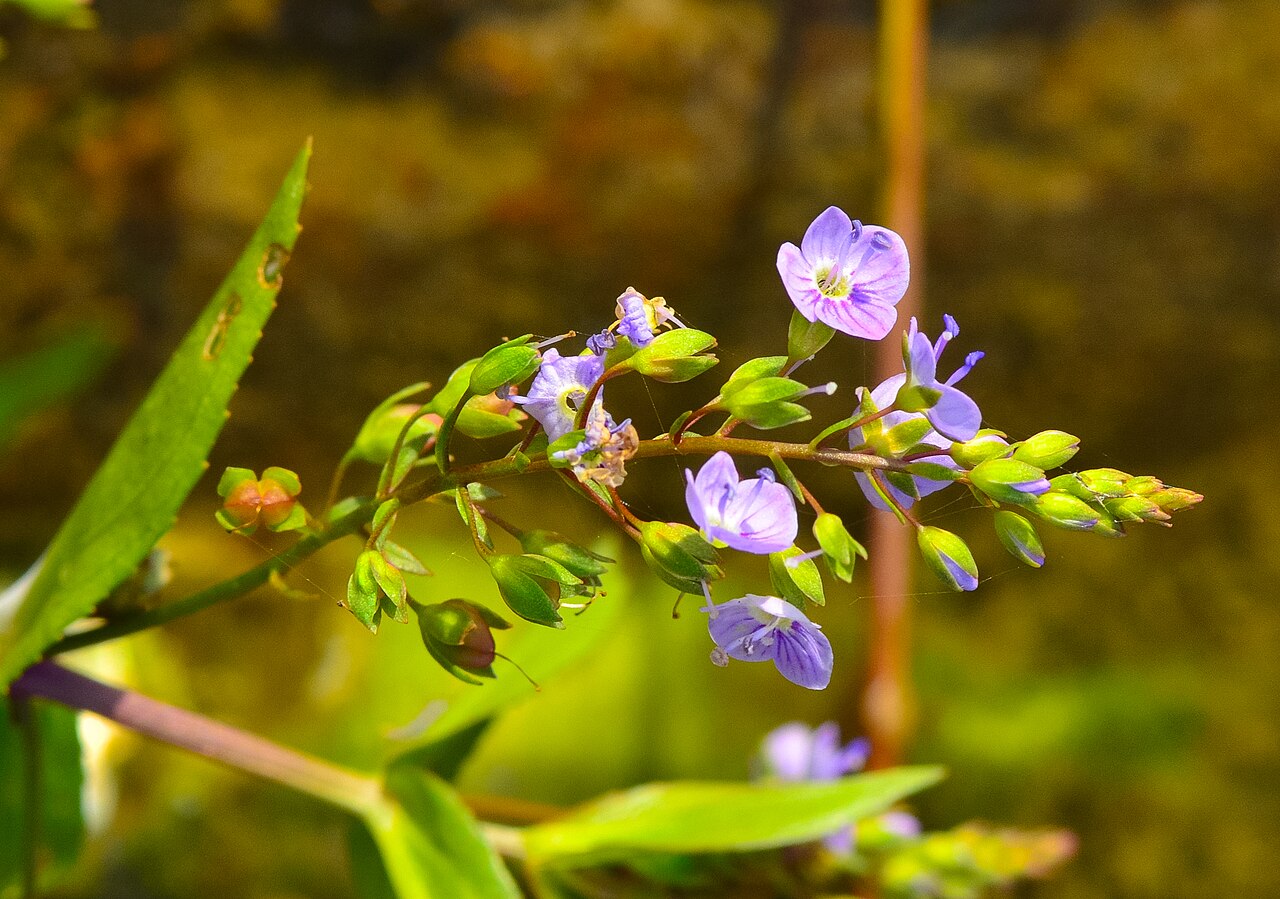
Veronica americana, known as American Brooklime or American speedwell, is a low, sprawling perennial of streams, springs and wet ground across most of North America. It belongs to the plantain family (Plantaginaceae), which now includes the speedwells. Its smooth, fleshy stems creep and root along the mud or float in shallow water, and from late spring through summer they carry loose clusters of small, pale blue to violet flowers with darker stripes.
It is one of the most widespread native wetland wildflowers in the United States and Canada, growing from Alaska and the Yukon to Newfoundland and south to California, Arizona, New Mexico, Texas and the Carolinas. It is especially common along cold mountain streams and springs in the West. Small bees and flies visit the flowers.
American brooklime is a good plant for the edges of ponds, streams, rain gardens and wet ditches, where it forms a soft, green mat. Its young leaves are edible like watercress, but only gather it from clean water: plants from polluted or livestock-grazed streams can carry harmful bacteria and parasites.
Identification
Look for smooth, creeping or floating stems with opposite, short-stalked, toothed leaves and loose clusters of small, four-lobed blue flowers rising from the leaf axils, always in or near water.
Growth Habit
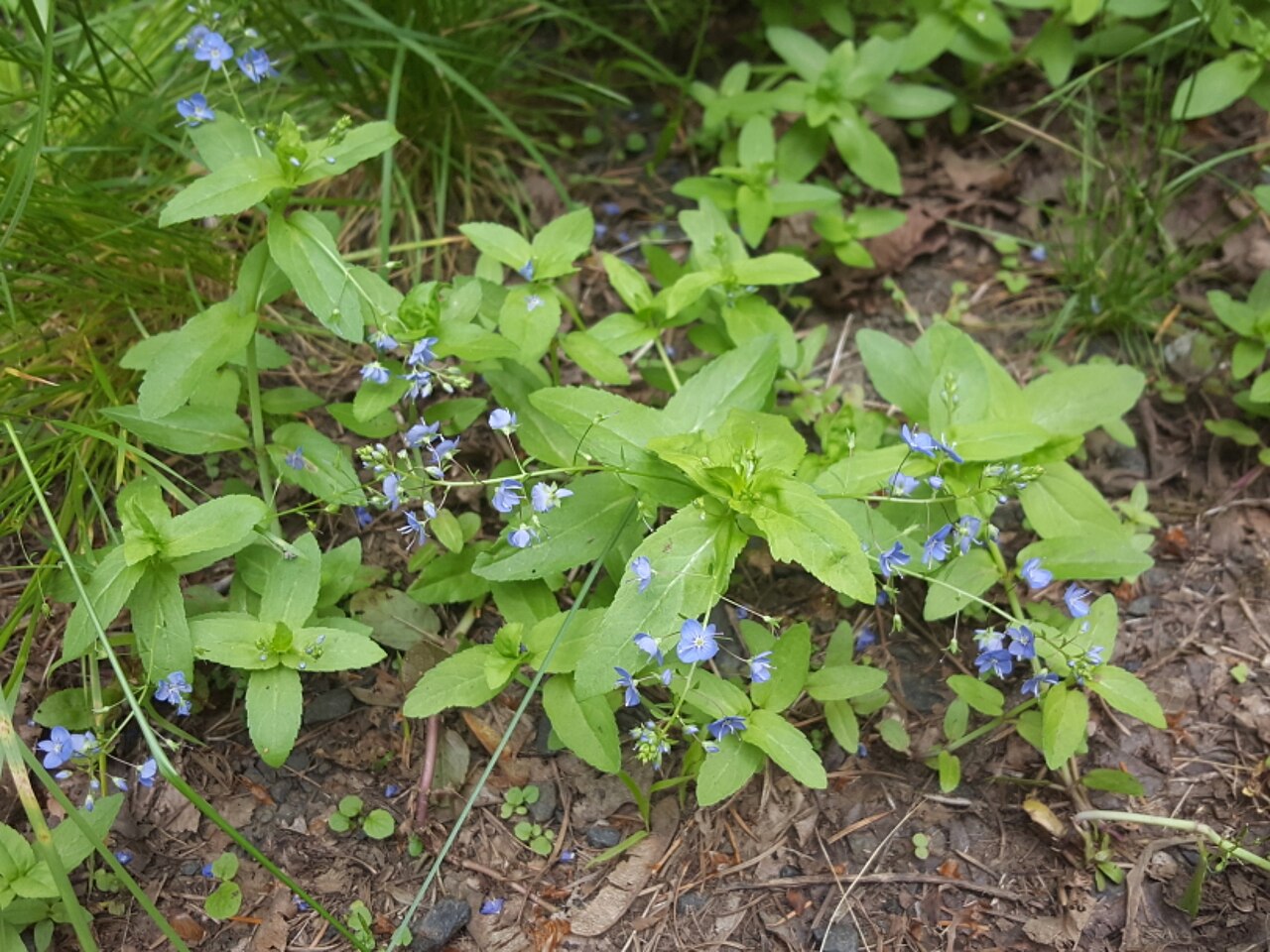
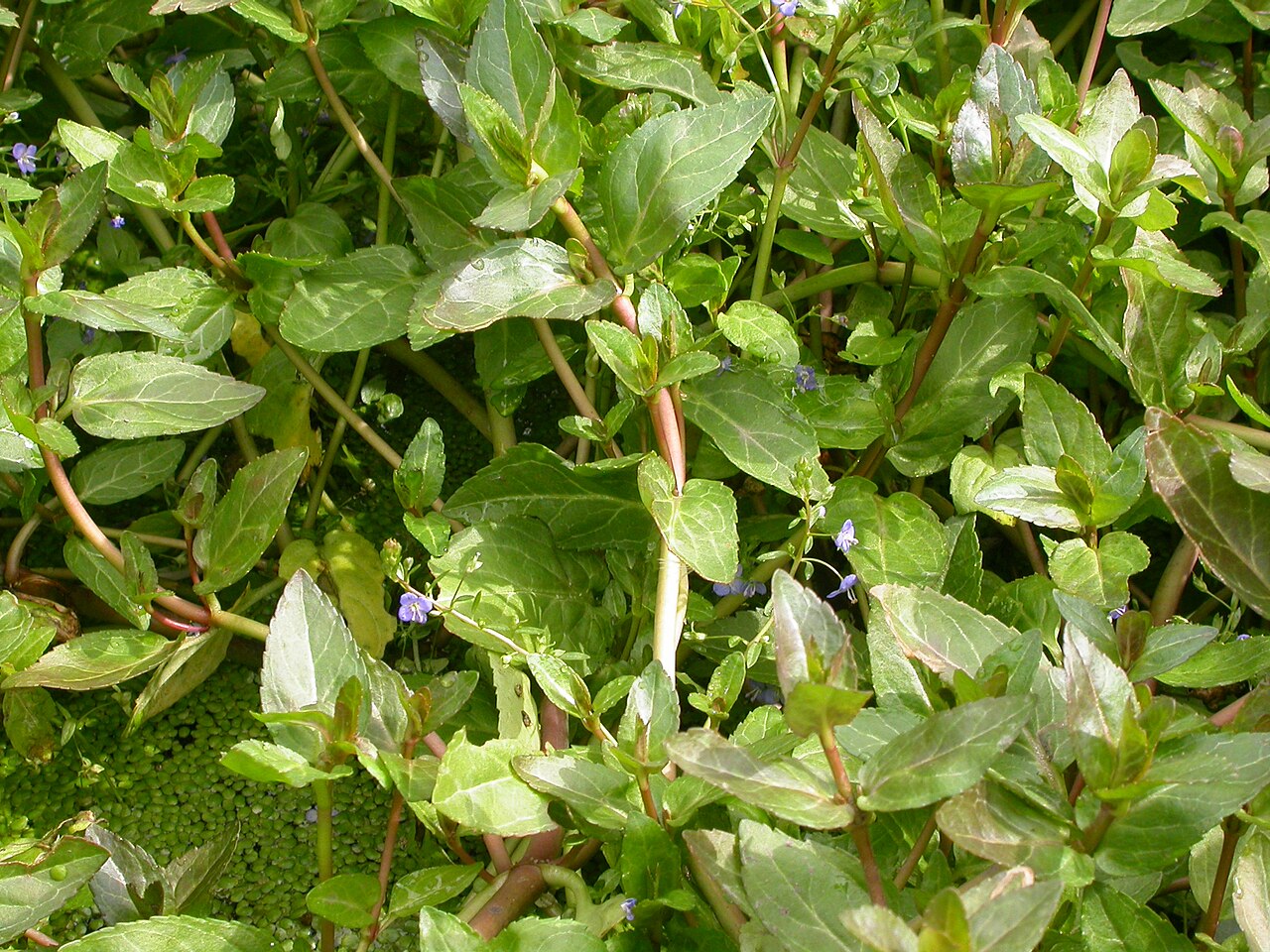
American brooklime is a perennial with smooth, somewhat succulent, hollow stems 4 inches to 3 feet long. The stems lie on the ground or float in water, rooting at the lower nodes, and turn upward at the tips. It forms loose mats or tangles along stream edges and in shallow water.
Leaves
The leaves are opposite, 3/4 to 3 inches long, lance-shaped to narrowly ovate, with a pointed tip and finely toothed edges. Most have a short but distinct stalk. They are smooth, somewhat fleshy and bright to dark green.
Flowers
The flowers grow in loose, stalked racemes of 10 to 25 from the leaf axils, usually in pairs at each node. Each flower is about 1/4 to 3/8 inch across, with four rounded lobes, the lower one narrower than the others. They are pale blue to violet, sometimes nearly white, with darker blue lines, and have two stamens. Bloom time is May to September.
Fruit & Seeds
The fruit is a small, rounded, slightly notched, flattened capsule that holds many tiny seeds. Seeds and broken stem pieces float and spread the plant along streams.
Look-alikes
European brooklime (Veronica beccabunga) is a non-native species found in parts of the United States. It looks very similar, but its leaves are rounder, more blunt-tipped and shorter-stalked. Water speedwell (V. anagallis-aquatica), also introduced, has stalkless, clasping leaves. Marsh speedwell (V. scutellata), a native, has very narrow, stalkless leaves and fewer, paler flowers.
Quick Facts
| Scientific Name | Veronica americana |
| Family | Plantaginaceae (plantain family) |
| Plant Type | Creeping aquatic or wetland perennial |
| Mature Height | 4–24 in |
| Mature Spread | 1–3 ft; spreads by rooting stems |
| Growth Rate | Fast |
| Sun Exposure | Full sun to part shade |
| Water Needs | High; wet soil or shallow water |
| Soil Type | Wet mud, sand, gravel or muck |
| Soil pH | Slightly acidic to alkaline (about 6.0–8.0) |
| Bloom Time | May–September |
| Flower Color | Pale blue to violet with darker lines |
| Fall Color | None; often stays green in cold water |
| Fruit | Small, flattened, notched capsule |
| Deer Resistant | Moderate; grazed occasionally |
| USDA Hardiness Zones | 2–9 |
Native Range
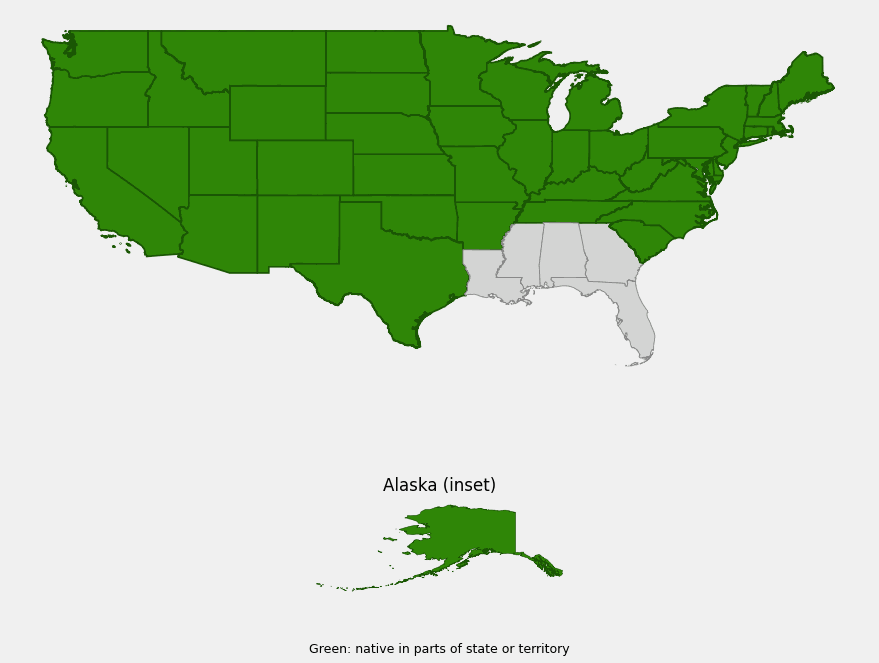
American brooklime grows across much of North America and into northeastern Asia. USDA PLANTS lists it as native in Alaska, the lower 48 states and Canada, from the Yukon and British Columbia to Newfoundland. In the United States it is recorded from 44 states, and is absent only from the Deep South (Florida, Georgia, Alabama, Mississippi and Louisiana) and Hawaii.
It is most common in the West, along mountain streams, springs and seeps from Alaska and Washington to California, Arizona and New Mexico, and through the northern half of the East, from Minnesota and Wisconsin to New England and south in the Appalachians to North Carolina and Tennessee. In Texas it grows mainly along spring-fed streams of the Edwards Plateau and in the far west; in Oklahoma and Arkansas it is scattered.
Its habitats are always wet: the edges of streams and rivers, springs and spring runs, seeps, ditches, marshes, wet meadows and the shallow edges of ponds and lakes. It is especially common in cold, clear, flowing water.
📋 Regional plant lists featuring American Brooklime: New York, Pennsylvania & Northern New Jersey · Idaho, Eastern Oregon & Eastern Washington · Ohio & Indiana · Montana & Wyoming · Michigan, Wisconsin & Eastern Minnesota · Kentucky & Tennessee · Nebraska, Kansas & Eastern Colorado · Utah & Western Colorado · Connecticut, Massachusetts & Rhode Island · New Hampshire, Maine & Vermont · Maryland, Virginia & West Virginia · Delaware, Southern New Jersey & Long Island · Arizona & New Mexico · Illinois, Iowa & Missouri · Alaska · North & South Carolina · Arkansas, Louisiana, Eastern Oklahoma & Eastern Texas · South & West Texas · North Dakota, South Dakota & Western Minnesota · Western Oregon & Western Washington · California & Nevada
Growing & Care Guide
American brooklime is easy to grow wherever the soil stays wet. It is sold by some native plant and water garden nurseries, and it establishes quickly from cuttings.
Light
Full sun to part shade. It flowers best with at least a few hours of sun, but in hot climates it appreciates afternoon shade.
Soil & Water
Plant it in wet mud or in shallow water up to about 4 inches deep. It grows in sand, gravel, loam or muck. It needs constant moisture and will not survive in ordinary garden soil that dries out.
Planting Tips
Set plants or rooted cuttings along the margin of a pond, stream or bog garden, or in a pot set in shallow water. It is a good choice for softening the edges of a natural pond and for rain gardens that stay wet. It grows quickly and fills in within a season.
Pruning & Maintenance
Trim or pull back stems that spread too far; they root easily but are easy to remove. Remove dead stems in spring. Plants can be short-lived in warm, still water and do best where water is cool or moving.
Propagation
Root stem cuttings in water or wet soil; almost any piece with a node will root within days. It also grows from seed sown on the surface of wet soil in spring.
Landscape Uses
- Pond and stream edges: a soft, flowering ground cover at the waterline
- Rain gardens: fills the wettest low spots
- Water gardens: grows in shallow water in pots or along the edge
- Wetland and stream restoration: helps cover and hold bare, wet soil
- Wild food gardens: young leaves can be eaten like watercress if the water is clean
Wildlife & Ecological Value
American brooklime is an important part of the plant life along streams and springs.
For Pollinators
Small bees, especially sweat bees, and hoverflies and other small flies visit the flowers for pollen and nectar. It blooms over a long season.
For Birds
Ducks and other waterbirds may eat the stems and seeds, and its mats shelter the insects that many birds feed on.
For Mammals
Deer, elk, moose and other grazers eat it occasionally along streams. Muskrats and beavers may also feed on it.
Ecosystem Role
Its creeping and floating stems shade the water, trap sediment, and provide habitat for aquatic insects, snails, amphibians and small fish along stream edges and in springs.
Cultural & Historical Uses
The genus is named for Saint Veronica. The common name “brooklime” is an old English name that refers to the plant’s habitat in brooks and to the “lime,” or mud, it grows in.
The young leaves and stems of American brooklime are edible and were eaten raw or cooked by Indigenous peoples and settlers, much like watercress. They are slightly bitter. Only harvest plants from clean, unpolluted water, and avoid streams below pastures, septic systems or towns, where the plants can carry bacteria, parasites such as liver flukes, and contaminants. Cooking reduces the risk but does not remove chemical pollutants.
Several Indigenous peoples also used the plant in traditional medicine. The genus Veronica was long placed in the figwort family (Scrophulariaceae), but DNA studies moved it to the plantain family.
Frequently Asked Questions
Is American brooklime edible?
Yes, the young leaves and stems are edible raw or cooked, like watercress. Only gather them from clean water, because plants from polluted or grazed streams can carry harmful bacteria and parasites.
How is it different from European brooklime?
European brooklime (Veronica beccabunga) has rounder, blunter leaves with shorter stalks. American brooklime has longer, pointed, lance-shaped leaves with distinct short stalks.
Can American brooklime grow in a garden pond?
Yes. It grows well in mud or shallow water at the edge of ponds and water gardens and spreads quickly.
When does American brooklime bloom?
From May to September, often for several months in cool, wet sites.
Does American brooklime need full sun?
It grows in full sun to part shade, as long as its roots stay wet.

Looking for a nursery that carries American Brooklime?
Browse our native plant nursery directory: Alaska, Arizona & Arkansas · California · Colorado, Connecticut & Delaware · Idaho, Illinois, Indiana, Iowa & Kansas · Kentucky, Maine, Maryland, Massachusetts, Michigan, Minnesota, Missouri & Montana · Nebraska, Nevada, New Hampshire, New Jersey, New Mexico, New York, North Carolina, North Dakota, Ohio & Oklahoma · Oregon · Pennsylvania, Rhode Island, South Carolina, South Dakota, Tennessee, Texas, Utah, Vermont & Virginia · Washington · West Virginia, Wisconsin & Wyoming