
American Bluehearts (Buchnera americana)
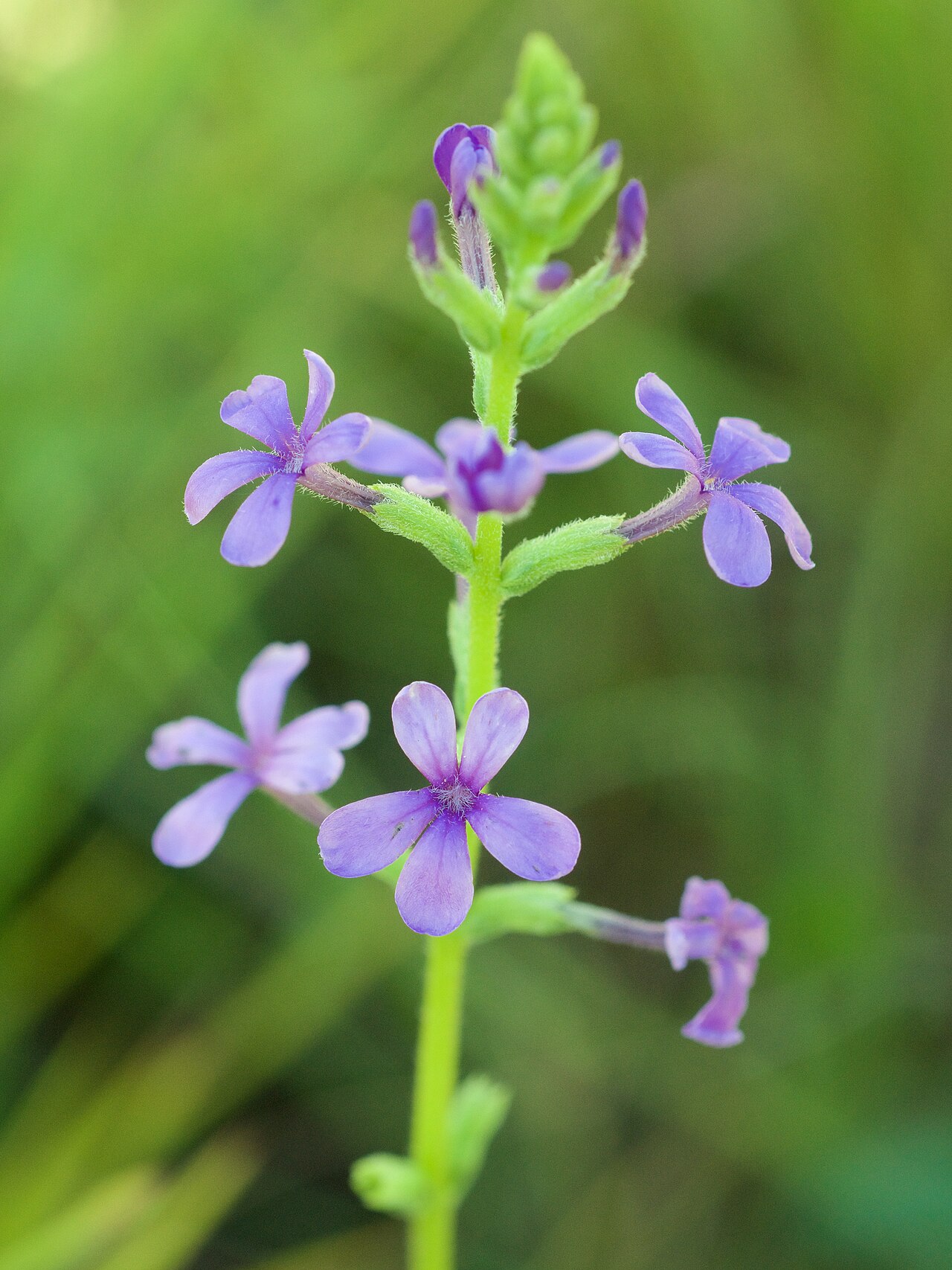
Buchnera americana, American Bluehearts, is a slender wildflower of open, sunny grasslands, glades, savannas and pine flatwoods in the eastern and central United States. From late spring into fall it carries spikes of small, lavender to deep purple flowers on stiff, hairy stems 1 to 3 feet tall. It is easy to overlook among grasses until the flowers open, but a patch in bloom is a lovely sight.
Bluehearts belongs to the broomrape family (Orobanchaceae) and is a root hemiparasite. It has green leaves and makes its own food by photosynthesis, but it also attaches to the roots of neighboring plants, such as grasses, and draws water and minerals from them. Like many of its relatives, it turns black when the plant is dried or damaged.
Plants in Florida and the Southeast are sometimes separated as Buchnera floridana, Florida bluehearts, but USDA PLANTS includes them in B. americana. It is still fairly common in parts of the South but has become rare toward the northern edge of its range. Because of its parasitic lifestyle it is rarely sold and is hard to grow. This guide covers how to recognize it, where to find it, what growing it really involves, and its role in native grasslands.
Identification
American bluehearts is a slim, upright plant with paired, rough leaves and a narrow spike of five-lobed purple flowers at the top. It grows among grasses in sunny, open places.
Stems & Leaves
The stems are usually single or few-branched, 1 to 3 feet tall, stiff and covered with short, rough hairs. The leaves are opposite, stalkless and lance-shaped to oblong, about 1 to 3 inches long, with a few coarse teeth and three prominent veins. They are rough to the touch and become smaller up the stem. The whole plant tends to darken or blacken as it dries.
Flowers
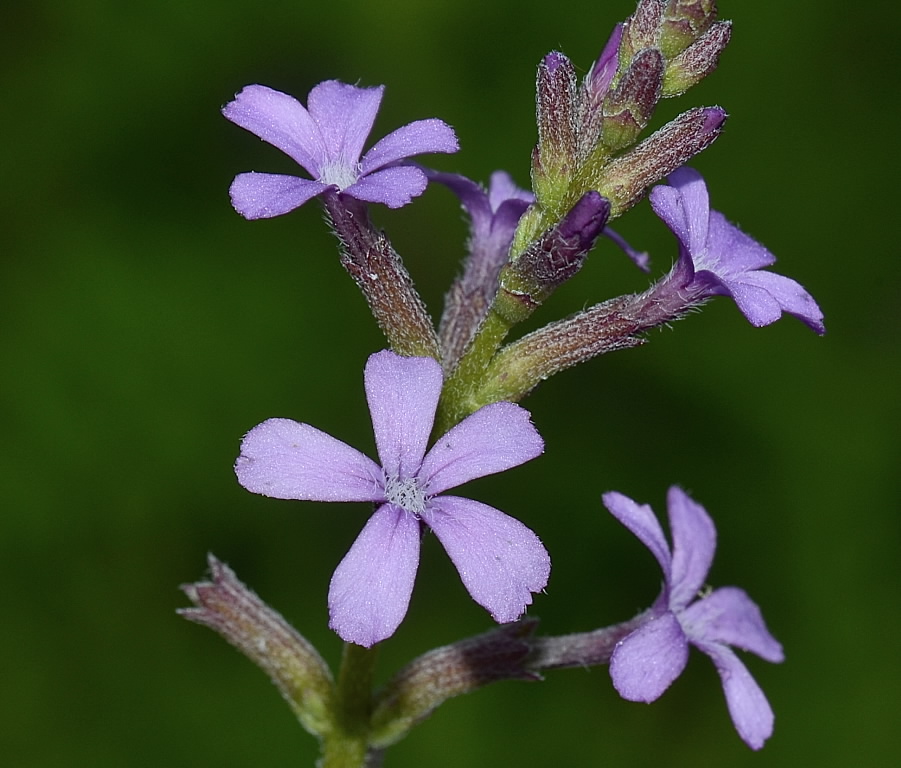
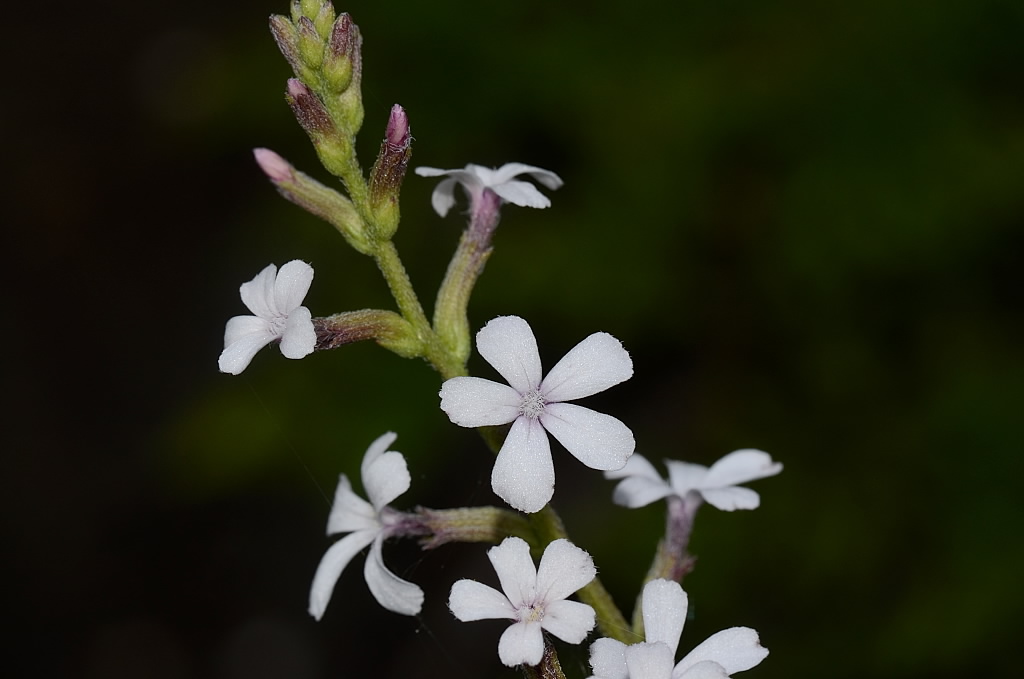
The flowers are arranged in a slender spike at the top of the stem, opening a few at a time from the bottom upward over a long period. Each is about ½ inch across: a narrow, slightly curved tube that opens abruptly into five spreading, rounded, nearly equal lobes. The color ranges from pale lavender to deep blue-purple, and occasional plants are white. Each flower sits in a hairy, tubular calyx with a small bract below it. Flowering runs from about May to October, peaking in summer.
Fruit
The fruit is a small, egg-shaped capsule about ¼ inch long, held inside the persistent calyx and turning dark brown to black as it ripens. It splits open to release many tiny seeds.
Look-alikes
Bluehearts can be mistaken for a vervain (Verbena) or a small phlox. Vervains have square stems and many tiny flowers crowded into a spike, and phlox flowers have five lobes on a long, straight tube with smooth, untoothed leaves. Bluehearts’ combination of rough, three-veined, toothed opposite leaves and widely spaced flowers on a slender spike is distinctive. Its relatives in the same family include the false foxgloves (Agalinis), which have pink, bell-shaped flowers.
Quick Facts
| Scientific Name | Buchnera americana (incl. B. floridana) |
| Family | Orobanchaceae (broomrape family) |
| Plant Type | Short-lived perennial; root hemiparasite |
| Mature Height | 1–3 ft |
| Mature Spread | 6–12 in |
| Growth Rate | Moderate |
| Sun Exposure | Full sun |
| Water Needs | Moderate; moist to fairly dry soils |
| Soil Type | Sandy, loamy or thin rocky soils among grasses |
| Soil pH | About 5.0–7.5 |
| Bloom Time | May–October |
| Flower Color | Lavender to deep purple; rarely white |
| Fall Color | None; plants blacken as they die back |
| Fruit | Small capsule with many tiny seeds |
| Deer Resistant | Unknown; small and often overlooked |
| USDA Hardiness Zones | 5–11 |
Native Range
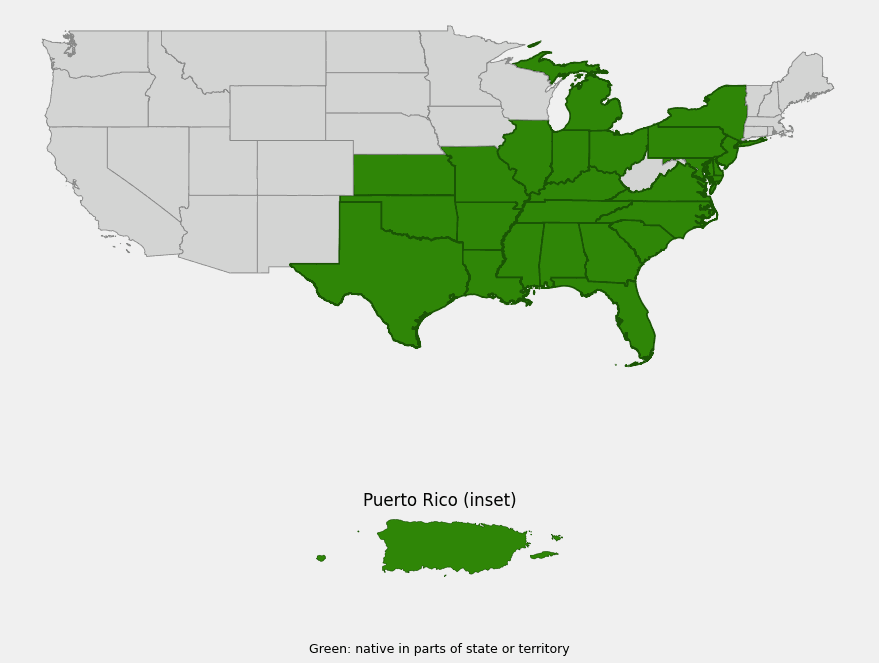
American bluehearts is native to the eastern and central United States. USDA PLANTS lists it as native in 24 states and Puerto Rico, from New York, New Jersey and Pennsylvania west to Michigan, Illinois, Missouri, Kansas and Oklahoma, and south to Florida, the Gulf Coast and Texas. In Canada it is known only from a few sites near the Lake Huron shore in southwestern Ontario, where it is listed as Endangered.
It is most common in the South and in the Ozark and Interior Low Plateau regions, including Missouri, Tennessee, Arkansas and much of the Southeast Coastal Plain. Toward the north and northeast it becomes rare, and several states in that part of its range track it as a rare or listed plant. In Texas it grows mainly in the eastern part of the state. In Puerto Rico it grows in open grassy areas.
It grows in sunny, open, grassy habitats: wet and dry prairies, limestone and sandstone glades, pine flatwoods and savannas, the edges of wet depressions and ponds, and open woods. Like other grassland plants, it depends on fire, mowing or other disturbance to keep its habitat open, and it disappears where shrubs and trees take over.
📋 Regional plant lists featuring American Bluehearts: New York, Pennsylvania & Northern New Jersey · Ohio & Indiana · Michigan, Wisconsin & Eastern Minnesota · Kentucky & Tennessee · Nebraska, Kansas & Eastern Colorado · Maryland, Virginia & West Virginia · Delaware, Southern New Jersey & Long Island · Illinois, Iowa & Missouri · Alabama, Georgia & Mississippi · North & South Florida · Puerto Rico · North & South Carolina · Arkansas, Louisiana, Eastern Oklahoma & Eastern Texas
Growing & Care Guide
Be realistic about growing bluehearts. As a root hemiparasite, it does best when its roots can connect to those of host plants, and it is rarely offered by nurseries. It cannot simply be bought as a potted plant and set into an ordinary flower bed. Never dig plants from the wild: they do not survive transplanting, and the species is rare in several states.
The practical way to add bluehearts to a landscape is to sow seed, from a reputable native seed supplier or legally and responsibly collected, into an existing sunny planting of native grasses and wildflowers within its native range.
Light
Full sun. It needs open, sunny grassland and quickly disappears where it is shaded by shrubs or tall plants.
Soil & Water
It grows in a wide range of soils, from moist sandy flatwoods and wet prairie edges to thin, rocky glade soils, as long as the site is open. In a planting, it needs established host plants nearby, especially native grasses, and doesn’t need fertilizer.
Planting Tips
Scatter seed in fall or winter on bare spots in an established native meadow or prairie, among grasses such as little bluestem. The seeds are tiny and should be pressed onto the soil surface, not buried. Expect a low and unpredictable success rate; plants usually appear in the second year if they establish.
Pruning & Maintenance
Do not weed out the grasses it grows among, since it depends on them. In meadows and prairies, a dormant-season burn or mowing in late winter keeps the planting open, which bluehearts needs.
Propagation
Propagation is by seed only. The plants cannot be divided or moved, and they generally need a host to grow well. Seedlings grown alone in pots usually stay weak, so sow seed directly where host plants are already growing.
Landscape Uses
- Prairie and meadow restoration: add seed to established native grass plantings within its range
- Pine savanna and flatwoods restoration: part of a diverse, fire-maintained ground cover
- Glade and barrens management: a characteristic wildflower of open, rocky glades
- Pollinator habitat: long-season flowers for butterflies and small bees
- Wildflower walks: look for it in summer in sunny prairies, glades and flatwoods
Wildlife & Ecological Value
Bluehearts is a small but interesting part of open grassland communities, where its long flowering season and parasitic habit both play a role.
For Pollinators
The tubular flowers are visited by butterflies, including skippers and sulphurs, and by small bees and bee flies. Bluehearts is also reported as a caterpillar food plant of the common buckeye butterfly, whose larvae feed on several plants in this family.
For Birds
Its tiny seeds are of little direct value to birds, but it is part of the open prairies, glades and pine savannas that species such as bobwhite quail, Bachman’s sparrow and other grassland birds depend on.
For Mammals
Small and scattered, it is not an important food for mammals.
Ecosystem Role
As a root hemiparasite, bluehearts takes some water and nutrients from its host plants, usually grasses. Hemiparasites can reduce the vigor of dominant grasses and so make room for a greater variety of wildflowers. Bluehearts depends on regular fire or other disturbance to keep its habitat open, and its presence is a sign of healthy, well-managed grassland.
Cultural & Historical Uses
The genus Buchnera was named by Carl Linnaeus in honor of the German naturalist Andreas Elias Büchner. Buchnera americana was one of the original species Linnaeus described, in 1753, and it is the only member of its large, mostly tropical genus that is widespread in the United States.
The common name “bluehearts” refers to the blue-purple flowers. The plant was traditionally placed in the figwort family (Scrophulariaceae), but DNA studies moved it, along with other root parasites such as false foxgloves, paintbrushes and louseworts, into the broomrape family (Orobanchaceae).
Bluehearts has no well-documented uses as food or medicine. Today it is valued mainly by botanists, land managers and wildflower enthusiasts as an indicator of open, fire-maintained grasslands, and protecting and burning those habitats is the best way to keep it.
Frequently Asked Questions
Is American bluehearts a parasite?
Partly. It is a root hemiparasite: it has green leaves and makes its own food, but it also attaches to the roots of nearby plants, especially grasses, to take water and minerals.
Can I buy and plant American bluehearts?
It is rarely sold and is hard to grow as an ordinary potted perennial, because it does best attached to host plants. The best approach is to sow seed into an established native grass planting within its range. Never dig plants from the wild.
When does American bluehearts bloom?
From about May to October, with the peak in summer. Each spike keeps opening new flowers for several weeks.
Why do bluehearts turn black?
Like many plants in the broomrape family, bluehearts contains compounds that darken when tissues are damaged or dried, so the plants and herbarium specimens often turn black.
What is the difference between American and Florida bluehearts?
Some botanists treat southeastern plants with smaller flowers as a separate species, Buchnera floridana (Florida bluehearts). USDA PLANTS includes them in Buchnera americana.

Looking for a nursery that carries American Bluehearts?
Browse our native plant nursery directory: Alabama & Arkansas · Delaware, Florida & Georgia · Illinois, Indiana & Kansas · Kentucky, Louisiana, Maryland, Michigan, Mississippi & Missouri · New Jersey, New York, North Carolina, Ohio & Oklahoma · Pennsylvania, South Carolina, Tennessee, Texas & Virginia