
Allegheny Blackberry (Rubus allegheniensis)
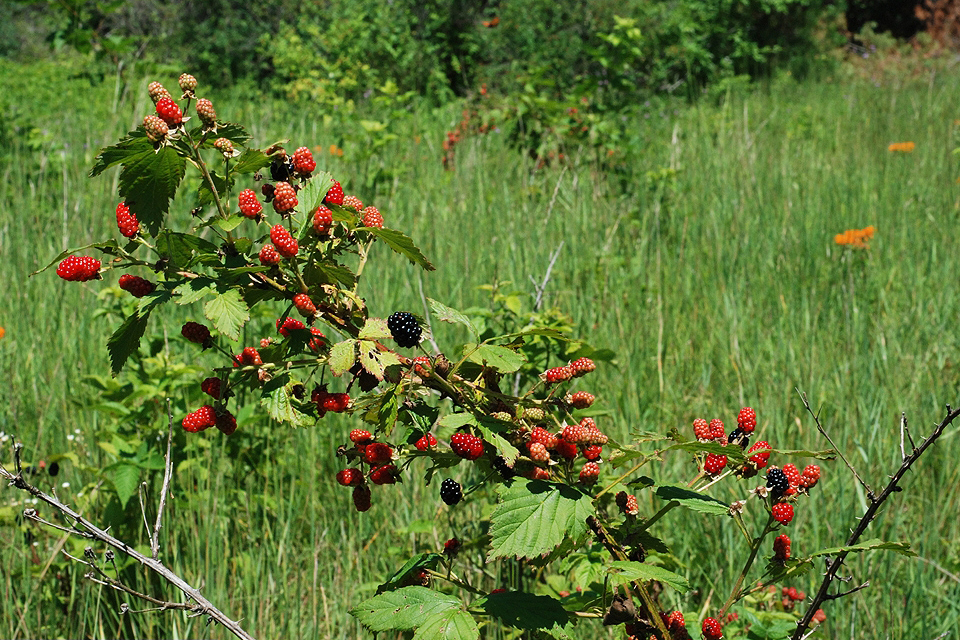
Rubus allegheniensis, known as Allegheny Blackberry (also common blackberry), is a thorny, thicket-forming shrub of the rose family (Rosaceae) native to eastern and central North America. It is the familiar wild blackberry of old fields, woodland edges, clearings and roadsides from the Great Lakes and New England south through the Appalachians. Its arching canes, white flowers in late spring and sweet black berries in mid to late summer are a classic part of the eastern countryside.
Like other blackberries, it grows from a perennial root system that sends up biennial canes. In its first year a cane grows long and leafy; in its second year it flowers, fruits and dies, while new canes replace it. Plants spread by root suckers into dense, prickly thickets that are very valuable as wildlife food and cover, and that also help protect tree seedlings from browsing deer as forests regrow after logging, fire or abandonment of farmland.
For gardeners, Allegheny blackberry is a wildlife plant first: few native shrubs feed and shelter as many birds and mammals. It is best in naturalized areas, hedgerows, meadow edges and wildlife gardens where its thorns and spreading habit are an advantage rather than a problem, and its berries are as good as any wild blackberry for eating fresh or making jam.
Identification
Allegheny blackberry is one of many similar wild blackberries in eastern North America, and blackberries hybridize freely, so identification can be tricky. Its most useful features are the sticky, gland-tipped hairs on the flower and fruit stalks and the long, narrow flower clusters.
Canes
Canes are upright at first, then arch over, usually 3 to 8 feet long. They are ridged or angled, green to dark red, and armed with stout, straight or slightly curved prickles. First-year canes (primocanes) produce leaves only; second-year canes (floricanes) produce short side branches that bear flowers and fruit and then die back after fruiting.
Leaves
The leaves are alternate and palmately compound, with five leaflets on first-year canes and usually three on flowering branches. Leaflets are oval with long, pointed tips and sharply toothed edges, and the undersides are pale and softly velvety. Leaf stalks and midribs carry small prickles. In fall the leaves often turn red to purple, and some persist into winter.
Flowers
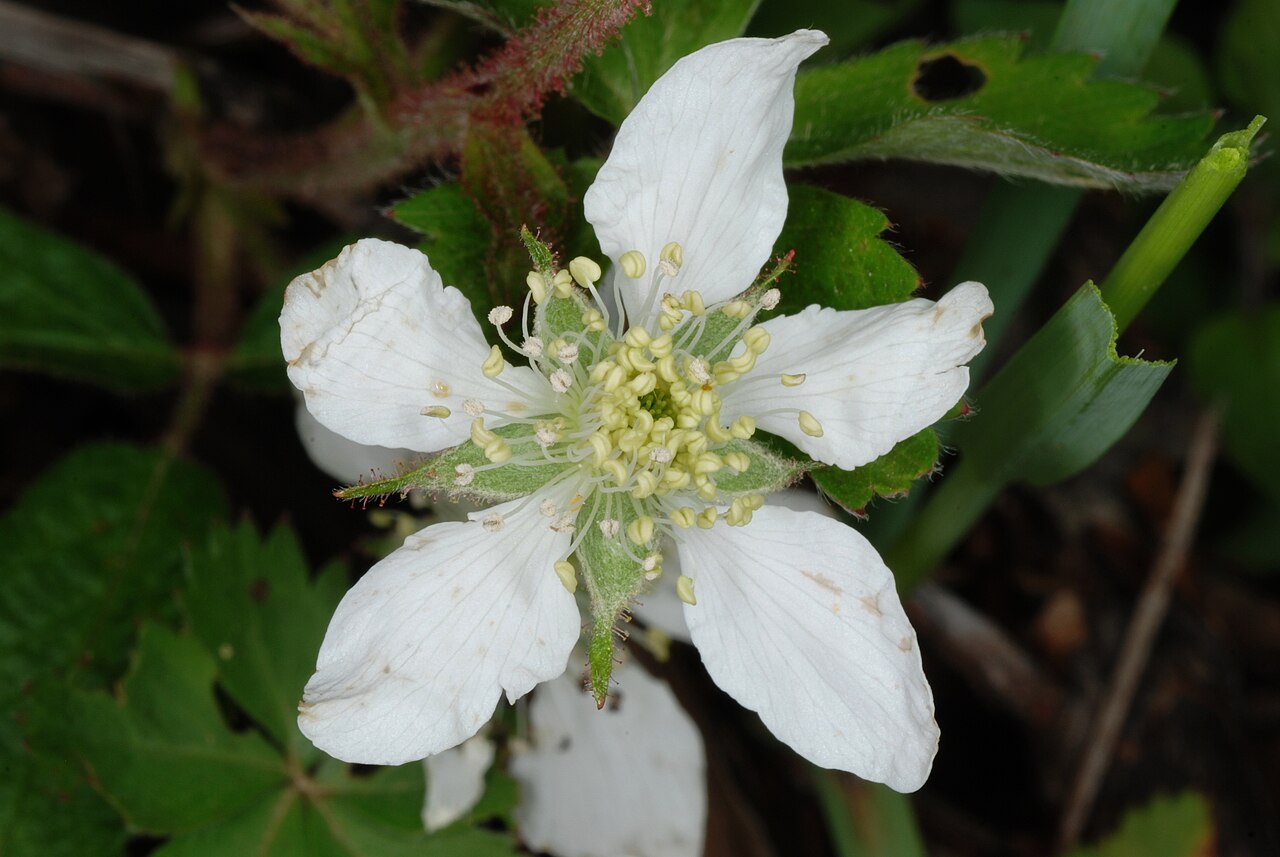
From May to June, flowering branches produce elongated, many-flowered clusters (racemes) that extend well beyond the leaves. Each flower is about 3/4 to 1 inch across, with five white petals and many stamens. The flower stalks and the main stalk of the cluster are covered with sticky, gland-tipped hairs, a key feature of this species.
Fruit
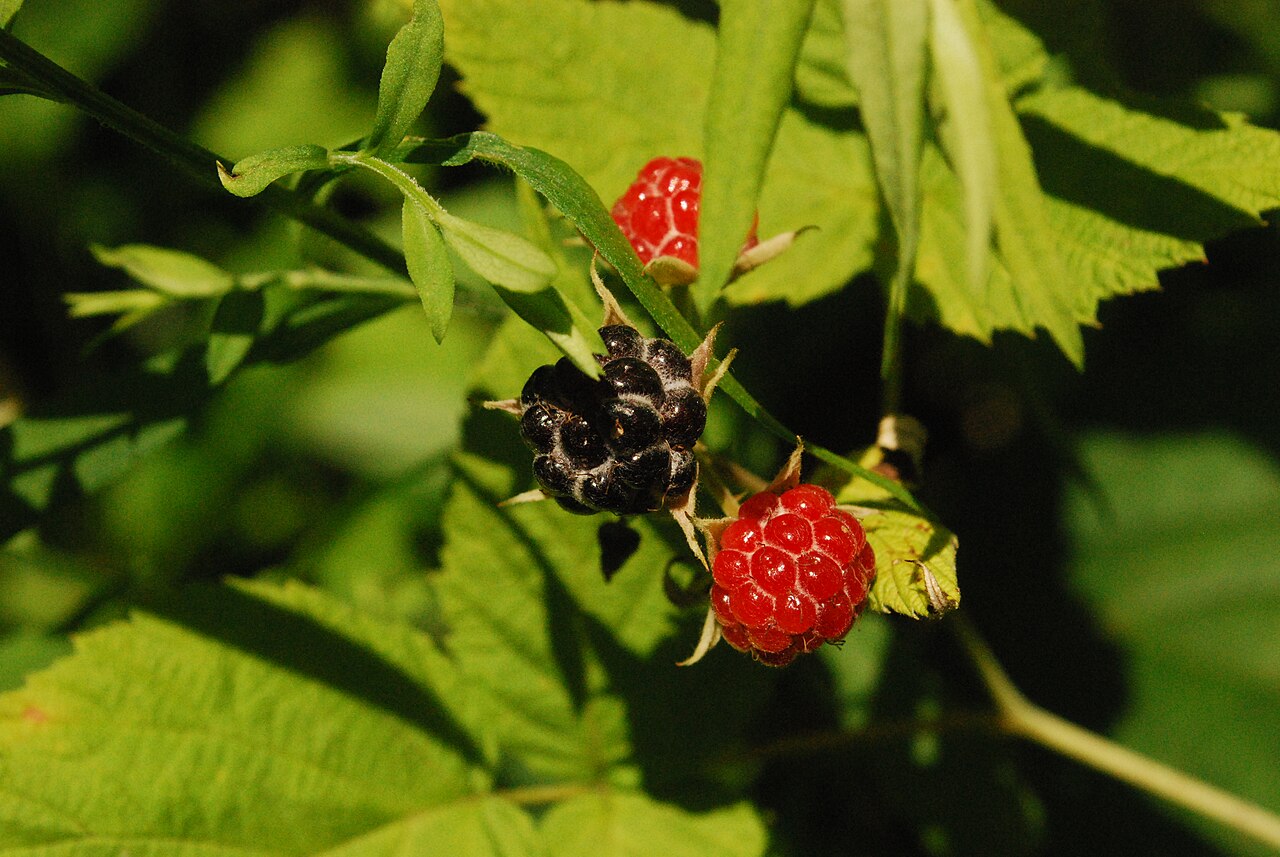
The fruit is an aggregate of many small, juicy drupelets, about 1/2 to 1 inch long, usually longer than wide. Berries turn from green to red and finally to glossy black when ripe, from July to August. Unlike raspberries, the fleshy core (receptacle) comes away with the berry when picked.
Look-alikes
Pennsylvania blackberry (Rubus pensilvanicus) and several other highbush blackberries are very similar but usually lack the dense glandular hairs on the flower stalks. Dewberries, such as Northern Dewberry, have trailing canes that root at the tips and few flowers per cluster. Black Raspberry has whitish, waxy canes and berries that come off hollow. Non-native Himalayan and cutleaf blackberries have much stouter canes and broader, often deeply cut leaves.
Quick Facts
| Scientific Name | Rubus allegheniensis |
| Family | Rosaceae (rose family) |
| Plant Type | Deciduous thicket-forming shrub with biennial canes |
| Mature Height | 3–8 ft |
| Mature Spread | Spreads by suckers into thickets 6 ft or more wide |
| Growth Rate | Fast |
| Sun Exposure | Full sun to partial shade |
| Water Needs | Moderate; tolerates dry spells once established |
| Soil Type | Most well-drained soils: loam, sand, clay, rocky |
| Soil pH | About 5.0–7.0 |
| Bloom Time | May–June |
| Flower Color | White |
| Fall Color | Red to purple |
| Fruit | Black aggregate berry, July–August; edible |
| Deer Resistant | No; deer browse the leaves and canes |
| USDA Hardiness Zones | 3–8 |
Native Range
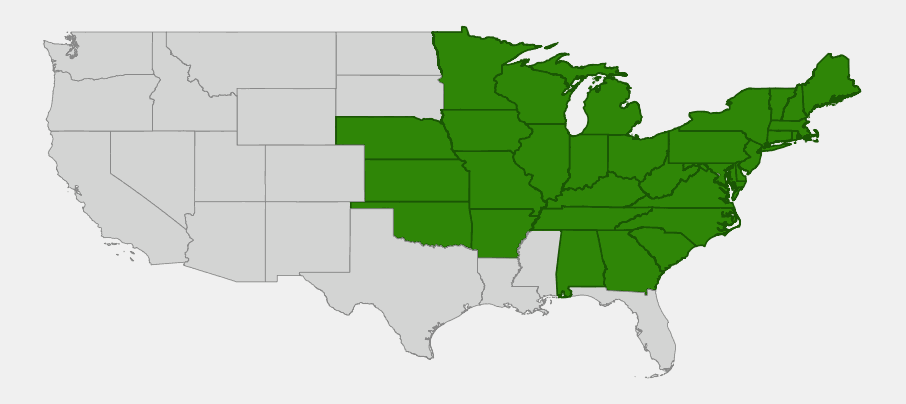
Allegheny blackberry is native to eastern and central North America. USDA PLANTS records it from 32 states and the District of Columbia, from Maine and Minnesota south to Georgia and Alabama and west to Nebraska, Kansas and Oklahoma. In Canada it grows in Ontario, Quebec, New Brunswick, Nova Scotia and Prince Edward Island. USDA also lists California and British Columbia, but those plants are naturalized escapes: the Biota of North America Program maps California records as introduced, and NatureServe treats British Columbia plants as exotic.
It is most common in the Northeast, the Great Lakes region and the Appalachian Mountains, where it is often the dominant blackberry of old fields and clearings. In the Southeast it is mainly a plant of the mountains and Piedmont, and at the western edge of its range, in Kansas, Nebraska and Oklahoma, it is less common and found mostly in the east of those states.
Typical habitats include old fields, woodland edges and openings, clearings left after logging, burns, fencerows, roadsides and power-line corridors. It thrives in sun and disturbed ground, and it can persist for years under thin canopies until the forest closes in and shades it out.
📋 Regional plant lists featuring Allegheny Blackberry: New York, Pennsylvania & Northern New Jersey · Ohio & Indiana · Michigan, Wisconsin & Eastern Minnesota · Kentucky & Tennessee · Nebraska, Kansas & Eastern Colorado · Connecticut, Massachusetts & Rhode Island · New Hampshire, Maine & Vermont · Maryland, Virginia & West Virginia · Delaware, Southern New Jersey & Long Island · Illinois, Iowa & Missouri · Alabama, Georgia & Mississippi · North & South Carolina · Arkansas, Louisiana, Eastern Oklahoma & Eastern Texas
Growing & Care Guide
Allegheny blackberry is very easy to grow; the challenge is managing it. It spreads by root suckers into dense, prickly thickets, so plant it where it has room or where you are willing to mow around it. In the right place it gives you berries, wildlife and a living hedge with almost no care.
Light
Full sun gives the most flowers and fruit. It tolerates partial shade, such as woodland edges, but fruits less there, and it declines in full shade.
Soil & Water
It grows in almost any well-drained soil, from sand and gravel to clay loam, and prefers slightly acidic conditions. Water new plants during their first summer. Established thickets tolerate dry spells, though regular moisture during fruiting gives larger, juicier berries. Avoid soggy soil.
Planting Tips
Plant rooted canes or suckers in early spring, about 3 feet apart for a hedgerow. Choose a spot away from paths, play areas and lawn edges, since prickly suckers can come up several feet from the parent plant. A mown strip or a path around the planting makes control easy. Do not plant it next to cultivated blackberries if you want to keep them separate.
Pruning & Maintenance
After fruiting, cut the second-year canes that bore fruit down to the ground; they will die anyway. In late winter, thin the remaining first-year canes to the strongest few per foot of row and shorten long canes to 4 to 5 feet to make picking easier. Wear heavy gloves and long sleeves. Mow or pull suckers that come up where you do not want them.
Propagation
The easiest method is to dig rooted suckers in early spring. Root cuttings, short sections of root laid horizontally in moist soil, also sprout readily. Seeds need a long cold, moist period and often take two years to germinate; birds plant them freely.
Landscape Uses
- Wildlife hedgerows: dense, prickly cover plus summer fruit
- Edible landscaping: sweet wild blackberries for eating and jam
- Meadow and field edges: a natural transition to woodland
- Habitat restoration: shelters tree seedlings on disturbed sites
- Erosion control: its roots and suckers bind soil on banks
Wildlife & Ecological Value
Wild blackberries are among the most important wildlife plants in eastern North America, and Allegheny blackberry is one of the most widespread.
For Pollinators
The white flowers attract honey bees, bumble bees, mining bees, sweat bees and many other native bees, as well as flies and butterflies. Pithy dead canes provide nest sites for small carpenter bees and other stem-nesting bees. The leaves feed the caterpillars of a number of moths.
For Birds
The berries are eaten by dozens of bird species, including gray catbirds, northern cardinals, American robins, brown thrashers, wood thrushes, eastern towhees, cedar waxwings, wild turkeys and ruffed grouse. The prickly thickets are favorite nesting and escape cover for catbirds, indigo buntings, chestnut-sided warblers, field sparrows and other shrubland birds.
For Mammals
Black bears, raccoons, foxes, opossums, chipmunks and squirrels eat the fruit. White-tailed deer browse the leaves and young canes, especially in winter, and cottontail rabbits use the thickets for food and shelter.
Ecosystem Role
Allegheny blackberry is an early-successional plant that quickly covers disturbed ground after fire, logging or windthrow. Its thickets reduce erosion and protect tree seedlings from deer browsing, helping the next forest grow. Its seeds can survive for many years in the soil, ready to sprout when the canopy opens again.
Cultural & Historical Uses
Wild blackberries have been gathered in eastern North America for thousands of years. Many Native American peoples ate the berries fresh, dried them into cakes for winter, and used the roots and leaves in traditional remedies, particularly as a tea for diarrhea. Settlers learned to use them the same way, and blackberry picking remains a summer tradition in rural areas.
Allegheny blackberry is one of the native species behind cultivated American blackberries. Early cultivars such as ‘Eldorado’ and ‘Snyder’, selected in the nineteenth century, were derived largely from wild Allegheny blackberry and were valued for their winter hardiness. Modern thornless and trailing blackberries come from crosses involving several other species.
The species was described by Thomas Conrad Porter in 1896 from plants of the Allegheny Mountains of Pennsylvania, which gives it its name. Blackberries are a notoriously difficult group for botanists, because many reproduce by seeds formed without fertilization and hybridize easily, producing hundreds of named forms. Allegheny blackberry is one of the best-defined and most widespread species of the group.
Frequently Asked Questions
Are Allegheny blackberries edible?
Yes. The ripe black berries are sweet and juicy and can be eaten fresh or used in jam, pies and cobblers. Pick only fully black, soft berries, and be sure of your identification.
Will Allegheny blackberry spread in my yard?
Yes. It spreads by root suckers and birds spread its seeds. Plant it where it has room, and mow or pull unwanted suckers to keep it in bounds.
How is it different from invasive Himalayan blackberry?
Allegheny blackberry is a native shrub with canes usually under 8 feet long and sticky, glandular flower stalks. Himalayan blackberry is a non-native, much more aggressive plant with very thick canes and large, rounded leaflets.
When do Allegheny blackberries ripen?
Usually from mid-July to August, depending on latitude and elevation. Berries on the same cluster ripen over a few weeks.
Should I prune wild blackberries?
In a garden, cut out the old canes after they fruit and thin the new ones in late winter. In wildlife areas, you can leave thickets alone and simply mow around their edges.

Looking for a nursery that carries Allegheny Blackberry?
Browse our native plant nursery directory: Alabama & Arkansas · Connecticut, Delaware & Georgia · Illinois, Indiana, Iowa & Kansas · Kentucky, Maine, Maryland, Massachusetts, Michigan, Minnesota & Missouri · Nebraska, New Hampshire, New Jersey, New York, North Carolina, Ohio & Oklahoma · Pennsylvania, Rhode Island, South Carolina, Tennessee, Vermont & Virginia · West Virginia & Wisconsin