
Prairie False Foxglove (Agalinis heterophylla)
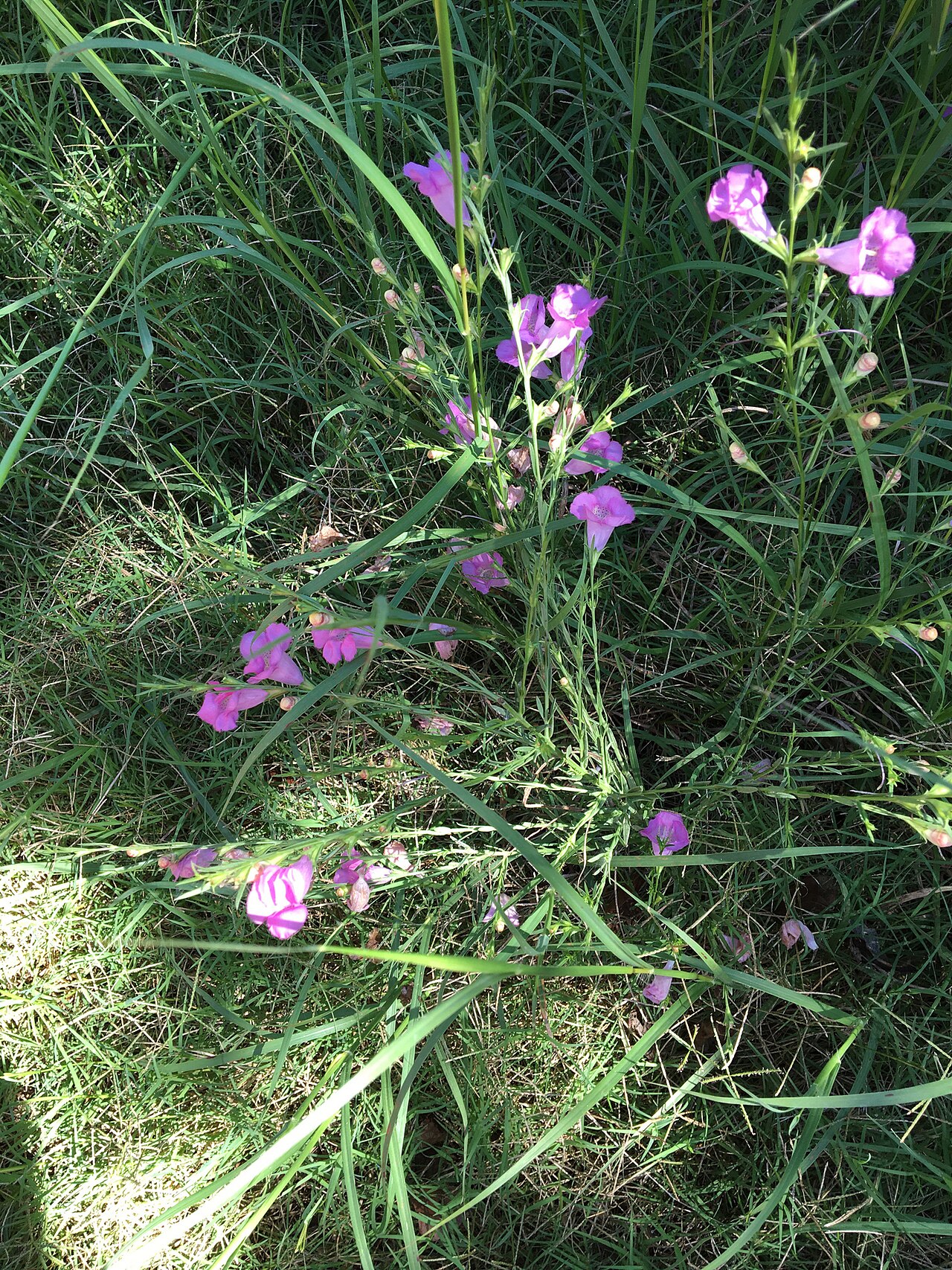
Agalinis heterophylla, known as Prairie False Foxglove, is a native annual wildflower of prairies, open grasslands and old fields in the south-central United States. It belongs to the broomrape family (Orobanchaceae), which includes many plants that are partly or wholly parasitic; older books place it in the figwort family. From late summer into fall it bears pink to lavender, bell-shaped flowers about an inch long on thin, much-branched stems 1 to 3 feet tall.
Prairie false foxglove is a hemiparasite. It has green leaves and makes its own food by photosynthesis, but its roots also attach to the roots of neighboring plants, especially grasses, and draw water and nutrients from them. This does little harm to healthy prairie grasses, and in fact helps keep grasses from crowding out other wildflowers. It also means the plant cannot be grown alone in a pot or flower bed the way ordinary wildflowers can.
The species is important to wildlife. Its leaves feed the caterpillars of the common buckeye butterfly, and its flowers are visited by native bees. It grows from Kansas and Missouri south through Oklahoma, Arkansas and Louisiana to Texas, with scattered populations east to Mississippi, Alabama, Tennessee and Georgia. The best way to grow it is from seed sown among established native grasses.
Identification
Look for a slender, wiry, freely branched plant with very narrow leaves, standing among grasses in late summer, with scattered pink, open-faced, bell-shaped flowers. The name heterophylla (“different leaves”) refers to the lower leaves, which are sometimes lobed, unlike the narrow upper leaves.
Stems & Leaves
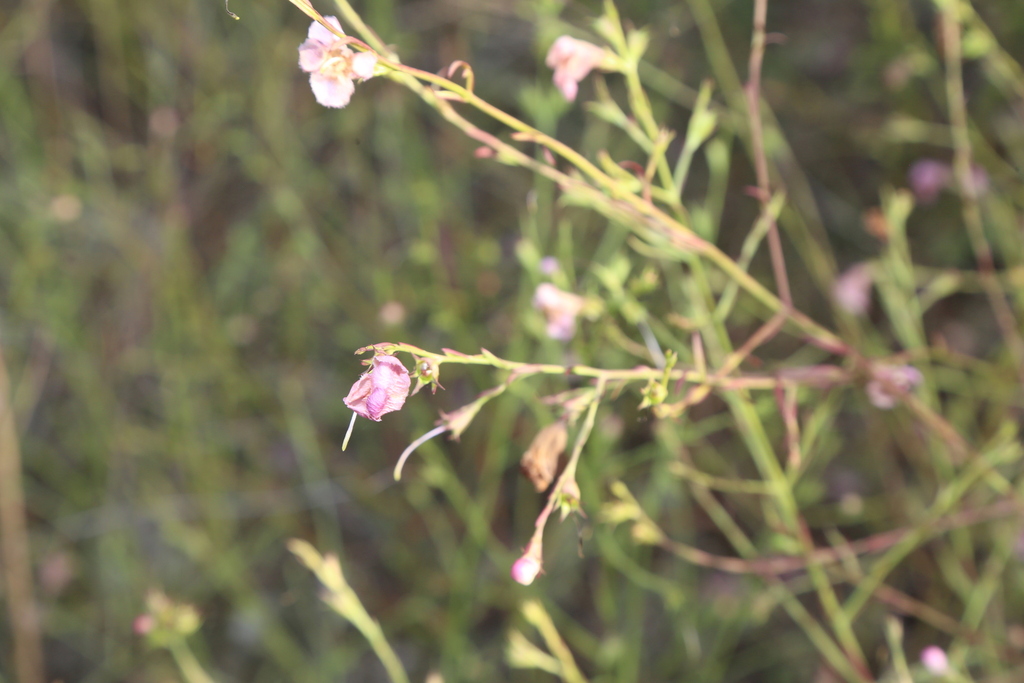
The stems are slender, angled and branched, usually 1 to 3 feet tall, smooth or slightly rough. The leaves are opposite and very narrow, mostly linear and 1/2 to 1 1/2 inches long. Some of the lower leaves are wider and may have one or two narrow side lobes. The leaves often drop or turn purplish by the time the plant is in full flower.
Flowers
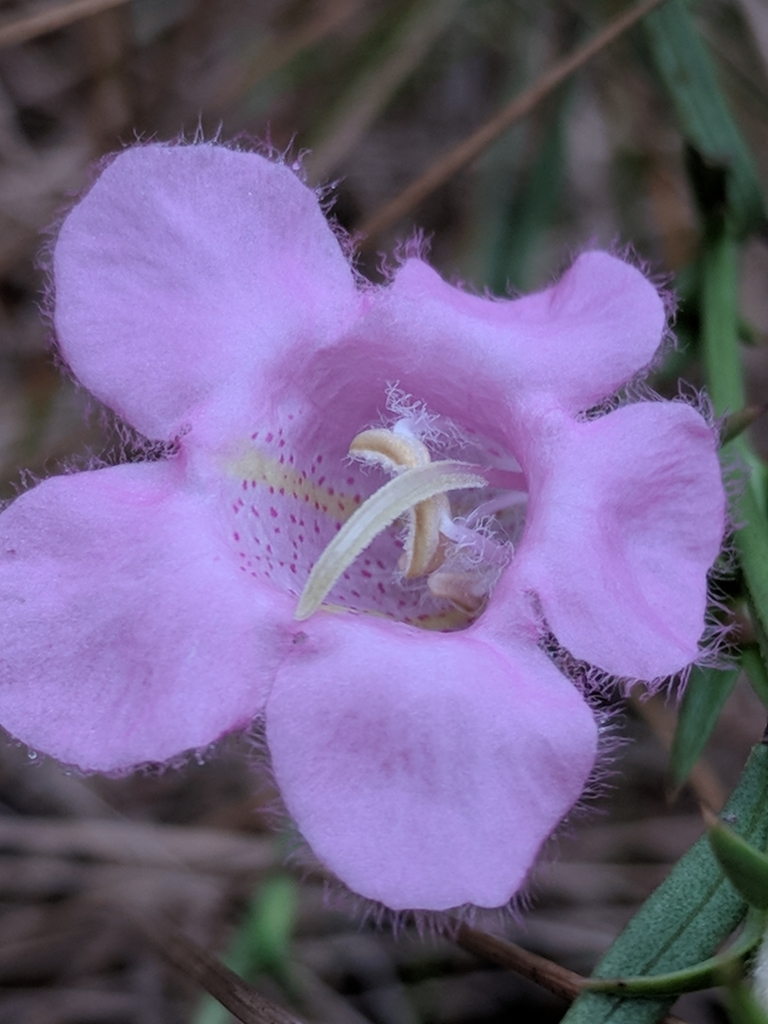
The flowers grow singly from the upper leaf axils on short stalks. Each is a broad, funnel-shaped tube about 3/4 to 1 1/4 inches long, pink to rose-lavender, flaring into five rounded, slightly unequal lobes. The inside of the throat is paler, often with two yellowish lines and small purple spots, and the lobes are finely hairy. Each flower lasts only a day, but the plant keeps blooming for weeks, mainly August to October (sometimes earlier).
Fruit & Seeds
The fruit is a small, round capsule about 1/4 inch across that splits open to release many tiny, dark seeds. The dried plants often turn blackish, a common trait of Agalinis.
Roots
The root system is small. Fine roots form little attachment structures (haustoria) on the roots of nearby plants, especially grasses, through which the plant takes water and nutrients.
Look-alikes
There are many similar pink Agalinis species in the South. Beach false foxglove (A. fasciculata) has rough stems and clusters of short leaves along the stems. Slender false foxglove (A. tenuifolia) has smaller flowers with a hairy upper lip curving over the stamens. Prairie false foxglove is told by its relatively large flowers, its often-lobed lower leaves and its prairie and grassland habitat. Close identification often requires examining the calyx, flower stalks and leaves.
Quick Facts
| Scientific Name | Agalinis heterophylla |
| Family | Orobanchaceae (broomrape family) |
| Plant Type | Annual wildflower; hemiparasite on grass roots |
| Mature Height | 1–3 ft |
| Mature Spread | 6–18 in |
| Growth Rate | Fast (completes its life in one season) |
| Sun Exposure | Full sun to light shade |
| Water Needs | Low to medium |
| Soil Type | Prairie loam, clay or sandy soil among native grasses |
| Soil pH | Slightly acidic to slightly alkaline (about 5.5–8.0) |
| Bloom Time | August–October (sometimes from June) |
| Flower Color | Pink to rose-lavender |
| Fall Color | Stems often turn purplish, then blackish |
| Fruit | Small round capsule with many tiny seeds |
| Deer Resistant | Moderate; slender stems are seldom heavily browsed |
| USDA Hardiness Zones | Annual; grows wild in zones 6–9 |
Native Range
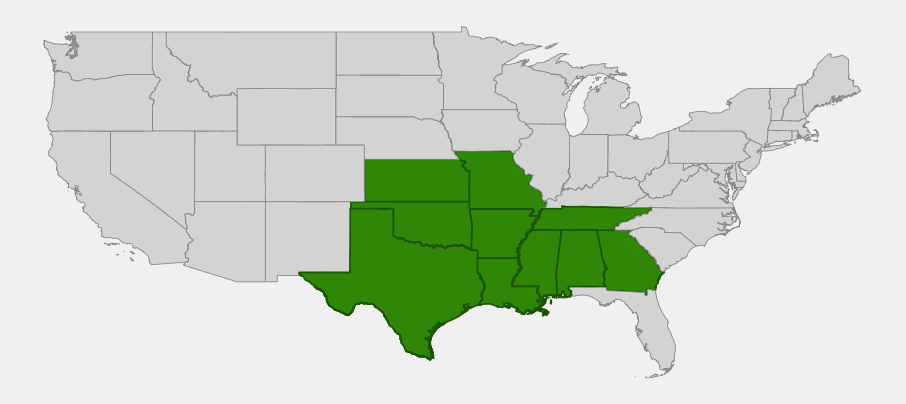
USDA PLANTS lists prairie false foxglove as native in the lower 48 states, with records from Texas, Oklahoma, Kansas, Missouri, Arkansas, Louisiana, Mississippi, Alabama, Tennessee and Georgia. It is a plant of the southern Great Plains and the prairies of the south-central states.
It is most common in Texas, Oklahoma, Arkansas and Louisiana. The Lady Bird Johnson Wildflower Center notes that in Texas it grows east of a line from Grayson County on the Red River to Cameron County at the mouth of the Rio Grande, which takes in the Blackland Prairie, the Post Oak Savannah, the Coastal Prairie, the eastern edge of the Edwards Plateau around Austin and San Antonio, and parts of South Texas. It reaches north into southeastern Kansas and Missouri. East of the Mississippi River it is much less common, with scattered records in Mississippi, Alabama, Tennessee and Georgia, mostly in prairie remnants and open grasslands.
Its habitats are prairies and plains, grasslands, fallow fields, roadsides and open woodlands, sometimes on rocky soils, usually where the soil is at least somewhat moist in the growing season. It needs grasses or other host plants nearby.
📋 Regional plant lists featuring Prairie False Foxglove: Kentucky & Tennessee · Nebraska, Kansas & Eastern Colorado · Illinois, Iowa & Missouri · Alabama, Georgia & Mississippi · Arkansas, Louisiana, Eastern Oklahoma & Eastern Texas · South & West Texas
Growing & Care Guide
Prairie false foxglove can be grown, but only on its own terms. As an annual hemiparasite, it needs living host plants, usually native grasses, growing right next to it. It is rarely sold as nursery plants because seedlings cannot survive in a pot alone and do not transplant. The honest way to grow it is from seed sown into an established native grass planting or prairie, where it can self-sow year after year.
Light
Grow it in full sun or very light shade, as in an open prairie or meadow.
Soil & Water
It is adaptable to clay, loam and sandy soils, as long as they are not constantly wet. In an established prairie planting it needs no extra water; the host grasses and the plant share the available moisture.
Planting Tips
Buy seed from a native seed supplier that collects in your region, or collect a small amount from a large wild population where permitted. In fall, scatter the tiny seeds on the surface of bare patches of soil among clumps of little bluestem, sideoats grama or other native bunchgrasses, and press them in lightly; do not bury them. Germination is often low the first year. Once a population is established, it reseeds itself if the seeds can reach bare soil.
Pruning & Maintenance
Do not cut the plants until they have dropped their seed in late fall. Mowing or burning prairie plantings in late winter or early spring helps keep openings where the seeds can sprout. Avoid herbicides and heavy mulch, which block germination.
Propagation
It is propagated only by seed. Seeds need a period of cold, moist conditions over winter before they germinate in spring. The seedlings must find a host root within a few weeks, so sowing next to host plants is essential. Do not try to dig and move plants; they die once their root connections are broken.
Landscape Uses
- Prairie and meadow plantings: late-season pink flowers among native grasses
- Butterfly gardens: a host plant for common buckeye caterpillars
- Grassland restoration: adds diversity and helps keep grasses from dominating
- Pollinator habitat: late-summer nectar and pollen for native bees
- Roadside wildflower plantings: a self-sowing annual for grassy, unmown areas
Wildlife & Ecological Value
Prairie false foxglove supports butterflies and bees and plays a quiet but important role in shaping prairie plant communities.
For Pollinators
The large pink flowers are visited mainly by bumble bees and other native bees, which crawl into the broad tube to collect nectar and pollen. Late-season bloom makes it valuable when many other prairie flowers have finished.
For Birds
The seeds are tiny and not an important bird food, but the plant is part of grassland habitat used by sparrows, quail and other prairie birds.
For Mammals
Mammals rarely eat much of it. The thin, wiry stems offer little forage.
Ecosystem Role
False foxgloves (Agalinis) are the main larval host plants of the common buckeye (Junonia coenia) and also host some other butterflies and moths. As a root hemiparasite on grasses, it takes resources from the dominant grasses, which can make room for other wildflowers and increase plant diversity in a prairie.
Cultural & Historical Uses
The genus name Agalinis was coined by the botanist Constantine Rafinesque in the 1830s. For much of the 19th and 20th centuries these plants were placed in the genus Gerardia, and prairie false foxglove was first described by Thomas Nuttall as Gerardia heterophylla. “Gerardia” is still used as a common name for the group.
The name false foxglove refers to the tubular flowers, which resemble those of the unrelated European foxglove (Digitalis). Unlike foxglove, Agalinis is not known as a dangerous poisonous plant, but it is not a food or medicinal plant either.
Scientists now place false foxgloves, along with Indian paintbrushes, louseworts and broomrapes, in the broomrape family (Orobanchaceae), a family that ranges from green, partly parasitic plants like this one to leafless plants that depend entirely on their hosts. Their parasitic habits make these plants difficult to grow, but they are an important part of native prairies.
Frequently Asked Questions
Is prairie false foxglove a parasite?
It is a hemiparasite. It has green leaves and makes its own food, but its roots attach to the roots of nearby plants, mostly grasses, to take water and nutrients. It does not kill its hosts.
Can I buy prairie false foxglove plants?
Rarely. Because it needs host roots and does not transplant, nurseries seldom sell it as plants. Look for seed from a regional native seed supplier and sow it among native grasses.
How do I grow it from seed?
Scatter the tiny seeds on bare soil among established native bunchgrasses in fall, press them in lightly and leave them uncovered. They need winter cold to germinate, and seedlings must quickly find a host root.
What butterflies use prairie false foxglove?
It is a larval host plant for the common buckeye butterfly, whose caterpillars eat the leaves. Native bees visit the flowers for nectar and pollen.
Is it related to the garden foxglove?
No. The name comes from the similar tubular flowers. Garden foxglove (Digitalis) is a European plant in the plantain family; prairie false foxglove is a native member of the broomrape family.

Looking for a nursery that carries Prairie False Foxglove?
Browse our native plant nursery directory: Alabama & Arkansas · Georgia · Kansas · Louisiana, Mississippi & Missouri · Oklahoma · Tennessee & Texas