
Heartleaf Arnica (Arnica cordifolia)
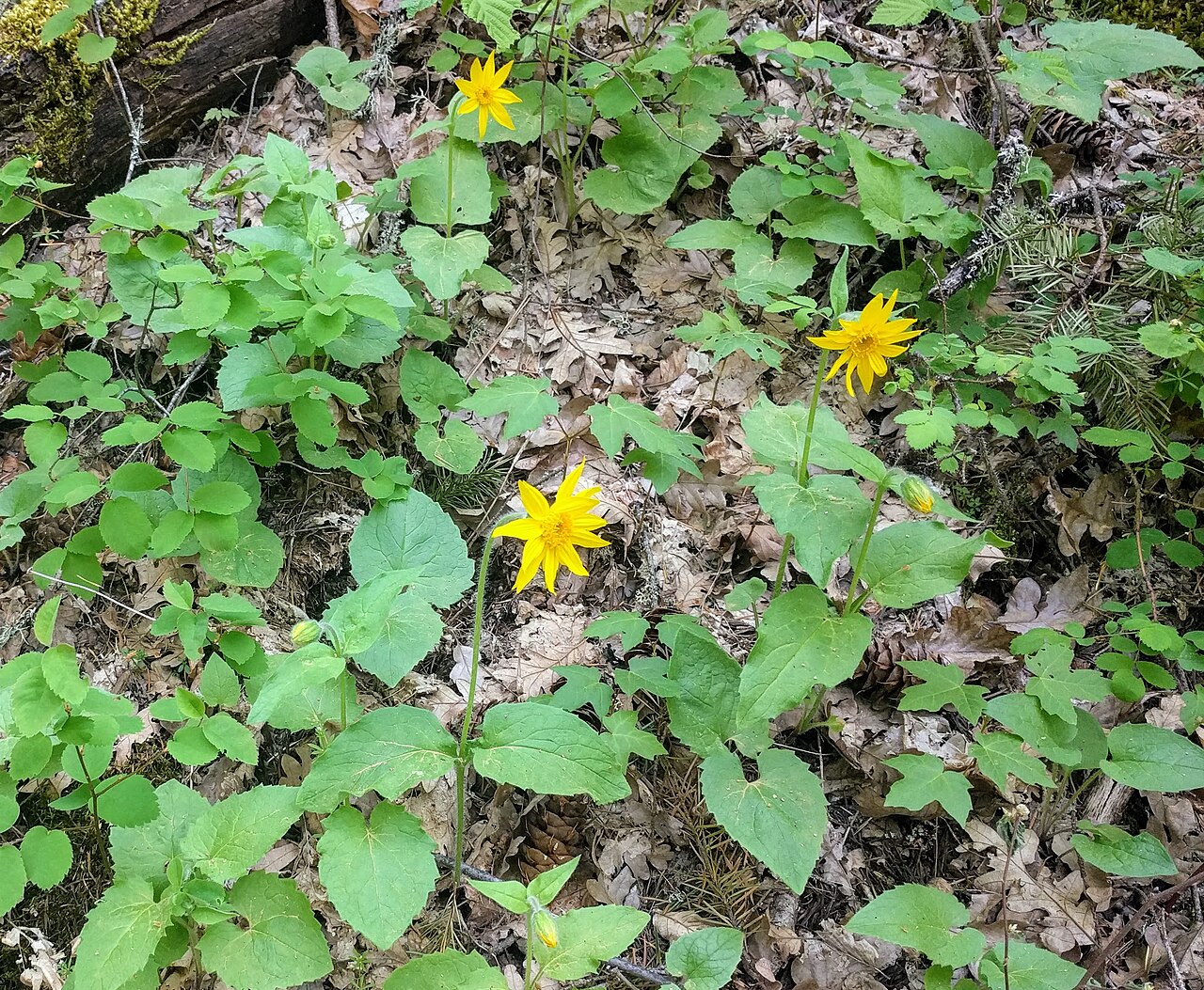
Arnica cordifolia, known as Heartleaf Arnica (also heart-leaf leopardbane), is a native perennial wildflower of the sunflower family (Asteraceae). It is one of the most common and widespread arnicas of western North America, growing in mountain forests and openings from Alaska and western Canada south through the Rocky Mountains, the Cascades and the Sierra Nevada to California, Arizona and New Mexico, east to the Black Hills.
In late spring and summer it lights up the forest floor with bright yellow, daisy-like flower heads 2 to 3 inches across, held on single stems above pairs of heart-shaped leaves. The plants spread by underground rhizomes and often form large colonies of heart-shaped leaves under aspen, pine, fir and spruce, many of which never flower in deep shade. In sunnier openings, plants bloom freely.
Heartleaf arnica is a fine native groundcover for woodland gardens in the mountain West, where it brings cheerful color to part shade. Like other arnicas, it is toxic if eaten. It should never be taken internally or used on broken skin; keep it away from children and pets who might chew on it.
Identification
Look for single stems with one to three bright yellow, daisy-like flower heads above two to four pairs of opposite leaves, and patches of long-stalked, heart-shaped basal leaves on the forest floor.
Growth Form
A perennial herb 4 to 24 inches tall, spreading by slender rhizomes into loose colonies. Each flowering stem is usually unbranched, with soft, often glandular hairs. Many shoots in shady places produce only a few basal leaves and no flowers. Dwarf plants with stems only 4 to 8 inches tall, sometimes called var. pumila, occur in alpine and exposed sites.
Leaves
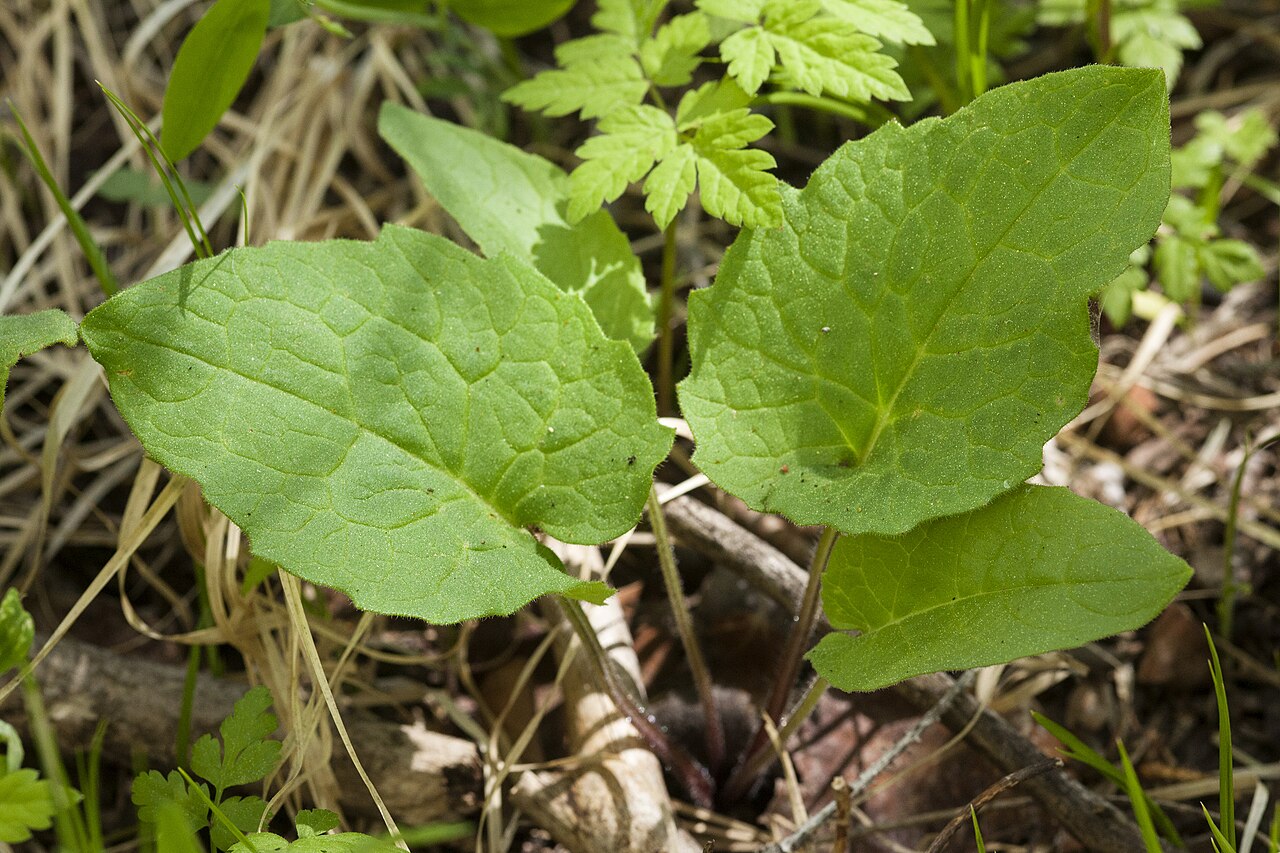
The basal leaves and those on non-flowering shoots are broadly heart-shaped, 1-1/2 to 5 inches long, with coarse teeth and long stalks. Flowering stems carry two to four pairs of opposite leaves, which become smaller, narrower and shorter-stalked toward the top. Leaves are soft-hairy and medium green.
Flowers
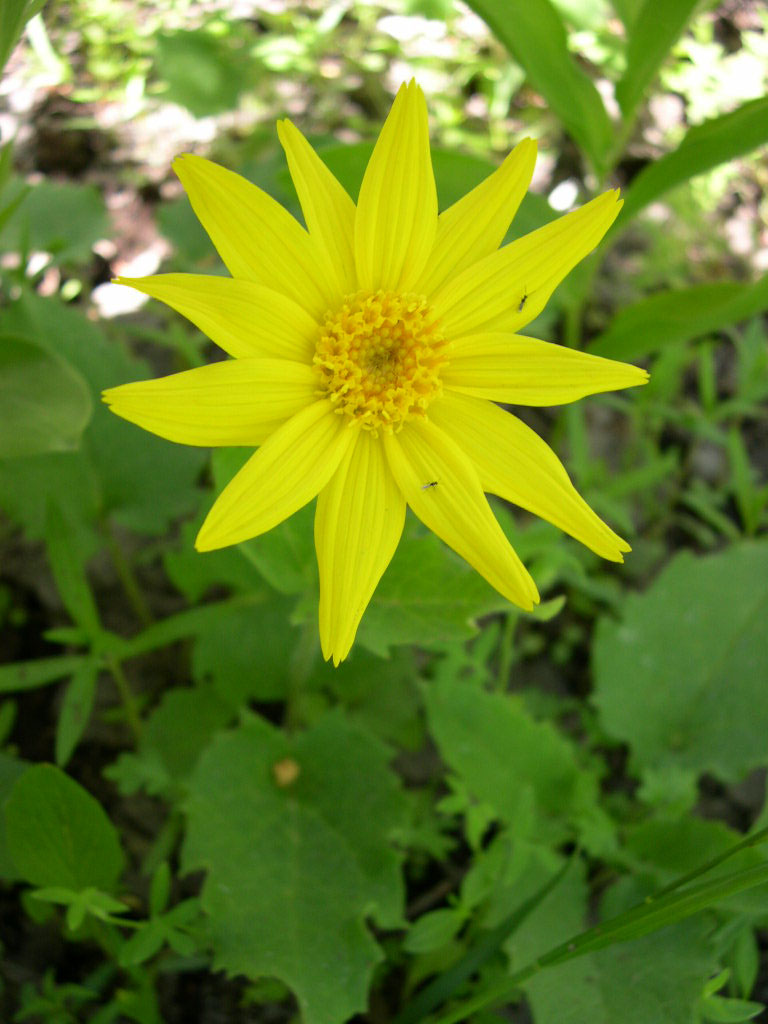
From about April to August, depending on elevation, each stem bears one to three flower heads 2 to 3 inches across. Each head has about 8 to 15 bright yellow, pointed ray flowers, 3/4 to 1-1/4 inches long with toothed tips, surrounding a domed center of many golden-yellow disk flowers. The bracts beneath the head are hairy and glandular.
Fruit & Seeds
The seeds (achenes) are small, slender and hairy, each topped with a ring of white to pale tan bristles (pappus) that carry them on the wind. Seed heads look like small, fluffy dandelion balls.
Look-alikes
Other western arnicas look similar. Broadleaf arnica (A. latifolia) has toothed, oval leaves that are not heart-shaped and mostly stalkless stem leaves. Mountain arnica (A. fulgens) and foothill arnica (A. sororia) have narrow, lance-shaped leaves and grow in dry, open grasslands. Heart-leaved groundsels (Senecio) have alternate, not opposite, stem leaves. The opposite stem leaves and heart-shaped basal leaves on long stalks identify heartleaf arnica.
Safety Note
All arnicas contain helenalin and related compounds that are toxic if swallowed and can cause stomach pain, vomiting, diarrhea and, in larger amounts, heart problems. Arnica can also cause skin irritation and allergic reactions, especially on broken skin. Never eat any part of the plant or make homemade preparations from it. Keep children, pets and livestock from eating it.
Quick Facts
| Scientific Name | Arnica cordifolia |
| Family | Asteraceae (sunflower family) |
| Plant Type | Rhizomatous herbaceous perennial |
| Mature Height | 4–24 in |
| Mature Spread | Spreads by rhizomes; colonies several feet wide |
| Growth Rate | Moderate |
| Sun Exposure | Partial shade (sun in cool, moist sites) |
| Water Needs | Moderate; moist to fairly dry, well-drained soil |
| Soil Type | Loamy, gravelly or sandy forest soils |
| Soil pH | About 5.5–7.5 (acidic to neutral) |
| Bloom Time | April–August (mainly May–July) |
| Flower Color | Bright yellow |
| Fall Color | Leaves turn yellow-brown and die back |
| Fruit | Small achenes with white to tan bristles |
| Deer Resistant | Moderately; browsed by deer and elk in some areas |
| USDA Hardiness Zones | 3–8 |
Native Range
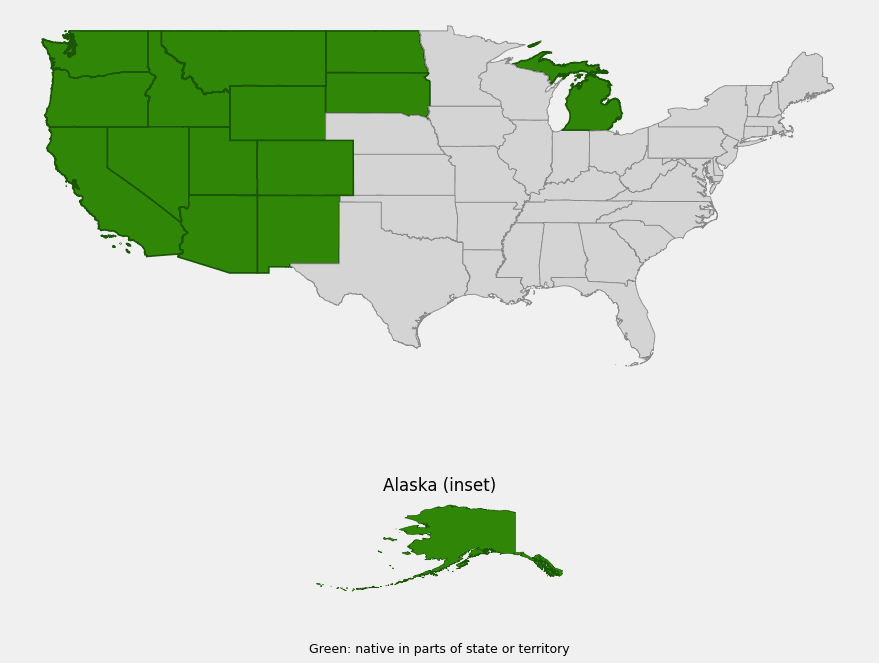
Heartleaf arnica is native to western North America. USDA PLANTS lists it as native to Alaska, Canada and the lower 48 states, and records it from Alaska, Arizona, California, Colorado, Idaho, Michigan, Montana, Nevada, New Mexico, North Dakota, Oregon, South Dakota, Utah, Washington and Wyoming. The Lady Bird Johnson Wildflower Center summarizes its range as Alaska to the Black Hills, south to California and New Mexico, rare west of the Cascades, with an outlying population in Keweenaw County, Michigan.
It is most abundant in the Rocky Mountains from Alberta and British Columbia south to Colorado and New Mexico, in the mountains of Idaho, eastern Oregon and eastern Washington, and in the Sierra Nevada and other ranges of California and Nevada. In Canada it grows in Yukon, British Columbia and Alberta and east into Saskatchewan. East of the Rockies it reaches the Black Hills of South Dakota and western North Dakota. The population on Michigan’s Keweenaw Peninsula, far from the main range, is a rare relict and is tracked as a rare plant by the state.
Habitats include dry or moist, open or wooded places, especially aspen groves and coniferous forests of lodgepole pine, ponderosa pine, Douglas-fir, spruce and subalpine fir, as well as forest edges, burns, clearings and subalpine meadows. The Lady Bird Johnson Wildflower Center gives its elevation as about 3,500 to 10,000 feet, although it grows lower in the north.
📋 Regional plant lists featuring Heartleaf Arnica: Idaho, Eastern Oregon & Eastern Washington · Montana & Wyoming · Michigan, Wisconsin & Eastern Minnesota · Utah & Western Colorado · Arizona & New Mexico · Alaska · North Dakota, South Dakota & Western Minnesota · Western Oregon & Western Washington · California & Nevada
Growing & Care Guide
Heartleaf arnica is a good native groundcover for woodland and shade gardens in the mountain West and Pacific Northwest. It does best where summers are not too hot. Buy plants or seed from a native plant nursery; do not dig plants from the wild.
Light
Give it part shade, such as dappled light under aspens or pines, or morning sun and afternoon shade. In cool, moist mountain gardens it tolerates full sun and blooms more heavily there; in deep shade it forms leafy patches with few flowers.
Soil & Water
Plant it in well-drained loamy, gravelly or sandy soil with some organic matter, such as leaf litter or forest duff. Keep the soil evenly moist in spring and early summer. Once established, it tolerates moderate summer dryness, and plants may go partly dormant in late summer in dry sites. No fertilizer is needed.
Planting Tips
Plant in spring or early fall, 12 inches apart, in a woodland garden, under trees or along a shady path. It combines well with native shrubs, ferns, wild strawberry, kinnikinnick and other western woodland wildflowers. Avoid hot, low-elevation sites with intense afternoon sun and reflected heat.
Pruning & Maintenance
Little care is needed. Remove spent flower stems if you want to keep the patch tidy, or leave them to drop seed. Mulch with leaves or pine needles to keep the roots cool. Wear gloves when handling it if you have sensitive skin, since arnica can cause skin reactions in some people.
Propagation
Divide established patches in early spring or fall, keeping a section of rhizome with each piece. It can also be grown from seed sown outdoors in fall or after a few weeks of cold, moist stratification. Seedlings take a year or two to flower.
Landscape Uses
- Woodland gardens: a bright yellow groundcover under aspens, pines and firs
- Mountain landscapes: for cabins and homes in forested settings
- Shade borders: early-summer color in part shade in cool climates
- Restoration: revegetating forest edges, clearings and burns
- Pollinator gardens: nectar and pollen for native bees and flies
Wildlife & Ecological Value
Heartleaf arnica provides early summer flowers in western forests, and its patches of leaves cover the forest floor.
For Pollinators
The bright yellow heads are visited by native bees, flower flies, beetles and butterflies, which collect nectar and pollen from the many small disk flowers.
For Birds
Small seed-eating birds such as juncos and finches may pick at the seeds. Its patches provide low cover for ground-foraging forest birds.
For Mammals
Deer and elk browse heartleaf arnica, mostly in spring and early summer, and it is eaten by some livestock. Rodents may also eat the seeds.
Ecosystem Role
Its spreading rhizomes help hold soil on forest slopes, and it often increases after fires and light disturbance, quickly covering ground in burned and logged forests. It is a characteristic member of the herb layer in aspen and conifer forests across the West.
Cultural & Historical Uses
The genus name Arnica has uncertain origins, possibly from a Greek word for lamb’s skin, referring to the soft, hairy leaves. The species name cordifolia means “heart-leaved.” The name leopardbane, shared with some European relatives, is an old name with no clear connection to leopards.
Arnica, mainly the European Arnica montana, has a long history as an external remedy for bruises and sprains, and some western Indigenous peoples also used native arnicas, including heartleaf arnica, in poultices for bruises and swellings. Because arnica is toxic when swallowed and can irritate skin, it should only be used in properly prepared commercial products for external use, never in homemade preparations or internally.
For hikers in the mountain West, the bright yellow flowers of heartleaf arnica in aspen groves and pine forests are a familiar sign of early summer. Its isolated population on Michigan’s Keweenaw Peninsula, hundreds of miles from the main range, is a botanical curiosity that is thought to be a relict from cooler times after the last Ice Age.
Frequently Asked Questions
Is heartleaf arnica poisonous?
Yes, if swallowed. Like all arnicas, it contains helenalin and related compounds that can cause severe stomach upset and heart problems. It can also irritate skin. Never eat it or use homemade preparations, and keep children, pets and livestock away from it.
Does heartleaf arnica grow in shade?
Yes. It grows naturally under aspens and conifers in part shade. In deep shade it forms leafy patches with few flowers; it blooms best in dappled light or in sun in cool mountain gardens.
When does heartleaf arnica bloom?
Mainly from May to July, from April at low elevations to August high in the mountains.
How do I tell heartleaf arnica from other arnicas?
Look for the heart-shaped basal leaves on long stalks and two to four pairs of opposite stem leaves. Other arnicas have oval or narrow leaves and different habitats.
Will heartleaf arnica spread in my garden?
It spreads slowly by rhizomes into a loose groundcover, especially in moist, partly shaded sites. It is easy to control by dividing extra plants.

Looking for a nursery that carries Heartleaf Arnica?
Browse our native plant nursery directory: Alaska & Arizona · California · Colorado · Idaho · Michigan & Montana · Nevada, New Mexico & North Dakota · Oregon · South Dakota & Utah · Washington · Wyoming