
Inland Ceanothus (Ceanothus herbaceus)
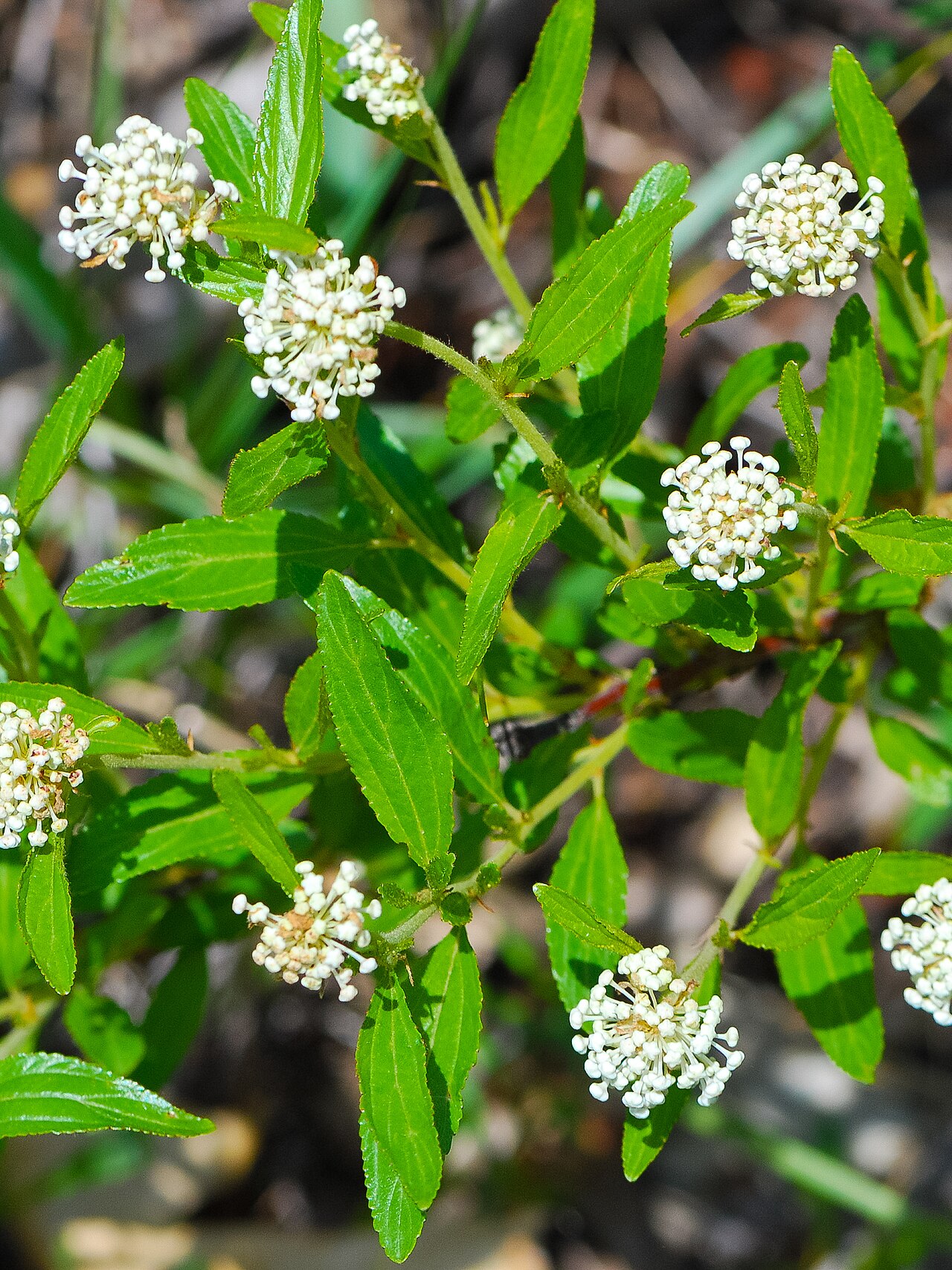
Ceanothus herbaceus, known as Inland Ceanothus, prairie redroot or inland New Jersey tea (listed by USDA PLANTS as Jersey tea), is a low, rounded native shrub of the prairies, plains and rocky hillsides of central North America. It grows 1 to 3 feet tall from a massive red root, and in late spring it is covered with small, rounded clusters of tiny white flowers that hum with bees, beetles and butterflies.
It is the western and prairie counterpart of the better-known New Jersey Tea (Ceanothus americanus). The two are closely related and look much alike, but inland ceanothus has narrower, glossier leaves, flower clusters at the tips of the new shoots rather than on long stalks from the leaf axils, and an earlier bloom. It also tolerates drier, more alkaline soils. Older references call it Ceanothus ovatus.
Both species belong to the buckthorn family (Rhamnaceae). Inland ceanothus is a nitrogen-fixing, fire-adapted shrub that has survived on the prairie for thousands of years by resprouting from its deep root, and it is a superb, compact choice for dry, sunny gardens in its range. This guide covers identification, range, growing tips and its value for wildlife.
Identification
Inland ceanothus is easy to recognize as a Ceanothus in bloom. Telling it from New Jersey tea depends on the leaves and the position of the flower clusters.
Growth Habit
It forms a low, rounded, much-branched shrub 1 to 3 feet tall and about as wide. The young stems are green to reddish and finely hairy, and older stems become woody near the base. In prairies that burn often, the stems die back and resprout each year from the woody crown, so the plant behaves almost like a perennial, which explains the species name herbaceus.
Leaves
The leaves are alternate, narrowly elliptic to lance-shaped, about 1 to 2½ inches long and ¼ to 1 inch wide, with finely toothed edges. They are glossy dark green above and paler beneath, with three prominent veins running from the base and yellowish veins on the underside. New Jersey tea has broader, more oval, duller leaves.
Flowers
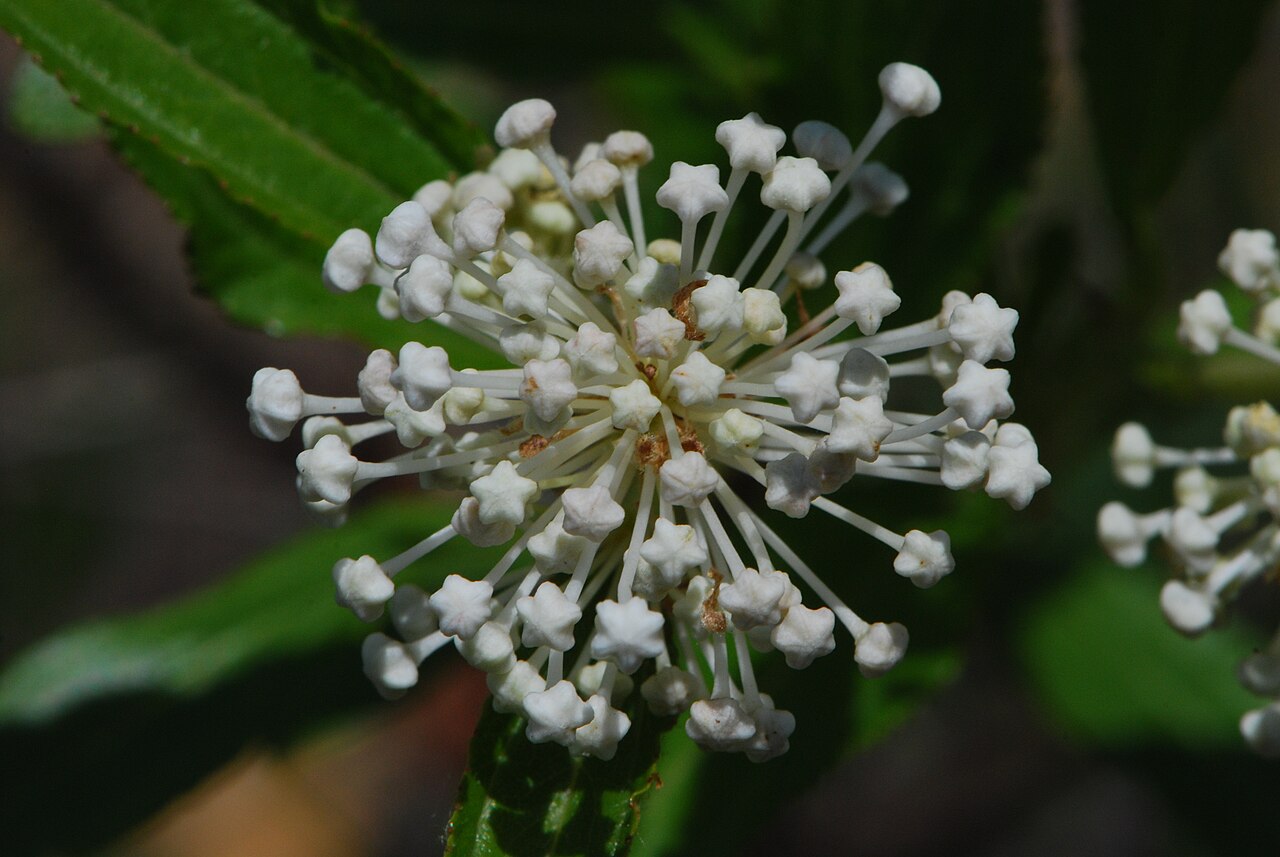
The tiny white flowers are borne in dense, rounded or slightly elongated clusters about ½ to 1 inch wide at the ends of the current year’s shoots. Each flower has five hooded petals on a slender stalk, and the clusters look like small puffs of white foam. Bloom is from late April to June, usually a few weeks earlier than New Jersey tea, whose flower clusters sit on long stalks arising from the leaf axils lower on the shoot.
Fruit & Seeds
After flowering, each flower forms a small, three-lobed capsule about ⅛ to ¼ inch across that turns from green to dark brown or black. When ripe, the capsules split explosively and throw their seeds a short distance. The cup-shaped bases of the capsules often remain on the stems into winter.
Roots
The root system is the source of the name redroot. A thick, woody taproot and burl with deep red inner bark can grow to a large size and extend several feet into the soil. Like other Ceanothus, the roots host nitrogen-fixing Frankia bacteria in small nodules.
Quick Facts
| Scientific Name | Ceanothus herbaceus (syn. C. ovatus) |
| Family | Rhamnaceae (buckthorn family) |
| Plant Type | Low deciduous shrub |
| Mature Height | 1–3 ft |
| Mature Spread | 1–3 ft |
| Growth Rate | Slow to moderate |
| Sun Exposure | Full sun to light shade |
| Water Needs | Low; very drought tolerant once established |
| Soil Type | Well-drained sand, gravel, rocky soil, loam or limy clay |
| Soil pH | About 6.0–8.0 (tolerates alkaline soils) |
| Bloom Time | Late April–June |
| Flower Color | White |
| Fall Color | Leaves turn yellow |
| Fruit | Small, three-lobed dark capsule |
| Deer Resistant | No; deer and rabbits browse the young shoots |
| USDA Hardiness Zones | 3–7 |
Native Range
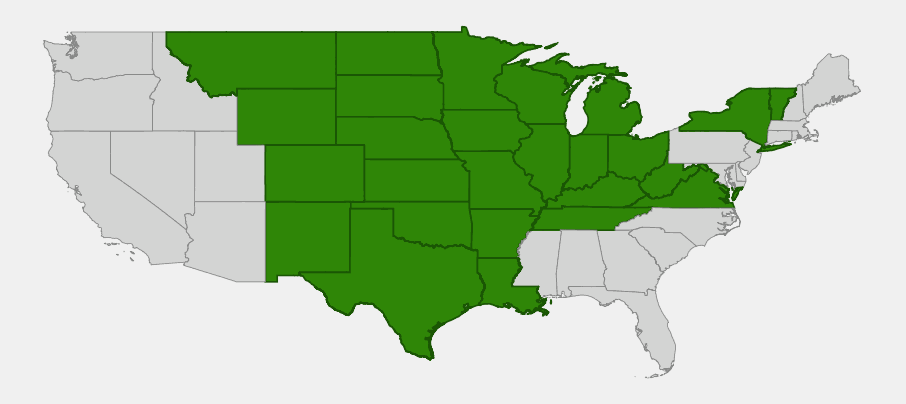
Inland ceanothus is native to central and eastern North America, with its center of distribution on the Great Plains and in the prairie and savanna country of the Midwest. USDA PLANTS records it from Montana, Wyoming, the Dakotas, Colorado and New Mexico east through Nebraska, Kansas, Oklahoma and Texas to Minnesota, Wisconsin, Iowa, Missouri, Arkansas and Louisiana, and from the Great Lakes states to Ohio, Kentucky and Tennessee. In Canada it grows in Manitoba, Ontario and Quebec.
East of the Ohio Valley it becomes a rare plant of scattered sites. Go Botany lists it as native and endangered in Vermont, where it grows on sandy lakeshores and banks. Records from New York, Virginia and West Virginia are also outlying ones at the eastern edge of the range. USDA PLANTS also shows Massachusetts, but Go Botany considers it introduced there, so Massachusetts is left off the map on this page.
Across its range it grows in dry, open places: upland and sand prairies, rocky and gravelly hillsides, limestone and sandstone outcrops, oak savannas and open woods, and roadside banks. The Lady Bird Johnson Wildflower Center notes that it grows in drier, more alkaline habitats than New Jersey tea, often among little bluestem.
📋 Regional plant lists featuring Inland Ceanothus: New York, Pennsylvania & Northern New Jersey · Ohio & Indiana · Montana & Wyoming · Michigan, Wisconsin & Eastern Minnesota · Kentucky & Tennessee · Nebraska, Kansas & Eastern Colorado · New Hampshire, Maine & Vermont · Maryland, Virginia & West Virginia · Delaware, Southern New Jersey & Long Island · Illinois, Iowa & Missouri · Arkansas, Louisiana, Eastern Oklahoma & Eastern Texas · South & West Texas · North Dakota, South Dakota & Western Minnesota
Growing & Care Guide
Inland ceanothus is a tough, long-lived shrub once it settles in. Its deep root makes it extremely drought tolerant, but also slow to establish and hard to move. Start with small plants, put them in the right spot, and let them be.
Light
Full sun gives the densest plants and best bloom. It tolerates light shade along savanna edges and open woods but flowers less there.
Soil & Water
It needs well-drained soil and does well in sand, gravel, rocky soil, loam and lean, limy clay, as long as water does not sit around the roots. Water regularly during the first growing season, then little or not at all. It does not need fertilizer, since its root nodules supply nitrogen.
Planting Tips
Plant young, container-grown plants in spring. Larger plants transplant poorly because of their deep taproot. Space plants 2 to 3 feet apart. It works well in prairie plantings among grasses, at the front of a dry shrub border, or on sunny banks and slopes where its roots help hold the soil.
Pruning & Maintenance
Very little pruning is needed. Remove dead stems in late winter or, to rejuvenate an older plant, cut it back hard to a few inches; it resprouts vigorously, as it would after a prairie fire. Protect young plants from rabbits and deer with a wire cage for the first few years, since browsing on new shoots can set them back.
Propagation
Seeds have a hard coat and a dormant embryo. Pour hot (not boiling) water over them and let them soak overnight, then give them about 60 to 90 days of cold, moist stratification before sowing in spring. Sow in deep pots to allow for the taproot. Softwood cuttings taken in early summer can also be rooted with rooting hormone and bottom heat. Collect ripe capsules in a paper bag, since they split and throw their seeds.
Landscape Uses
- Prairie and meadow plantings: a compact shrub that blends with grasses and wildflowers in dry, sunny sites
- Dry, rocky and sandy gardens: thrives where poor soil and drought defeat many shrubs
- Pollinator gardens: its spring flower clusters attract a wide range of small bees, beetles, wasps and butterflies
- Slope and bank stabilization: its massive root holds soil on dry banks and hillsides
- Savanna restoration: a characteristic shrub of oak savannas and upland prairies in its native range
Wildlife & Ecological Value
Like New Jersey tea, inland ceanothus is one of the most heavily visited flowering shrubs of the prairie, and it supports a range of insects and birds.
For Pollinators
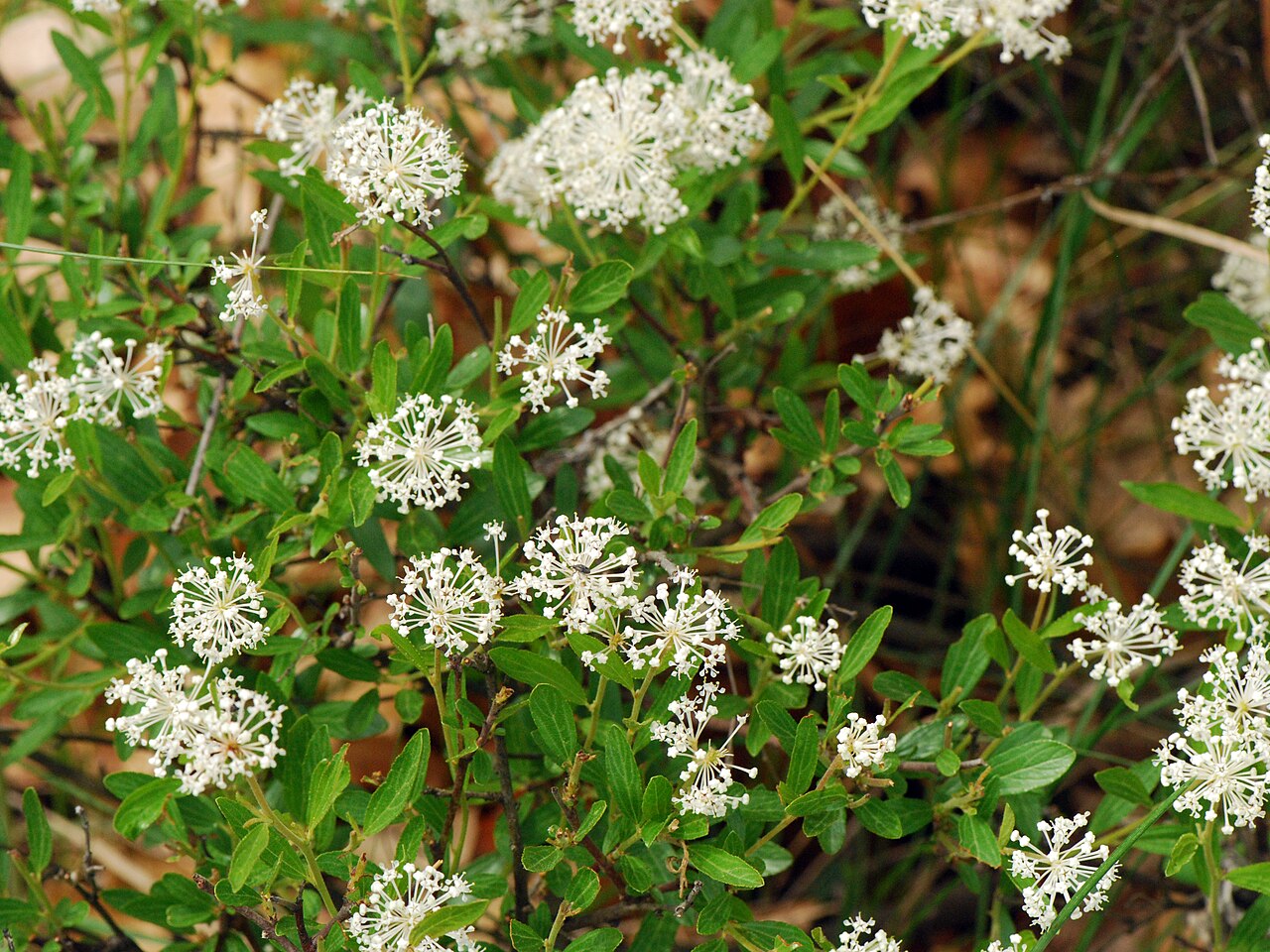
The small, fragrant flowers provide easy-to-reach nectar and pollen for many short-tongued insects, including small bees such as sweat bees and mining bees, bumble bees, wasps, flies, beetles and small butterflies. A plant in full bloom can be covered with insects on a warm spring day.
For Birds
Wild turkeys, quail and some songbirds eat the seeds. The dense, low branches provide cover for ground-nesting birds in prairie and savanna, and the many insects on the flowers feed birds raising young.
For Mammals
Deer, elk and rabbits browse the twigs and leaves, especially new growth after a fire. The plant usually tolerates browsing thanks to its large root.
Ecosystem Role
Inland ceanothus is a larval host for the mottled duskywing, a skipper butterfly that has declined along with its prairie and savanna habitats, and for several moths. Nitrogen-fixing bacteria in its root nodules enrich prairie soils. Its fire-resistant root crown allows it to resprout quickly after prairie fires, and it is an indicator of high-quality, long-unplowed prairie and savanna.
Cultural & Historical Uses
The genus name Ceanothus comes from a Greek word Theophrastus used for a spiny plant, applied by Linnaeus to this New World genus. The leaves of inland ceanothus, like those of its eastern relative, were used as a substitute for tea, and Native American peoples of the Plains used the plant for tea and medicine. The deep red roots were used to make a reddish dye.
The species has been known under several names. Ceanothus herbaceus was described in the early nineteenth century, and for many years it was widely called Ceanothus ovatus. Several varieties have been named, including a hairier plant once called C. herbaceus var. pubescens. Current floras usually treat these as one variable species.
Its common names reflect its range and roots. “Inland” and “prairie” distinguish it from the eastern New Jersey tea, “redroot” refers to the color of its massive roots, and USDA PLANTS simply calls it Jersey tea.
Frequently Asked Questions
What is the difference between inland ceanothus and New Jersey tea?
Inland ceanothus has narrower, glossier leaves, flower clusters at the tips of the new shoots and an earlier bloom. New Jersey tea has broader, duller leaves and flower clusters on long stalks from the leaf axils. Inland ceanothus also tolerates drier, more alkaline soil.
Is inland ceanothus deer resistant?
No. Deer and rabbits browse the young shoots, especially on new plants. Protect young plants with a wire cage for the first few years.
How big does inland ceanothus get?
Usually 1 to 3 feet tall and wide. It is a compact shrub that suits small gardens and prairie plantings.
Can I transplant an established inland ceanothus?
Not easily. Its deep, woody taproot makes older plants very hard to move. Plant young, container-grown plants in their permanent location.
Is inland ceanothus good for pollinators?
Yes. Its spring flowers attract a wide variety of small native bees, bumble bees, wasps, beetles and butterflies, and it is a larval host for the mottled duskywing.

Looking for a nursery that carries Inland Ceanothus?
Browse our native plant nursery directory: Arkansas · Colorado · Illinois, Indiana, Iowa & Kansas · Kentucky, Louisiana, Michigan, Minnesota, Missouri & Montana · Nebraska, New Mexico, New York, North Dakota, Ohio & Oklahoma · South Dakota, Tennessee, Texas, Vermont & Virginia · West Virginia, Wisconsin & Wyoming

