
Narrowleaf Paleseed (Leucospora multifida)
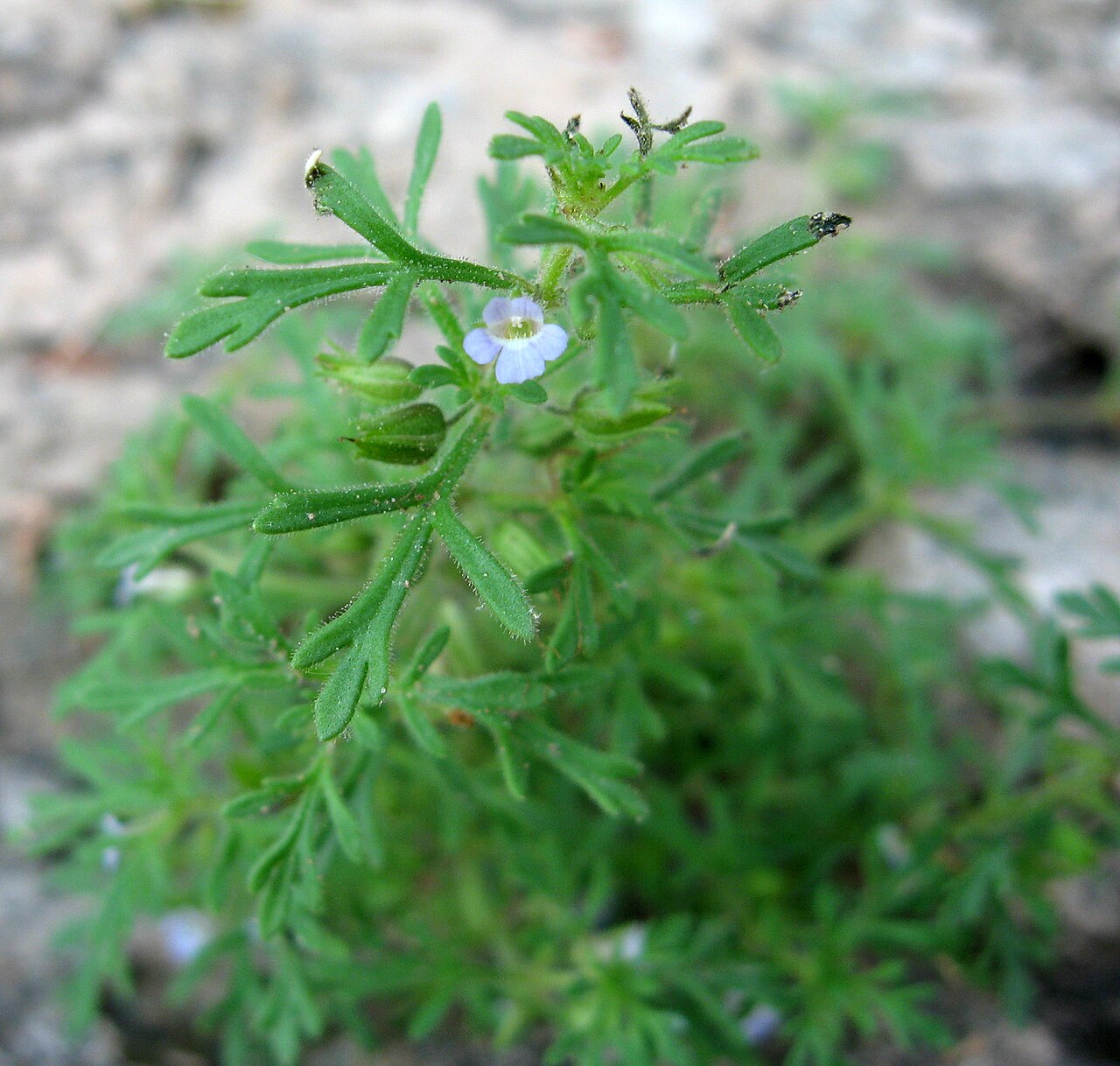
Leucospora multifida, known as Narrowleaf Paleseed (USDA), narrow-leaved paleseed, cut-leaved conobea or cliff conobea, is a small, bushy annual wildflower of the plantain family (Plantaginaceae). It is the only species in its genus. It grows on damp, sandy, gravelly or rocky ground along rivers, lakes and ditches across the central and southeastern United States, with its heartland in the Midwest and the lower Mississippi and Ohio valleys.
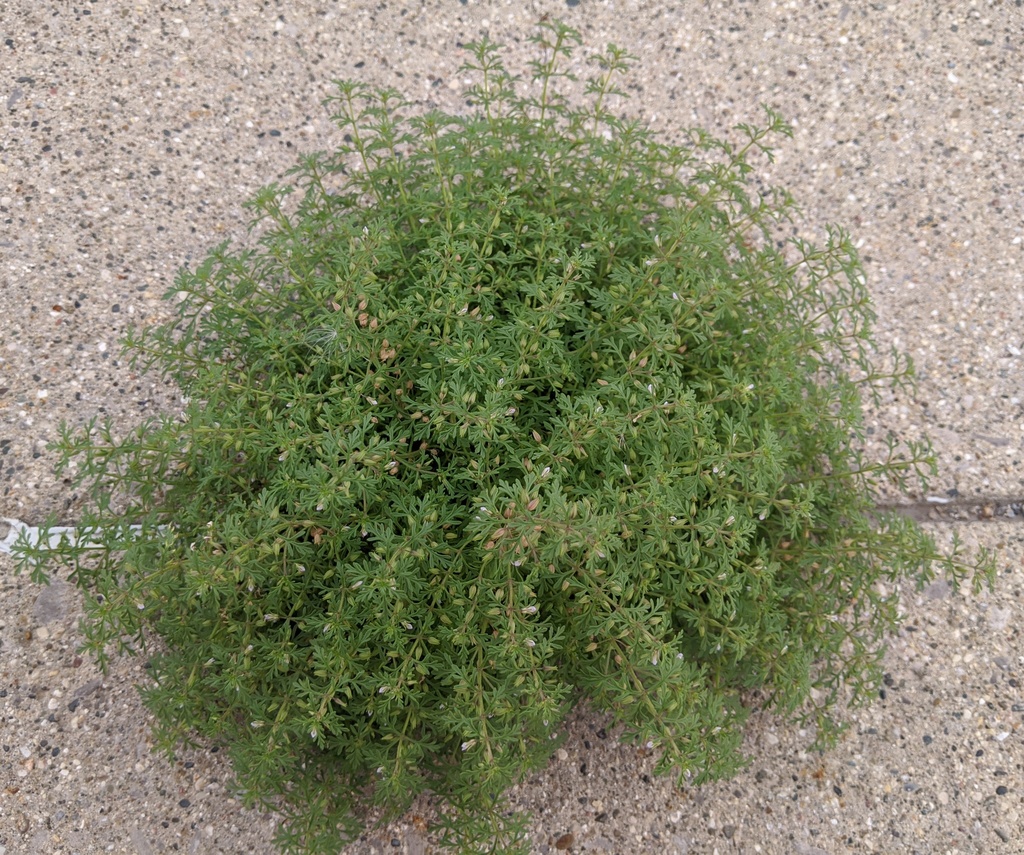
Plants are usually only 4 to 8 inches tall and form low, much-branched mounds of lacy, deeply divided leaves covered in sticky glandular hairs. From early summer to fall, small, two-lipped flowers, pale lavender to whitish and about a quarter inch long, appear singly in the leaf axils. The genus name means “white seed,” for its tiny pale seeds. In the Chicago region it picked up the playful nickname “Obi-Wan conobea,” a pun on its old name Conobea that local botanists actually used.
Narrowleaf paleseed is a plant for botanists and naturalists rather than a garden showpiece. It is rarely offered for sale, but it is a charming native annual for damp gravel, the edges of rain gardens and ponds, and other open, moist spots where it can reseed. It is worth knowing as part of the specialized flora of river gravel bars and shorelines.
Identification
Look for a low, many-branched annual with lacy, finely divided, sticky-hairy leaves and tiny pale lavender flowers tucked in the leaf axils, growing on damp sand, gravel or mud near water.
Growth Habit
Narrowleaf paleseed is a taprooted annual that germinates in late spring or early summer once shorelines and gravel bars dry out. Plants branch from the base into a low, rounded or sprawling mound, usually 4 to 8 inches tall and up to about a foot across. The whole plant is covered in short, glandular hairs that feel slightly sticky.
Leaves
The leaves are mostly opposite (sometimes in whorls or alternate), about 1/2 to 1 1/2 inches long, and deeply cut once or twice into narrow, linear lobes, giving them a feathery or lacy look. The common and scientific names both refer to this: multifida means “much-divided.”
Flowers
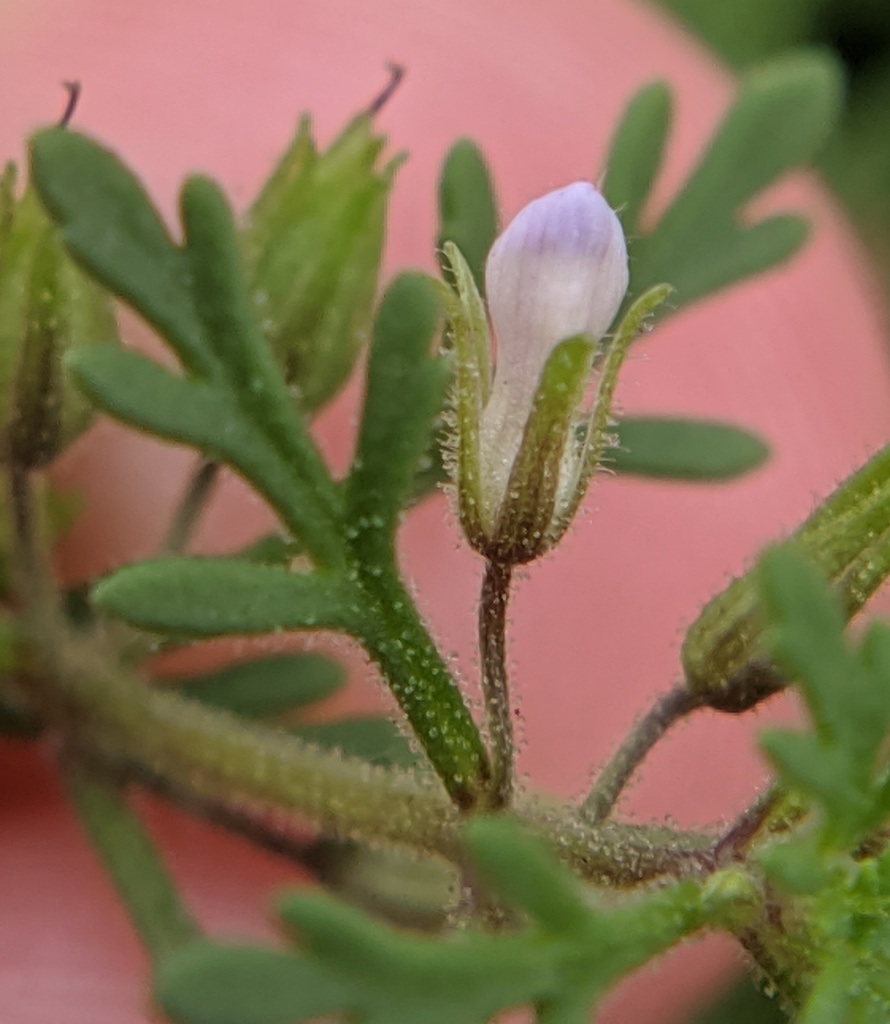
From June into October or November, single flowers grow on short stalks from the leaf axils. Each flower is about 1/4 inch long, with a narrow tube that opens into two lips: a small upper lip and a three-lobed lower lip. The corolla is pale lavender, pale blue or whitish, sometimes with a yellowish throat. The calyx is divided into five narrow, hairy lobes.
Fruit & Seeds
The fruit is a small, egg-shaped capsule, about 1/8 to 1/4 inch long, held within the persistent calyx lobes. It splits open to release numerous tiny, pale seeds, the “pale seeds” of its common name.
Look-alikes
Its finely divided, sticky leaves set it apart from most other small annuals of shorelines. False pimpernels (Lindernia) and hedge-hyssops (Gratiola), which grow in similar places, have undivided leaves. Young plants of mock bishop’s weed or other small carrot-family plants can have similarly divided leaves but are not glandular-hairy and have tiny flowers in umbels.
Quick Facts
| Scientific Name | Leucospora multifida |
| Family | Plantaginaceae (plantain family) |
| Plant Type | Annual herb (wildflower) |
| Mature Height | 4–10 in |
| Mature Spread | 6–12 in |
| Growth Rate | Fast (annual) |
| Sun Exposure | Full sun to light shade |
| Water Needs | Medium to high; damp soil |
| Soil Type | Sand, gravel, rocky or marly soil; mud flats |
| Soil pH | Neutral to alkaline (about 6.0–8.0) |
| Bloom Time | June–November |
| Flower Color | Pale lavender, pale blue or white |
| Fall Color | None notable |
| Fruit | Small capsule with tiny pale seeds |
| Deer Resistant | Unknown; too small to attract much browsing |
| USDA Hardiness Zones | Annual (grows in zones 5–9) |
Native Range
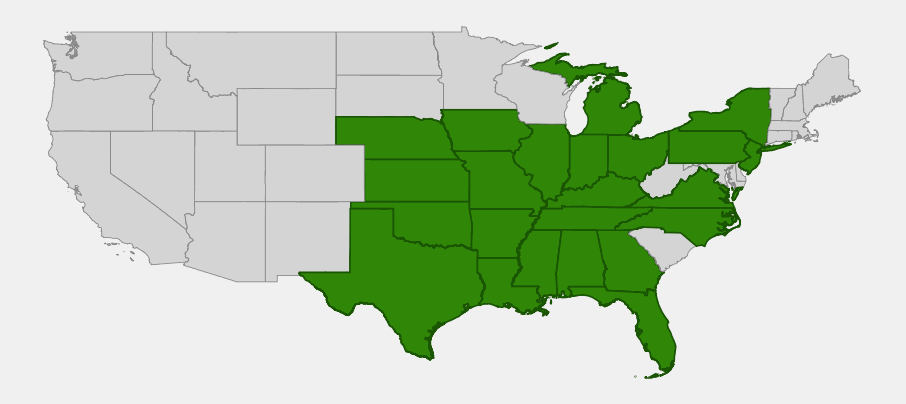
Narrowleaf paleseed is native to the central and eastern United States and southern Ontario. Its core range is the Midwest and South-Central states, especially Illinois, Missouri, Indiana, Ohio, Kentucky, Tennessee, Arkansas, Oklahoma, Kansas and eastern Nebraska, extending south to Texas and the Gulf Coast states. USDA PLANTS lists it as native in 22 states; it is also well documented as native in Illinois, which we include here.
Toward the edges of its range, in states such as New York, New Jersey, Pennsylvania, Virginia, North Carolina, Georgia, Florida and Michigan, records are scattered, and some floras suggest that a few of these outlying populations may have arrived along roads and railroads. In Texas it is frequent in the Hill Country and along rivers of central Texas, including the San Antonio and Austin areas.
It grows on open, damp, sandy, gravelly or rocky ground: river gravel bars and limestone scours, receding lake and pond shores, mudflats, ditches and swales, and wet spots in disturbed ground, even cracks in pavement. It is rated an obligate or facultative wetland plant, so it nearly always grows where the ground is wet at least part of the year.
📋 Regional plant lists featuring Narrowleaf Paleseed: New York, Pennsylvania & Northern New Jersey · Ohio & Indiana · Michigan, Wisconsin & Eastern Minnesota · Kentucky & Tennessee · Nebraska, Kansas & Eastern Colorado · Maryland, Virginia & West Virginia · Delaware, Southern New Jersey & Long Island · Illinois, Iowa & Missouri · Alabama, Georgia & Mississippi · North & South Florida · North & South Carolina · Arkansas, Louisiana, Eastern Oklahoma & Eastern Texas · South & West Texas
Growing & Care Guide
Narrowleaf paleseed is an annual that lives fast on bare, damp ground and depends on reseeding. Plants are seldom sold, so the usual way to grow it is from seed collected responsibly from a large local population (take only a small share, with permission) or from a native seed exchange.
Light
Full sun to light shade. It needs open ground without taller plants crowding it out.
Soil & Water
Give it damp sand, gravel or gritty loam that stays moist in summer, such as the edge of a pond, a rain garden basin, a gravel path near a downspout or a seepy spot. It tolerates limestone and alkaline soils well. It will not compete in rich, lush soil with perennials and grasses.
Planting Tips
Scatter the tiny seeds on bare, moist soil in fall or early spring and press them in lightly; do not bury them. Keep the area damp until seedlings appear in late spring. Because it is small, place it at the very front of a planting or among stones where it can be seen.
Pruning & Maintenance
No pruning is needed. Leave plants in place until the capsules have dropped their seeds in fall, and keep a patch of open, bare ground nearby every year so the next generation can germinate. Avoid heavy mulch, which prevents reseeding.
Propagation
By seed only. Collect dry capsules in late summer or fall and sow them right away on the surface of damp, gritty soil. Seed that has been through a winter outdoors usually germinates well the following spring.
Landscape Uses
- Pond and stream edges: a small annual for damp gravel and sand
- Rain garden margins: fills bare spots near the bottom of the basin
- Gravel gardens: lacy texture among stones
- Shoreline restoration: part of the natural flora of gravel bars
- Nature study: an interesting, little-known native annual
Wildlife & Ecological Value
Narrowleaf paleseed is a small player in the specialized plant community of shorelines and gravel bars, which are constantly reshaped by floods and droughts.
For Pollinators
The small, pale flowers are open to small bees and flies, though the pollination of this little-studied plant has not been well documented, and some seed is probably set by self-pollination.
For Birds
Its tiny seeds can be eaten by ground-foraging songbirds and shorebirds feeding on exposed mud and gravel, along with the seeds of other shoreline annuals.
For Mammals
It is too small and sticky to be an important food for mammals.
Ecosystem Role
Annuals like narrowleaf paleseed quickly cover bare, newly exposed river gravel and mud after floods recede, helping stabilize the surface and adding organic matter.
Cultural & Historical Uses
The species was first described in 1803 by the French botanist André Michaux as Capraria multifida. Thomas Nuttall placed it in its own genus, Leucospora, in 1834, from the Greek for “white seed.” For a long time it was also known as Conobea multifida, which is why many common names include the word “conobea.”
The nickname “Obi-Wan conobea,” a play on the Star Wars character Obi-Wan Kenobi, appeared in the 1994 edition of Plants of the Chicago Region. It is sometimes thought to be a joke slipped into the book, but regional botanists were apparently already using it.
Like many plants once placed in the figwort family (Scrophulariaceae), narrowleaf paleseed was moved to the plantain family (Plantaginaceae) after DNA studies reshaped how botanists group these plants.
Frequently Asked Questions
Is narrowleaf paleseed an annual?
Yes. It grows from seed each year, flowers from early summer to fall and dies with frost, returning from seed the next year.
Why is it called Obi-Wan conobea?
It is a pun on its old name, Conobea multifida, and the Star Wars character Obi-Wan Kenobi. The nickname was used by Chicago-area botanists and appeared in a 1994 regional flora.
Where does narrowleaf paleseed grow?
On damp, open sand, gravel and mud along rivers, lakes and ditches, mainly in the central and southeastern United States.
Can I buy narrowleaf paleseed?
It is rarely sold. Look for seed from native plant societies or seed exchanges, or collect a small amount from a large local population with permission.
Is narrowleaf paleseed weedy?
No. It is a small, short-lived native annual that only persists on open, damp ground and does not crowd out other plants.

Looking for a nursery that carries Narrowleaf Paleseed?
Browse our native plant nursery directory: Alabama & Arkansas · Florida & Georgia · Illinois, Indiana, Iowa & Kansas · Kentucky, Louisiana, Michigan, Mississippi & Missouri · Nebraska, New Jersey, New York, North Carolina, Ohio & Oklahoma · Pennsylvania, Tennessee, Texas & Virginia

