
Limewater Brookweed (Samolus ebracteatus)
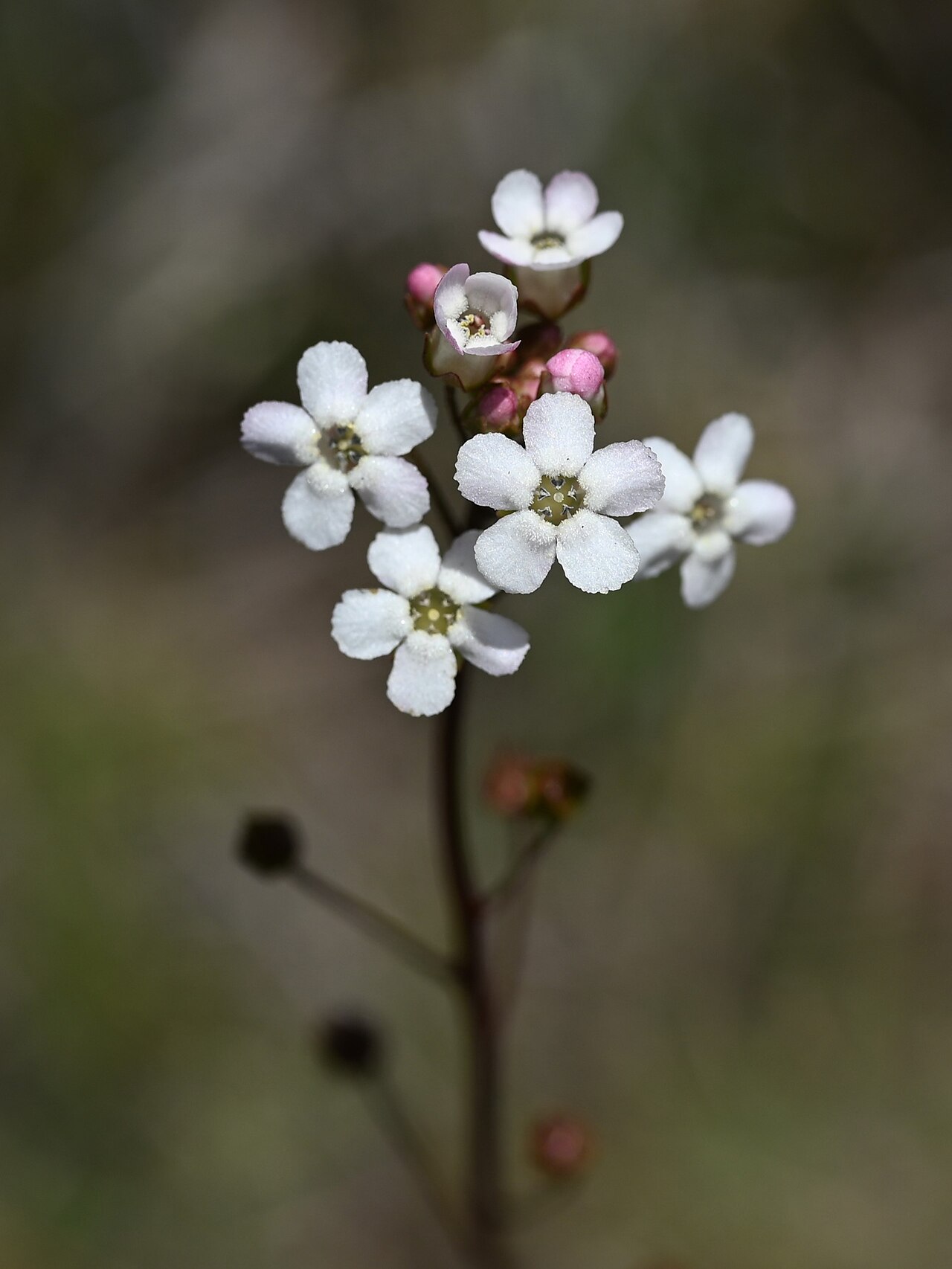
Samolus ebracteatus, known as Limewater Brookweed or water pimpernel, is a small, smooth perennial wildflower of wet, limy (calcium-rich) or brackish ground. It forms a rosette of somewhat fleshy, spoon-shaped leaves and sends up slender stalks, usually 4 to 16 inches tall, topped by clusters of small white to pink, five-lobed flowers. It belongs to the primrose family in the broad sense (Primulaceae); some botanists place brookweeds in their own small family, Samolaceae.
Its common name reflects its habitat: it grows around limestone springs, in marl prairies and calcareous seeps, and in brackish marshes near the coast. In the United States it grows from the Florida Everglades and the Gulf Coast west through Texas to desert springs in New Mexico and Nevada, and it also occurs in the Caribbean and Mexico. The species name ebracteatus means “without bracts,” because its flower stalks lack the tiny leaf-like bract found on the stalks of the related seaside brookweed.
Limewater brookweed is a modest but pretty plant for bog gardens, pond margins and wet, sunny spots with alkaline or brackish soil. In western desert springs it grows in rare, fragile habitats, so enjoy it in place and never dig plants from the wild.
Identification
Look for a low rosette of smooth, spoon-shaped leaves in wet, limy or salty ground, with slender, mostly leafless stalks bearing small five-lobed white or pink flowers on long pedicels that have no bracts.
Growth Habit
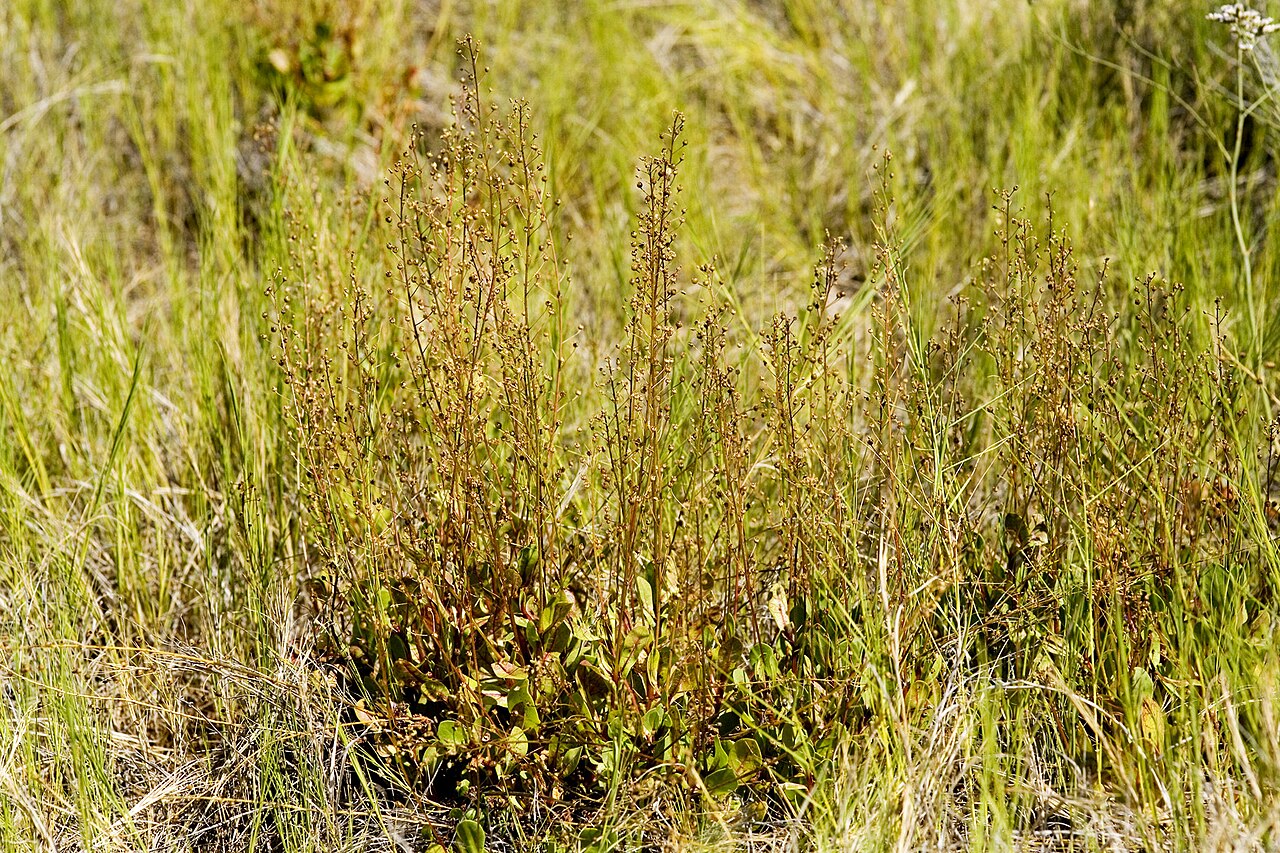
Plants are perennials with a basal rosette of leaves and one to several erect or leaning flowering stems, usually 4 to 16 inches tall. The whole plant is hairless and often slightly fleshy, and older stems and leaf edges may turn reddish. Plants often form small colonies in wet ground.
Leaves
Most leaves are in the basal rosette. They are spatula- to spoon-shaped (wider toward the tip), 1 to 4 inches long, with smooth edges and a gradually narrowed base. They are bright green, smooth and somewhat succulent, often with a reddish edge or midvein. A few smaller leaves may grow on the lower stem.
Flowers
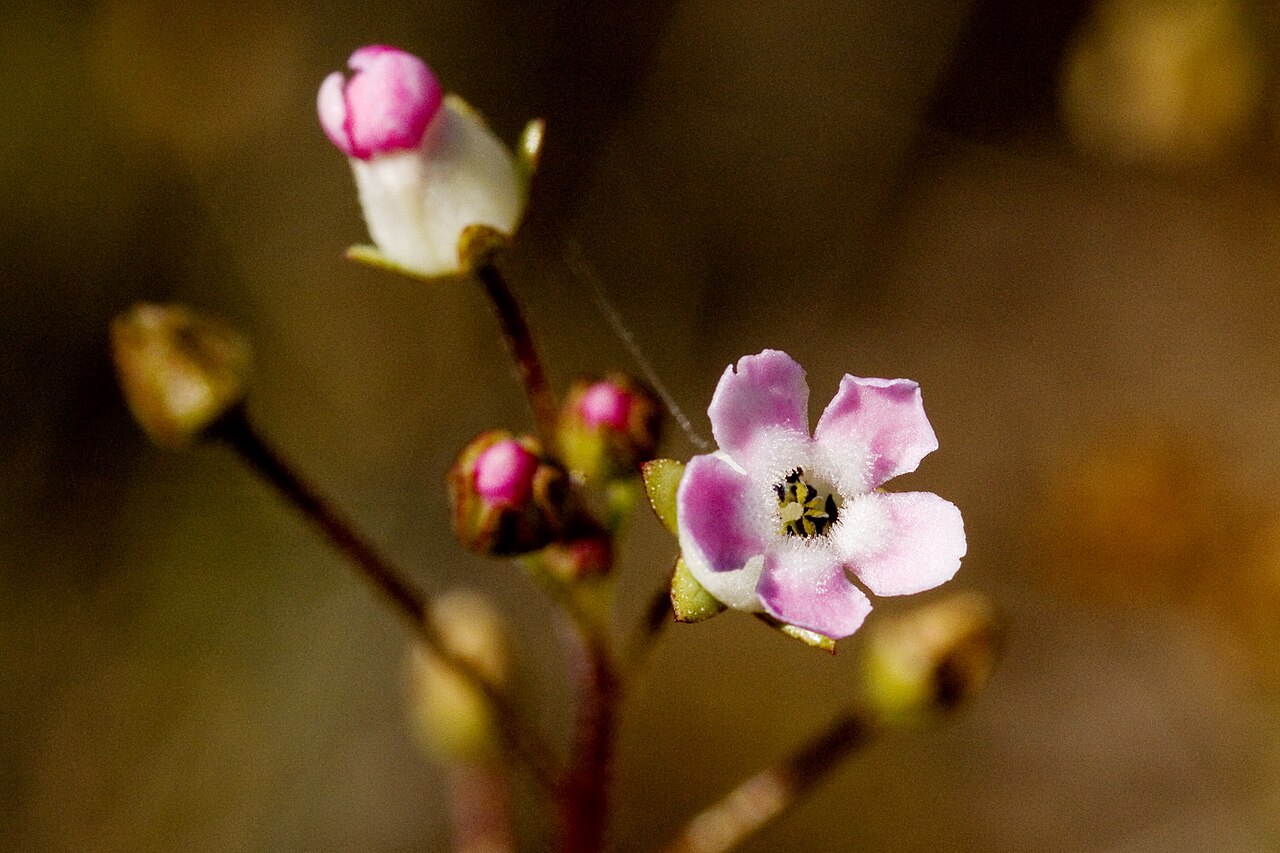
The flowers are carried in a loose raceme at the top of the stem, each on its own slender stalk (pedicel). The pedicels have no bract along their length, unlike seaside brookweed. Each flower is about 1/4 to 3/8 inch across, with five rounded lobes, white to pink or pale lavender, and a small yellowish or greenish center. The calyx is often glandular. Flowers appear from spring through fall, and nearly all year in South Florida.
Fruit
The fruit is a small, round capsule partly enclosed by the calyx. It opens at the top to release many tiny brown seeds. The persistent dark capsules on the lower stem are often visible while the top is still in flower.
Varieties
Two varieties are recognized. Variety ebracteatus grows mainly in Florida, along the Gulf Coast and in the Caribbean. Variety cuneatus, with narrower, wedge-shaped leaves, grows mainly inland in Texas, Oklahoma, Kansas, New Mexico and northern Mexico, around springs and seeps.
Look-alikes
Seaside brookweed (Samolus valerandi) has a tiny bract partway up each flower stalk, smaller white flowers and leafier stems. Pimpernels (Lysimachia or Anagallis) have opposite leaves. Small white-flowered plants such as herb-of-grace (Bacopa monnieri) have opposite, fleshy leaves and grow creeping on mud.
Quick Facts
| Scientific Name | Samolus ebracteatus |
| Family | Primulaceae (primrose family); sometimes Samolaceae |
| Plant Type | Herbaceous perennial wildflower |
| Mature Height | 4–16 in |
| Mature Spread | 4–8 in |
| Growth Rate | Moderate |
| Sun Exposure | Full sun to part shade |
| Water Needs | High; wet or saturated soil |
| Soil Type | Wet marl, limestone, alkaline or brackish mud and sand |
| Soil pH | Neutral to alkaline (about 7.0–8.5) |
| Bloom Time | March–November; nearly all year in South Florida |
| Flower Color | White to pink or pale lavender |
| Fall Color | None |
| Fruit | Small round capsule with tiny seeds |
| Deer Resistant | Unknown; rarely browsed |
| USDA Hardiness Zones | 7–11 |
Native Range
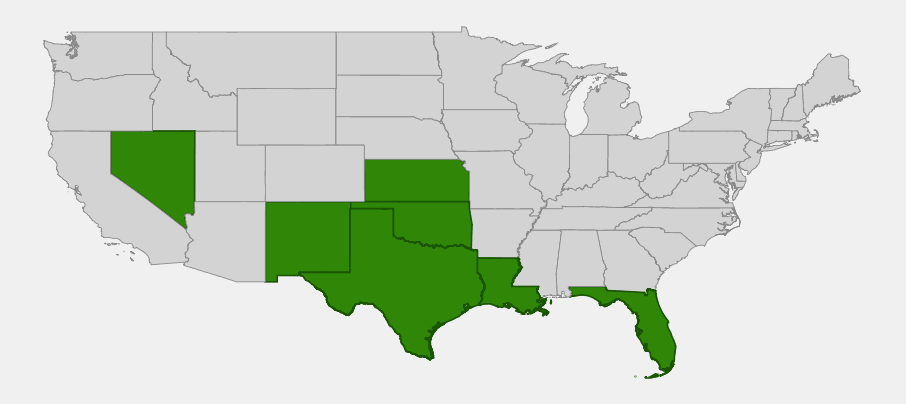
Limewater brookweed is native to the southern United States, Mexico, the Bahamas and the Caribbean. USDA PLANTS lists it as native in Florida, Kansas, Louisiana, Nevada, New Mexico, Oklahoma and Texas. It is most common in South Florida, especially the Everglades and the Florida Keys, and in Texas, where it grows along the Gulf Coast and at springs and seeps across the Edwards Plateau, the Trans-Pecos and South Texas.
Farther inland it is scattered at alkaline springs, seeps and salt flats in Oklahoma, New Mexico and southern Nevada, where it grows in spring-fed wetlands of the Mojave Desert. Records from Kansas are few and represent the northern edge of its range. In Louisiana it grows in coastal brackish marshes.
Habitats include marl prairies, calcareous seeps and spring runs, limestone ledges with dripping water, brackish and salt marsh edges, coastal flats, wet ditches and the margins of alkaline lakes and pools. It grows from near sea level to around 5,000 feet at desert springs.
📋 Regional plant lists featuring Limewater Brookweed: Nebraska, Kansas & Eastern Colorado · North & South Florida · Arkansas, Louisiana, Eastern Oklahoma & Eastern Texas · South & West Texas · California & Nevada
Growing & Care Guide
Limewater brookweed is rarely sold, but it is easy to grow in a sunny, constantly wet spot with alkaline soil or water. It suits bog gardens, pond edges and container water gardens in warm climates.
Light
Full sun to light shade. It flowers best with at least half a day of sun.
Soil & Water
Keep the soil wet or saturated all year. It prefers alkaline conditions, such as soil with limestone, marl or shell, and tolerates hard and slightly brackish water. It will not grow in dry soil or in strongly acidic peat bogs.
Planting Tips
Plant at the edge of a pond, in a bog garden or in a pot set in a saucer of water, with the crown at or just above the water line. Mix limestone chips or crushed shell into the soil if it is acidic. Space plants about 6 inches apart to form a small colony.
Pruning & Maintenance
Remove old flower stalks if they look untidy, or leave some to drop seed. Keep vigorous grasses and sedges from crowding it out. In regions with hard frosts, grow it in a pot that can be moved to shelter.
Propagation
It grows from seed sown on the surface of wet, alkaline soil, and it often self-sows in suitable spots. Rosettes can also be divided. Obtain seed or plants from cultivated sources, not from wild springs.
Landscape Uses
- Bog gardens: a small, long-blooming plant for wet, alkaline soil
- Pond and water garden edges: grows at or just above the water line
- Coastal gardens: tolerates brackish water and salt spray
- Wetland restoration: part of marl prairie and spring plant communities
- Containers: a dainty plant for a pot in a water-filled saucer
Wildlife & Ecological Value
Limewater brookweed is part of the specialized plant communities of springs, seeps and marl wetlands, which support many rare plants and animals.
For Pollinators
The small, open flowers are visited by small bees, flies and other insects that forage in wet places. The plants can also self-pollinate.
For Birds
It is not an important bird food plant, but it is part of the wet meadow and marsh vegetation used by wading birds and other wetland birds.
For Mammals
It has little value as browse for mammals.
Ecosystem Role
At desert springs and spring runs it helps form the wet edge habitat where rare invertebrates, pupfish and other spring-dependent species live. In the Everglades it is one of many small wildflowers of the marl prairies.
Cultural & Historical Uses
The genus name Samolus is an old name used by the Roman writer Pliny for a plant that grew in wet places and was gathered by the Druids. Linnaeus applied it to the brookweeds. The species name ebracteatus refers to the flower stalks without bracts.
The species was described in 1818 by the botanists Kunth, Humboldt and Bonpland from material collected on their expedition in the Americas. The common name “limewater brookweed” refers to its liking for water that is rich in lime (calcium carbonate).
There are no well-known food or medicinal uses for limewater brookweed. Its main value is ecological: it is a good indicator of alkaline, spring-fed wetlands, many of which have been drained, pumped dry or altered by development.
Frequently Asked Questions
Where does limewater brookweed grow?
It grows in wet, alkaline or brackish places such as marl prairies, limestone springs and seeps, coastal marshes and salt flats, from Florida and Texas west to New Mexico and Nevada, and south into Mexico and the Caribbean.
How is it different from seaside brookweed?
Seaside brookweed has a tiny bract partway up each flower stalk and smaller white flowers. Limewater brookweed has no bract on its flower stalks and usually larger, often pinkish flowers.
Can I grow limewater brookweed in a pond?
Yes. It grows well at the edge of a pond or in a pot sitting in shallow water, especially where the water is hard or alkaline.
Is limewater brookweed a perennial?
Yes. It is a perennial that grows from a basal rosette and can bloom for much of the year in warm climates.
Is limewater brookweed rare?
It is common in South Florida and parts of Texas, but scattered and local inland, where it depends on springs and seeps that are often threatened by groundwater pumping.

Looking for a nursery that carries Limewater Brookweed?
Browse our native plant nursery directory: Florida · Kansas · Louisiana · Nevada, New Mexico & Oklahoma · Texas

