
Huckleberry Oak (Quercus vacciniifolia)
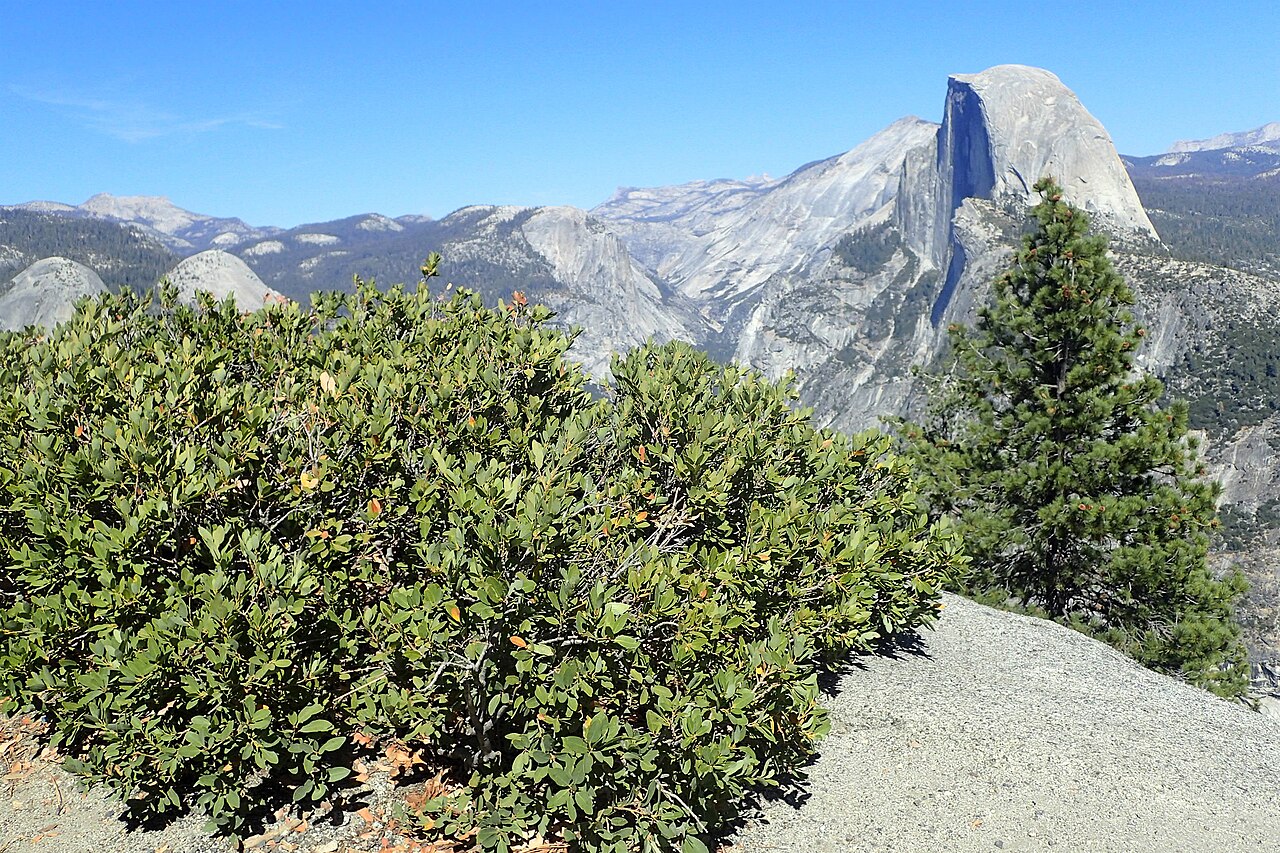
Quercus vacciniifolia, known as Huckleberry Oak, is a low, evergreen shrub oak of the mountains of California, southwestern Oregon and the Lake Tahoe area of Nevada. It rarely grows more than 3 to 5 feet tall, spreading into dense, springy thickets on granite slopes, ridges and rocky openings in the conifer forest. Its small, smooth-edged leaves look more like those of a huckleberry than an oak, which gives the plant both its common and scientific names.
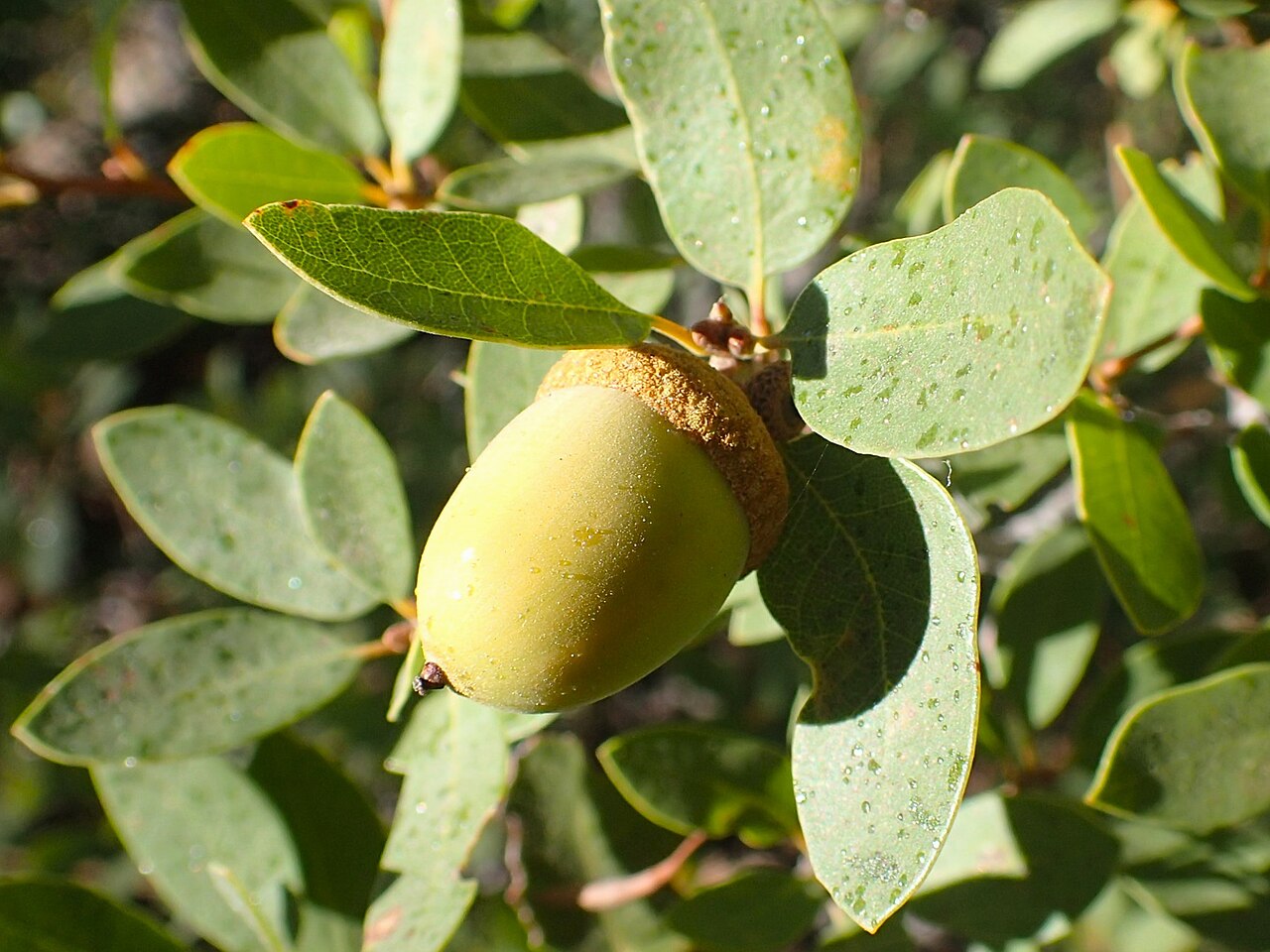
It belongs to the beech family (Fagaceae) and to the small group of “intermediate” or golden-cup oaks (section Protobalanus), with its close relative canyon live oak (Quercus chrysolepis). Like canyon live oak, its acorns take two seasons to ripen. The species name vacciniifolia means “with leaves like Vaccinium“, the genus of huckleberries and blueberries.
Huckleberry oak is one of the main shrubs of montane chaparral in the Sierra Nevada, Klamath Mountains and southern Cascades, where it covers granite and serpentine slopes, protects soil, and provides food and shelter for wildlife. It is also a tough, attractive shrub for mountain and rock gardens. This guide covers how to identify it, where it grows, how to grow it, and its value to wildlife.
Identification
Huckleberry oak is easy to overlook as an oak until you find its acorns. Look for a low, evergreen shrub with small, smooth-edged leaves that are green above and pale beneath, growing in rocky places in the mountains.
Growth Habit
It is a low, much-branched evergreen shrub, usually 2 to 5 feet tall, with flexible stems that often sprawl or root where they touch the ground. It forms dense, rounded thickets that can cover large areas of rocky slopes. After fire it resprouts vigorously from its root crown.
Leaves
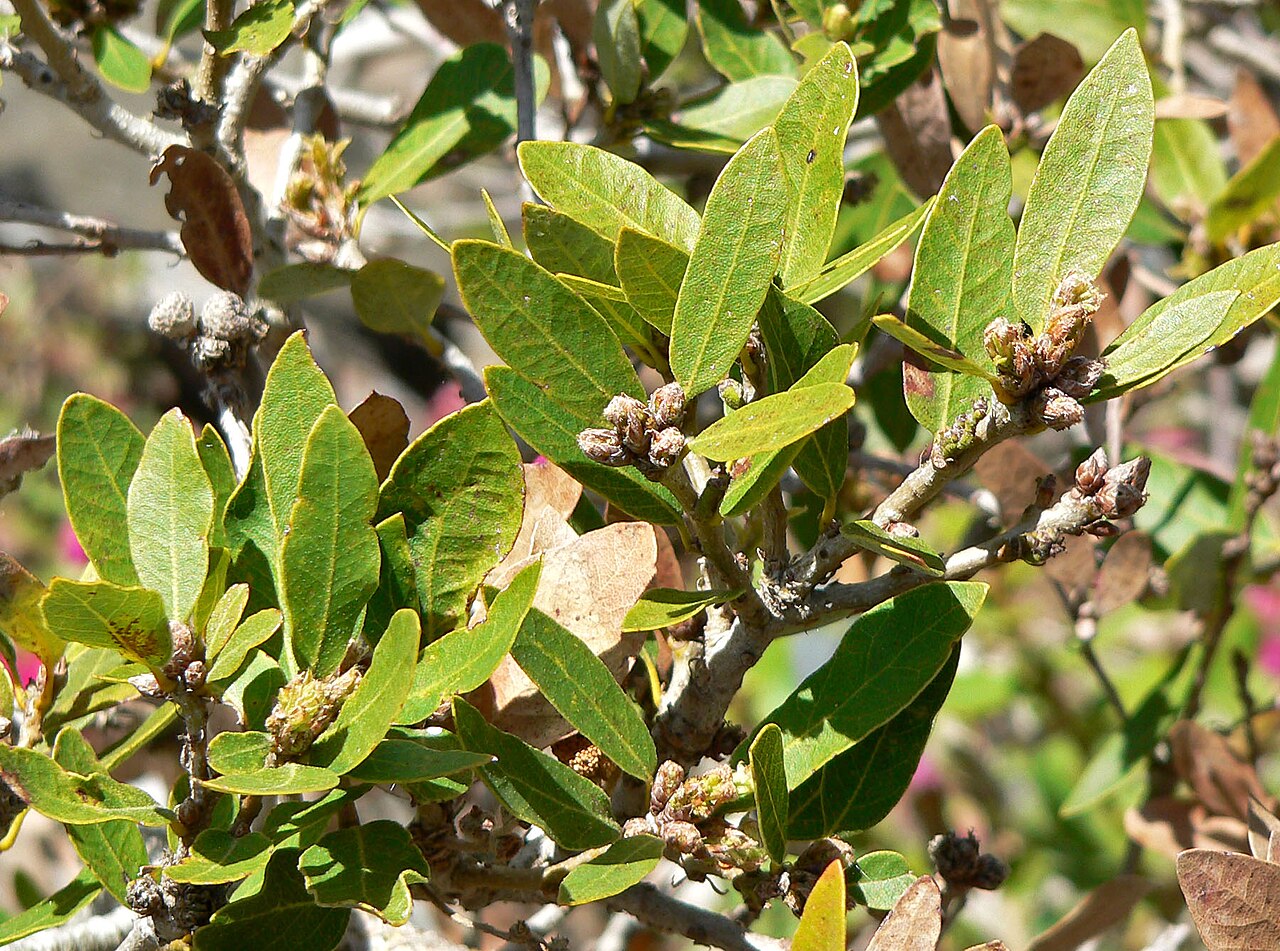
The leaves are alternate, oval to elliptic, usually 1/2 to 1 1/4 inches long, with smooth edges or occasionally a few small teeth. They are dull green above and paler and grayish beneath, without the golden fuzz found on canyon live oak leaves. They stay on the plant for two or more years.
Flowers
Like all oaks, it has separate male and female flowers on the same plant. The male flowers hang in small yellowish catkins in late spring or early summer, and the tiny female flowers sit in the leaf axils. They are wind-pollinated and not showy.
Acorns
The acorns take two growing seasons to mature. They are egg-shaped, about 1/2 inch long, set in a shallow, thin cup covered with small, often slightly woolly scales. They ripen in late summer or fall of the second year.
Look-alikes
Canyon live oak (Quercus chrysolepis) usually grows as a tree or large shrub, with leaves that are golden-fuzzy beneath when young and a thick acorn cup with golden hairs; the two sometimes hybridize. Bush chinquapin (Chrysolepis sempervirens) grows in the same places, but its leaves are golden beneath and its fruit is a spiny bur. Huckleberry oak is identified by its low habit, small, smooth-edged leaves that are pale but not golden beneath, and thin-cupped acorns.
Quick Facts
| Scientific Name | Quercus vacciniifolia Kellogg |
| Family | Fagaceae (beech family) |
| Plant Type | Evergreen shrub oak |
| Mature Height | 2–5 ft |
| Mature Spread | 4–10 ft; forms thickets |
| Growth Rate | Slow |
| Sun Exposure | Full sun to light shade |
| Water Needs | Low; drought tolerant once established |
| Soil Type | Rocky, gravelly or sandy soils; granite, volcanic and serpentine |
| Soil pH | About 5.0–7.5 |
| Bloom Time | May–July (catkins) |
| Flower Color | Yellowish catkins (inconspicuous) |
| Fall Color | None; evergreen |
| Fruit | Acorn about 1/2 in long, maturing in the second year |
| Deer Resistant | No; browsed by deer |
| USDA Hardiness Zones | 5–9 |
Native Range
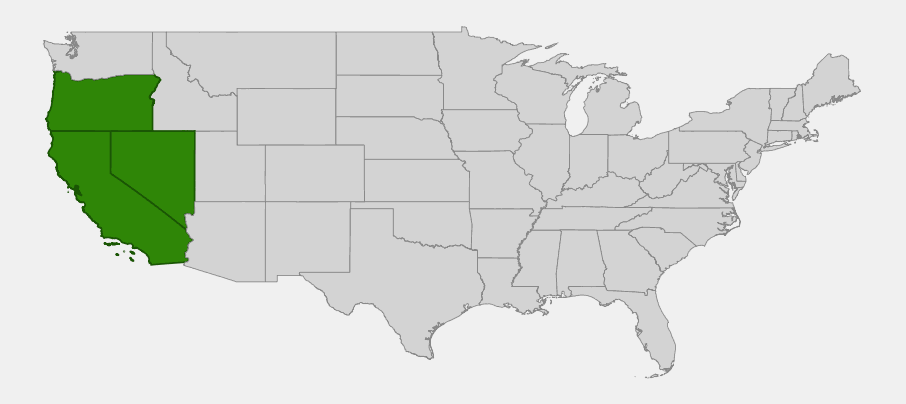
Huckleberry oak is native to the mountains of California, southwestern Oregon and far western Nevada. USDA PLANTS lists it in California, Oregon and Nevada, and it does not occur outside the United States.
In California it grows throughout the Sierra Nevada, in the Klamath and Siskiyou Mountains, the southern Cascades around Mount Shasta and Lassen, and the high North Coast Ranges. In Oregon it grows in the Siskiyou Mountains and the southern Cascades of the southwestern part of the state, west of the Cascade crest. In Nevada it is found only in the Carson Range around Lake Tahoe, at the eastern edge of the Sierra Nevada.
It grows on rocky slopes, ridges and granite outcrops, in montane chaparral and in openings in mixed conifer, Jeffrey pine and red fir forests. In the Klamath region it often grows on serpentine. It is found mostly from about 3,000 to 9,000 feet, lower in the Klamath Mountains and higher in the southern Sierra Nevada.
📋 Regional plant lists featuring Huckleberry Oak: Western Oregon & Western Washington · California & Nevada
Growing & Care Guide
Huckleberry oak is a slow-growing but very tough shrub for mountain gardens, rock gardens and dry slopes in its native region. It is occasionally offered by California native plant nurseries and botanic garden sales. It is best suited to cool, mountain or foothill climates with good drainage, and it is a good choice for erosion control on rocky banks.
Light
Grow it in full sun or light shade. It is naturally a plant of open, sunny, rocky places and becomes sparse in deep shade.
Soil & Water
It needs fast-draining soil, such as decomposed granite, gravelly loam or rocky soil, and tolerates poor and serpentine soils. Water regularly the first year or two; after that it needs little or no summer water in mountain gardens and only occasional deep watering at lower elevations. Avoid heavy, wet clay.
Planting Tips
Plant it in fall so the roots establish over winter. Space plants about 4 to 6 feet apart for a ground-covering mass. It combines well with manzanitas, ceanothus and bush chinquapin in a montane chaparral planting, or among boulders in a rock garden.
Pruning & Maintenance
Little pruning is needed. Remove dead or damaged branches in late winter. It can be cut back hard to rejuvenate old plants, since it resprouts from the base. Mulch with gravel or leaf litter rather than rich compost.
Propagation
Grow it from fresh acorns collected in fall of their second year, sown immediately in deep containers or where the plant is to grow; don’t let acorns dry out. It can also be propagated by layering, since the stems often root where they touch the ground.
Landscape Uses
- Mountain and rock gardens: a low, tough evergreen shrub for rocky sites
- Erosion control: dense roots and thickets hold soil on slopes
- Wildlife gardens: acorns and shelter for birds and mammals
- Habitat restoration: a key shrub of montane chaparral after fire or disturbance
- Low hedges and mass plantings: a natural, informal evergreen cover
Wildlife & Ecological Value
Huckleberry oak is an important wildlife plant in the mountains of California and southwestern Oregon, providing food, cover and nesting sites.
For Pollinators
The flowers are wind-pollinated, but oaks host many native moth and butterfly caterpillars, including hairstreaks and duskywings, as well as gall wasps.
For Birds
Steller’s jays, mountain quail, band-tailed pigeons and woodpeckers eat the acorns. The dense thickets give cover and nesting sites to fox sparrows, green-tailed towhees and other shrubland birds.
For Mammals
Black bears, squirrels, chipmunks and other rodents eat the acorns. Deer browse the leaves and twigs, and the thickets give them cover.
Ecosystem Role
Huckleberry oak quickly covers rocky ground after fire by resprouting from its roots, protecting the soil from erosion. Its leaf litter builds soil on thin granite and serpentine slopes, and its thickets shelter conifer seedlings and other plants.
Cultural & Historical Uses
Huckleberry oak was described in the 1850s by Albert Kellogg, a physician and one of the founders of the California Academy of Sciences, who named many California plants. Its name compares the small leaves to those of huckleberries and blueberries in the genus Vaccinium.
Native peoples of California used acorns from many oak species as a staple food, leaching out the bitter tannins before cooking. Acorns of huckleberry oak are small, and larger acorns from other oaks were generally preferred, but the shrub was part of the mountain landscape that many Sierra and Klamath peoples knew well.
Hikers in the high Sierra know huckleberry oak as one of the shrubs that make cross-country travel difficult. Its dense, springy thickets cover many granite slopes around Yosemite, Lake Tahoe and the Trinity Alps, and climbing through them is often slow going.
Frequently Asked Questions
Is huckleberry oak really an oak?
Yes. It is a true oak (Quercus) that produces acorns, but it grows as a low shrub with small leaves that look like huckleberry leaves.
How tall does huckleberry oak grow?
It usually grows 2 to 5 feet tall, spreading into dense thickets several feet wide.
Where does huckleberry oak grow?
It grows in the Sierra Nevada, Klamath Mountains, southern Cascades and North Coast Ranges of California, in southwestern Oregon, and around Lake Tahoe in Nevada, mostly between about 3,000 and 9,000 feet.
Is huckleberry oak evergreen?
Yes. Its leaves stay on the plant year-round, each lasting two or more years.
Can I grow huckleberry oak in my garden?
Yes, in well-drained, rocky or gravelly soil with full sun to light shade. It grows slowly and needs little water once established, and it does best in mountain and foothill gardens.

Looking for a nursery that carries Huckleberry Oak?
Browse our native plant nursery directory: California · Nevada · Oregon

