
Bush Chinquapin (Chrysolepis sempervirens)
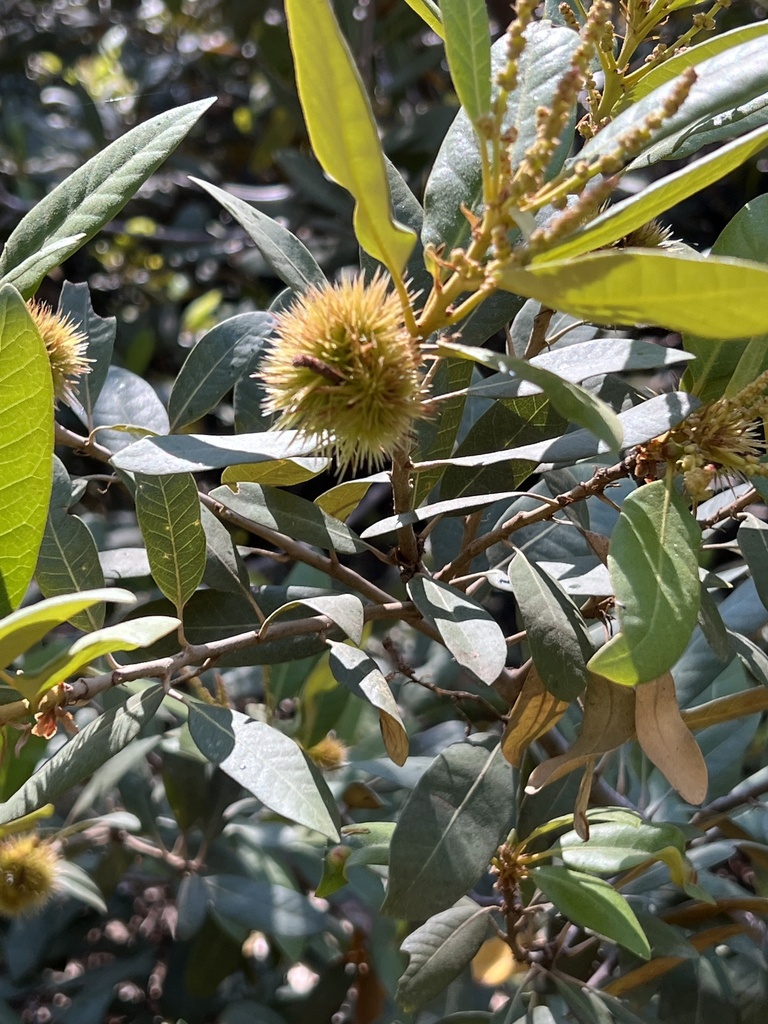
Chrysolepis sempervirens, known as Bush Chinquapin (also Sierra chinquapin or bush chinkapin), is a low, evergreen shrub of the mountains of California and southern Oregon, with a small outlying population in Nevada near Lake Tahoe. It belongs to the beech family (Fagaceae), alongside oaks and chestnuts, and was long known as Castanopsis sempervirens. Its leathery leaves are dull green above and covered with golden scales beneath, and in late summer it bears spiny, chestnut-like burs.
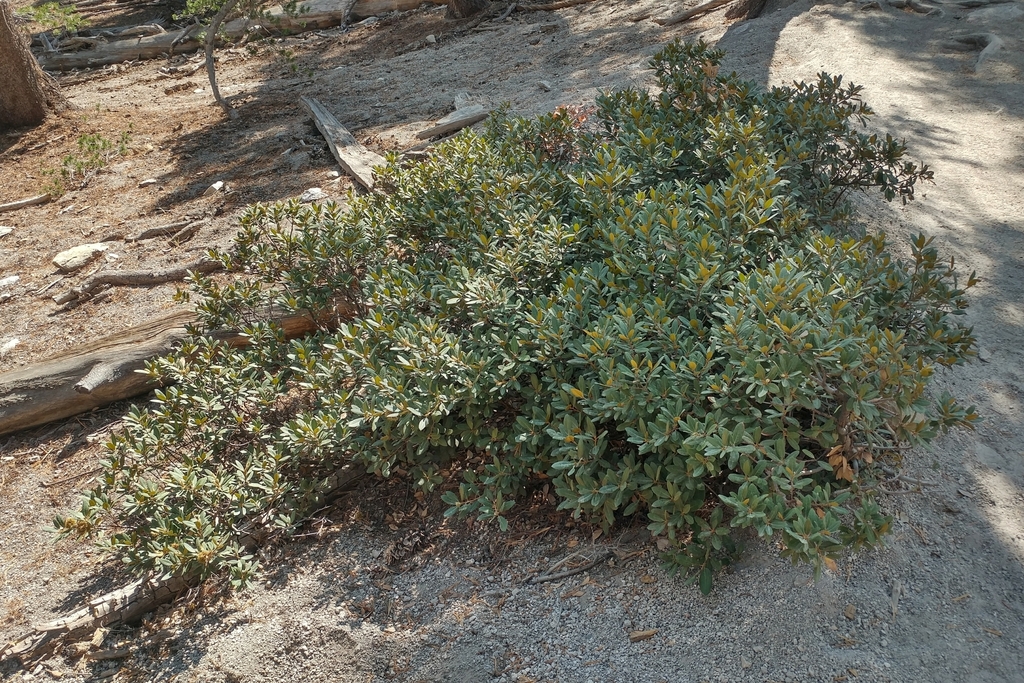
It usually grows 1 to 8 feet tall as a dense, rounded mound, often spreading wider than it is tall. It forms large patches on dry, rocky slopes, open conifer forests and mountain chaparral, mostly from about 3,000 to 11,000 feet. In summer, upright cream-colored catkins with a strong, musky scent cover the branch tips. The burs take more than a year to ripen and hold one to three small nuts that are eaten by chipmunks, squirrels, jays and other wildlife.
Bush chinquapin is a sturdy, drought-tolerant native for mountain gardens and erosion control on dry slopes. It resprouts after fire, has no serious pests and needs little care once established. It is slow to start and seldom sold, so it is mainly grown by native plant enthusiasts and restoration crews.
Identification
Look for a low, rounded evergreen shrub with oblong, untoothed leaves that are dull green above and golden to rusty beneath, upright cream catkins in summer, and spiny burs like small chestnut husks.
Growth Habit
Bush chinquapin is a many-branched evergreen shrub, usually 1 to 8 feet (0.3 to 2.5 m) tall, forming dense mounds or broad thickets. On exposed granite slopes at high elevation it can be almost prostrate. It sprouts from a woody root crown, so old plants form wide clumps. The bark is smooth and gray-brown.
Leaves
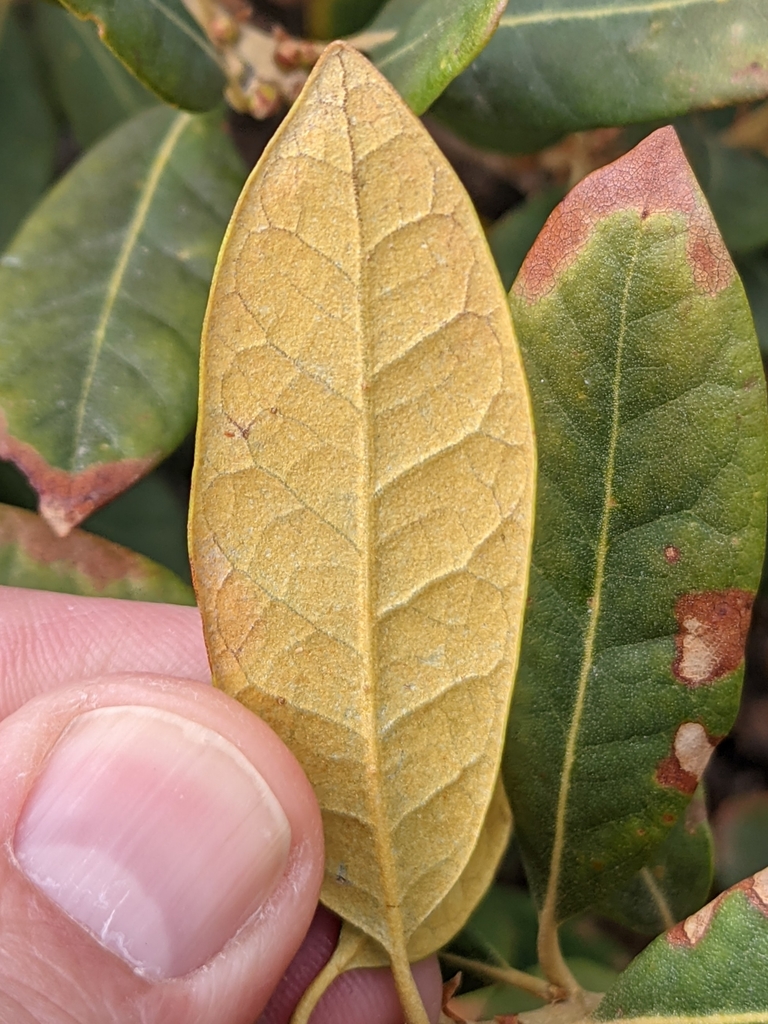
The leaves are alternate, leathery and evergreen, about 1 1/4 to 3 1/2 inches (3 to 9 cm) long, oblong to lance-shaped with a rounded or blunt tip. The edges are smooth (not toothed) and often slightly rolled under. The upper surface is yellow-green to gray-green and fairly dull; the underside is covered with tiny golden to rust-colored scales, giving the genus its name, Chrysolepis, “golden scale.” The leaves are often folded upward slightly along the midrib.
Flowers
Male and female flowers grow on the same plant. The male flowers are in upright, cream to pale yellow catkins 1 to 2 1/2 inches long, clustered at the branch tips in summer (about June to August). They have a strong, musky odor that some people find unpleasant. Small female flowers sit at the base of some catkins and develop into burs.
Fruit & Nuts
The fruit is a spiny bur about 3/4 to 1 1/4 inches across, like a small chestnut husk, densely covered in branched spines. It takes over a year to mature, so young green burs and ripening brown ones can be on a plant at the same time. Each bur splits to release one to three hard, shiny brown nuts with a sweet, edible kernel.
Look-alikes
Giant Chinquapin (Chrysolepis chrysophylla) is usually a tree or tall shrub with pointed leaves that stay golden underneath for years; it grows mostly at lower elevations in the Coast Ranges and Cascades. Huckleberry oak (Quercus vacciniifolia) grows in the same places and looks similar from a distance, but its leaves are gray-green underneath without golden scales, and it bears acorns. Manzanitas have smooth red bark and berry-like fruit. The golden leaf underside and spiny burs identify bush chinquapin.
Edibility & Safety
The nuts are edible, raw or roasted, and were gathered by Native peoples, but they are small and the spines of the burs are sharp, so wear gloves when handling them. The species is common and widespread in California and is not of conservation concern.
Quick Facts
| Scientific Name | Chrysolepis sempervirens (syn. Castanopsis sempervirens) |
| Family | Fagaceae (beech family) |
| Plant Type | Evergreen shrub |
| Mature Height | 1–8 ft |
| Mature Spread | 3–10 ft |
| Growth Rate | Slow |
| Sun Exposure | Full sun to part shade |
| Water Needs | Low; drought tolerant once established |
| Soil Type | Well-drained rocky, sandy or gravelly soils, often granitic or volcanic |
| Soil pH | About 5.0–7.0 (acidic to neutral) |
| Bloom Time | June–August (catkins) |
| Flower Color | Cream to pale yellow |
| Fall Color | None; evergreen |
| Fruit | Spiny bur with 1–3 small edible nuts, maturing the second year |
| Deer Resistant | Moderately; leathery leaves are browsed lightly |
| USDA Hardiness Zones | 5–9 |
Native Range
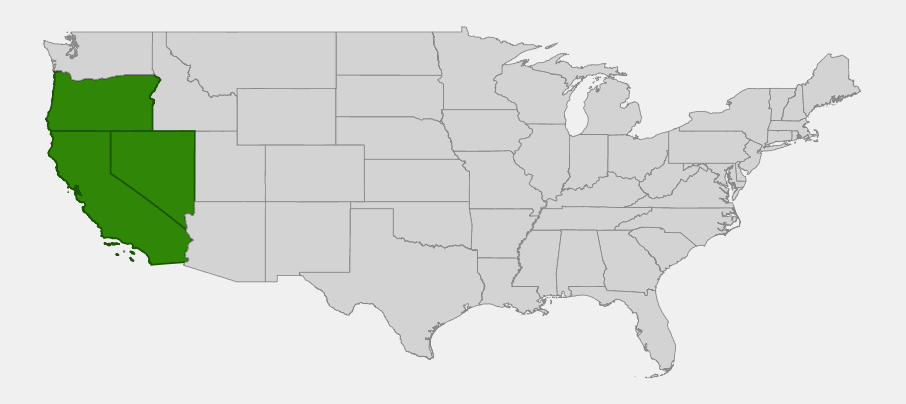
Bush chinquapin is native to the mountains of California and southern Oregon, with a small outlying population in western Nevada. USDA PLANTS lists it as native in California, Nevada and Oregon. In Nevada it is known only from the Carson Range on the east side of Lake Tahoe, an extension of the Sierra Nevada population.
In California it grows throughout the Sierra Nevada, the southern Cascades around Mount Shasta and Lassen, the Klamath Mountains and the North Coast Ranges, and south into the Transverse and Peninsular Ranges (San Gabriel, San Bernardino and San Jacinto Mountains). In Oregon it is found in the Siskiyou Mountains and the southern Cascades, including the east slope in Klamath County. It is a common sight in Yosemite, Sequoia and Kings Canyon, and Lassen Volcanic national parks.
It grows on dry, rocky slopes, granite outcrops, ridgetops and open forest floors, in mixed conifer, Jeffrey pine, red fir and lodgepole pine forests and in montane chaparral. It often forms large patches with manzanitas, huckleberry oak and mountain whitethorn, especially where fire or thin soils keep the forest open.
📋 Regional plant lists featuring Bush Chinquapin: Idaho, Eastern Oregon & Eastern Washington · Western Oregon & Western Washington · California & Nevada
Growing & Care Guide
Bush chinquapin is best suited to mountain and foothill gardens with cold winters, dry summers and fast-draining soil. It is slow to establish but very long-lived and tough once rooted.
Light
Full sun to part shade. At high elevation and in cooler areas it does best in full sun; in hot, low-elevation gardens give it afternoon shade.
Soil & Water
Plant in well-drained, rocky, sandy or gravelly soil that is acidic to neutral. Heavy, wet clay can cause root rot. Water regularly for the first one or two summers to establish deep roots, then water only occasionally in dry summers. Established plants in their native range need no irrigation.
Planting Tips
Plant in fall so winter rain and snow can settle the roots. Start with small container plants; like many members of the beech family, it develops a deep root system and dislikes being moved. Use it on slopes, among boulders or under open pines, with manzanita and ceanothus. Mulch with gravel or pine needles rather than rich bark.
Pruning & Maintenance
Little pruning is needed. Remove dead or damaged branches in late winter. Old, leggy plants can be cut back hard, since they resprout from the base. In fire-prone areas, keep plants away from structures and thin dead wood, as the dense foliage can carry fire.
Propagation
Grow from fresh nuts sown in fall outdoors or after one to three months of cold, moist stratification. Protect seed from rodents and jays, which take it quickly. Germination is fair, and seedlings grow slowly. Cuttings root poorly. Never dig wild plants; their deep roots seldom survive transplanting.
Landscape Uses
- Erosion control: dense roots and spreading habit hold dry, rocky slopes
- Mountain native gardens: an evergreen backbone shrub for cold, dry sites
- Wildlife gardens: nuts feed chipmunks, squirrels and birds
- Restoration: used to revegetate disturbed mountain slopes and burn areas
- Rock gardens: low mounds look natural among granite boulders
Wildlife & Ecological Value
Bush chinquapin is an important food and cover plant in western mountain forests.
For Pollinators
The fragrant catkins produce large amounts of pollen and attract bees, flies and beetles in summer, though the plant is also partly wind-pollinated. Bush chinquapin is a larval host plant for the golden hairstreak butterfly (Habrodais grunus), whose caterpillars feed on chinquapin and some oak leaves.
For Birds
Steller’s jays, mountain quail, sooty grouse and woodpeckers eat the nuts. The dense, evergreen mounds also give cover and nesting sites to ground-dwelling birds such as quail, towhees and fox sparrows.
For Mammals
Chipmunks, golden-mantled ground squirrels, Douglas squirrels and other rodents gather and cache the nuts, and black bears eat them too. Deer browse the leaves lightly. The thickets give shelter to small mammals.
Ecosystem Role
Bush chinquapin is a common part of montane chaparral, which develops on dry, rocky ground and after forest fires. It resprouts from its root crown after fire and helps stabilize soils while conifers re-establish. Rodents that cache the nuts and forget some help plant new shrubs.
Cultural & Historical Uses
The genus name Chrysolepis comes from the Greek chrysos, “gold,” and lepis, “scale,” for the golden scales on the leaves and young shoots. The species name sempervirens means “evergreen.” The common name chinquapin comes from an Algonquian word used for the related Chinquapin (Castanea pumila) of the eastern United States.
Native peoples of California, including Sierra Nevada and northern California tribes, gathered and ate chinquapin nuts, which taste like small chestnuts. Willis Linn Jepson pictured the “characteristic low or semi-prostrate growth on granite slopes” of this shrub in his early 1900s work on California trees and shrubs.
The genus Chrysolepis has just two species, both in the western United States: bush chinquapin and Giant Chinquapin. They are close relatives of the chestnuts (Castanea) and of the tanoak (Tan Oak).
Frequently Asked Questions
Are bush chinquapin nuts edible?
Yes. The small nuts are sweet and can be eaten raw or roasted, like tiny chestnuts. Wear gloves to open the spiny burs.
How is bush chinquapin different from giant chinquapin?
Bush chinquapin is a low shrub, usually under 8 feet, with blunt-tipped leaves, growing at higher elevations. Giant chinquapin is usually a tree or tall shrub with pointed leaves, mostly in the Coast Ranges and Cascades.
Does bush chinquapin grow in Nevada?
Yes, but only in a small area of the Carson Range on the Nevada side of Lake Tahoe, an extension of its Sierra Nevada range.
Is bush chinquapin drought tolerant?
Yes. Once established in well-drained soil, it survives dry summers with no irrigation in its native mountain range.
Can I grow bush chinquapin in my garden?
Yes, in cold-winter, dry-summer gardens with fast-draining soil. Grow it from fresh nuts or small nursery plants, not from wild-dug plants.

Looking for a nursery that carries Bush Chinquapin?
Browse our native plant nursery directory: California · Nevada · Oregon