
Water Avens (Geum rivale)
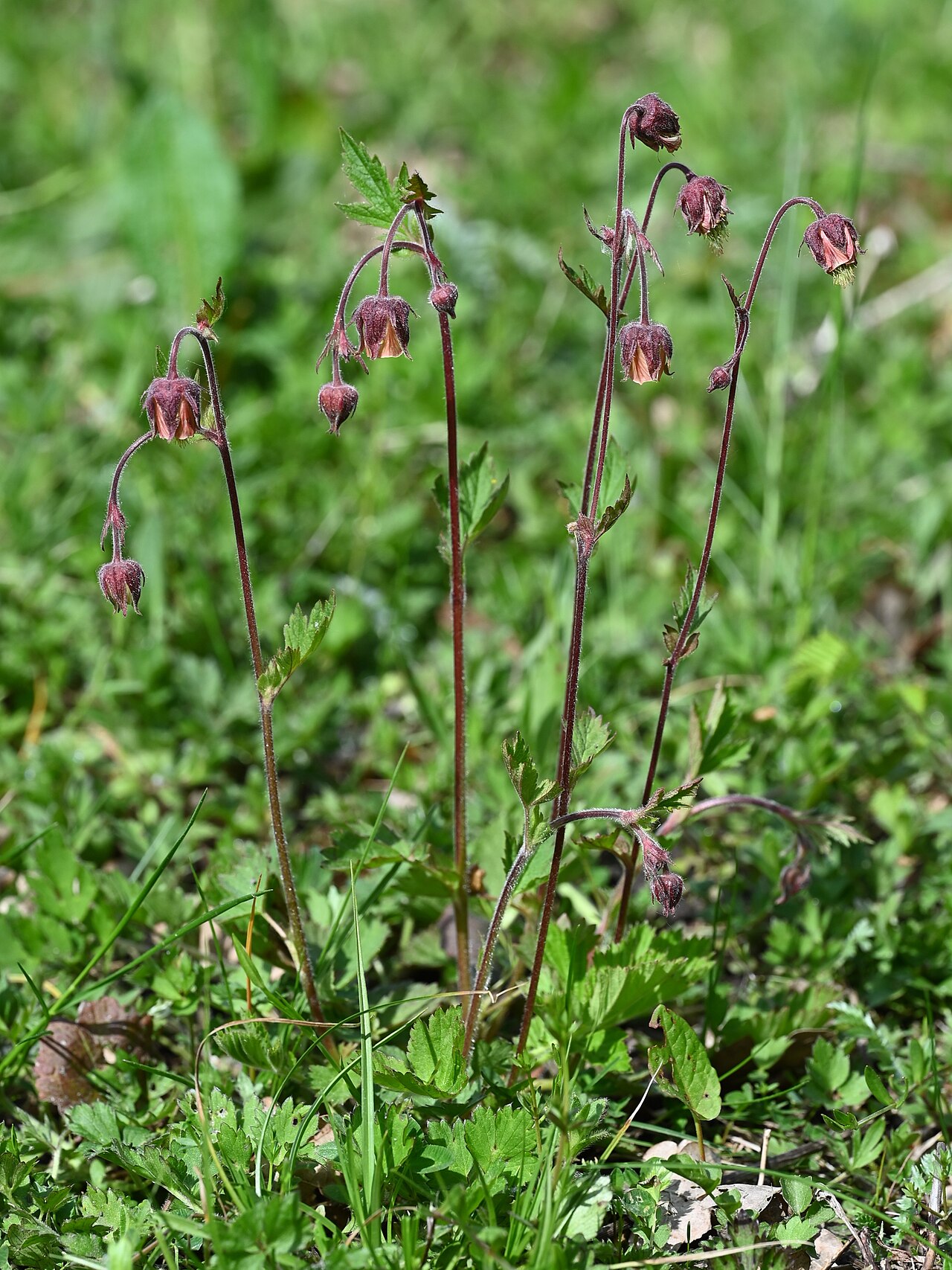
Geum rivale, known as Water Avens or purple avens (the USDA name), is a native perennial wildflower of wet meadows, fens, bogs, swamps and stream banks across the northern part of North America and Eurasia. In late spring and early summer it raises slender, reddish stems 1 to 2 feet tall, each bearing several nodding, bell-shaped flowers with dusky purple-red sepals and creamy pink to apricot petals.
It belongs to the rose family (Rosaceae), in the same genus as prairie smoke and the yellow-flowered avens. The species name rivale means “of brooks” or “growing by streams”, describing its preference for wet ground. Its thick, aromatic rootstock was once boiled to make a drink, which earned it the old name “chocolate root” or “Indian chocolate”.
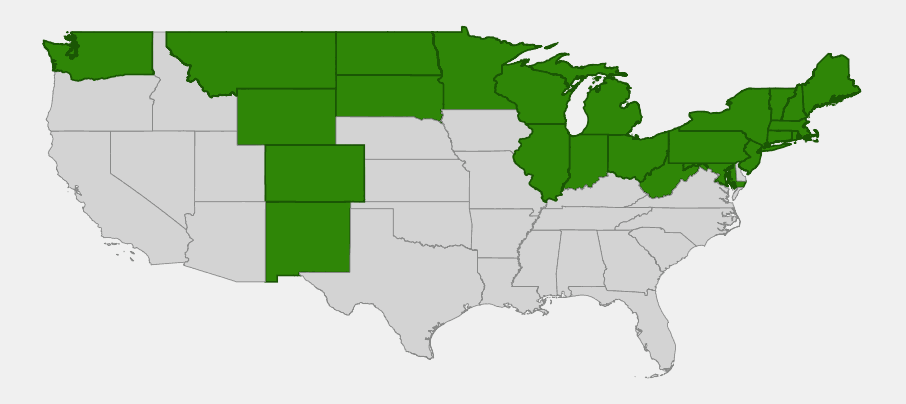
In the United States water avens grows from Maine and the Great Lakes states west to North Dakota, with outlying populations in the Rocky Mountains from Montana to New Mexico and in northeastern Washington. It is an attractive, long-blooming native for bog gardens, rain gardens and moist, cool borders, and a good bumblebee plant. This guide covers how to identify it, where it grows, how to grow it and its value to wildlife.
Identification
Water avens is easiest to spot in late spring and early summer, when its nodding, purplish bells hang from slender stems above a clump of divided leaves in wet, open ground.
Growth Habit
It is a clump-forming perennial with a thick, short rhizome. A rosette of basal leaves produces several upright flowering stems, usually 1 to 2 feet tall and occasionally to about 2 1/2 feet. The stems are hairy and often reddish purple.
Leaves
The basal leaves are pinnately divided, with a large, rounded, lobed and toothed end leaflet and several much smaller leaflets below it. The stem leaves are smaller and usually divided into three. The leaves are softly hairy.
Flowers
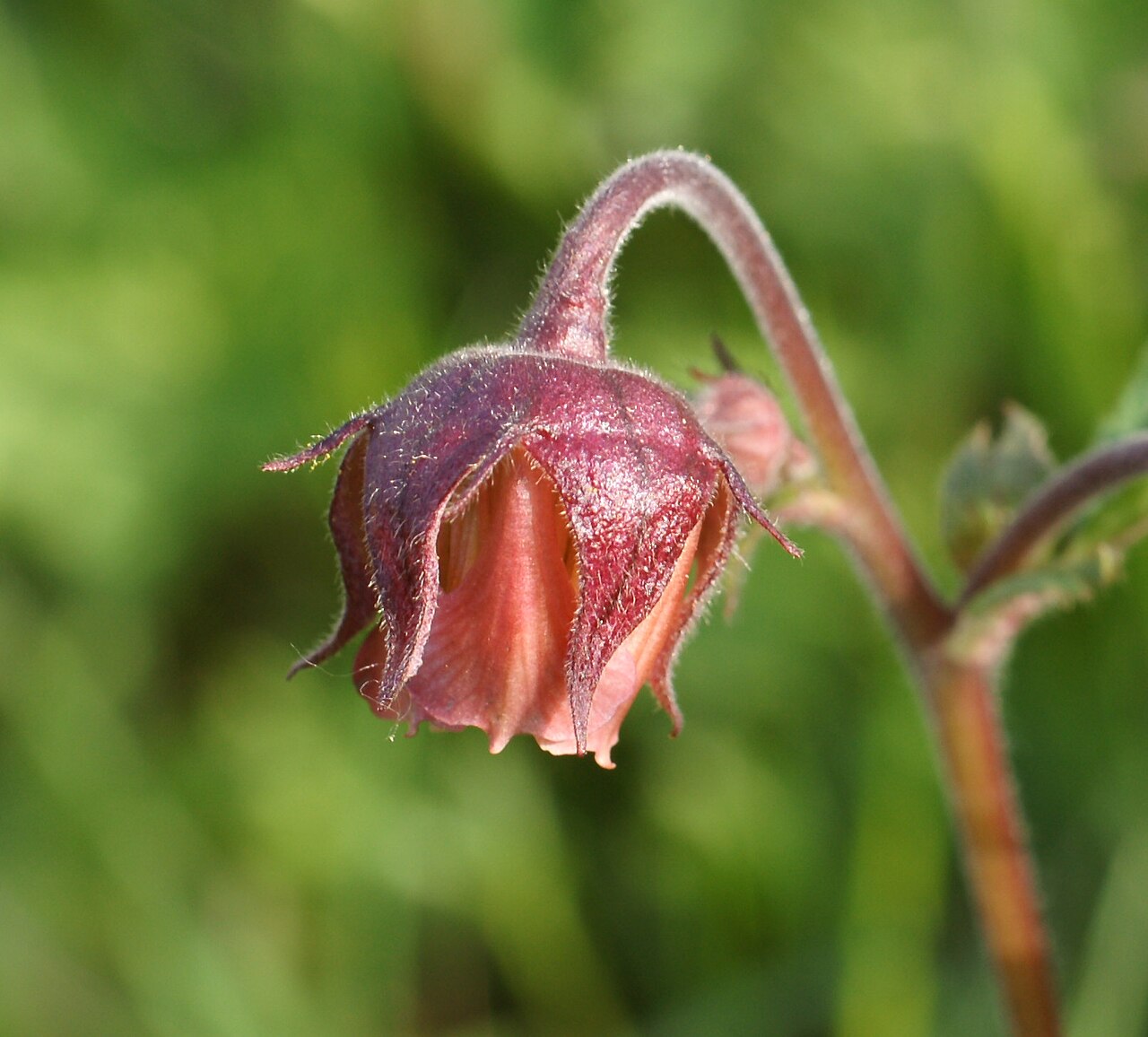
The flowers nod at the tips of the branches, usually in groups of two to five. Each is bell-shaped and about 1/2 to 3/4 inch long, with five dark purplish-brown sepals that stay partly closed around five pale yellow, pink or apricot petals with purple veins. Numerous stamens and pistils fill the center. Bloom time is mainly May to July.
Fruit & Seeds
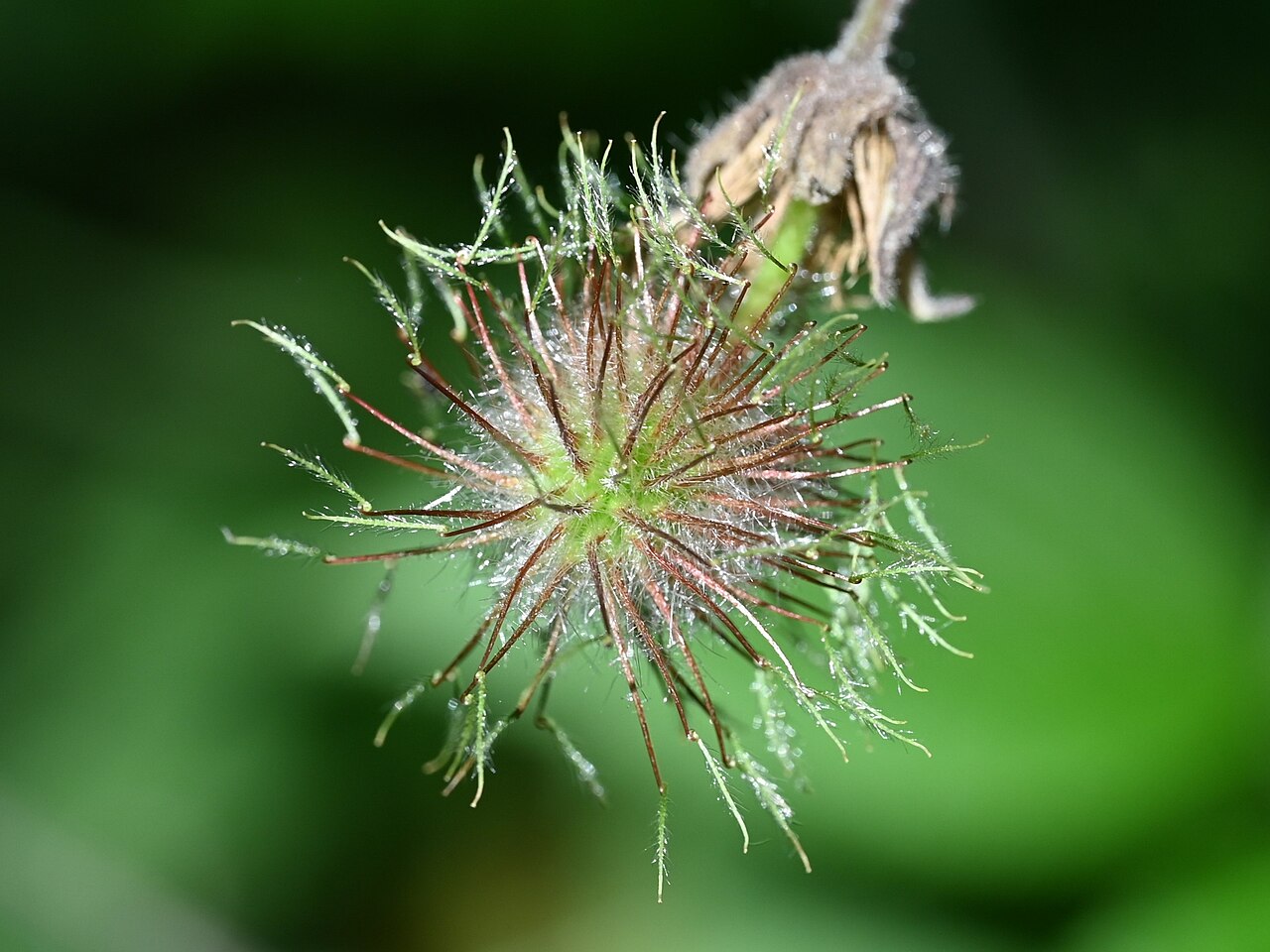
After flowering, the flower heads turn upright and develop into round, bristly heads of many small achenes. Each achene carries a long, jointed, hairy style with a hook at the bend, which catches on fur, feathers and clothing and spreads the seed.
Look-alikes
Prairie smoke (Geum triflorum) also has nodding purplish flowers but grows in dry prairies and has fern-like leaves and long, feathery plumes on the fruits. Large-leaved avens (Geum macrophyllum), yellow avens (Geum aleppicum) and white avens (Geum canadense) have upward-facing, open yellow or white flowers. Water avens sometimes hybridizes with yellow-flowered avens, producing plants with intermediate, yellowish-pink flowers.
Quick Facts
| Scientific Name | Geum rivale L. |
| Family | Rosaceae (rose family) |
| Plant Type | Herbaceous perennial |
| Mature Height | 1–2 ft (to 2 1/2 ft) |
| Mature Spread | 1–1 1/2 ft |
| Growth Rate | Moderate |
| Sun Exposure | Full sun to part shade |
| Water Needs | High; moist to wet soil |
| Soil Type | Moist to wet loam, peat or muck; tolerates some lime |
| Soil pH | About 5.5–7.5 |
| Bloom Time | May–July |
| Flower Color | Purplish-red sepals; cream, pink or apricot petals |
| Fall Color | Basal leaves stay green into late fall |
| Fruit | Bristly head of hooked achenes |
| Deer Resistant | Moderately; foliage is seldom heavily browsed |
| USDA Hardiness Zones | 3–7 |
Native Range
Water avens is circumboreal, native across northern North America, Europe and northern Asia. In North America it grows from Newfoundland and Labrador west to British Columbia and the Northwest Territories. USDA PLANTS lists it in 24 states, from Maine to Maryland and West Virginia, west through the Great Lakes states to Minnesota and the Dakotas, and in the Rocky Mountain states of Montana, Wyoming, Colorado and New Mexico, plus Washington.
In the East it is most common in northern New England, New York, northern Pennsylvania and the upper Great Lakes, and becomes rare southward in Maryland, West Virginia, northern Ohio, Indiana and Illinois. In the West its populations are scattered: in northeastern Washington (Okanogan, Ferry, Stevens and Pend Oreille Counties), western Montana, Wyoming, the Black Hills and northeastern North Dakota, and the mountains of Colorado and northern New Mexico, which mark the southern limit of its range.
It grows in cool, wet, open or lightly shaded places: fens, sedge meadows, wet meadows, bogs, swamps, alder and willow thickets, stream banks and wet woods, often in calcareous seepage. It is found from near sea level in the Northeast to montane and subalpine elevations in the Rockies.
📋 Regional plant lists featuring Water Avens: New York, Pennsylvania & Northern New Jersey · Ohio & Indiana · Montana & Wyoming · Michigan, Wisconsin & Eastern Minnesota · Connecticut, Massachusetts & Rhode Island · New Hampshire, Maine & Vermont · Maryland, Virginia & West Virginia · Delaware, Southern New Jersey & Long Island · Illinois, Iowa & Missouri · North Dakota, South Dakota & Western Minnesota
Growing & Care Guide
Water avens is an easy, long-lived perennial for cool, moist gardens. It is sold by many nurseries, often as named European selections; for native plantings, look for straight-species plants or seed from a regional native nursery.
Light
Grow it in full sun where the soil stays moist, or in part shade. In hot-summer areas it does best with afternoon shade.
Soil & Water
It needs consistently moist to wet soil and does well in heavy or organic soils, at the edge of a pond or stream, or in a bog or rain garden. It tolerates slightly acidic to slightly alkaline conditions. It does not tolerate drought, and the foliage scorches if the soil dries out in summer heat.
Planting Tips
Plant in spring or fall, spacing plants about 12 to 18 inches apart. It works well in groups at the front of a moist border or along a stream bank, with marsh marigold, blue flag, sedges and meadow-rue. It is best suited to cooler regions; south of its native range it struggles in hot, humid summers.
Pruning & Maintenance
Remove the spent flower stems if you want to tidy the plant or prevent self-sowing, or leave them for the interesting seed heads. Divide crowded clumps every few years in early spring or fall.
Propagation
It grows readily from seed, which needs no pretreatment; sow fresh seed in late summer or in spring, on the surface of moist soil. Clumps can also be divided in spring or fall.
Landscape Uses
- Bog and rain gardens: nodding purple bells in late spring for wet soil
- Stream and pond edges: a natural fit for cool, moist banks
- Pollinator gardens: early-season nectar for bumblebees
- Wetland restoration: a native forb of fens, sedge meadows and wet thickets
- Cottage and woodland-edge gardens: charming, long-blooming flowers in part shade
Wildlife & Ecological Value
Water avens provides early-summer nectar in wet meadows and fens and is part of the rich flora of these cool, wet habitats.
For Pollinators
The nodding flowers are visited mainly by bumblebees, which hang beneath them to reach the nectar. Other bees and flies also visit.
For Birds
The bristly seed heads may be eaten by some songbirds, and the hooked fruits can be carried in feathers. Wet meadows with water avens also shelter nesting birds such as sparrows and wrens.
For Mammals
The hooked achenes catch in the fur of passing mammals, which disperse the seed. The foliage is seldom heavily browsed.
Ecosystem Role
Water avens is a characteristic plant of fens, sedge meadows and wet thickets, which are uncommon and declining in parts of the Midwest and along the southern edge of its range. Populations there are scattered and worth protecting; never dig plants from the wild.
Cultural & Historical Uses
Carl Linnaeus named Geum rivale in 1753. The genus name Geum is an old Latin plant name, possibly from the Greek geuo, to taste, referring to the aromatic roots of some species, and rivale refers to its streamside habitat.
Its rootstock contains tannins and has a mild, clove-like aroma. In both Europe and North America it was used historically as a home remedy and was boiled to make a drink likened to cocoa, which led to names such as chocolate root and Indian chocolate. It is not recommended as a food or remedy today.
In European gardens water avens has long been a cottage garden favorite, and selections such as ‘Leonard’s Variety’ with coppery pink flowers are widely sold. North American gardeners can enjoy the same charm with straight native plants in wet, cool corners of the garden.
Frequently Asked Questions
Why is it called water avens?
It grows in wet places such as wet meadows, fens and stream banks, and the species name rivale means “of brooks”. USDA PLANTS calls it purple avens.
Where does water avens grow?
Across northern North America, Europe and Asia. In the U.S. it grows from New England and the Great Lakes to the Dakotas, in the Rocky Mountains south to New Mexico, and in northeastern Washington.
Is water avens the same as prairie smoke?
No. Both are avens with nodding purplish flowers, but prairie smoke grows in dry prairies and has feathery seed plumes, while water avens grows in wet ground.
Can I grow water avens in my garden?
Yes. Plant it in moist to wet soil in full sun or part shade, especially in cool-summer areas. It does well in bog and rain gardens.
What pollinates water avens?
Mainly bumblebees, which hang beneath the nodding flowers to reach the nectar.

Looking for a nursery that carries Water Avens?
Browse our native plant nursery directory: Colorado & Connecticut · Illinois & Indiana · Maine, Maryland, Massachusetts, Michigan, Minnesota & Montana · New Hampshire, New Jersey, New Mexico, New York, North Dakota & Ohio · Pennsylvania, Rhode Island, South Dakota & Vermont · Washington · West Virginia, Wisconsin & Wyoming

