
Downy Skullcap (Scutellaria incana)
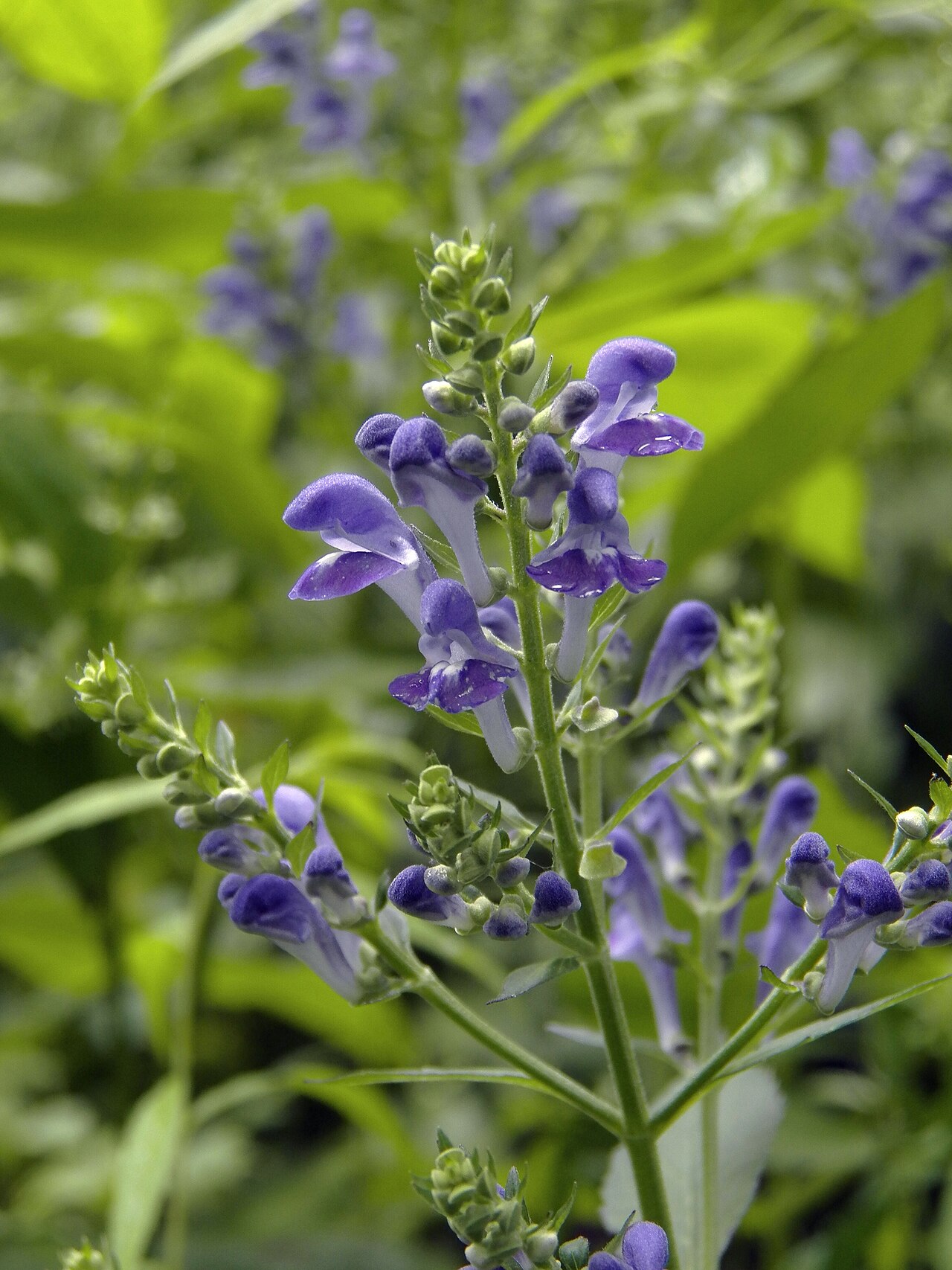
Scutellaria incana, known as Downy Skullcap or hoary skullcap (the USDA name), is a native perennial wildflower of open woods, woodland edges and rocky slopes in the eastern and central United States. It belongs to the mint family (Lamiaceae) and has the family’s square stems and opposite leaves, but not a strong minty scent. From early summer into early fall it carries branched spikes of blue-violet, two-lipped flowers above clumps of soft, grayish-green foliage.
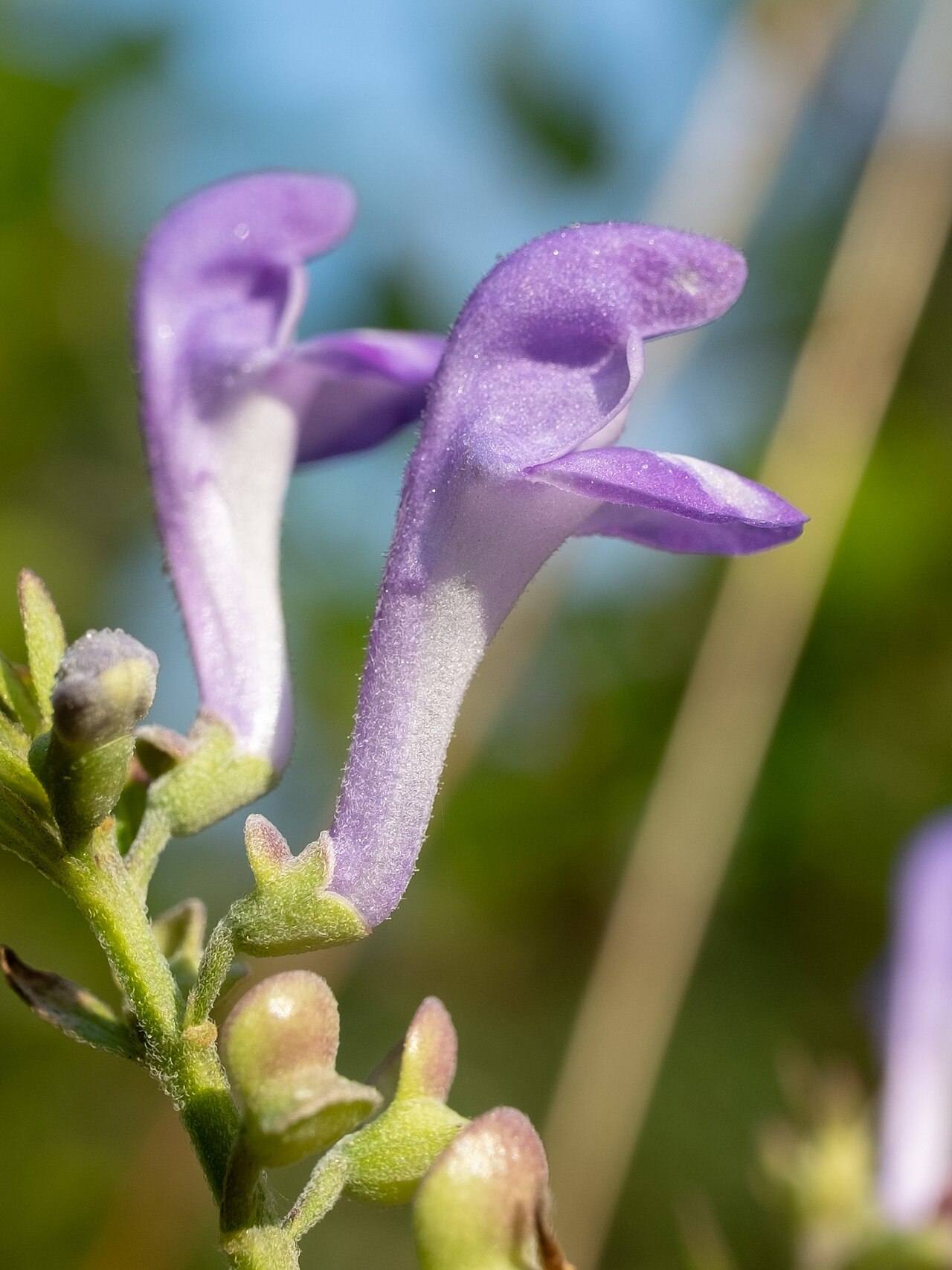
It is one of the largest and showiest of the eastern skullcaps, usually 2 to 3 feet tall. The name “downy” or “hoary” refers to the fine, grayish hairs that cover the stems, leaves and calyces. Each flower has a hooded upper lip and a broader lower lip with a white patch in the throat, and the calyx bears a small raised cap, the feature that gives skullcaps their name.
Downy skullcap is easy to grow in partial shade and dry to average soil, making it a good choice for woodland edges and shade gardens where few native plants bloom in midsummer. Bumblebees and other long-tongued bees visit the flowers, and the plant self-sows modestly without becoming weedy.
Identification
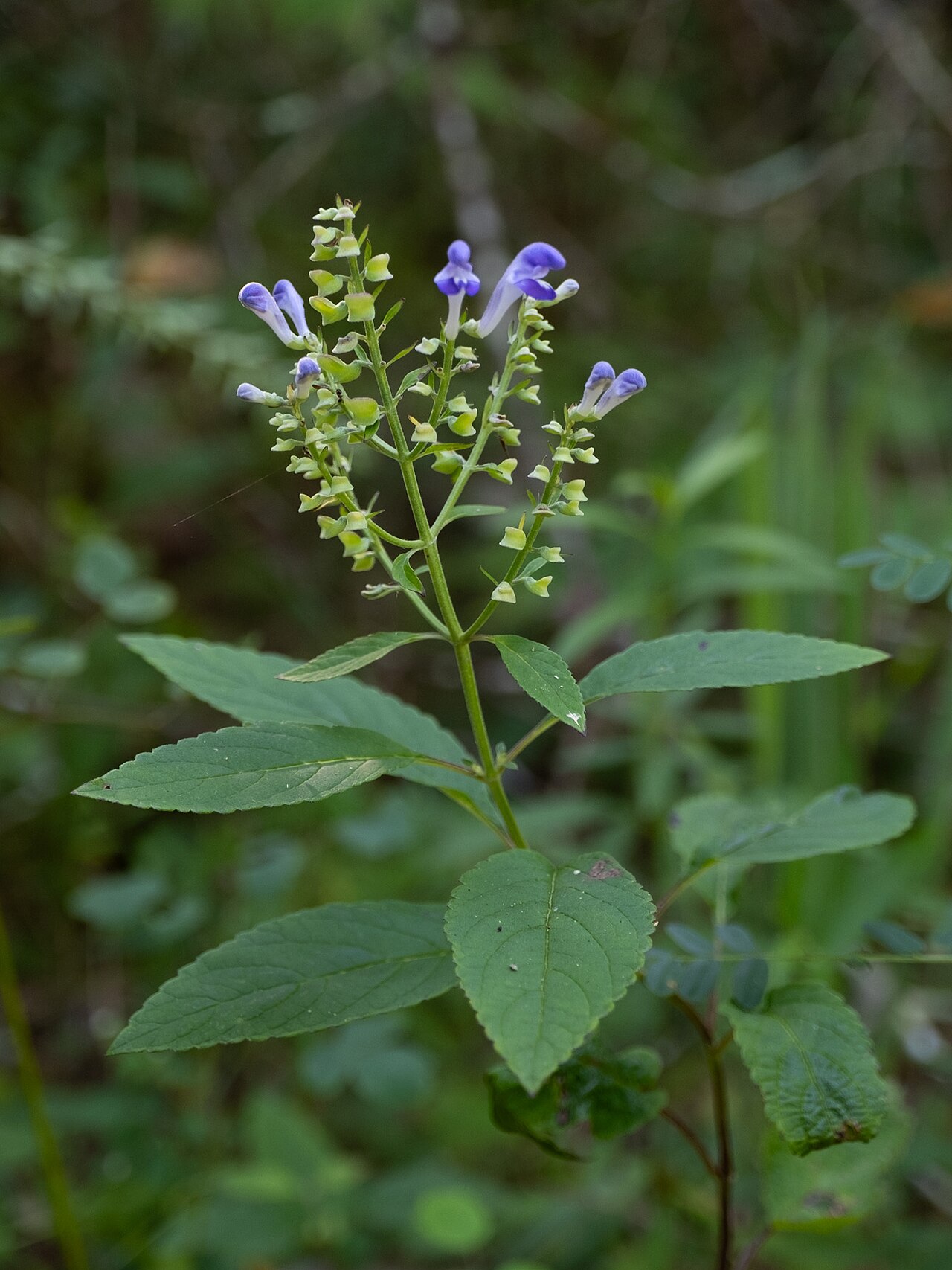
Look for upright, grayish, finely hairy plants with pairs of broad, coarsely toothed leaves on short stalks, topped by branched clusters of blue-violet hooded flowers in summer.
Growth Habit
An erect, clump-forming perennial 2 to 3 feet tall (occasionally to about 4 feet), with square stems that are usually unbranched below and branched in the flowering part. Plants spread slowly by short rhizomes and form small colonies.
Leaves
The leaves are opposite, egg-shaped to broadly lance-shaped, about 2 to 6 inches long, with rounded teeth along the edges and short leaf stalks. They are green above and paler and finely hairy beneath, giving the plant a soft, gray-green look.
Flowers
Flowers are borne in branched, spike-like clusters (racemes) 3 to 6 inches long at the top of the stem and upper branches, from June to September. Each flower is about 3/4 to 1 inch long, blue to blue-violet, with a hooded upper lip and a broad lower lip marked with a white patch. The calyx is densely covered in fine gray hairs and has a small rounded hump (the “skullcap”) on its upper side.
Fruit & Seeds
After flowering, each calyx closes around four small, dark nutlets. When ripe in late summer and fall, the calyx splits and the seeds drop near the parent plant.
Look-alikes
Heart-leaved skullcap (S. ovata) has heart-shaped leaf bases and unbranched flower spikes. Side-flowering skullcap (S. lateriflora) grows in wet places and has small flowers in one-sided spikes from the leaf axils. Helmet skullcap (S. integrifolia) has narrow, mostly untoothed upper leaves. Downy skullcap’s combination of grayish hairs, broad toothed leaves and branched terminal flower clusters sets it apart.
Quick Facts
| Scientific Name | Scutellaria incana |
| Family | Lamiaceae (mint family) |
| Plant Type | Herbaceous perennial wildflower |
| Mature Height | 2–3 ft |
| Mature Spread | 1–2 ft |
| Growth Rate | Moderate |
| Sun Exposure | Part shade to full sun |
| Water Needs | Low to medium |
| Soil Type | Dry to medium loam, sand or rocky soil |
| Soil pH | Acidic to neutral (about 5.0–7.0) |
| Bloom Time | June–September |
| Flower Color | Blue to blue-violet with a white throat |
| Fall Color | None notable |
| Fruit | Four small nutlets in the calyx |
| Deer Resistant | No; deer browse it |
| USDA Hardiness Zones | 5–9 |
Native Range
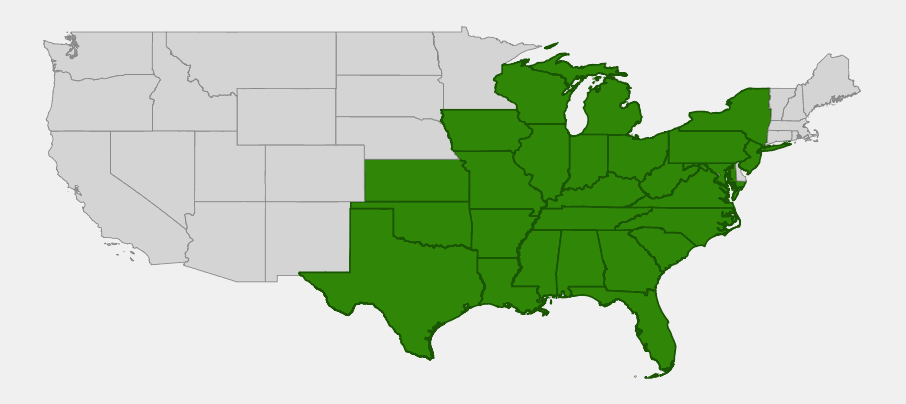
Downy skullcap is native to the eastern and central United States. USDA PLANTS records it in 26 states, from New York, New Jersey and Pennsylvania south to Florida, west to Michigan, Wisconsin, Iowa, Kansas and Oklahoma, and south to eastern Texas and Louisiana. It is not known from New England or Canada.
It is most common in the Appalachian region, the Ohio and Tennessee valleys, the Ozarks and the Piedmont. At the northern edge of its range in New York, New Jersey, Michigan, Wisconsin and Iowa it is scattered and uncommon. In Texas it grows only in the eastern part of the state, and in Florida mainly in the north.
Typical habitats are dry to moist open woods, woodland edges and openings, rocky wooded slopes, bluffs, thickets, clearings, roadsides and sandy pinelands. It does best in light shade or dappled sun and is often found where the canopy is thin, such as along trails and forest edges.
📋 Regional plant lists featuring Downy Skullcap: New York, Pennsylvania & Northern New Jersey · Ohio & Indiana · Michigan, Wisconsin & Eastern Minnesota · Kentucky & Tennessee · Nebraska, Kansas & Eastern Colorado · Maryland, Virginia & West Virginia · Delaware, Southern New Jersey & Long Island · Illinois, Iowa & Missouri · Alabama, Georgia & Mississippi · North & South Florida · North & South Carolina · Arkansas, Louisiana, Eastern Oklahoma & Eastern Texas
Growing & Care Guide
Downy skullcap is an adaptable, low-care perennial for the shady or partly sunny parts of the garden. It tolerates dry soil once established and brings blue flowers to midsummer, when many woodland plants have finished blooming.
Light
Part shade is ideal, such as high, open shade or morning sun with afternoon shade. It also grows in full sun if the soil does not dry out completely, and in fairly deep shade with fewer flowers.
Soil & Water
Grow it in well-drained, average to dry soil, including sandy, rocky or clay loam. It prefers acidic to neutral soil and does not need rich soil. Water new plants during their first summer; after that it tolerates dry spells well.
Planting Tips
Plant in spring or fall, about 18 inches apart. Use it in groups at the edge of a woodland garden, under high-branched trees, or with ferns, sedges and goldenrods. It pairs well with other summer-blooming shade plants.
Pruning & Maintenance
Little care is needed. Leave the stems standing after bloom so the seeds can ripen; cut them back in late winter. Tall plants in rich soil or deep shade may lean, so a little support from neighboring plants helps.
Propagation
Grow it from seed collected in late summer or fall and sown outdoors in fall, or after about 30 to 60 days of cold, moist stratification. It can also be grown from stem cuttings in early summer or by dividing clumps in spring.
Landscape Uses
- Woodland edges: summer blue flowers in dappled shade
- Shade gardens: fills the midsummer gap after spring ephemerals
- Dry shade: tolerates dry soil under trees once established
- Pollinator gardens: a long-blooming source of nectar for bees
- Naturalized areas: self-sows modestly in open woods and meadows
Wildlife & Ecological Value
Downy skullcap blooms for a long period in summer and attracts a variety of bees and other insects to woodland edges.
For Pollinators
Bumblebees and other long-tongued bees are the main visitors, landing on the broad lower lip and reaching into the corolla for nectar. Skipper butterflies and other insects also visit the flowers.
For Birds
The small nutlets are of limited value to birds, but the plant adds cover to woodland edges used by ground-feeding birds.
For Mammals
Deer and rabbits sometimes browse the plants, especially young growth. Planting in groups helps a few stems survive to bloom.
Ecosystem Role
As a common plant of open woods and edges, downy skullcap helps support native bees through the summer and adds diversity to the herb layer of oak-hickory and mixed forests.
Cultural & Historical Uses
The genus name Scutellaria comes from the Latin scutella, a small dish or saucer, after the shape of the cap on the calyx. The species name incana is Latin for “hoary” or “gray,” referring to the fine gray hairs on the plant.
Several skullcaps, especially side-flowering skullcap (S. lateriflora), have been used in herbal medicine. Downy skullcap is less well known in that tradition, and like other wild plants it should not be used as a home remedy.
Botanists recognize two forms of downy skullcap, one with gland-tipped hairs and one without, sometimes treated as separate varieties. Both share the same garden qualities and habitats.
Frequently Asked Questions
Why is it called skullcap?
The calyx of each flower has a small, raised cap on its upper side, thought to resemble an old-fashioned skullcap or helmet.
Is downy skullcap the same as hoary skullcap?
Yes. Hoary skullcap is the USDA common name for Scutellaria incana; downy skullcap is another widely used name.
Does downy skullcap grow in shade?
Yes. It grows best in part shade and tolerates fairly deep shade, although it flowers more in brighter light.
Is downy skullcap invasive?
No. It is a native plant that spreads slowly and self-sows modestly. It is easy to remove where it is not wanted.
When does downy skullcap bloom?
From June to September, with the main bloom in midsummer.

Looking for a nursery that carries Downy Skullcap?
Browse our native plant nursery directory: Alabama & Arkansas · Florida & Georgia · Illinois, Indiana, Iowa & Kansas · Kentucky, Louisiana, Maryland, Michigan, Mississippi & Missouri · New Jersey, New York, North Carolina, Ohio & Oklahoma · Pennsylvania, South Carolina, Tennessee, Texas & Virginia · West Virginia & Wisconsin

