
Narrowleaf Gumweed (Grindelia lanceolata)
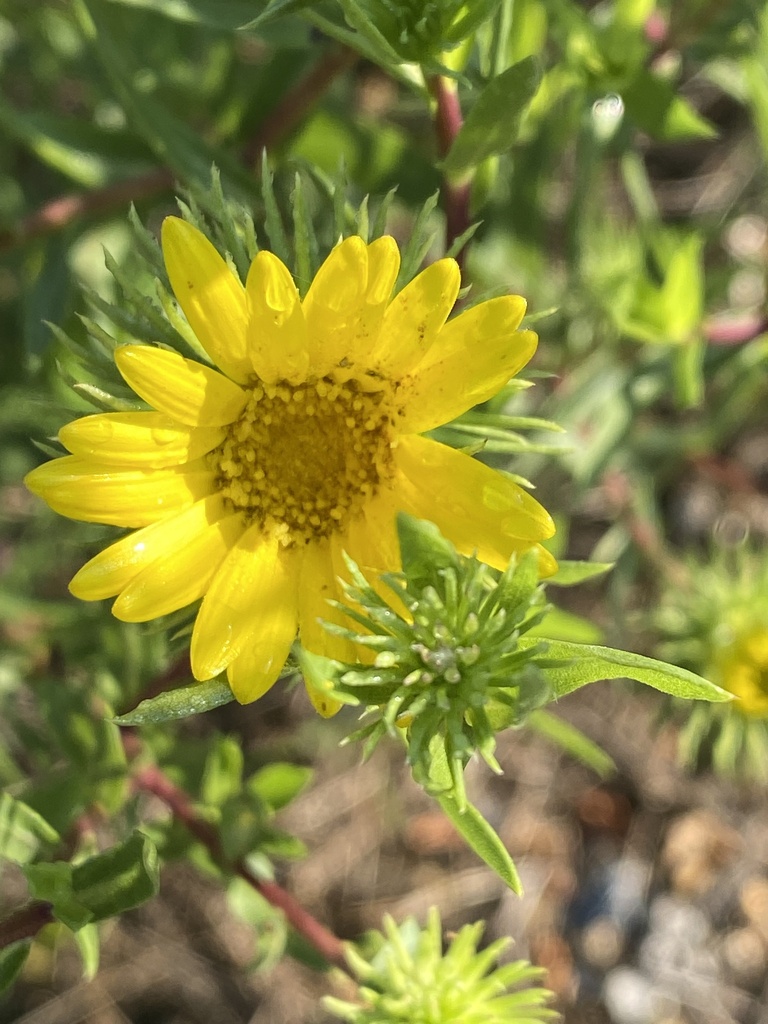
Grindelia lanceolata, known as Narrowleaf Gumweed or narrow-leaf gumweed, is a tough, late-blooming wildflower in the aster family (Asteraceae). It grows 1 to 3 feet tall, sometimes taller, with stiff, branching stems, narrow, sharply toothed leaves and bright yellow, daisy-like flower heads about 1 1/2 inches across from midsummer to fall. Like other gumweeds, its buds are covered with a sticky, white resin.
It is native to the south-central United States and northeastern Mexico. Its heartland is the Ozarks, the cedar glades and limestone barrens of Tennessee and Kentucky, and the prairies and limestone hills of north-central Texas and Oklahoma. It is a classic plant of thin, rocky soil over limestone, and it also takes readily to roadsides and other open, disturbed ground. Older Texas books may list it as Grindelia texana.
Narrowleaf gumweed is short-lived, but it is easy, drought-proof and blooms when few other plants do, making it valuable for late-season pollinators. It suits dry, sunny wildflower gardens, glade and prairie plantings and difficult, rocky sites where little else will grow.
Identification
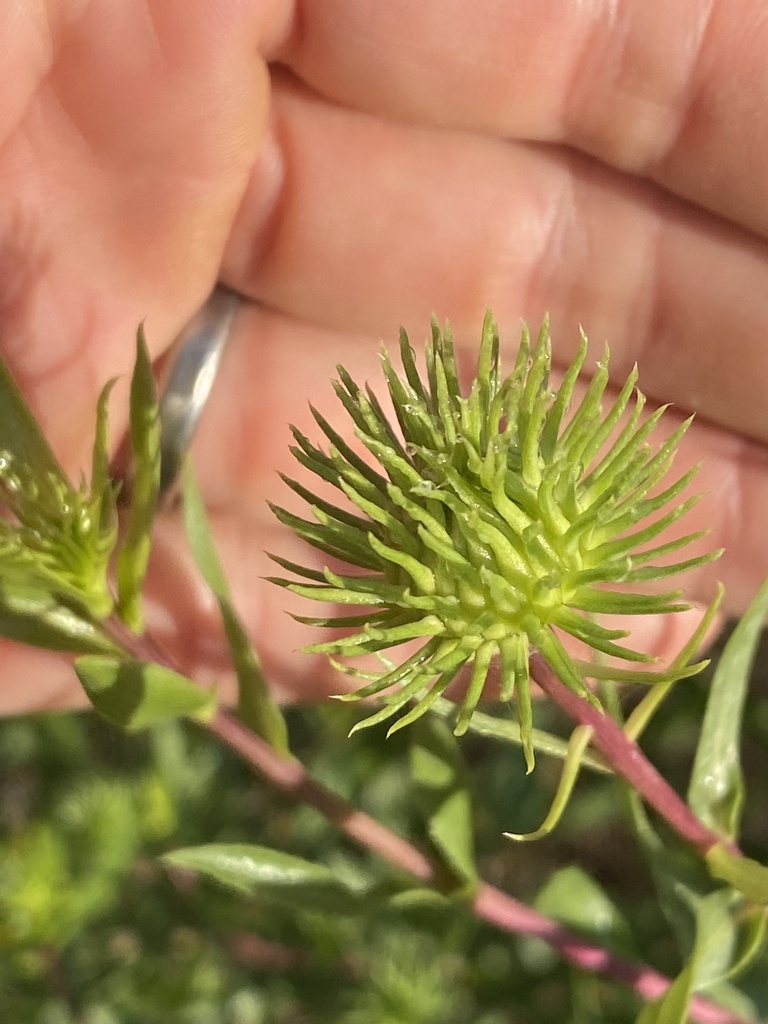
Look for a stiff, branching plant with narrow, sharp-toothed leaves and yellow daisy-like heads whose buds are wrapped in long, slender, spreading green bracts and glisten with sticky resin.
Growth Habit
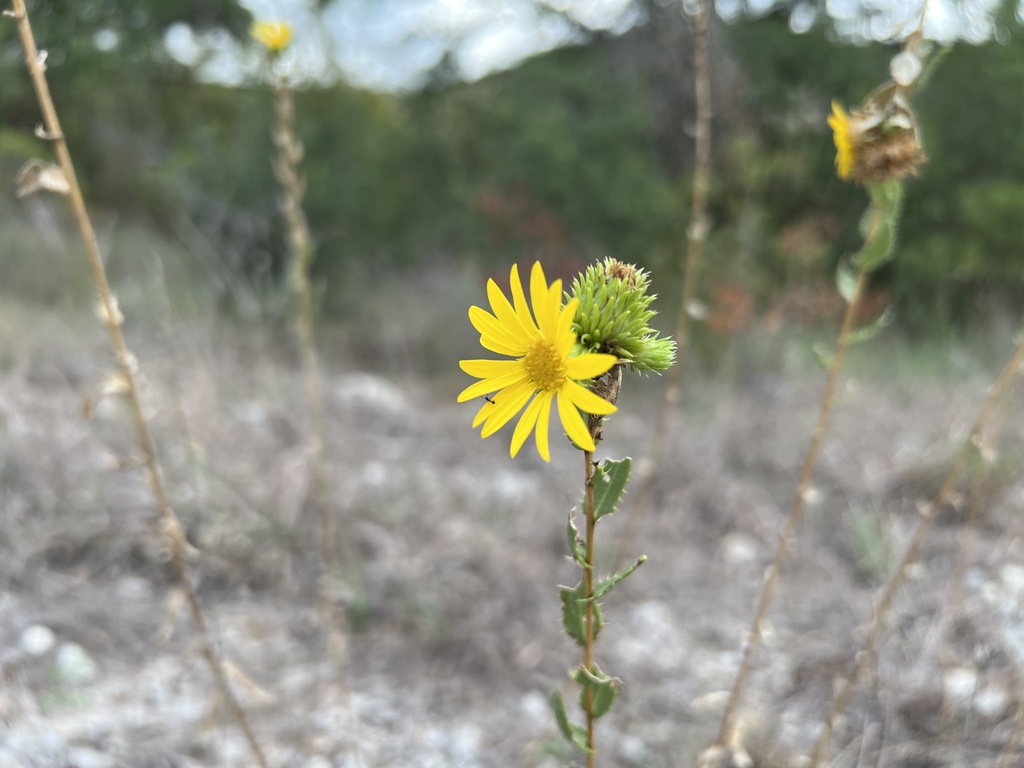
Narrowleaf gumweed is a biennial or short-lived perennial. In its first year it forms a low rosette; in later years it sends up one to several erect, branched stems 1 to 3 feet tall (occasionally to 4 feet). The stems are smooth, often reddish and become somewhat woody at the base.
Leaves
The leaves are alternate, 1 1/2 to 4 inches long, narrowly lance-shaped to linear, stalkless and often slightly clasping the stem. Their edges carry sharp, bristle-tipped teeth, especially on the lower leaves, which separates it from most other gumweeds. They are smooth, firm and dotted with tiny resin glands.
Flowers
The flower heads are borne at the ends of the branches and are about 1 to 1 3/4 inches across, with 15 to 30 bright yellow ray flowers around a yellow disk. The base of each head is wrapped in many green bracts (phyllaries) with long, slender, thread-like tips that spread outward or curve slightly, but are not tightly rolled into hooks as in curlycup gumweed. The buds exude a white, gummy resin. It blooms from July into October.
Fruit & Seeds
The fruits are small, brown, angled achenes topped with two to three stiff awns that fall off easily. The dried heads remain on the stems into winter.
Look-alikes
Curlycup gumweed (Grindelia squarrosa) is the most common gumweed in the Plains and West; its bracts have strongly rolled, hooked tips and its leaves are oblong with smaller, blunter teeth. Narrowleaf gumweed has narrower leaves with sharp, bristle-tipped teeth and long, thread-like bract tips. Yellow composites such as sunflowers and goldeneyes lack the sticky resin and the distinctive spiky buds.
Quick Facts
| Scientific Name | Grindelia lanceolata |
| Family | Asteraceae (aster family) |
| Plant Type | Biennial or short-lived perennial wildflower |
| Mature Height | 1–3 ft (occasionally to 4 ft) |
| Mature Spread | 1–2 ft |
| Growth Rate | Fast |
| Sun Exposure | Full sun |
| Water Needs | Low; very drought tolerant |
| Soil Type | Dry, rocky, gravelly or clay soils; thin soil over limestone |
| Soil pH | Neutral to alkaline (about 6.5–8.5) |
| Bloom Time | July–October |
| Flower Color | Bright yellow |
| Fall Color | None notable |
| Fruit | Small achenes with deciduous awns |
| Deer Resistant | Yes; resinous, bitter foliage |
| USDA Hardiness Zones | 5–9 |
Native Range
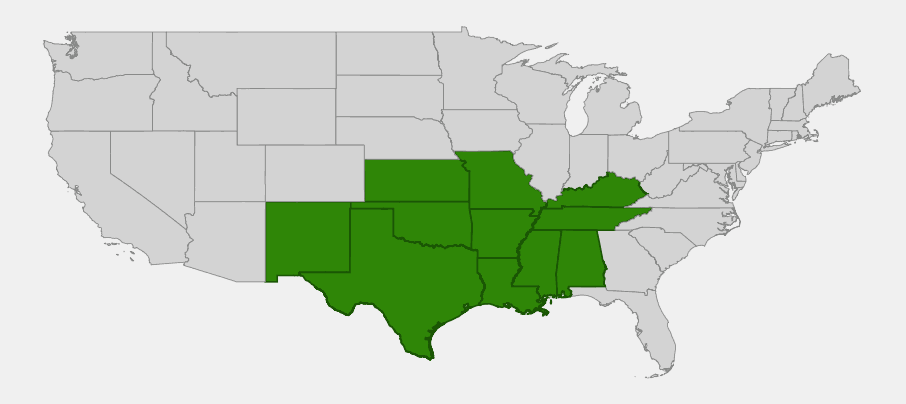
Narrowleaf gumweed is native to the south-central United States and northeastern Mexico. Its main range runs from the Ozarks of Missouri, Arkansas and eastern Kansas and Oklahoma east across the limestone regions of Tennessee, Kentucky and northern Alabama and Mississippi, and south through Oklahoma and north-central Texas to Louisiana. It is also recorded from eastern New Mexico, where it is an outlying record at the western edge of its range.
USDA PLANTS also lists it from Connecticut, Ohio, Virginia and Wisconsin, but NatureServe treats it as not native in those four states. Those records represent scattered introduced or waif populations, often along railroads and roadsides, so they are not included on the native range map. It is rare at the edges of its native range and is tracked as a rare plant in Kentucky and Louisiana.
Typical habitats are limestone and cedar glades, dolomite and chert barrens, rocky prairies and pastures, bluffs, and disturbed ground such as roadsides, railroad embankments and vacant lots. In Texas it is especially common in the Blackland Prairie and Cross Timbers around Dallas and Fort Worth and on limestone hills south toward the Lampasas Cut Plain and eastern Edwards Plateau.
📋 Regional plant lists featuring Narrowleaf Gumweed: Kentucky & Tennessee · Nebraska, Kansas & Eastern Colorado · Illinois, Iowa & Missouri · Alabama, Georgia & Mississippi · Arkansas, Louisiana, Eastern Oklahoma & Eastern Texas · South & West Texas
Growing & Care Guide
Narrowleaf gumweed is one of the easiest native wildflowers for hot, dry, sunny spots. The main thing to remember is that it is short-lived and depends on reseeding to persist.
Light
Plant it in full sun. In shade it becomes leggy, flops and blooms poorly.
Soil & Water
It thrives in poor, dry, well-drained soil, including rocky limestone, gravel and heavy clay. Rich, moist, fertilized soil makes it tall and floppy. Once established it needs no watering.
Planting Tips
Use it in a dry meadow, glade or prairie planting, a gravel garden or a difficult roadside bank. It combines well with sideoats grama, little bluestem, prairie clovers and asters. Give it open ground around it so it can reseed.
Pruning & Maintenance
Leave the seed heads standing over winter for seed-eating birds and so the plant can reseed, then cut old stems down in late winter. Remove unwanted seedlings in spring if it spreads farther than you like.
Propagation
Sow seed in fall or late winter on the surface of the soil; a period of cold, moist conditions improves germination. Seedlings form a rosette the first year and usually bloom in the second. It reseeds readily on bare, open soil.
Landscape Uses
- Late-season pollinator gardens: yellow flowers from midsummer into fall
- Glade and prairie plantings: fits rocky, thin-soiled restorations
- Xeriscapes: thrives with no supplemental water
- Difficult sites: grows on roadsides, gravel and heavy clay
- Deer-resistant plantings: resinous leaves are rarely browsed
Wildlife & Ecological Value
Narrowleaf gumweed flowers late in the season, when food for pollinators is getting scarce in dry, open habitats.
For Pollinators
The flower heads are visited by many native bees, including leafcutter, sweat and mining bees, and by butterflies, beetles and flies. Some native bees specialize on gumweeds and related yellow composites.
For Birds
Goldfinches, sparrows and other seed-eating birds pick seeds from the old heads in fall and winter.
For Mammals
The resinous, bitter leaves are avoided by deer and most livestock, which is one reason gumweeds increase in heavily grazed pastures.
Ecosystem Role
As a pioneer of bare, rocky and disturbed soil, narrowleaf gumweed helps hold soil on eroding slopes and roadsides. Its flowers and resin support many insects, including small moths and beetles whose larvae feed in the flower heads.
Cultural & Historical Uses
The genus Grindelia honors David Hieronymus Grindel, an 18th- and 19th-century Baltic German botanist and pharmacist. The species name lanceolata refers to the narrow, lance-shaped leaves.
Gumweeds have a long history of medicinal use. Native American peoples used several species for skin irritations and respiratory problems, and gumweed preparations were once listed in the United States Pharmacopoeia as a remedy for coughs and asthma. These are traditional uses only, and the plant should not be used as a home remedy without expert advice.
The sticky resin on the buds and leaves helps the plant reduce water loss and discourages grazing animals and insects. Gumweeds can also take up selenium from some soils, which is another reason livestock should not graze them heavily.
Frequently Asked Questions
Why is it called gumweed?
The flower buds and young heads are coated with a sticky, white, gum-like resin.
Is narrowleaf gumweed a perennial?
It is a biennial or short-lived perennial. Individual plants live only a few years, but it persists in gardens by reseeding.
How is it different from curlycup gumweed?
Curlycup gumweed has bracts with tightly rolled, hooked tips and broader leaves with small, blunt teeth. Narrowleaf gumweed has narrow leaves with sharp, bristle-tipped teeth and long, thread-like bract tips.
Is narrowleaf gumweed native in Ohio or Wisconsin?
No. It has been found there, but those populations are considered introduced. Its native range is the south-central United States, from the Ozarks and Tennessee to Texas.
Is narrowleaf gumweed good for pollinators?
Yes. It blooms from midsummer into fall and is visited by many native bees, butterflies and other insects.

Looking for a nursery that carries Narrowleaf Gumweed?
Browse our native plant nursery directory: Alabama & Arkansas · Kansas · Kentucky, Louisiana, Mississippi & Missouri · New Mexico & Oklahoma · Tennessee & Texas

