
Dwarf Lousewort (Pedicularis centranthera)
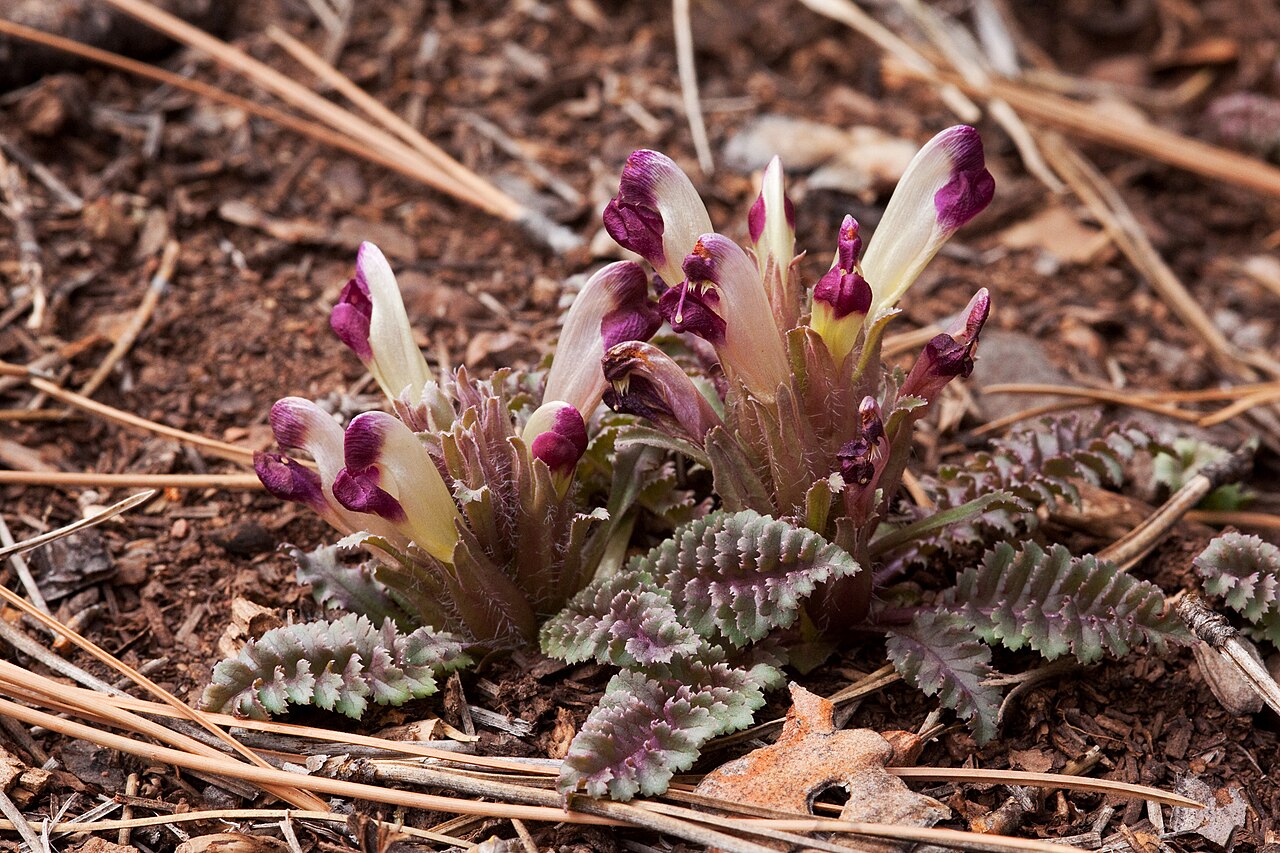
Pedicularis centranthera, known as Dwarf Lousewort, is one of the shortest louseworts in North America and one of the first wildflowers of spring in the pinyon-juniper and ponderosa pine country of the Intermountain West and Southwest. It forms a low tuft of crinkled, fern-like leaves, often purplish or bronze, and in early spring opens a few comparatively large, long-tubed flowers that sit almost on the ground. The flowers are white to pale yellow, with a hooded upper lip tipped in rich purple or magenta.
Dwarf lousewort belongs to the broomrape family (Orobanchaceae). Like all louseworts it is a root hemiparasite: it has green leaves and makes its own food, but its roots attach to the roots of nearby plants and draw water and nutrients from them. It grows in dry, open woodland and shrubland rather than the moist mountain meadows where most louseworts are found.
Because it depends on host plants in its native plant community, dwarf lousewort cannot be grown from nursery stock in the normal way, it does not survive transplanting, and it should never be dug up. This page is an identification and appreciation guide: how to recognize it, where it grows, why it is not a garden plant, and where to look for it on early-spring walks.
Identification
Look for a flat or low tuft of purplish, fern-like leaves on dry ground under pinyon, juniper or ponderosa pine in early spring, with a few large white-and-purple flowers nestled in the center. No other lousewort in its range blooms so early or grows so low.
Growth Habit
Plants are stemless or nearly so, usually only 2 to 5 inches tall, growing from a short, thick root crown with fleshy roots. Several leaves and a short, dense flower cluster rise from the crown. The above-ground parts wither by early summer.
Leaves
The leaves are basal, 2 to 6 inches long, narrow in outline and deeply cut on both sides into many small, toothed lobes, so they look like small fern fronds. Their edges are often crisped or wavy and lined with tiny whitish teeth. Young leaves are frequently purplish, reddish or bronze, becoming greener as they mature.
Flowers
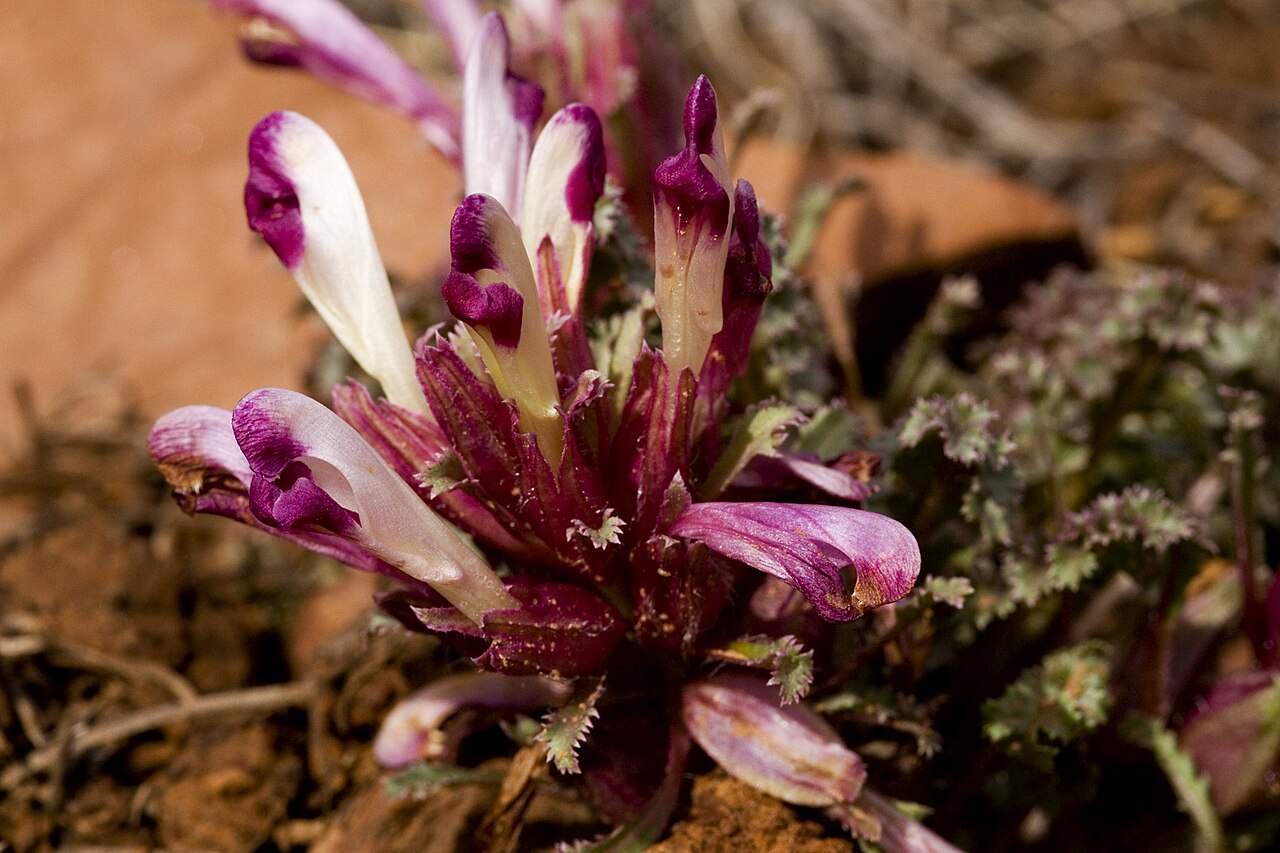
The flowers are crowded in a short cluster in the center of the leaf tuft, often partly hidden by leafy bracts. Each flower is large for the size of the plant, about 1 to 1½ inches long, with a long, slender tube. The upper lip (galea) is a curved hood with a short, blunt tip and no long beak, and it is usually deep purple or magenta at the end; the tube and lower lip are white, cream or pale yellow, sometimes flushed with pink. Plants bloom from March in Arizona and New Mexico to May or June farther north and at higher elevations.
Fruit & Seeds
Each flower produces a flattened, oblique, pointed capsule that splits to release a few seeds. The capsules ripen in late spring as the leaves dry.
Look-alikes
Most other louseworts in its range, such as bracted lousewort, little elephant’s head and sickletop lousewort, are taller summer-blooming plants of moist mountain forests and meadows with flowers on a leafy stem. Dwarf lousewort’s very short, nearly stemless habit, early bloom and dry woodland habitat set it apart.
Quick Facts
| Scientific Name | Pedicularis centranthera A. Gray |
| Family | Orobanchaceae (broomrape family; formerly Scrophulariaceae) |
| Plant Type | Herbaceous perennial; root hemiparasite |
| Mature Height | 2–5 in |
| Mature Spread | 3–8 in |
| Growth Rate | Slow |
| Sun Exposure | Full sun to part shade |
| Water Needs | Low; moist only in early spring |
| Soil Type | Dry, well-drained, gravelly, sandy or rocky soils with litter |
| Soil pH | About 6.0–8.0 |
| Bloom Time | March–June, depending on elevation and latitude |
| Flower Color | White to pale yellow with a purple or magenta tip |
| Fall Color | None; leaves wither by early summer |
| Fruit | Flattened, oblique capsule |
| Deer Resistant | Not documented |
| USDA Hardiness Zones | 4–8 |
Native Range
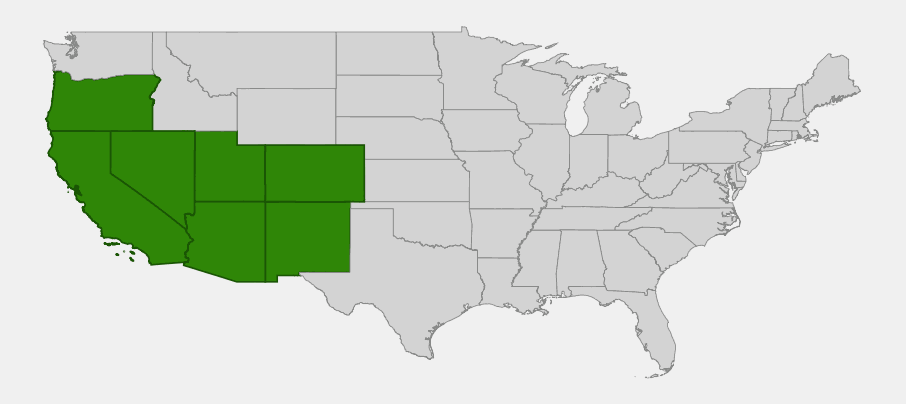
Dwarf lousewort is native to the interior western United States. USDA PLANTS lists it in Arizona, California, Colorado, Nevada, New Mexico, Oregon and Utah. Its stronghold is the Colorado Plateau and surrounding highlands: northern and central Arizona, including the Mogollon Rim and the rims of the Grand Canyon; southern and eastern Utah, including Zion National Park and the La Sal Mountains area; southwestern Colorado; and the mountains of northern and central New Mexico.
From there it extends west across the Great Basin of Nevada and north to southeastern Oregon, where it is known from Harney and Lake counties, and into northeastern California, where it is a rare plant of the Modoc Plateau in Lassen County. It does not reach the moist, west-side forests of Oregon or Washington.
Its habitat is dry, open woodland and shrubland: pinyon-juniper woodland, ponderosa pine forest, oak and mountain-mahogany scrub, and sagebrush flats and slopes, usually on gravelly or rocky soils. It is mostly found between about 4,500 and 9,000 feet.
📋 Regional plant lists featuring Dwarf Lousewort: Arizona & New Mexico · Utah & Western Colorado · California & Nevada
Can You Grow It?
No, not in an ordinary garden. Dwarf lousewort is a root hemiparasite that lives attached to the roots of neighboring shrubs, grasses and herbs in its native woodland. It is not sold by nurseries, it cannot be grown from nursery stock in the normal way, and it does not survive transplanting. Please never dig it up: removing it kills the plant and harms the community it belongs to. The best way to enjoy it is in the wild in early spring.
Light
In the wild it grows in full sun to light shade in open woodland, often under the edge of pinyon, juniper or ponderosa pine canopies.
Soil & Water
It grows in dry, well-drained gravelly, sandy or rocky soils that are moist only briefly from winter snow and early spring rain. It finishes its growth and goes dormant before the hot, dry early summer.
Planting Tips
Do not try to plant it. If you own land where it grows, protect the existing plant community: avoid soil disturbance, heavy equipment and herbicides near known patches, and keep invasive annual grasses such as cheatgrass under control.
Pruning & Maintenance
Wild populations need no care. On trails, look closely but avoid stepping on the low plants, and do not pick the flowers, so they can set seed.
Propagation
Researchers have raised some louseworts from seed by growing them together with host plants, but there is no established horticultural method for this species. Do not collect seed from wild plants, especially on public lands where collecting may require a permit.
Where to See It
- Grand Canyon rims: one of the first flowers of spring in the pine and pinyon-juniper woodland of the South Rim
- Zion National Park and southern Utah: on rims and plateaus such as the East Rim and Cable Mountain trails in April and May
- Mogollon Rim and northern Arizona: under ponderosa pine and in pinyon-juniper woodland from March
- New Mexico mountains: in pinyon-juniper and ponderosa pine foothills such as the Manzano Mountains
- Great Basin and southeastern Oregon: in sagebrush and juniper country in May and June
Wildlife & Ecological Value
Dwarf lousewort is a small plant, but it blooms at a time when few other flowers are open, which makes it important to early-season pollinators.
For Pollinators
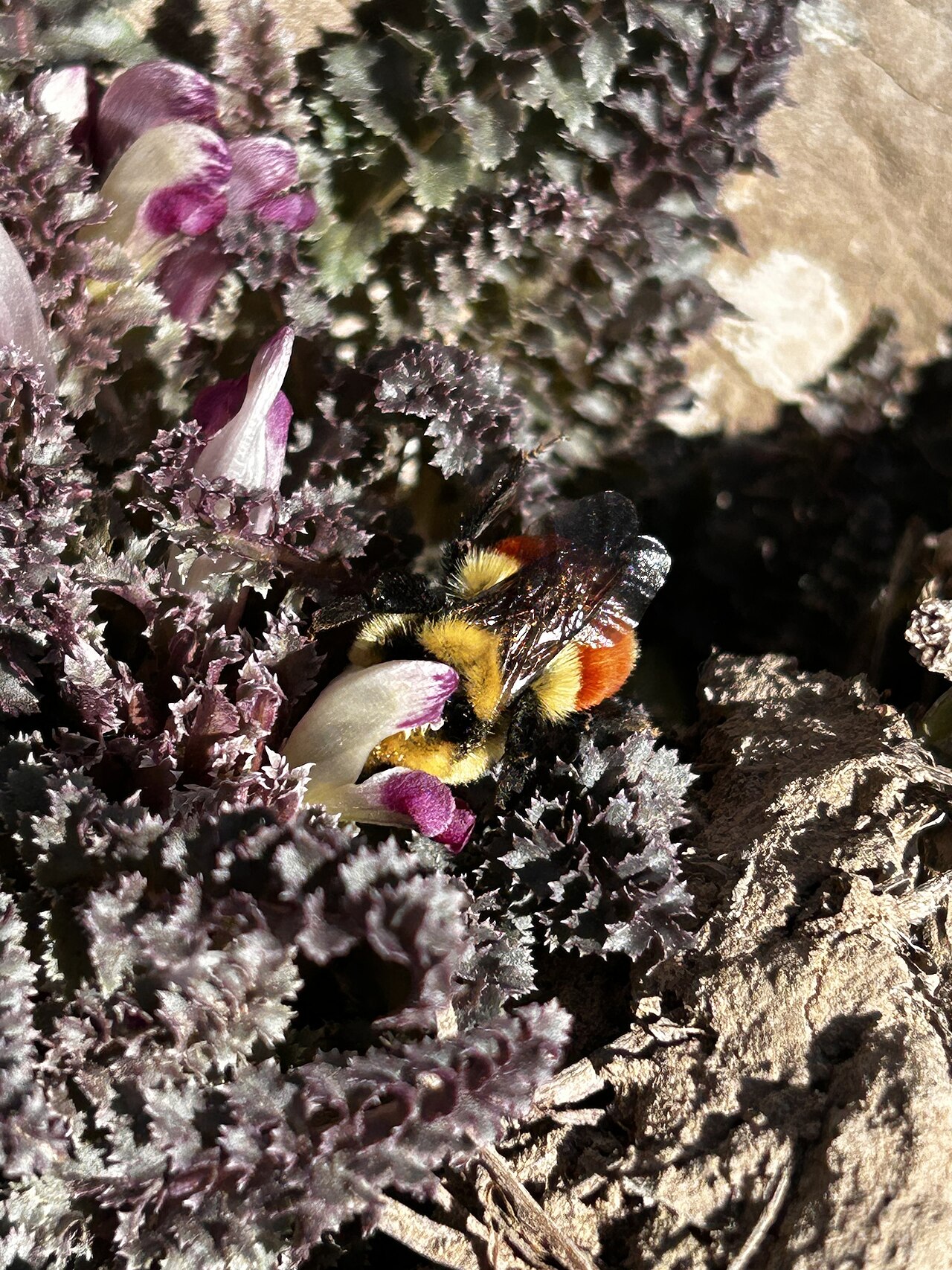
The long-tubed flowers are visited mainly by bumble bee queens that have just emerged from hibernation, including Hunt’s bumble bee. Few other flowers are available in the dry woodlands so early, so louseworts like this one can be an important early food source for queens starting new colonies.
For Birds
It has little direct value for birds, but it is part of the understory community of pinyon-juniper and pine woodlands that supports insects eaten by woodland birds in spring.
For Mammals
Its small size and early dormancy make it of little importance to grazing mammals. Rodents may eat the seeds or roots.
Ecosystem Role
As a root hemiparasite, it forms connections called haustoria with the roots of a variety of neighboring plants and takes water and nutrients from them. Hemiparasites can reduce the vigor of their hosts slightly and are thought to help maintain plant diversity by keeping dominant species in check.
Cultural & Historical Uses
The American botanist Asa Gray described Pedicularis centranthera in the nineteenth century. The species name combines the Greek kentron, spur or point, with anthera, anther, referring to the small points on the anthers. The genus name comes from the Latin pediculus, louse, from an old European belief that livestock grazing on louseworts became infested with lice.
Dwarf lousewort has no well-documented history of human use. Louseworts can absorb chemical compounds from their host plants, and some of those hosts are toxic, so wild louseworts should never be eaten or used as remedies.
For hikers in the Southwest and Intermountain West, finding dwarf lousewort blooming beneath the pines while snow still lingers in the shade is one of the first signs of spring. It is a plant to admire on hands and knees with a camera or hand lens.
Frequently Asked Questions
Can I grow dwarf lousewort in my garden?
No. It is a root hemiparasite that depends on host plants in its native woodland, it is not sold by nurseries and it does not survive transplanting. Never dig it from the wild. Enjoy it on early-spring walks instead.
Is dwarf lousewort a parasite?
It is a hemiparasite. It has green leaves and makes its own food through photosynthesis, but its roots also tap into the roots of nearby plants for water and nutrients.
When does it bloom?
From March in Arizona and New Mexico into May or June in Utah, Nevada, Oregon and at higher elevations. It is one of the earliest wildflowers in its habitat.
Why is it called lousewort?
The name comes from an old European belief that livestock grazing on these plants got lice. The plants do not cause lice.
Where is the best place to see it?
Look on the rims of the Grand Canyon, in Zion National Park, along the Mogollon Rim in Arizona and in pinyon-juniper and ponderosa pine foothills of New Mexico and Utah in early spring, on dry, open ground under the trees.

Looking for a nursery that carries Dwarf Lousewort?
Browse our native plant nursery directory: Arizona · California · Colorado · Nevada & New Mexico · Oregon · Utah

