
Coastal Plain Joe-Pye Weed (Eutrochium dubium)
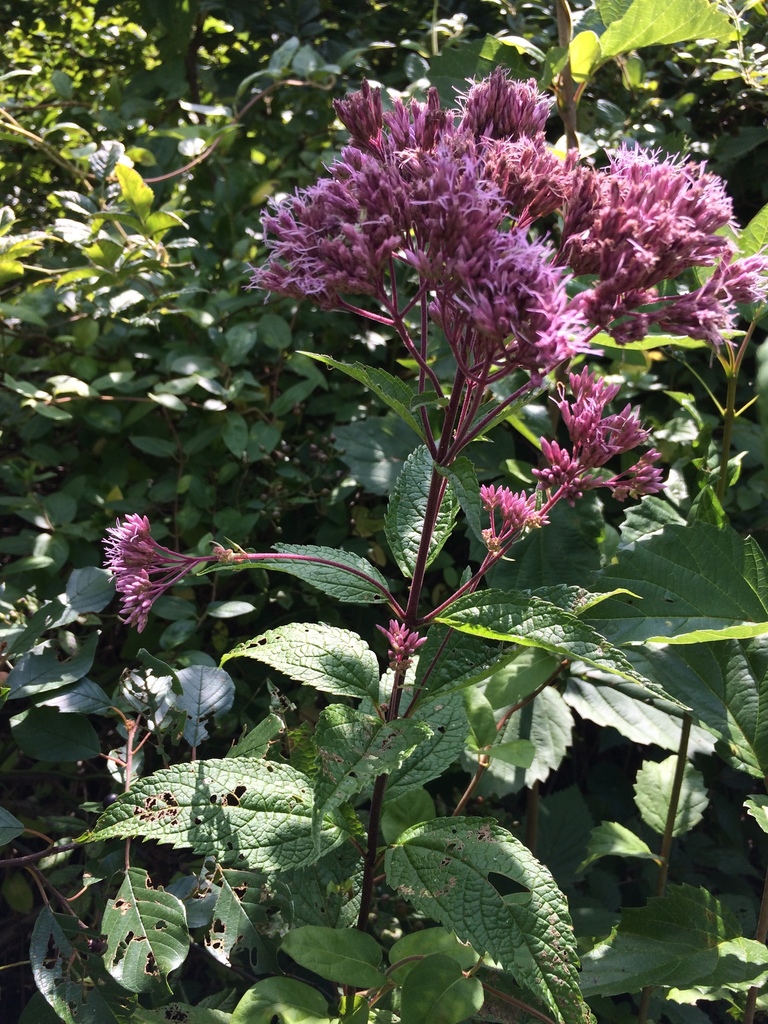
Eutrochium dubium, known as Coastal Plain Joe-Pye Weed or eastern Joe-Pye weed, is a native perennial wildflower in the aster family (Asteraceae). It is the smallest of the eastern Joe-Pye weeds, usually 2 to 5 feet tall, with whorls of coarsely toothed leaves on purple-speckled stems and domed clusters of dusty mauve-pink flowers from midsummer into early fall. Older references list it as Eupatorium dubium or Eupatoriadelphus dubius.
It grows mainly on the Atlantic Coastal Plain, from southwestern Nova Scotia and southern Maine south through coastal New England, Long Island, New Jersey, the Delmarva Peninsula and eastern Virginia to the Carolinas. Its home is wet ground: pond shores, marshes, wet meadows, swamp edges and ditches, often on sandy, acidic soils.
Its compact size makes it the most garden-friendly Joe-Pye weed, and the cultivar ‘Little Joe’ is widely sold. Like its taller relatives, it is a magnet for butterflies and bees in late summer, and it is an excellent choice for rain gardens, pond edges and moist borders in the East.
Identification
Look in late summer in wet, sunny places near the coast for a medium-height Joe-Pye weed with leaves in whorls of three or four, each leaf with three strong veins from the base, and rounded clusters of mauve-pink flowers.
Growth Habit
Coastal plain Joe-Pye weed is a clump-forming perennial that grows from a short, fibrous-rooted crown. It sends up one to several unbranched stems, usually 2 to 5 feet tall, sometimes a little taller. The stems are solid, not hollow, and green to purple, usually speckled or blotched with purple.
Leaves
The leaves grow in whorls of three or four (sometimes in pairs near the top). They are oval to lance-shaped, about 2 to 5 inches long, rough and slightly hairy, with coarse teeth along the edges. A key feature is that each leaf has three prominent veins running from near the base, while other Joe-Pye weeds have a single main vein with side veins. The leaves are relatively broad and short for the plant’s size.
Flowers
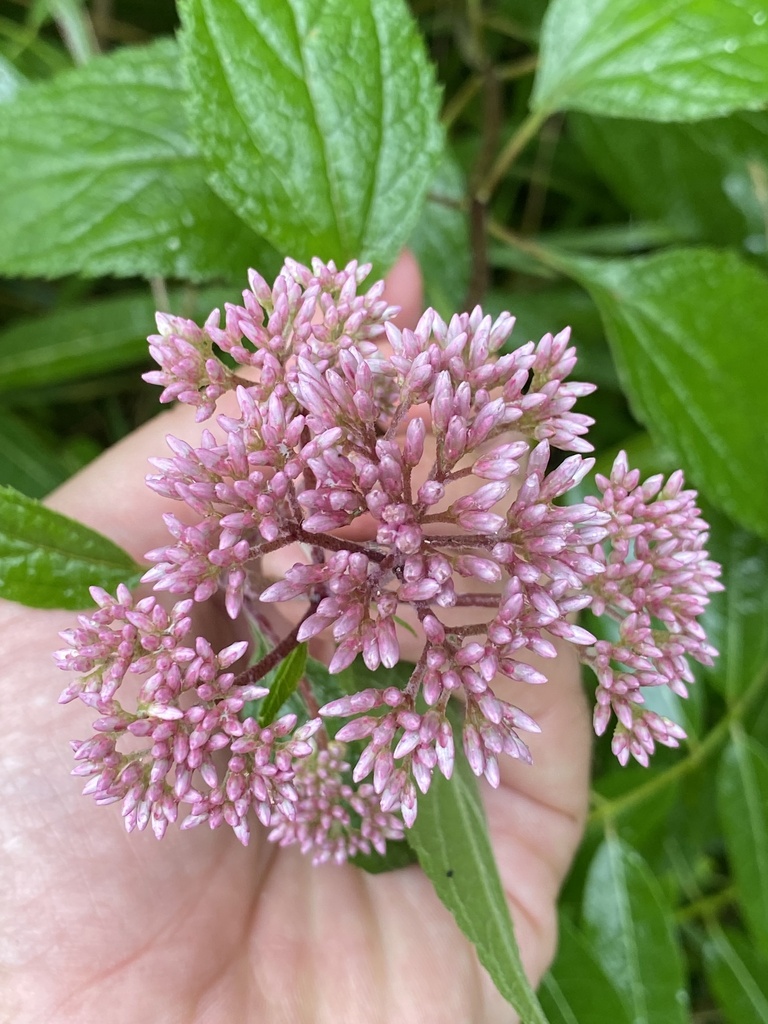
The flowers are borne from July to September in a rounded, domed cluster at the top of the stem, typically 4 to 8 inches across. The cluster is made up of many small flower heads, each with only about 5 to 9 tubular, mauve-pink to purplish florets and no ray petals. The long, thread-like styles give the clusters a fuzzy look. The flowers have a light, sweet scent.
Fruit & Seeds
The seeds are small, dark achenes with a tuft of fine, tan bristles that carry them on the wind. The fluffy seed heads stand through fall and into winter.
Look-alikes
It is often confused with spotted Joe-Pye weed (Eutrochium maculatum), which has flat-topped flower clusters with more florets per head (about 9 to 22) and leaves with a single main vein. Hollow Joe-Pye weed (E. fistulosum) is much taller, up to 10 feet, with hollow, purple, waxy stems. Sweet Joe-Pye weed grows in woodlands and has greenish stems with purple nodes and paler flowers.
Quick Facts
| Scientific Name | Eutrochium dubium (syn. Eupatorium dubium, Eupatoriadelphus dubius) |
| Family | Asteraceae (aster family) |
| Plant Type | Herbaceous perennial |
| Mature Height | 2–5 ft |
| Mature Spread | 2–3 ft |
| Growth Rate | Moderate to fast |
| Sun Exposure | Full sun to part shade |
| Water Needs | Moderate to high; moist to wet soil |
| Soil Type | Sandy, loamy or peaty; tolerates clay |
| Soil pH | Acidic to neutral (about 4.5–7.0) |
| Bloom Time | July–September |
| Flower Color | Mauve-pink to dusty purple |
| Fall Color | Purplish stems; tan seed heads |
| Fruit | Small achenes with fluffy, windborne bristles |
| Deer Resistant | Moderately |
| USDA Hardiness Zones | 4–9 |
Native Range
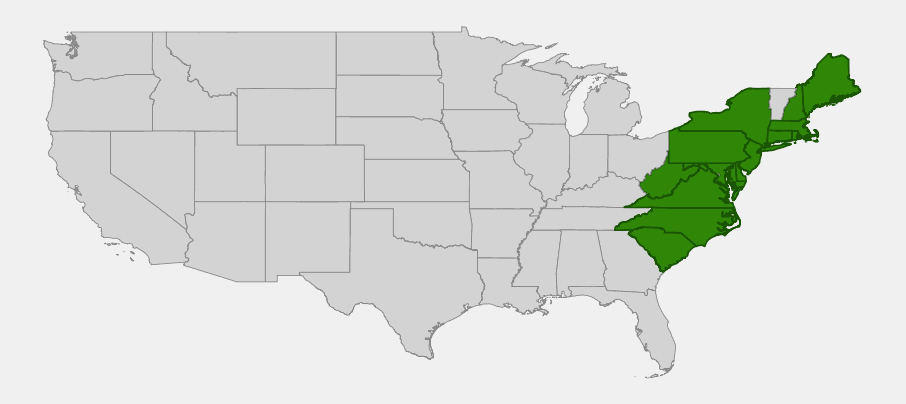
Coastal plain Joe-Pye weed is native to eastern North America. USDA PLANTS lists it from Connecticut, Delaware, Maine, Maryland, Massachusetts, New Hampshire, New Jersey, New York, North Carolina, Pennsylvania, Rhode Island, South Carolina, Virginia and West Virginia, and from Nova Scotia in Canada. USDA also lists Vermont, but the Native Plant Trust’s Go Botany flora of New England records it as absent there, so Vermont is left off this map.
It is most common on the Atlantic Coastal Plain: southeastern Massachusetts and Cape Cod, Rhode Island, coastal Connecticut, Long Island, the New Jersey Pine Barrens and Delmarva, and the coastal plain of Virginia and the Carolinas. It reaches inland into the Piedmont in some areas. Records from Pennsylvania, West Virginia, inland New Hampshire and Maine are outlying records at the inland edge of its range.
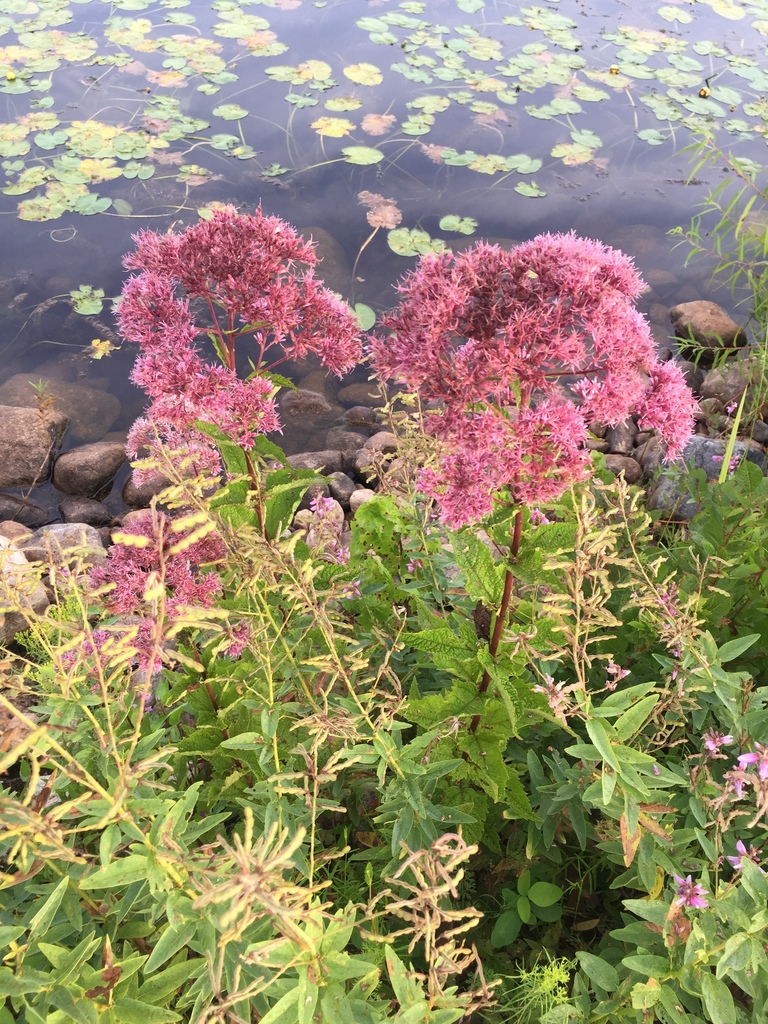
It grows in sunny or lightly shaded wet places: the shores of coastal plain ponds, marshes and wet meadows, the edges of swamps and bogs, wet thickets, ditches and roadsides. It is especially characteristic of the sandy, acidic shores of coastal plain ponds, whose water levels rise and fall with the seasons.
📋 Regional plant lists featuring Coastal Plain Joe-Pye Weed: New York, Pennsylvania & Northern New Jersey · Connecticut, Massachusetts & Rhode Island · New Hampshire, Maine & Vermont · Maryland, Virginia & West Virginia · Delaware, Southern New Jersey & Long Island · North & South Carolina
Growing & Care Guide
Coastal plain Joe-Pye weed is easy to grow and is the best Joe-Pye weed for smaller gardens. It is sold by many native plant nurseries, both as the straight species and as compact cultivars such as ‘Little Joe’, which grows about 3 to 4 feet tall.
Light
Full sun to part shade. It flowers best and stays sturdiest in full sun; in more shade it grows taller and leans.
Soil & Water
It prefers consistently moist to wet soil and tolerates short periods of standing water. It grows in sandy, loamy or peaty soils and tolerates clay. In average garden soil, water during dry spells; the leaves wilt and brown in drought.
Planting Tips
Plant in spring or fall, 2 to 3 feet apart, in a rain garden, at the edge of a pond or stream, in a wet meadow, or in the middle of a moist perennial border. It combines well with swamp milkweed, New York ironweed, rosemallows, asters and goldenrods.
Pruning & Maintenance
Leave the stems and seed heads standing through winter for birds and overwintering insects, and cut them back in early spring. Cutting the stems back by about a third in early June makes plants shorter and bushier, although it delays flowering a little. Divide large clumps every few years in spring.
Propagation
Grow it from seed sown outdoors in fall or given a cold, moist period of 4 to 8 weeks before spring sowing; seeds need light to germinate, so press them onto the surface. Clumps can also be divided in early spring, and stem cuttings root in early summer.
Landscape Uses
- Rain gardens: tolerates wet soil and periodic flooding
- Pond and stream edges: a natural plant of coastal plain pond shores
- Butterfly gardens: a top late-summer nectar plant
- Perennial borders: compact enough for smaller gardens
- Wet meadows and restoration: pairs with other native wetland wildflowers
Wildlife & Ecological Value
Like all Joe-Pye weeds, coastal plain Joe-Pye weed is one of the best late-summer nectar plants for butterflies in the East.
For Pollinators
The flowers attract many butterflies, including eastern tiger swallowtails, monarchs, fritillaries and skippers, as well as bumblebees, honey bees, native bees and flower flies. Its blooms come when monarchs are beginning their fall migration down the coast.
For Birds
Small birds such as goldfinches and sparrows eat the seeds in fall and winter, and the dense stems provide cover in wet meadows.
For Mammals
Deer usually browse it only lightly, and the leaves are rough and somewhat bitter.
Ecosystem Role
Coastal plain Joe-Pye weed is part of the diverse wildflower community of coastal plain pond shores and wet meadows. Its old stems, cut to different heights and left standing in the garden, may provide nesting sites for small stem-nesting bees, and its foliage feeds the caterpillars of several native moths.
Cultural & Historical Uses
The common name Joe-Pye weed is said to honor “Joe Pye,” described in 19th-century accounts as a New England herbalist who used the plant to treat fevers, but historians have not been able to confirm the story.
The genus name Eutrochium comes from Greek words meaning “well-wheeled,” a reference to the whorled leaves. The species name dubium means “doubtful,” perhaps because early botanists were unsure whether it was distinct from other Joe-Pye weeds.
The Joe-Pye weeds were long included in the large genus Eupatorium, with the bonesets and thoroughworts. They were later separated as Eupatoriadelphus and are now usually placed in Eutrochium, so the same plant may be listed under any of these names in field guides and nursery catalogs.
Frequently Asked Questions
How tall does coastal plain Joe-Pye weed get?
Usually 2 to 5 feet, smaller than other Joe-Pye weeds. The cultivar ‘Little Joe’ stays about 3 to 4 feet.
How do I tell it from spotted Joe-Pye weed?
Coastal plain Joe-Pye weed has domed flower clusters, fewer florets per head (about 5 to 9), and leaves with three strong veins from the base. Spotted Joe-Pye weed has flat-topped clusters and leaves with a single main vein.
Does coastal plain Joe-Pye weed need wet soil?
It prefers moist to wet soil but grows in average garden soil if watered in dry spells.
When does coastal plain Joe-Pye weed bloom?
From July to September.
Where is coastal plain Joe-Pye weed native?
Mainly on the Atlantic Coastal Plain from Nova Scotia and Maine to the Carolinas, with scattered inland records.

Looking for a nursery that carries Coastal Plain Joe-Pye Weed?
Browse our native plant nursery directory: Connecticut & Delaware · Maine, Maryland & Massachusetts · New Hampshire, New Jersey, New York & North Carolina · Pennsylvania, Rhode Island, South Carolina & Virginia · West Virginia

