
Canada Lettuce (Lactuca canadensis)
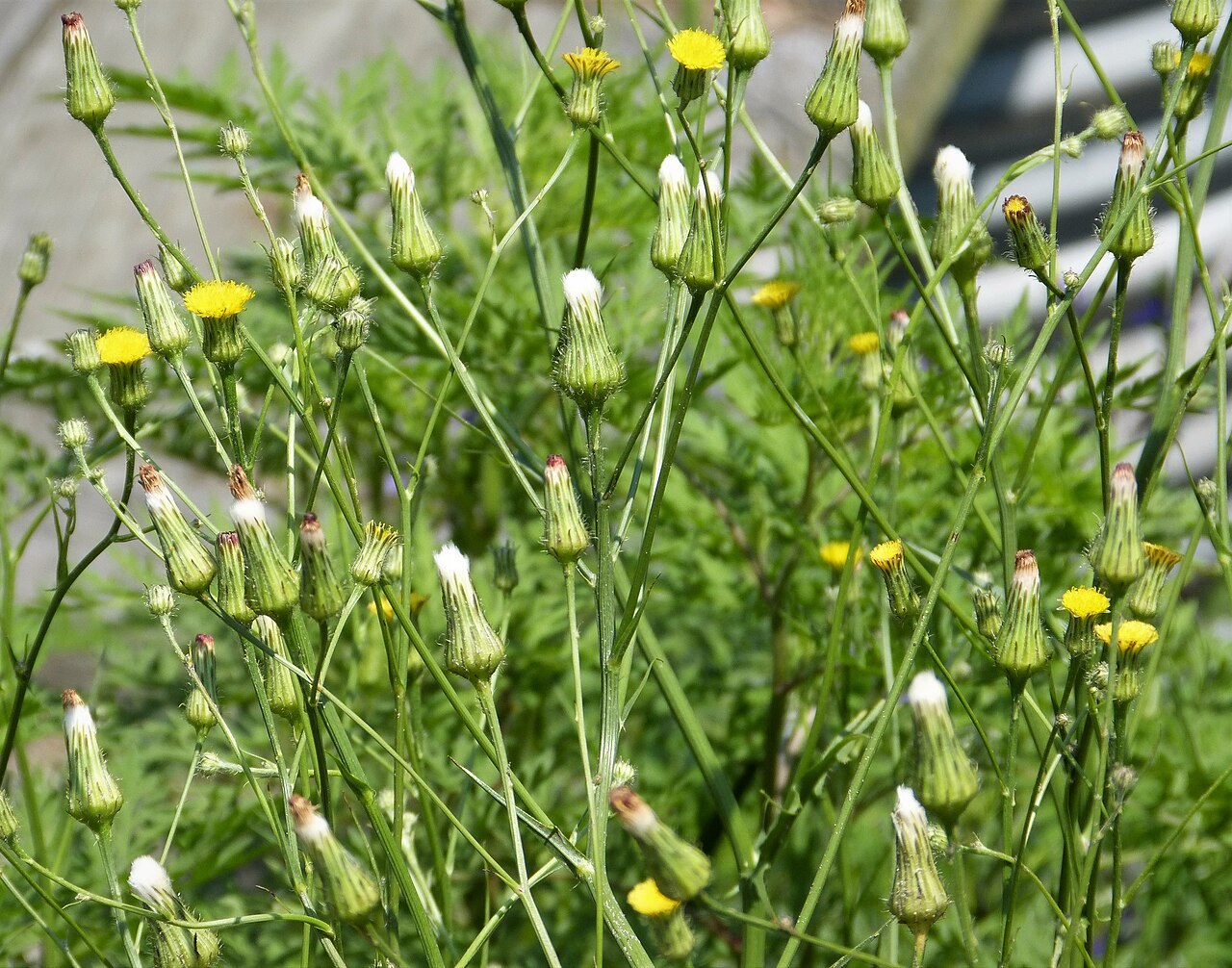
Lactuca canadensis, Canada Lettuce (also called wild lettuce, Canada wild lettuce or tall lettuce), is a tall native wildflower of fields, clearings and roadsides across eastern and central North America. It is a true relative of garden lettuce, and you can see the family resemblance in its milky sap and smooth, often bluish-green leaves. Unlike its garden cousin, though, it shoots up into a single towering stem that usually reaches 3 to 7 feet by late summer, topped with a loose, branching plume of small pale-yellow flower heads.
Canada lettuce is an annual or biennial. Most plants spend their first season as a low rosette of leaves, then bolt the following summer, bloom from July into September, scatter fluffy white-tufted seeds on the wind and die. It does not spread by rhizomes or form permanent clumps; every new plant comes from seed. That life cycle makes it a classic plant of open, recently disturbed ground: old fields, pasture edges, woodland clearings, ditches and the sunny margins of thickets.
This is the plant most people in Maine and the rest of New England mean when they say “wild lettuce.” It is common across the state, from southern York County fields to farm edges in Aroostook, and it is native everywhere from Maine to Florida and west to the Dakotas and Texas. It is not a showy garden perennial, but in a meadow, wildlife garden or rough corner it feeds bees and seed-eating birds, and it is easy to manage once you understand how it grows.
Identification
Canada lettuce is easiest to recognize in mid to late summer, when its tall, unbranched stem ends in an open, many-branched flower cluster. Look for the combination of milky white sap, alternate leaves, tiny yellow heads that look like miniature dandelions, and smooth (not prickly) leaf undersides.
Stems & Sap
The stem is single, stout and upright, smooth and often with a waxy, bluish bloom. It may be green, purplish or streaked with red, especially near the base. Break a leaf or stem and white, latex-like sap beads up immediately; this bitter milky juice is a trait shared by all lettuces (the genus name Lactuca comes from the Latin for milk). The stem branches only near the top, where it forms the flower cluster.
Leaves
The leaves are alternate, one per node, not opposite. They are famously variable. Lower leaves on many plants are deeply cut into backward-pointing lobes, a bit like a dandelion or oak leaf, while others on the same population are long, narrow and nearly unlobed. Leaves may reach 10 to 12 inches long near the base of the stem and get smaller upward. The upper leaves usually clasp the stem with small ear-like lobes. The surface is generally hairless and the underside often pale or bluish, and, importantly for identification, the midrib on the underside is smooth or nearly so, without the row of stiff prickles found on the non-native prickly lettuce.
Flowers
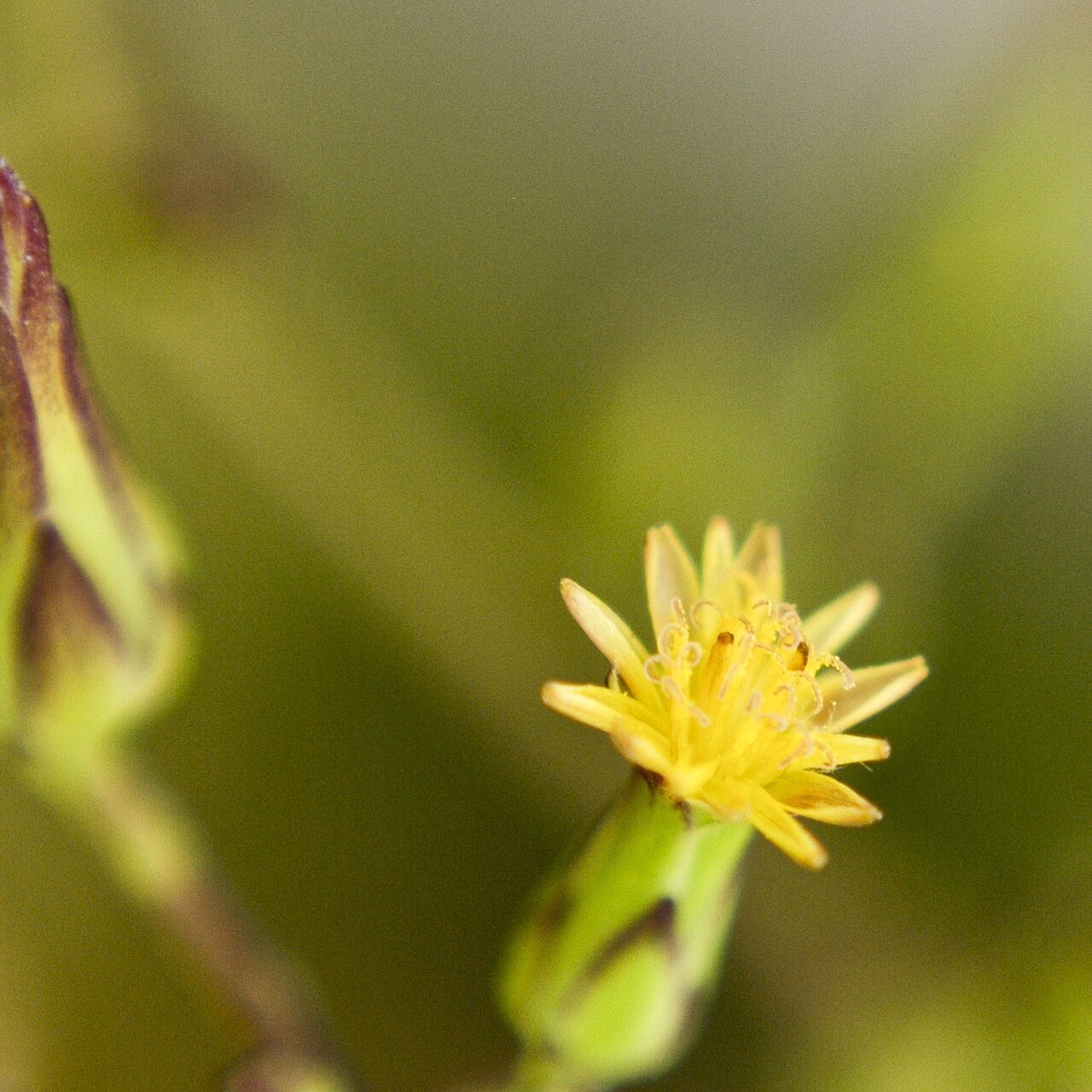
Each flower head is only about a quarter to half an inch across and is made up entirely of strap-shaped ray florets, usually around 15 to 25 per head. Most are pale yellow, but some plants have orange, coral or reddish florets, and the florets often turn orange or pink as they fade. The heads sit at the ends of slender branches in a loose, airy panicle that may hold dozens to hundreds of heads. Like many relatives in the chicory tribe, they open in the morning and close by afternoon, so a plant that looks flowerless at 4 p.m. may be in full bloom the next morning.
Seeds
The seeds (cypselae) are dark brown to nearly black, flattened, with a single raised rib down the middle of each face and a slender beak at the top. The beak carries a tuft of soft white bristles, so ripe heads turn into small white puffballs that drift away on the wind. White bristles help separate Canada lettuce from tall blue lettuce, whose pappus is light brown.
Quick Facts
| Scientific Name | Lactuca canadensis L. |
| Family | Asteraceae (Aster) |
| Plant Type | Annual or biennial wildflower (forb) |
| Mature Height | 3–7 ft (sometimes shorter in poor soil, rarely taller) |
| Mature Spread | 1–2 ft |
| Growth Rate | Fast in its flowering year |
| Sun Exposure | Full Sun to Part Shade |
| Water Needs | Average; tolerates fairly dry soil |
| Soil Type | Loam, clay or sandy soils; thrives on disturbed ground |
| Soil pH | Slightly acidic to slightly alkaline |
| Bloom Time | July – September |
| Flower Color | Pale yellow, sometimes orange or reddish |
| Fall Color | None notable; plants die after seeding |
| Fruit | Flattened dark seeds with white, wind-borne bristles |
| Deer Resistant | No (browsed by deer and rabbits) |
| USDA Hardiness Zones | Grows wild in zones 3–9 (annual/biennial) |
Native Range
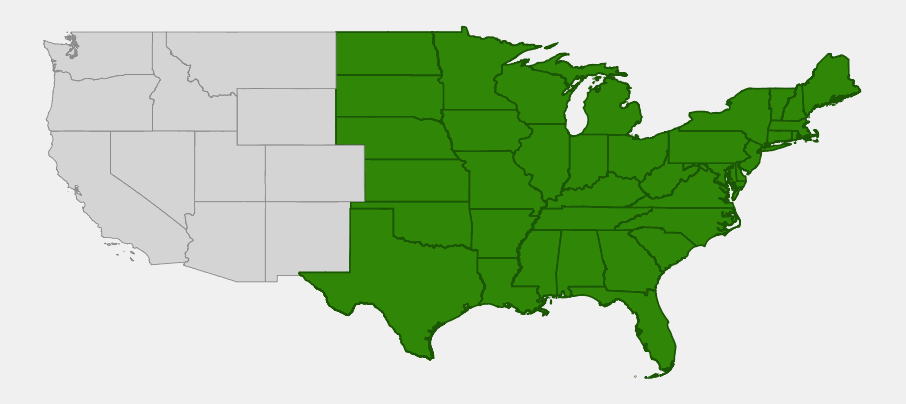
Canada lettuce is native across most of the eastern two-thirds of the United States. Its range runs from Maine, New Hampshire and Vermont south along the Atlantic states to northern and central Florida, and west through the Great Lakes, the Ohio Valley and the Mississippi Valley to the eastern Dakotas, Nebraska, Kansas, Oklahoma and eastern and central Texas. In Canada it grows in the southern parts of the provinces from Manitoba east to the Maritimes.
Farther west it thins out quickly. County records in the Rocky Mountain and Pacific states, from Montana and Colorado to Washington, Oregon and California, are scattered and are treated by the Biota of North America Program (BONAP) as introduced rather than native, so those states are left off the map below. In the Southeast it becomes less common toward the Gulf Coast and southern Florida.
Within its range it is a plant of sunny, open places with ordinary soil: abandoned fields, meadows, pasture margins, roadside banks, railway edges, forest openings, logged areas, and the edges of thickets and woods. It is rated Facultative Upland in wetland plant lists, meaning it usually grows in non-wetland sites but can turn up in moist meadows and streamside clearings.
📋 Regional plant lists covering Canada Lettuce’s native range: New Hampshire, Maine & Vermont · Connecticut, Massachusetts & Rhode Island · New York, Pennsylvania & Northern New Jersey · Delaware, Southern New Jersey & Long Island · Maryland, Virginia & West Virginia · North Carolina & South Carolina · Georgia, Alabama & Mississippi · Arkansas, Louisiana, Eastern Oklahoma & Eastern Texas · Kentucky & Tennessee · Ohio & Indiana · Illinois, Iowa & Missouri · Michigan, Wisconsin & Eastern Minnesota · North Dakota, South Dakota & Western Minnesota · Nebraska & Kansas
Growing & Care Guide
Few people plant Canada lettuce on purpose; it usually arrives on its own on wind-blown seed. But it is worth recognizing and, in the right spot, keeping. Because it is an annual or biennial that spreads only by seed, it is far easier to manage than its height suggests, and it fills a valuable late-summer niche for pollinators and birds.
Light
Canada lettuce grows best in full sun and also does well in part shade along woodland edges and in clearings. In deep shade it becomes weak and spindly and blooms poorly. Plants in sun are sturdier and branch more freely in the flower cluster.
Soil & Water
It is not fussy. Average garden soil, clay, loam and sandy soils all work, and it handles a wide pH range. A deep taproot lets established rosettes and bolting plants ride out dry spells, although the tallest, lushest plants grow in moist, fertile soil. It does not need fertilizer or regular watering once the rosette is established.
Planting Tips
If you want to add it to a meadow or wildlife planting, scatter fresh seed in fall on bare or lightly raked soil, or allow a few wild plants that appear on their own to go to seed. Seeds need light and contact with the soil, so press them in rather than burying them. Because plants can top 6 feet, place them toward the back of a planting or in an open meadow where the height looks natural rather than in a front border.
Pruning & Maintenance
The main management decision is how many plants you want next year. Each plant can produce thousands of seeds, so if you want only a few, cut the flower stalks after the bees have had a few weeks of bloom but before the heads turn into white puffs. Unwanted first-year rosettes pull or dig out easily before the taproot gets deep. Tall plants in rich soil sometimes lean or flop after storms; simply cut them back. Wear gloves if the sap irritates your skin.
Propagation
Propagation is by seed only. Collect ripe seed heads when the bristles are fluffed out and white, usually from late August into October. Seed can be sown outdoors in fall or given a few weeks of cold, moist stratification before spring sowing. Seedlings form a rosette quickly; many will flower the next year, and some bloom in their first season if started early.
Landscape Uses
- Meadows and prairie plantings, where it adds late-summer height alongside Canada goldenrod and panicled aster
- Wildlife and pollinator gardens that welcome self-sowing natives
- Field edges, hedgerows and rough ground where a fast native cover beats weedy non-natives
- Woodland-edge plantings with its blue-flowered relatives tall blue lettuce and woodland lettuce
- Restoration of disturbed sites as an early, short-lived native that gives way to perennials
Wildlife & Ecological Value
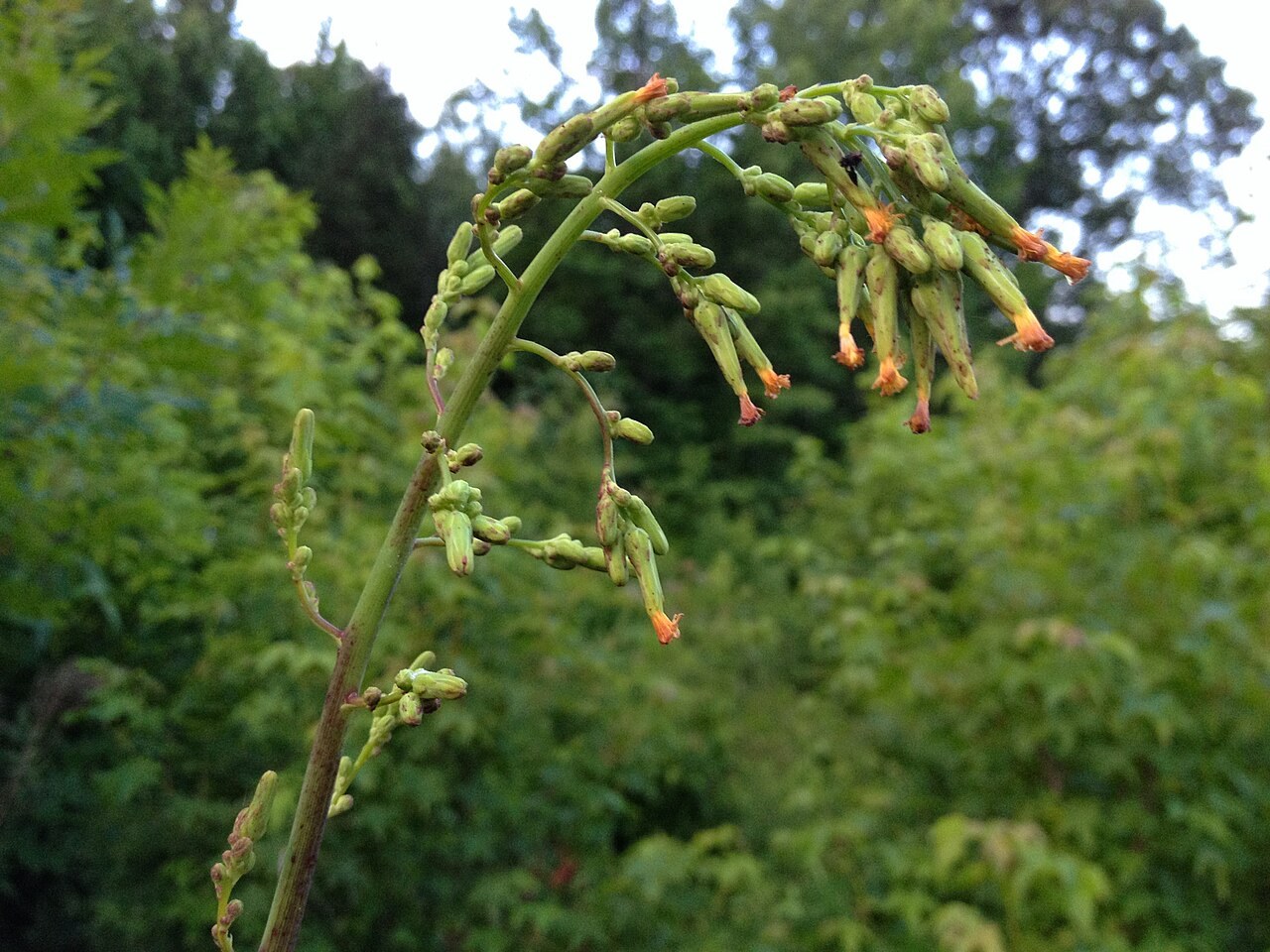
Canada lettuce is easy to dismiss as a weed, but in the late-summer landscape it provides flowers, seed, nesting material and forage at a time when many spring wildflowers have long since finished.
For Pollinators
The small heads are visited mostly by small bees, including sweat bees and other native bees, along with syrphid (hover) flies. Each head offers a little nectar and plenty of pollen, and because a single plant opens new heads every morning for several weeks, it keeps feeding these small pollinators through August and September.
For Birds
The seeds are eaten by American goldfinches and other small seed-eating birds, which pick them from the heads as they ripen. Goldfinches nest late in summer and line their nests with soft plant down, and fluffy seed heads like these are among the materials available to them at that time of year.
For Mammals
The tender rosettes and young stems are grazed by white-tailed deer, cottontail rabbits and groundhogs, so Canada lettuce is not deer resistant. The bitter latex increases as the plant matures, and older flowering stems are browsed less.
Ecosystem Role
As a fast-growing native of disturbed ground, Canada lettuce is one of the plants that quickly covers bare soil in clearings, after logging or fire and in abandoned fields. It fills space that would otherwise go to non-native weeds and then fades out as longer-lived grasses, goldenrods, asters and shrubs take over.
Cultural & Historical Uses
Canada lettuce has a long history of use. Ethnobotanical records list it among the plants used by eastern Native American nations, including the Cherokee, who are recorded as cooking the young leaves as spring greens. Early European settlers and later rural foragers in the East did the same, picking the leaves while young and before the plant bolted, and usually boiling them to reduce the bitterness.
The dried milky sap of wild lettuces, called lactucarium, was sold in the 1800s as a mild sedative, largely from the European bitter lettuce (Lactuca virosa). Canada lettuce was sometimes collected for the same purpose in North America, and it appears in Charles Millspaugh’s 1892 book American Medicinal Plants. These uses are historical; the sap is bitter and can irritate skin, and wild lettuce should not be taken as a remedy.
Today the plant is valued mostly by naturalists and meadow gardeners. It is a good example of how a common “weed” can be a fully native part of the ecosystem, and learning to tell it from the introduced prickly lettuce is a useful identification skill for anyone who walks fields and roadsides in summer.
Frequently Asked Questions
Is wild lettuce native to Maine?
Yes. Canada lettuce (Lactuca canadensis) is native throughout Maine and the rest of New England, where it is common in fields, clearings and roadsides. Another “wild lettuce” often seen along Maine roads, prickly lettuce (Lactuca serriola), is a European introduction. You can tell them apart by the leaf midrib: prickly lettuce has a row of stiff prickles along the underside, while Canada lettuce is smooth.
Is Canada lettuce a perennial? Does it spread by rhizomes?
No on both counts. It is an annual or biennial with a taproot. Each plant flowers once, sets seed and dies, and new plants come only from seed. It can self-sow freely, but cutting the flower stalks before the seed heads fluff out keeps it in check.
Are its leaves opposite or alternate?
Alternate: one leaf at each point on the stem, often clasping it at the base. Leaf shape is extremely variable, from deeply lobed to long and narrow, sometimes on plants growing side by side.
Can you eat Canada lettuce?
Young leaves have a long history as cooked spring greens in eastern North America, but they are very bitter, especially once the plant starts to bolt, and the milky sap can irritate sensitive skin and stomachs. Positive identification matters before trying any wild plant, and large amounts should be avoided.
How tall does Canada lettuce get?
Most plants reach 3 to 7 feet in their flowering year, and exceptionally vigorous plants in rich soil can grow even taller. First-year rosettes stay low, usually under a foot.

Looking for a nursery that carries Canada Lettuce?
Browse our native plant nursery directory: Alabama & Arkansas · Connecticut, Delaware, Florida & Georgia · Illinois, Indiana, Iowa & Kansas · Kentucky, Louisiana, Maine, Maryland, Massachusetts, Michigan, Minnesota, Mississippi & Missouri · Nebraska, New Hampshire, New Jersey, New York, North Carolina, North Dakota, Ohio & Oklahoma · Pennsylvania, Rhode Island, South Carolina, South Dakota, Tennessee, Texas, Vermont & Virginia · West Virginia & Wisconsin

