
Panicled Aster (Symphyotrichum lanceolatum)
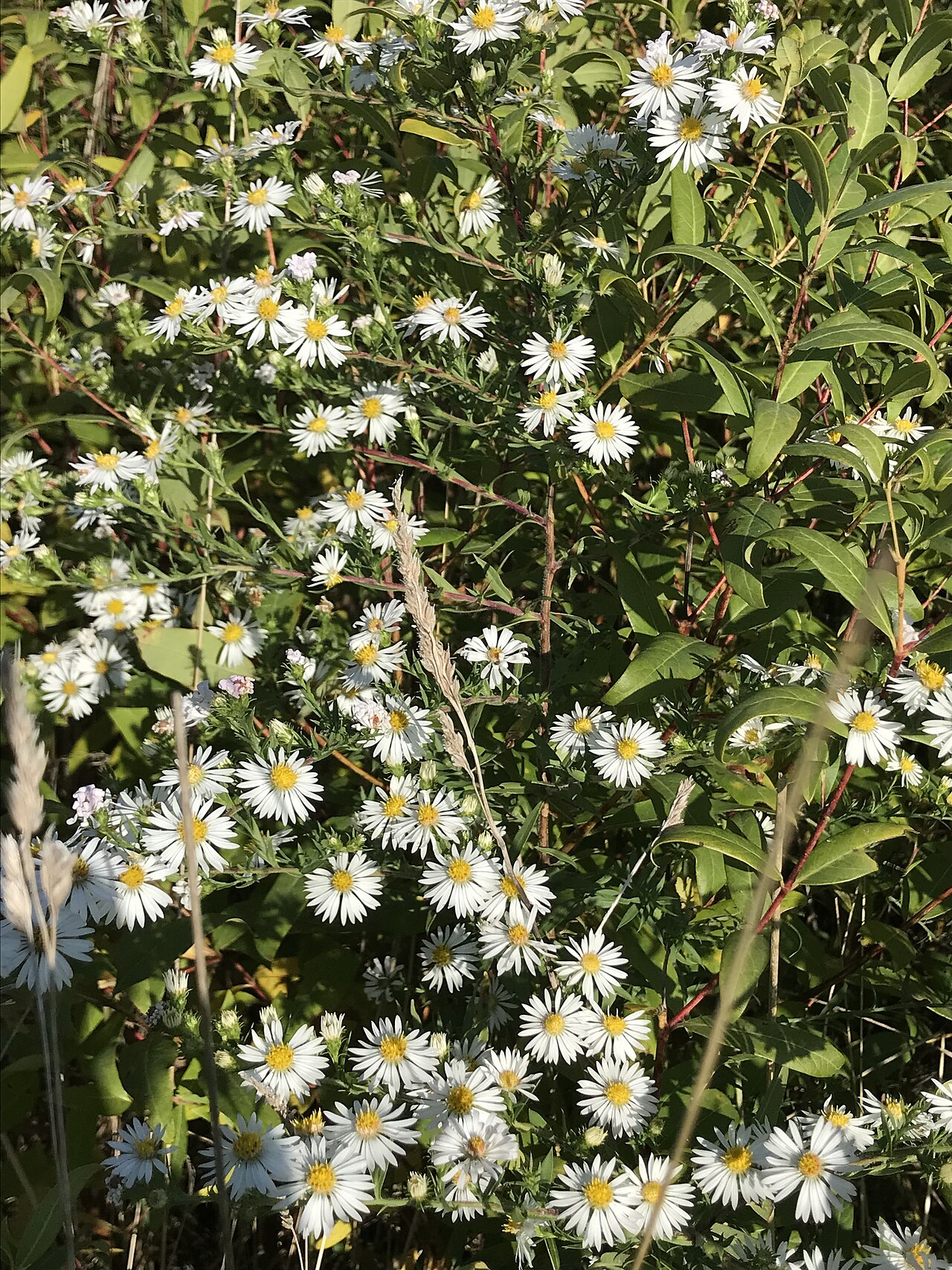
Symphyotrichum lanceolatum, known as Panicled Aster, white panicle aster or lance-leaved aster, is a tall, white-flowered perennial aster of moist meadows, stream banks, wet prairies, ditches and old fields. It is one of the most widespread asters in North America, native to nearly every state in the lower 48 and to most of Canada. Older books list it as Aster lanceolatus or Aster simplex.
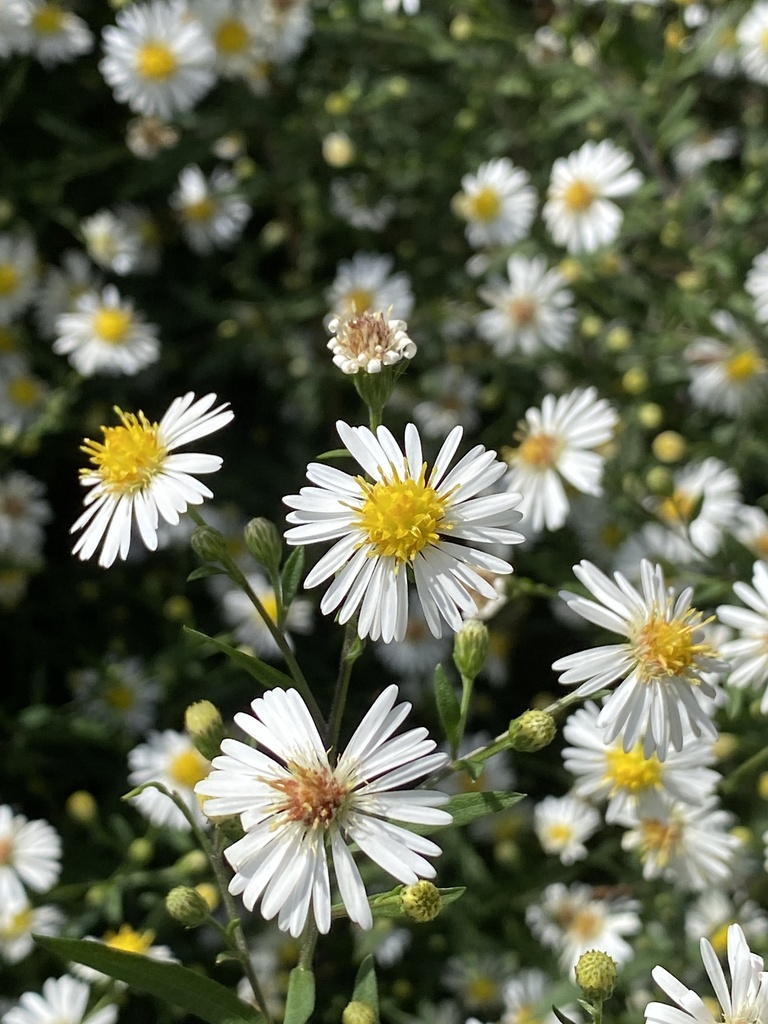
From late summer into fall it produces large, branching sprays of small white daisies, each about 3/4 inch across with a yellow center that turns reddish-purple with age. Plants grow 2 to 5 feet tall and spread by rhizomes into dense patches, so a single plant can become a colony of many stems.
Panicled aster is an excellent late-season nectar plant for bees, butterflies and other pollinators, and an easy choice for rain gardens, wet meadows and naturalized areas. Its vigorous spreading makes it less suitable for small, formal beds, where it can crowd out its neighbors.
Identification
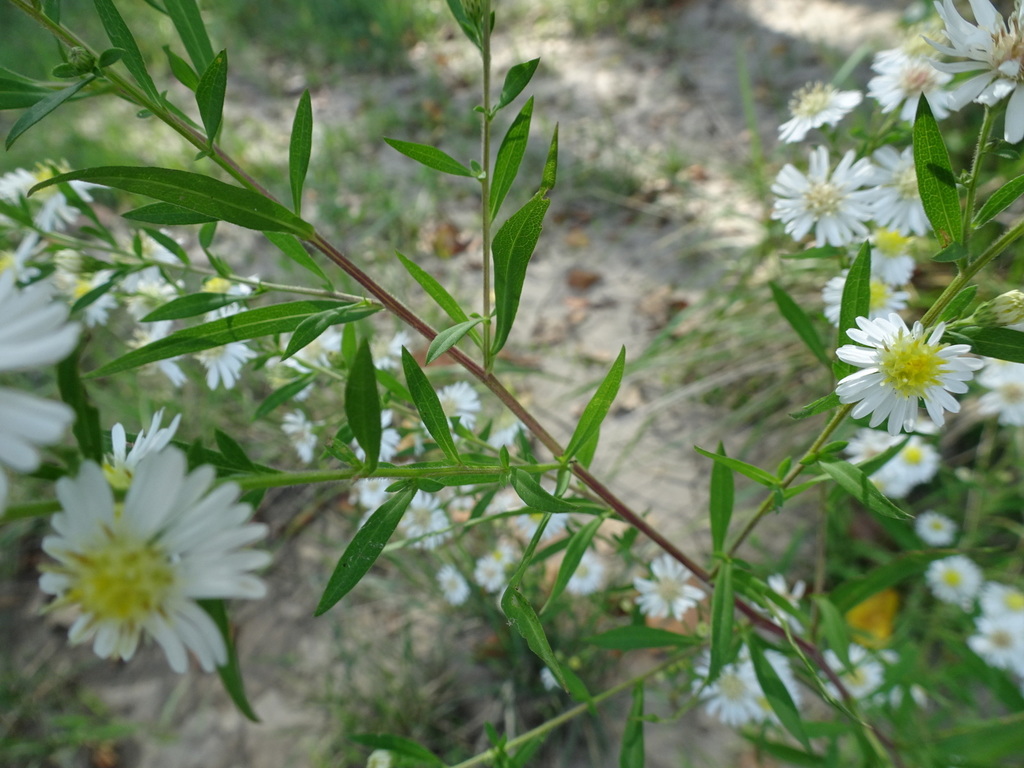
Look for tall, leafy stems with long, narrow, lance-shaped leaves, topped in late summer and fall by a loose, branching panicle of many small white asters with yellow centers, often in dense patches in moist ground.
Growth Habit
Panicled aster is a rhizomatous perennial with upright, branched stems usually 2 to 5 feet tall (occasionally to 6 feet). It spreads by long, creeping rhizomes and often forms dense colonies. The stems are green to reddish and smooth or with lines of fine hairs.
Leaves
The leaves are alternate, lance-shaped to linear, about 3 to 6 inches long and 1/4 to 3/4 inch wide, stalkless or tapering to a short base, with smooth or slightly toothed edges. They are smooth or slightly rough on top. The lower stem leaves often wither by flowering time, and the leaves on the flower branches are much smaller.
Flowers
The flower heads are about 1/2 to 1 inch across, with 20 to 45 narrow white rays (sometimes tinged pale pink or lavender) around a yellow disk that turns reddish-purple as it ages. They are carried in large, open, leafy panicles at the top of the stem and on the side branches. The bracts beneath each head are narrow and green-tipped. Bloom runs from about August to October, and later in the South.
Fruit
The small, dry fruits (cypselae) carry a tuft of white to tan bristles and are dispersed by wind in fall.
Varieties
Several varieties are recognized, including variety lanceolatum in the East, variety latifolium with broader leaves, variety interior in the Midwest and Northeast, variety hirsuticaule in the Southeast, and variety hesperium (western lance-leaved aster) across much of the West.
Look-alikes
Calico aster has smaller heads on one-sided, spreading branches. Frost aster and heath aster have tiny, crowded, often hairy leaves and grow in drier ground. Flat-top white aster has fewer rays and flat-topped flower clusters. Panicled aster’s long, narrow leaves and big, leafy panicles of white heads help separate it.
Quick Facts
| Scientific Name | Symphyotrichum lanceolatum |
| Family | Asteraceae (aster family) |
| Plant Type | Rhizomatous herbaceous perennial |
| Mature Height | 2–5 ft |
| Mature Spread | 2–3 ft per clump; spreads by rhizomes |
| Growth Rate | Fast |
| Sun Exposure | Full sun to part shade |
| Water Needs | Medium to high; moist to wet soil |
| Soil Type | Moist loam, clay, sand or silt |
| Soil pH | Acidic to alkaline (about 5.5–8.0) |
| Bloom Time | August–October |
| Flower Color | White (rarely pale pink or lavender), yellow center |
| Fall Color | Fall flowers; foliage yellow to brown |
| Fruit | Small cypselae with white bristles |
| Deer Resistant | Moderately; may be browsed |
| USDA Hardiness Zones | 3–9 |
Native Range
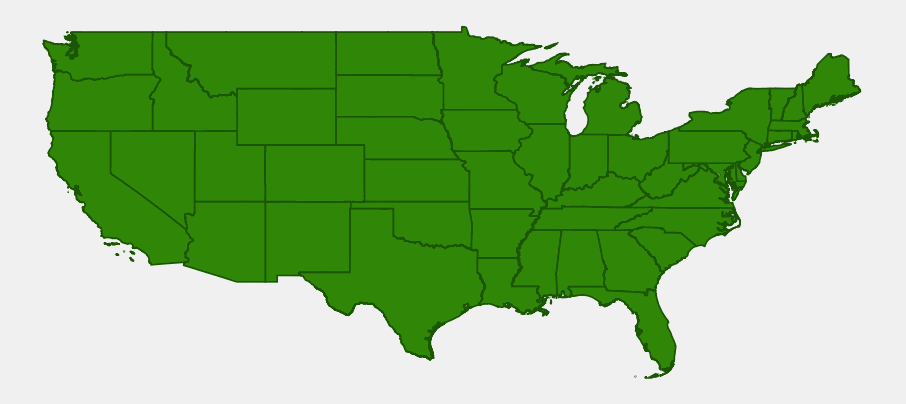
Panicled aster has one of the widest ranges of any North American aster. USDA PLANTS lists it as native in all 48 contiguous states, from Maine to Florida and west to Washington, Oregon, California and Arizona, and in every Canadian province from British Columbia to Newfoundland, plus the Northwest Territories.
It is most abundant in the Northeast, the Great Lakes region, the Midwest and the Great Plains. In the West it is represented mostly by variety hesperium, which grows along streams, springs and wet meadows in the Rocky Mountains, the Great Basin, the Southwest and the interior Northwest, mainly east of the Cascades. In Texas it grows in the eastern part of the state and along rivers and springs in central, southern and western Texas, and in the Deep South it is less common than in the North.
Its habitats include wet meadows, marsh edges, stream and pond banks, wet prairies, floodplains, roadside ditches, moist thickets and old fields. It does best in full sun and moist soils and readily colonizes open, disturbed wet ground.
📋 Regional plant lists featuring Panicled Aster: New York, Pennsylvania & Northern New Jersey · Idaho, Eastern Oregon & Eastern Washington · Ohio & Indiana · Montana & Wyoming · Michigan, Wisconsin & Eastern Minnesota · Kentucky & Tennessee · Nebraska, Kansas & Eastern Colorado · Utah & Western Colorado · Connecticut, Massachusetts & Rhode Island · New Hampshire, Maine & Vermont · Maryland, Virginia & West Virginia · Delaware, Southern New Jersey & Long Island · Arizona & New Mexico · Illinois, Iowa & Missouri · Alabama, Georgia & Mississippi · North & South Florida · North & South Carolina · Arkansas, Louisiana, Eastern Oklahoma & Eastern Texas · South & West Texas · North Dakota, South Dakota & Western Minnesota · California & Nevada
Growing & Care Guide
Panicled aster is one of the easiest native asters to grow. Its main needs are sun and moisture; its main drawback is vigor, so plan where it can spread.
Light
Full sun to part shade. It flowers best and stays sturdier in full sun; in shade it grows taller, leaner and blooms less.
Soil & Water
It prefers consistently moist to wet soil and tolerates clay, short flooding and poorly drained sites. It also adapts to average garden soil but may need water in dry spells. Avoid very dry sites.
Planting Tips
Plant in spring or early fall, about 2 feet apart. Because it spreads by rhizomes, use it in rain gardens, pond edges, wet meadows, ditches and naturalized areas rather than small formal beds. In mixed borders, give it a root barrier or pair it with vigorous companions such as goldenrods, Joe-Pye weed and tall grasses.
Pruning & Maintenance
Cut stems back by a third to a half in early summer (before mid-July) for shorter, bushier plants with more flowers. Leave the seed heads standing over winter for birds and cover for insects, then cut back in spring. Divide or remove runners every few years to keep it in bounds.
Propagation
Grow from seed sown outdoors in fall or after 60 days of cold, moist stratification. Divide clumps or take rhizome pieces in early spring. Buy local, nursery-grown plants or seed when possible.
Landscape Uses
- Rain gardens: tolerates wet soil and short flooding
- Pollinator gardens: abundant late-season nectar and pollen
- Wet meadows and restoration: a fast colonizer of moist open ground
- Naturalized areas: dense patches of fall bloom along ponds and ditches
- Stream bank cover: rhizomes help hold soil on moist banks
Wildlife & Ecological Value
As one of the most common fall-blooming asters across the continent, panicled aster is an important late-season food source for insects preparing for winter or migration.
For Pollinators
Its many small flowers feed native bees, honey bees, bumble bees, wasps, flies and butterflies, including migrating monarchs, in late summer and fall. Specialist bees that collect pollen only from asters visit it. Its leaves feed the caterpillars of the pearl crescent and other aster-feeding moths and butterflies.
For Birds
Finches, sparrows and other seed-eaters eat the seeds, and the dense patches give cover to birds in wet meadows and thickets. Insect-eating birds forage among the flowers.
For Mammals
White-tailed deer and rabbits sometimes browse the foliage. The dense stands provide cover for small mammals.
Ecosystem Role
Panicled aster is a pioneer of moist, open and disturbed ground. Its rhizomes stabilize stream banks and ditches, and its late bloom fills a key gap in the nectar supply before frost.
Cultural & Historical Uses
The genus name Symphyotrichum comes from Greek words meaning “junction of hairs,” a reference to the floral structure. The species name lanceolatum refers to its lance-shaped leaves. Most North American asters, including this one, were moved from Aster to Symphyotrichum after DNA studies showed that true Aster is mainly Eurasian.
Panicled aster was long known as Aster simplex or Aster lanceolatus, and some older guides call it tall white aster or lance-leaved aster. Its many varieties reflect how widely it grows and how much it varies across North America.
The species was introduced to Europe as a garden plant and has spread widely there, where it is now considered invasive in several countries. In North America it is a native and valuable part of wet meadows and old fields.
Frequently Asked Questions
Does panicled aster spread?
Yes. It spreads by rhizomes and can form large colonies, so give it room or use it in naturalized and wet areas.
What is the old name for panicled aster?
It was formerly called Aster lanceolatus or Aster simplex. USDA calls it white panicle aster.
When does panicled aster bloom?
Usually from August to October, with large sprays of small white flowers.
Does panicled aster grow in wet soil?
Yes. It thrives in moist to wet soils and is a good choice for rain gardens and pond edges.
Is panicled aster good for pollinators?
Yes. It is a major late-season nectar source for bees, butterflies and migrating monarchs.

Looking for a nursery that carries Panicled Aster?
Browse our native plant nursery directory: Alabama, Arizona & Arkansas · California · Colorado, Connecticut, Delaware, Florida & Georgia · Idaho, Illinois, Indiana, Iowa & Kansas · Kentucky, Louisiana, Maine, Maryland, Massachusetts, Michigan, Minnesota, Mississippi, Missouri & Montana · Nebraska, Nevada, New Hampshire, New Jersey, New Mexico, New York, North Carolina, North Dakota, Ohio & Oklahoma · Oregon · Pennsylvania, Rhode Island, South Carolina, South Dakota, Tennessee, Texas, Utah, Vermont & Virginia · Washington · West Virginia, Wisconsin & Wyoming
