
Native Globemallows (Sphaeralcea)
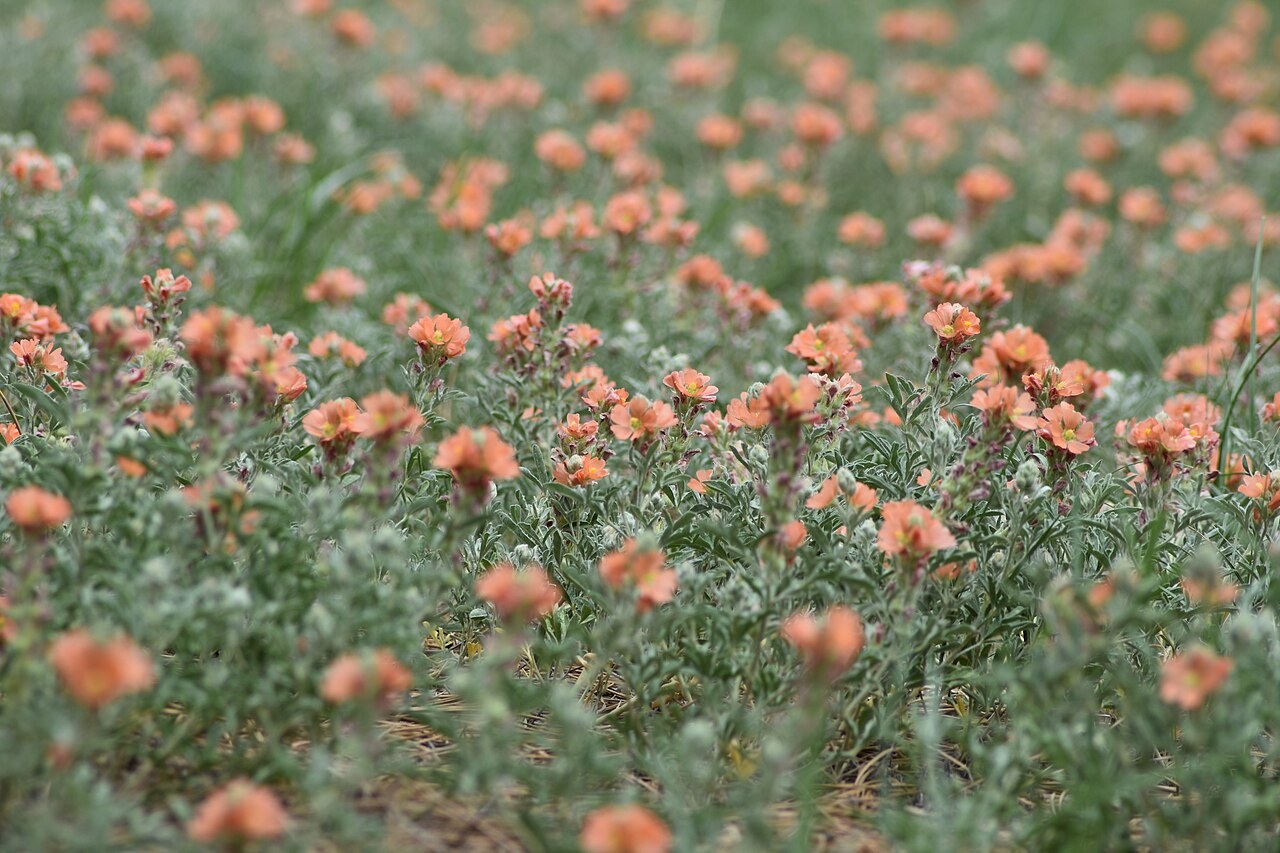
Globemallows (Sphaeralcea) are the cheerful orange wildflowers of the dry West. In late spring their cupped, apricot to brick-red blossoms light up sagebrush flats, desert washes, shortgrass prairie and roadsides from the Great Plains to the Mojave Desert, and in many places they are among the most common native flowers. They belong to the mallow family, along with hollyhocks, hibiscus and cotton, and their small, hollyhock-like flowers held along tall wands show the family resemblance.
All globemallows found wild in the United States are native. Roughly 20 to 25 species grow here (an approximate count, since several western species intergrade and are classified differently by different botanists), with the greatest variety in Arizona, New Mexico, Utah and Texas. The genus extends south through Mexico to South America, always in arid and semi-arid country.
For gardeners in Utah and the rest of the Intermountain West, globemallows are near-perfect native plants. They thrive on heat, sun and very little water, tolerate alkaline and poor soils, bloom for weeks, feed specialist native bees and are increasingly available from native nurseries and restoration seed suppliers. This guide covers the main species, how to tell them apart and how to grow them.
Identification
Globemallows are perennial herbs or woody-based subshrubs, with a few annuals. Most form clumps of upright or sprawling stems that range from under a foot tall in scarlet globemallow to 5 feet in desert and copper globemallow.
Leaves & Hairs
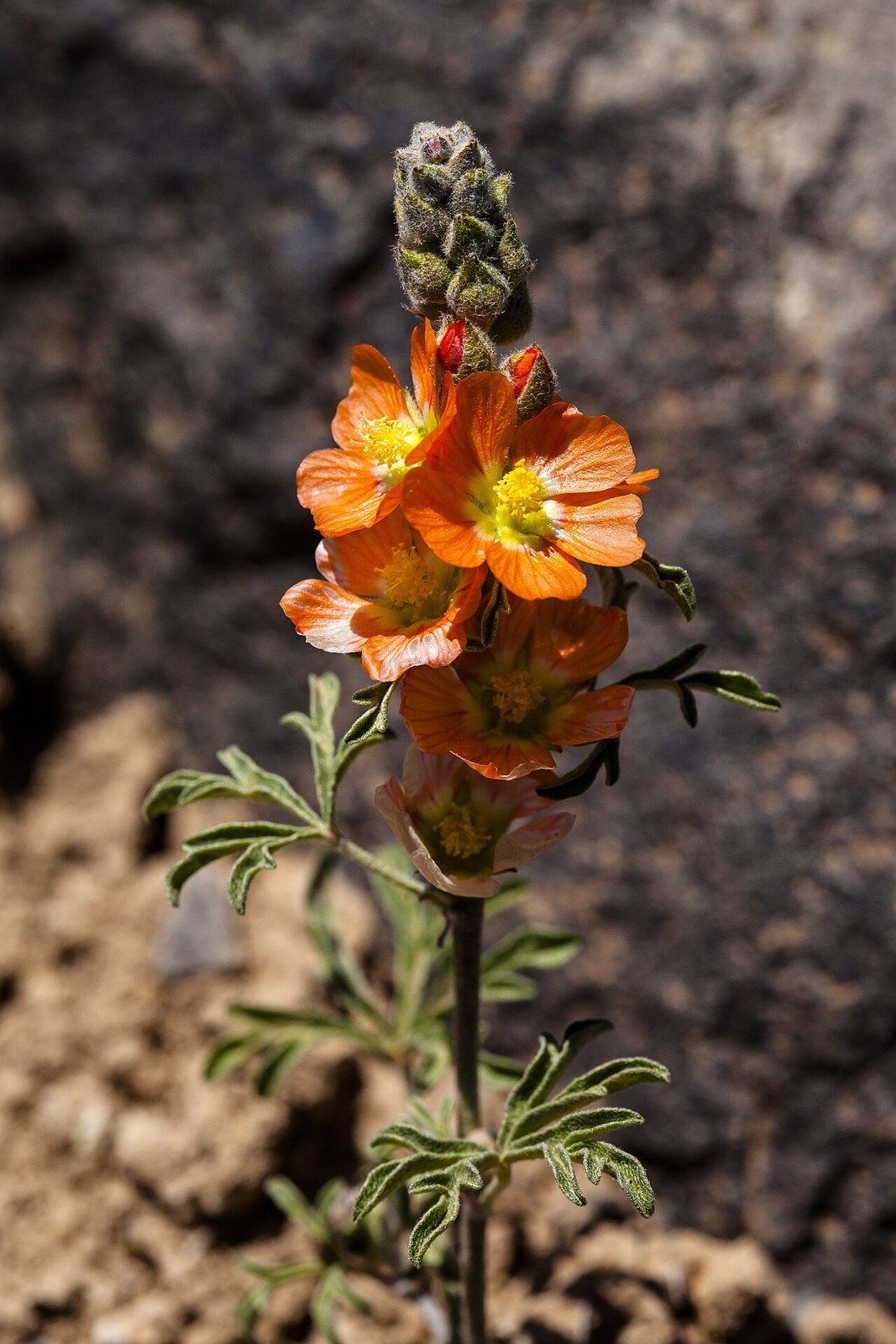
The whole plant is usually covered in dense, star-shaped (stellate) hairs that give stems and leaves a gray, gray-green or yellowish, felted look. These hairs reflect sunlight and reduce water loss. They also rub off easily and can irritate eyes and skin, which is why some globemallows are called “sore-eye poppy.” Leaf shape is the best clue to species: deeply divided into narrow fingers in scarlet globemallow, three-lobed and toothed like a gooseberry leaf in gooseberryleaf globemallow, shallowly lobed and roundish in Munro’s and small-leaf globemallow, and long, narrow and unlobed in copper globemallow.
Flowers
Flowers are cup-shaped with five broad petals, usually half an inch to an inch and a half across, with a central column of fused stamens typical of the mallow family. Most species are apricot to orange or reddish-orange, but desert globemallow also comes in pink, red, lavender and white forms. Flowers are held in clusters or spikes along the upper stems, opening over several weeks from spring into summer, and some species rebloom after summer rains.
Fruit
The fruit is a small ring of wedge-shaped segments (a schizocarp), each holding one or two seeds, that splits apart when dry. The shape and netted texture of these segments are what botanists use to separate the closely related species.
Quick Facts
| Scientific Name | Sphaeralcea A. St.-Hil. (genus) |
| Family | Malvaceae (Mallow) |
| US-Native Species | Roughly 20–25 (approximate); none of the US species is introduced |
| Growth Forms | Perennial herbs and woody-based subshrubs; a few annuals |
| Mature Height | About 4 in to 5 ft, depending on species |
| Mature Spread | 1–3 ft; scarlet globemallow spreads by rhizomes |
| Sun Exposure | Full Sun |
| Water Needs | Low; drought tolerant once established |
| Soil Type | Sandy, gravelly, rocky or clay soils with good drainage; tolerates alkaline soil |
| Soil pH | Neutral to alkaline |
| Bloom Time | April – August, with rebloom after rain in some species |
| Flower Color | Apricot, orange, red-orange; also pink, red, lavender, white in desert globemallow |
| Wildlife Value | Specialist globemallow bees, checkered-skipper and lady butterfly host plant |
| Deer Resistant | Moderately; browsed by deer, pronghorn and livestock in the wild |
| USDA Hardiness Zones | About 3–10 across the genus (scarlet globemallow to zone 3; desert globemallow zones 6–10) |
Native Range
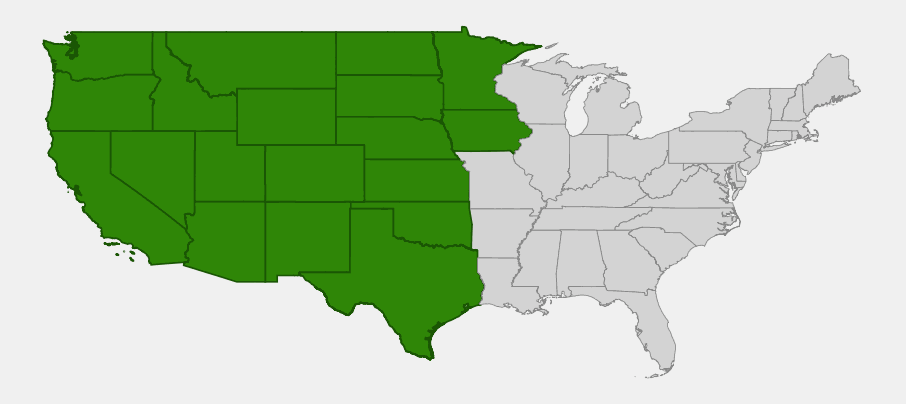
Globemallows are plants of the arid and semi-arid West. Scarlet globemallow has by far the widest range, from the Canadian prairies south through the Great Plains and Rocky Mountain states to Texas, New Mexico and Arizona, and west through the Great Basin to eastern Oregon and Washington. At its eastern edge it reaches western Minnesota and has rare native outposts in western Iowa. Munro’s globemallow and gooseberryleaf globemallow center on the sagebrush country of the Great Basin and the Columbia Plateau.
To the south, the species count climbs. The Colorado Plateau and the Mojave, Sonoran and Chihuahuan deserts hold desert, small-leaf, copper, Fendler’s, gray, Emory’s and several other globemallows, and Texas adds woolly globemallow of the southern sandy plains and spear globemallow of the western grasslands. Desert globemallow is native to the Mojave and Sonoran deserts of California, Nevada, Arizona and southwestern Utah.
Globemallows are not native east of the Great Plains. Copper globemallow is occasionally found as a waif farther east, but those records are not native populations. Within their range they grow on dry plains, sagebrush flats, desert washes, rocky slopes, pinyon-juniper woodland openings and, very commonly, along road shoulders and other disturbed ground.
📋 Regional plant lists covering globemallow country: Utah & Western Colorado · Arizona & New Mexico · California & Nevada · Idaho, Eastern Oregon & Eastern Washington · Montana & Wyoming · North Dakota, South Dakota & Western Minnesota · Nebraska, Kansas & Eastern Colorado · South & West Texas
Native Species
These are the globemallows gardeners are most likely to see or grow. Several are available from native nurseries and western restoration seed companies.
Scarlet globemallow (Sphaeralcea coccinea) is the most widespread species, a low, 4- to 12-inch perennial that spreads by rhizomes into patches. Its gray-green leaves are deeply cut into narrow fingers, and its brick-red to orange flowers appear from late spring into summer. Native from the Canadian prairies to Texas and Arizona and west to eastern Oregon, including much of Utah, it makes a tough, drought-proof ground cover for dry slopes and xeriscapes.
Munro’s or orange globemallow (Sphaeralcea munroana) grows 1 to 3 feet tall, with shallowly lobed, softly hairy leaves and apricot-orange flowers on long, leafy stems. It’s a key species of the sagebrush steppe in Washington, Oregon, Idaho, Nevada, Utah and western Montana and Wyoming, and one of the most-used globemallows in Great Basin restoration seedings.
Gooseberryleaf globemallow (Sphaeralcea grossulariifolia) is named for its deeply three- to five-lobed leaves, which resemble a gooseberry’s. It grows 1 to 3 feet tall in the Great Basin of Utah, Nevada, Idaho, Oregon and Washington, with bright orange-red flowers from spring into summer.
Small-leaf globemallow (Sphaeralcea parvifolia) is a Colorado Plateau species of Utah, Arizona, New Mexico, Colorado and Nevada, with small, roundish, shallowly lobed gray leaves and orange flowers on 1- to 3-foot stems. It thrives on sandy and clay soils around Moab, Canyonlands and the Four Corners.
Desert globemallow (Sphaeralcea ambigua) is the largest and showiest species, a mounding subshrub 2 to 3 feet tall (occasionally to 5 feet) with crinkled, triangular gray leaves and masses of apricot flowers in spring. Pink, red, lavender and white forms occur in the wild and are sold by nurseries. It is native to the Mojave and Sonoran deserts of California, Nevada, Arizona and southwestern Utah, and is a mainstay of low-water landscaping in Las Vegas, Phoenix, St. George and Southern California.
Copper globemallow (Sphaeralcea angustifolia) stands out for its long, narrow, unlobed leaves with wavy edges and tall wands of copper to lavender-pink flowers in summer. It grows 2 to 6 feet tall in the Southwest and southern Plains, from Arizona and Utah to Colorado, Kansas, Oklahoma and Texas.
Fendler’s globemallow (Sphaeralcea fendleri) is a shrubby, 2- to 4-foot species of open pinyon-juniper and ponderosa pine woodland in the Southwest, with pale orange to pinkish flowers in summer.
Gray globemallow (Sphaeralcea incana) grows tall and upright, to about 5 feet, with grayish leaves and long spikes of orange flowers, on desert grasslands and roadsides in Arizona, New Mexico and west Texas.
Emory’s globemallow (Sphaeralcea emoryi) is a desert species of southeastern California and southwestern Arizona, with orange to pink flowers, often along washes and roads in the low desert.
Spear globemallow (Sphaeralcea hastulata) is a low species of grasslands and desert scrub in the Southwest, recognized by its small spear- or arrow-shaped leaves.
Woolly globemallow (Sphaeralcea lindheimeri) is a densely white-woolly, low species of sandy soils in south Texas and northern Mexico.
Non-Native Look-Alikes
Globemallows are an unusually “clean” group for gardeners: none of the globemallows growing wild in the US is introduced, and there are no common non-native Sphaeralcea sold in the garden trade. A few other members of the mallow family can be confused with them, though.
- Common mallow or cheeses (Malva neglecta) and cheeseweed (Malva parviflora): Low, weedy, roundish-leaved mallows from Europe and the Mediterranean with small white to pale pink flowers. They are common in gardens, lawns and vacant lots throughout the West and are not native.
- Velvetleaf (Abutilon theophrasti): A tall, velvety annual from Asia with yellow-orange flowers and big heart-shaped leaves, a major crop weed in the Plains and Midwest. It has much larger leaves and a distinctive ring-shaped seed pod.
- Hollyhock (Alcea rosea): The classic tall garden mallow from Asia, which escapes along Western roadsides and alleys. Its flowers are much larger than any globemallow’s.
Several native mallows are also sometimes mistaken for globemallows: winecup (Callirhoe) has magenta flowers on sprawling stems, the checkerblooms (Sidalcea) have pink flowers and green leaves, and the mountain hollyhocks (Iliamna) are taller plants of moist mountain slopes.
Growing & Care Guide
Light
Globemallows need full sun. In shade they flop and bloom poorly. A hot, south- or west-facing slope, a parking strip or a gravel garden suits them perfectly.
Soil & Water
Plant in well-drained sandy, gravelly or rocky soil; heavy clay is tolerated if it does not stay wet. Globemallows handle alkaline soil easily. Water to establish them in the first season, then water sparingly, about once a month in hot, dry summers in the low desert and rarely or not at all in most of the Intermountain West. Too much water and fertilizer make plants floppy, short-lived and more prone to disease.
Planting Tips
Set out container plants in spring or early fall. Seed has a hard coat; nick it, pour near-boiling water over it and let it soak overnight, or sow in fall so winter weather softens the coat. Space desert globemallow 3 feet apart and smaller species 1 to 2 feet apart. Use gravel rather than bark mulch around the crowns.
Pruning & Maintenance
Cut spent flower stems back by about half after the main bloom to tidy the plant and encourage new flowers. Cut desert globemallow back hard in late winter if it gets leggy. In humid or heavily watered gardens, globemallows can get hollyhock rust, a fungus that makes orange spots under the leaves; better drainage, good air circulation and less water solve it. Wear gloves and avoid touching your eyes when handling the hairy foliage.
Propagation
Globemallows are grown mainly from seed, which often self-sows in gravel. Softwood cuttings of desert globemallow root in late spring, and scarlet globemallow can be divided in early spring.
Landscape Uses
- Xeriscapes and water-wise gardens with firecracker penstemon and tufted evening primrose
- Sagebrush and desert plantings with big sagebrush and rubber rabbitbrush
- Shortgrass and dry meadows with blue grama and Indian ricegrass
- Parking strips, roadsides and slopes where irrigation is limited
- Pollinator gardens for native bees in the arid West
- Restoration of disturbed rangeland with Munro’s, gooseberryleaf and scarlet globemallow
Wildlife & Ecological Value
For Pollinators
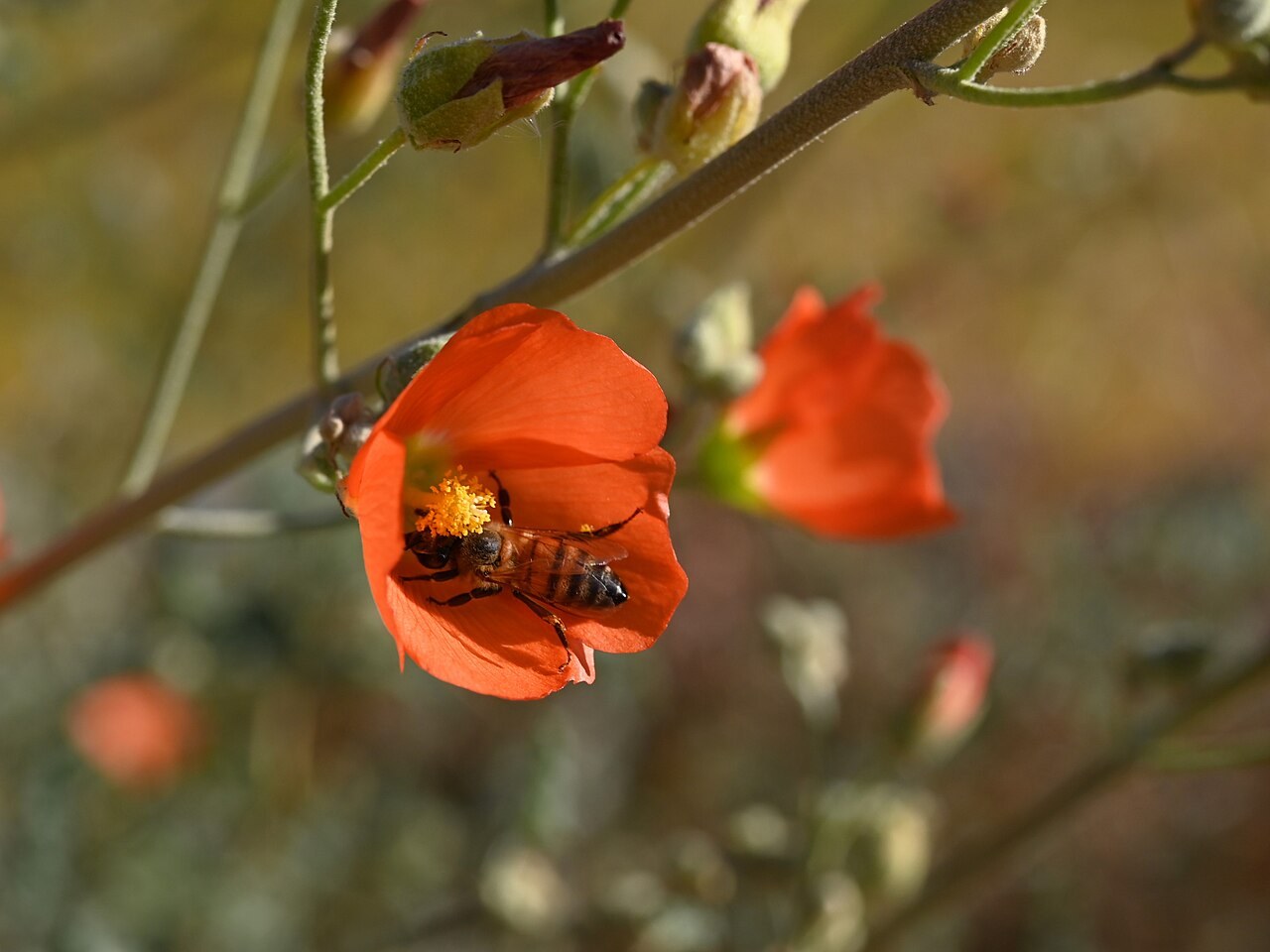
Globemallows are important bee plants. Several native bees, especially chimney bees in the genus Diadasia, collect pollen only from globemallows and related mallows and time their emergence to globemallow bloom. Bumblebees, sweat bees, long-horned bees and honeybees also visit, and male native bees sometimes spend the night sheltering inside the cupped flowers.
Butterfly Host Plants
Globemallow leaves feed the caterpillars of the common and small checkered-skippers, the West Coast lady and the painted lady, and the gray hairstreak also uses mallows. Look for small, folded leaf shelters made by skipper caterpillars.
For Birds & Mammals
Mule deer, pronghorn, bighorn sheep and livestock browse globemallows, and scarlet globemallow is a valued forage plant on western rangelands. Small seed-eating birds and rodents eat the seeds.
Ecosystem Role
Globemallows are fast, early colonizers of bare and disturbed ground, from roadcuts to burned rangeland. That makes them valuable in restoration, where they help hold soil and compete with weeds such as cheatgrass while slower shrubs and bunchgrasses establish.
Cultural & Historical Uses
Ethnobotanical records list globemallows among the plants used by many peoples of the Southwest and Great Basin, including the Navajo, Hopi and Zuni. The slippery, mucilage-rich sap typical of the mallow family was part of their value, and the plants were used in poultices, washes and ceremonies. These are historical uses, described here as history rather than advice.
The genus name comes from the Greek sphaira, “globe,” and alkea, a kind of mallow, referring to the rounded fruit. The common name “sore-eye poppy,” used for some species, refers to the irritating hairs.
Today globemallows have found a new role in conservation. Seed of Munro’s, gooseberryleaf and scarlet globemallow is grown commercially for rangeland restoration after wildfire across the Great Basin, and desert globemallow has become one of the signature plants of desert water-wise landscaping.
Frequently Asked Questions
Is globemallow native to Utah?
Yes. Utah has several native globemallows, including scarlet, Munro’s, gooseberryleaf and small-leaf globemallow statewide or regionally, and desert globemallow in the southwest corner around St. George. All globemallows growing wild in Utah are native.
Do globemallows need much water?
No. They are among the most drought-tolerant flowering perennials in the West. Overwatering is a more common problem than drought, causing floppy growth, rust disease and short lives.
Are globemallow hairs harmful?
The star-shaped hairs on leaves and stems rub off easily and can irritate eyes and sensitive skin. Wear gloves when pruning or dividing, and keep your hands away from your eyes.
How do I tell scarlet globemallow from other globemallows?
Scarlet globemallow is low (usually under a foot) and spreads in patches, and its leaves are deeply divided into narrow fingers. Most other common species are taller, 1 to 5 feet, with lobed, toothed or unlobed leaves.
Will globemallow spread in my garden?
Scarlet globemallow spreads slowly by rhizomes, and most species self-sow in gravel or bare soil. Seedlings are easy to pull or move while small.

Looking for a nursery that carries Native Globemallows?
Browse our native plant nursery directory: Arizona · California · Colorado · Idaho, Iowa & Kansas · Minnesota & Montana · Nebraska, Nevada, New Mexico, North Dakota & Oklahoma · Oregon · South Dakota, Texas & Utah · Washington · Wyoming

