
Woodland Lettuce (Lactuca floridana)
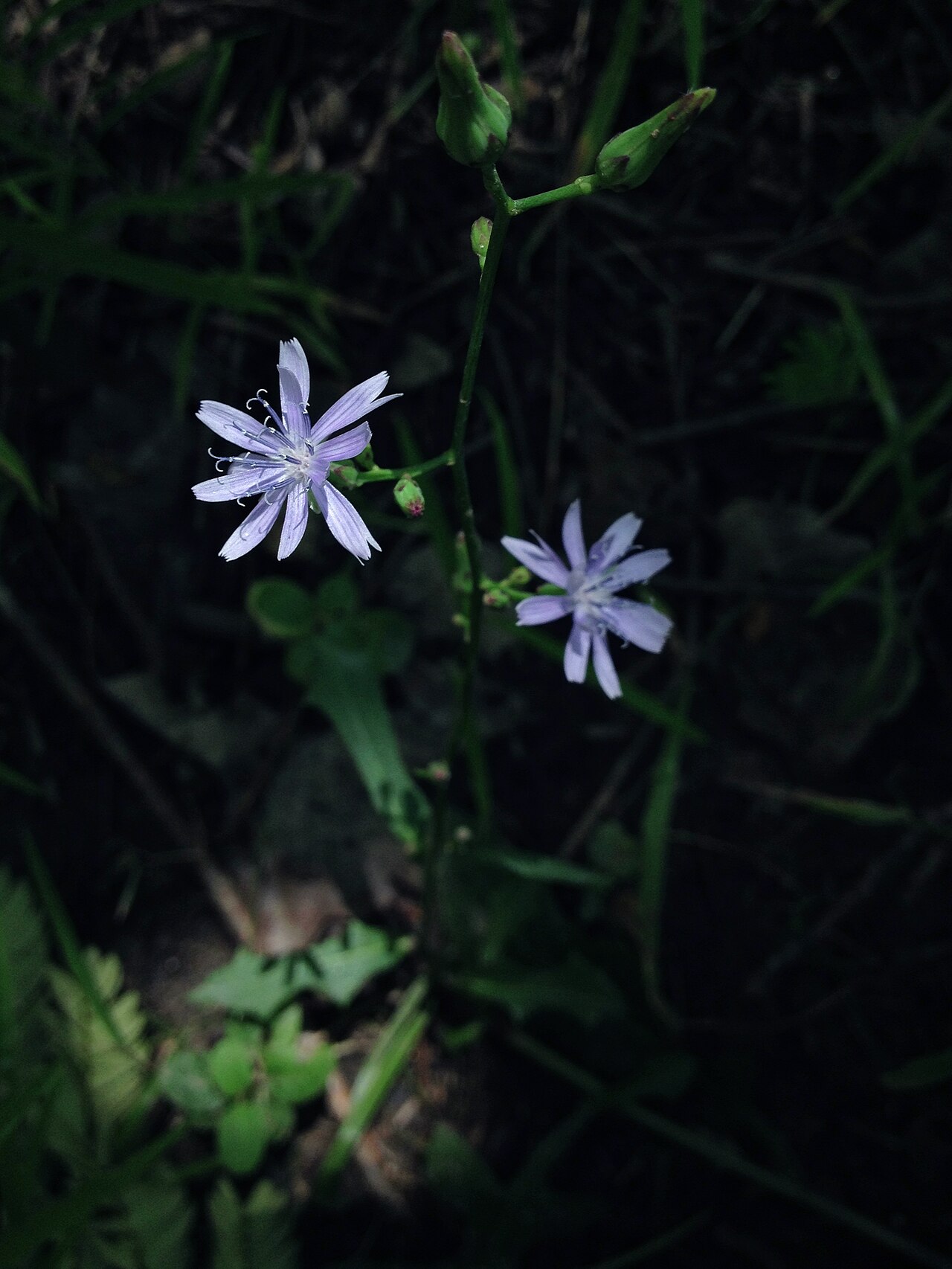
Lactuca floridana, known as Woodland Lettuce or Florida blue lettuce, is a tall native wild lettuce in the aster family (Asteraceae). It is an annual or biennial that grows from a basal rosette into a leafy stem 3 to 7 feet tall, topped in late summer and fall by an airy, branching cluster of small, pale blue to violet, dandelion-like flower heads. Like all lettuces, it has milky sap.
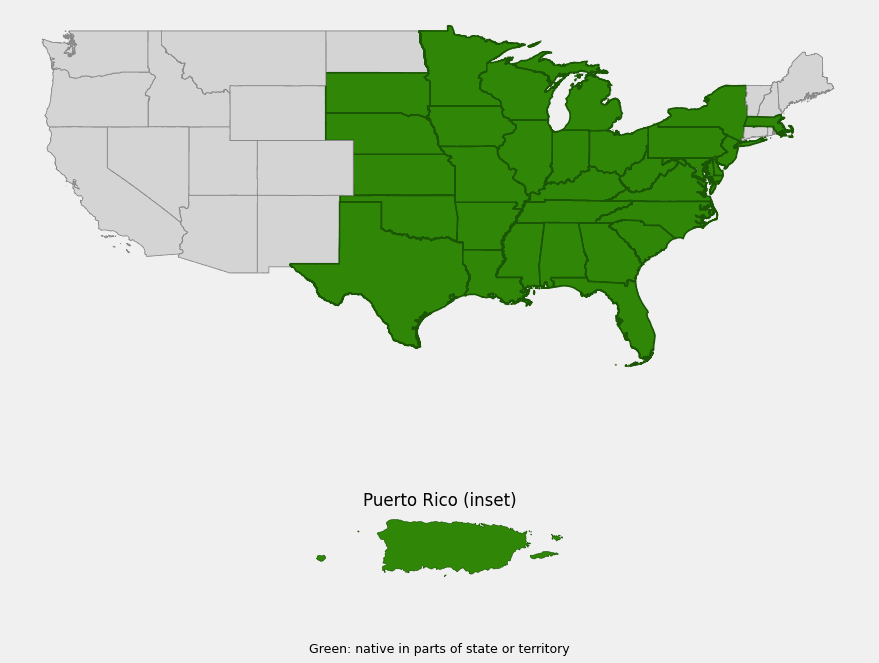
It grows in moist woods, woodland edges, thickets, stream banks and clearings across the eastern and central United States, from New York and Massachusetts west to Minnesota, South Dakota and Kansas and south to Florida and eastern Texas. It is related to garden lettuce (Lactuca sativa) and to tall blue lettuce (Lactuca biennis), which it closely resembles.
Woodland lettuce is not a common garden plant, but it is a valuable part of naturalized woodland edges and wildlife plantings. Its late flowers feed bees, its seeds feed songbirds, and its leaves feed many insects. It self-sows readily, so it suits informal plantings where some movement is welcome.
Identification
Look for a tall, leafy plant with milky sap, large lobed leaves, and a loose, open cluster of small, pale blue flower heads in late summer and fall.
Growth Habit
In its first year it forms a rosette of leaves; in the second year (or in the same year, if it behaves as an annual) it sends up a single stout, smooth or sparsely hairy stem 3 to 7 feet tall, often tinged with purple. All parts release a white, milky latex when broken.
Leaves
The leaves are alternate and highly variable, 4 to 12 inches long. Most are deeply pinnately lobed, with a large triangular end lobe and several pairs of pointed side lobes, but some plants have mostly unlobed, oval to lance-shaped leaves (sometimes separated as variety villosa). The leaf undersides have hairs along the midrib, and the leaf stalks are often winged and clasp the stem.
Flowers
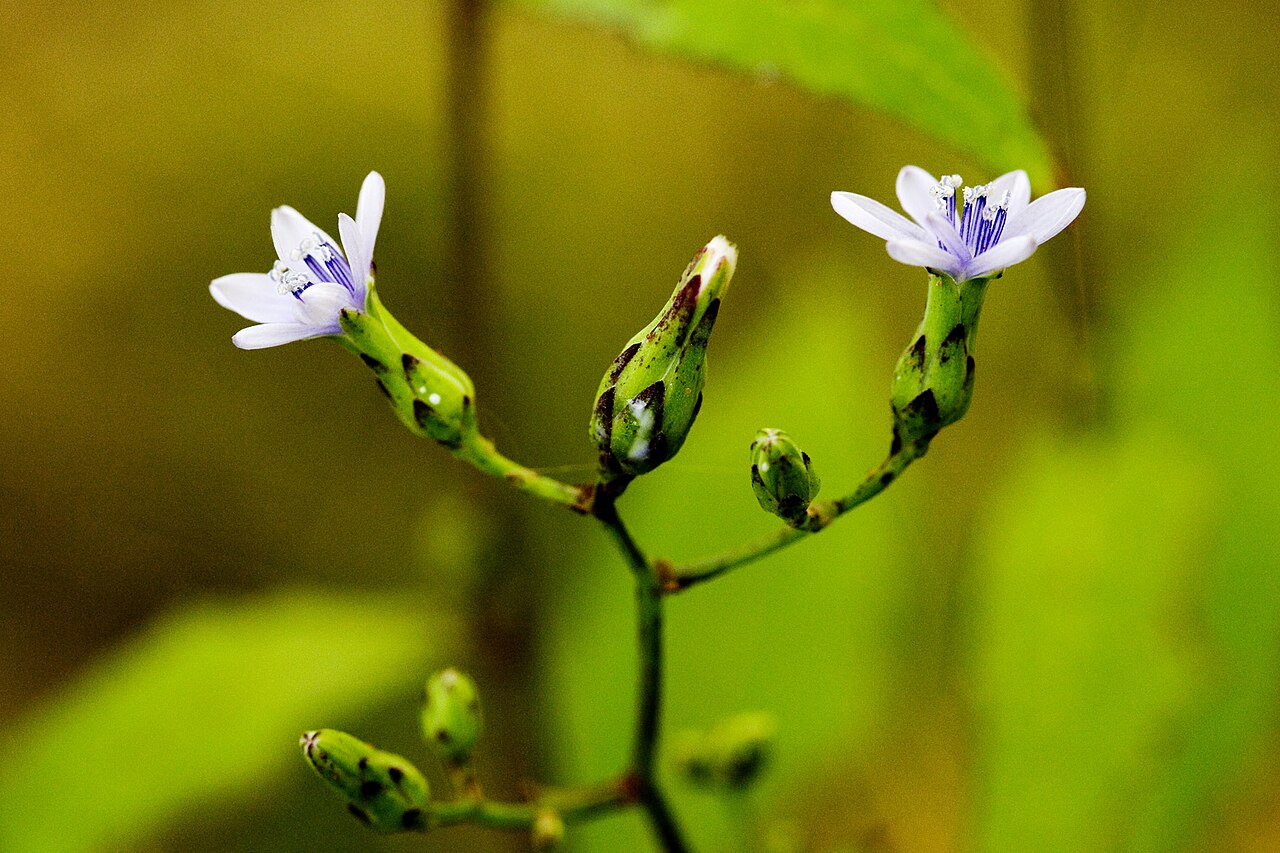
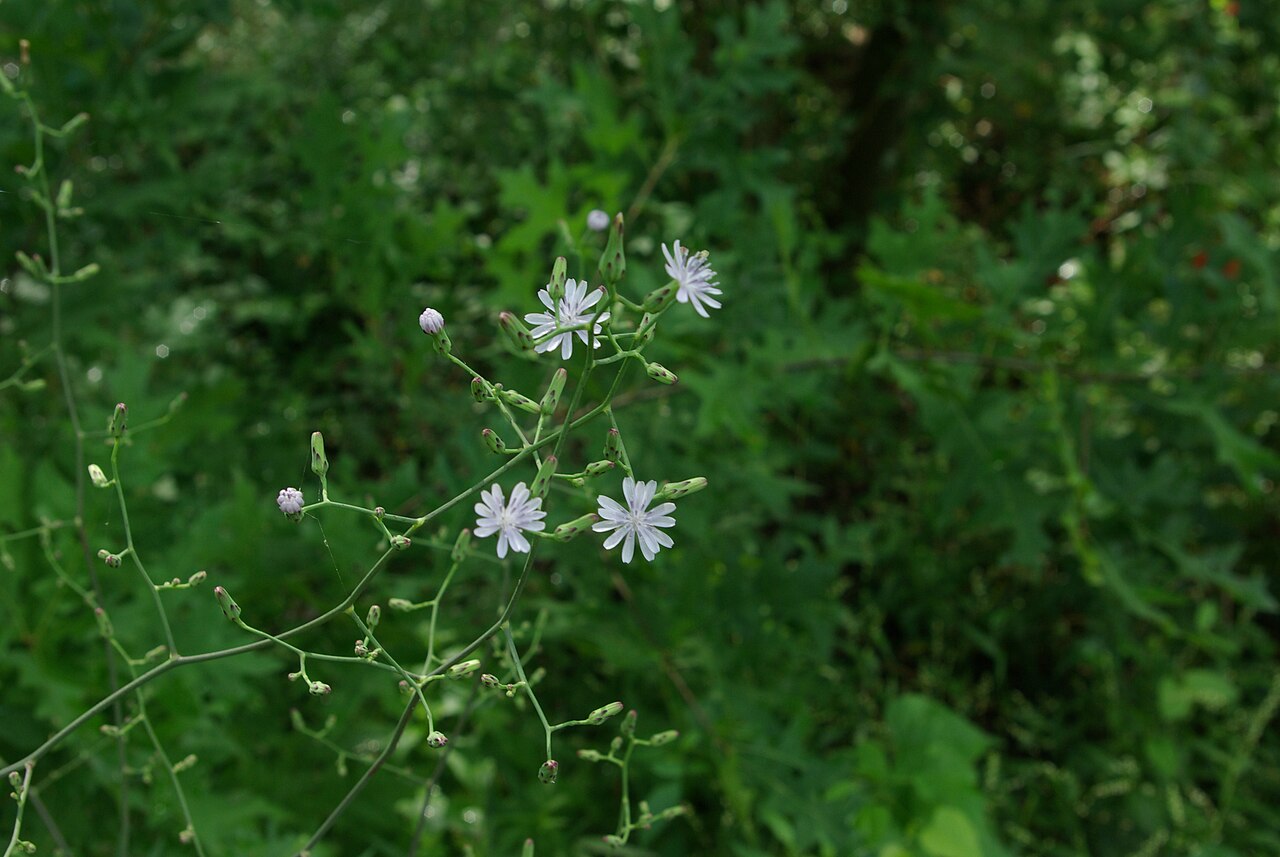
The flower heads are about 1/2 inch across and contain about 11 to 17 strap-shaped ray florets, with no central disk. The color is pale blue to lavender or violet, sometimes nearly white. Heads open in the morning and close by afternoon. They are borne in a large, open, branching cluster (panicle) at the top of the stem from about August to October.
Fruit & Seeds
The seeds (achenes) are dark brown, flattened and ribbed, with a short beak and a tuft of soft white bristles (pappus) that carries them on the wind.
Look-alikes
Tall blue lettuce (Lactuca biennis) has a dense, narrow flower cluster, more florets per head (about 15 to 34), and tan to light brown pappus, while woodland lettuce has an open cluster and white pappus. Wild lettuce (Lactuca canadensis) has yellow flowers. Chicory (Cichorium intybus), an introduced weed, has larger, bright blue flowers that sit directly on stiff stems.
Quick Facts
| Scientific Name | Lactuca floridana |
| Family | Asteraceae (aster family) |
| Plant Type | Annual or biennial wildflower |
| Mature Height | 3–7 ft |
| Mature Spread | 1–2 ft |
| Growth Rate | Fast |
| Sun Exposure | Part shade to full sun |
| Water Needs | Medium; prefers moist soil |
| Soil Type | Loam, clay loam or sandy loam, rich in organic matter |
| Soil pH | Slightly acidic to neutral (about 5.5–7.5) |
| Bloom Time | Late summer to fall (August–October) |
| Flower Color | Pale blue to violet, sometimes nearly white |
| Fall Color | None notable |
| Fruit | Beaked achenes with white bristles, wind-dispersed |
| Deer Resistant | No; deer and rabbits browse it |
| USDA Hardiness Zones | 4–9 |
Native Range
Woodland lettuce is native to the eastern and central United States and southern Canada (Ontario and Manitoba). USDA PLANTS records it from 31 states, from Massachusetts, New York and Michigan west to Minnesota, South Dakota, Nebraska and Kansas, and south to Florida, Louisiana and eastern Texas.
It is most common in the Southeast, the Ohio and Mississippi River valleys, the Ozarks and the Piedmont. It becomes less common toward the northern edge of its range, in Massachusetts, southern Michigan, Wisconsin, Minnesota and southeastern South Dakota, and toward the Great Plains in Nebraska, Kansas and Oklahoma. In Texas it grows mainly in the eastern third of the state. USDA PLANTS also lists it as native to Puerto Rico, an outlying record far from the main range.
Its habitats include moist deciduous woods, woodland edges and openings, thickets, stream banks and floodplains, ravines, clearings, fencerows and road banks. It often appears after a disturbance such as a tree fall, logging or flooding opens up the canopy.
📋 Regional plant lists featuring Woodland Lettuce: New York, Pennsylvania & Northern New Jersey · Ohio & Indiana · Michigan, Wisconsin & Eastern Minnesota · Kentucky & Tennessee · Nebraska, Kansas & Eastern Colorado · Connecticut, Massachusetts & Rhode Island · New Hampshire, Maine & Vermont · Maryland, Virginia & West Virginia · Delaware, Southern New Jersey & Long Island · Illinois, Iowa & Missouri · Alabama, Georgia & Mississippi · North & South Florida · Puerto Rico · North & South Carolina · Arkansas, Louisiana, Eastern Oklahoma & Eastern Texas · North Dakota, South Dakota & Western Minnesota
Growing & Care Guide
Woodland lettuce is easy to grow from seed in moist, partly shaded spots. Because it is an annual or biennial that reseeds itself, it is best used in naturalized areas, woodland edges and wildlife gardens rather than formal beds.
Light
Part shade is ideal, such as the edge of a woodland or the dappled light under tall trees. It also grows in full sun if the soil stays moist.
Soil & Water
It prefers moist, fertile soil rich in organic matter, but adapts to clay and sandy loams. Water seedlings during dry spells; established plants tolerate short droughts.
Planting Tips
Scatter seed on bare soil in fall, or press it into the surface in early spring. Plants are rarely sold in pots. Give them room at the back of a woodland planting, where their height and late flowers can rise above lower plants.
Pruning & Maintenance
Little care is needed. Remove some seed heads before they open if you want to limit self-sowing, or leave them for goldfinches and other birds. Pull unwanted seedlings while young. Wear gloves when handling broken stems if the milky sap irritates your skin.
Propagation
Grow from seed. Fresh seed sown in fall germinates the following spring; spring-sown seed benefits from a few weeks of cold, moist stratification. Plants self-sow freely.
Landscape Uses
- Woodland edges: tall, airy late-season flowers for partial shade
- Naturalized areas: self-sows into wild gardens, meadows and thickets
- Pollinator gardens: late nectar and pollen for bees
- Bird gardens: seeds for goldfinches and other small birds
- Restoration: a fast-growing native for disturbed, moist woodland openings
Wildlife & Ecological Value
Woodland lettuce is an important, if overlooked, part of the late-season woodland-edge food web.
For Pollinators
The flowers are visited by many bees, especially small sweat bees and other native bees, as well as syrphid flies. Because heads open in the morning, pollinator activity peaks early in the day.
For Birds
American goldfinches and other small seed-eating birds eat the seeds, which ripen in fall. The tall stems give perches in woodland openings.
For Mammals
Deer, rabbits and groundhogs eat the leaves, especially the young rosettes.
Ecosystem Role
Wild lettuces support many insects, including aphids, beetles and the caterpillars of several moths, which in turn feed birds. As a fast-growing annual or biennial, woodland lettuce helps fill gaps in the canopy after disturbance until longer-lived plants take over.
Cultural & Historical Uses
The genus name Lactuca comes from the Latin word for milk, lac, for the milky latex found in all lettuces. The species name floridana means “of Florida,” although the plant is widespread across the eastern United States.
Young leaves of several wild lettuces have been cooked and eaten as greens, but they are bitter, and the latex of some species has mild sedative effects. Do not eat wild lettuce unless you are certain of its identity, and avoid it in quantity.
Botanists have sometimes split plants with mostly unlobed leaves into a separate variety, Lactuca floridana var. villosa. Most modern treatments include them in one variable species.
Frequently Asked Questions
Is woodland lettuce related to garden lettuce?
Yes. It is in the same genus, Lactuca, as garden lettuce, but it is a tall, wild plant with small blue flowers and bitter leaves.
How do I tell woodland lettuce from tall blue lettuce?
Woodland lettuce has an open, airy flower cluster, fewer florets per head and white seed bristles. Tall blue lettuce has a denser, narrower cluster and tan to light brown seed bristles.
Is woodland lettuce an annual?
It is an annual or biennial. It forms a rosette, flowers, sets seed and dies, but reseeds itself readily.
When does woodland lettuce bloom?
From about August to October. The flower heads open in the morning and close by afternoon.
Does woodland lettuce grow in shade?
Yes. It grows best in part shade along woodland edges, but also does well in sun with moist soil.

Looking for a nursery that carries Woodland Lettuce?
Browse our native plant nursery directory: Alabama & Arkansas · Delaware, Florida & Georgia · Illinois, Indiana, Iowa & Kansas · Kentucky, Louisiana, Maryland, Massachusetts, Michigan, Minnesota, Mississippi & Missouri · Nebraska, New Jersey, New York, North Carolina, Ohio & Oklahoma · Pennsylvania, South Carolina, South Dakota, Tennessee, Texas & Virginia · West Virginia & Wisconsin