
Native Passionflowers (Passiflora)
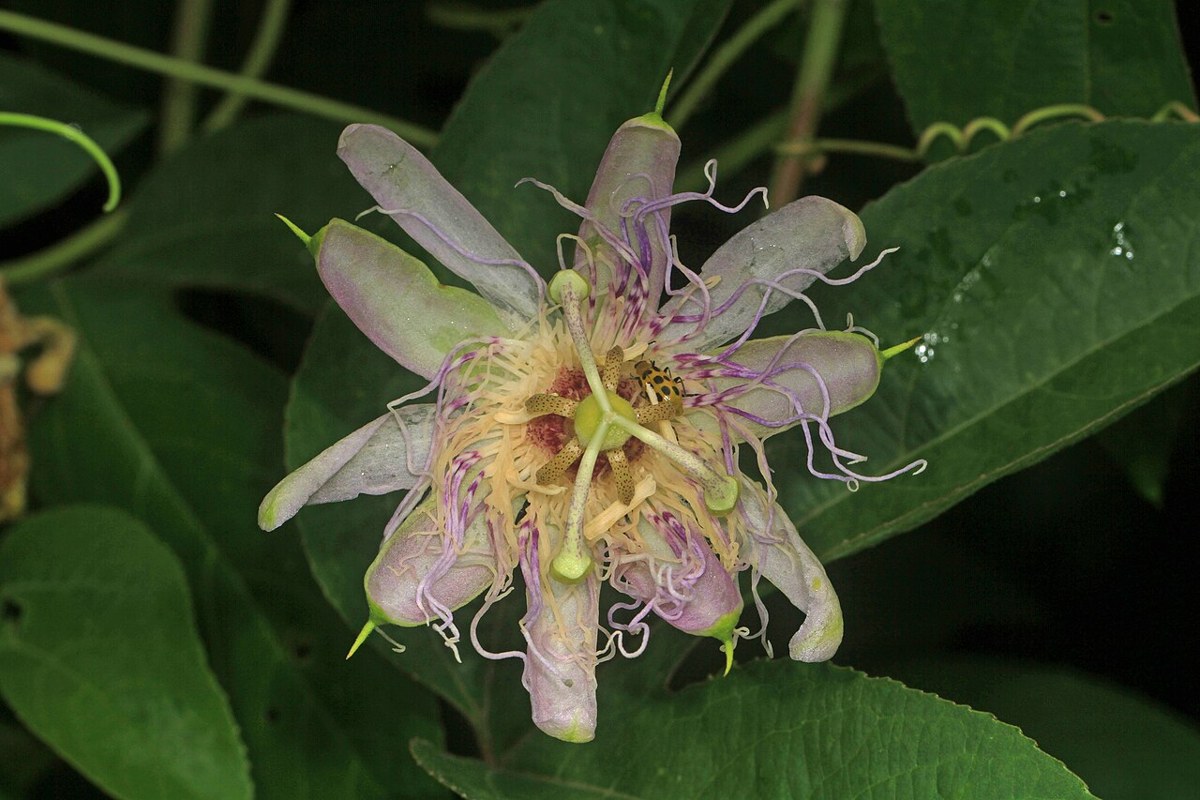
Passionflowers (genus Passiflora) are climbing vines that hold on with coiled tendrils and produce some of the most intricate flowers in the plant world: a ring of petals and sepals topped by a fringe of thread-like filaments, with the stamens and pistil raised on a central stalk. There are more than 500 species, nearly all of them in tropical Central and South America. Only about a dozen are native to the United States, mostly in the Southeast, Florida, Texas and southern Arizona.
Many of our vine articles, including our guides for Ohio, Indiana and Utah, simply say “passion flower.” That name covers everything from hardy native vines to tender tropical houseplants and fruiting passion fruit. This guide sorts them out. It explains how to recognize a passionflower, which species are truly native and where, how to grow the two hardy natives that most gardeners can actually use, and which popular nursery passionflowers are tropical imports.
For gardeners in the eastern half of the country, the answer is usually purple passionflower (maypop), which survives winters into zone 5 or 6 by dying back to its roots, or the smaller, shade-tolerant yellow passionflower. Both are larval host plants for fritillary butterflies. In Utah and the rest of the interior West no passionflower is native, so we point you to native vines that fill the same role.
Identification
Every passionflower climbs by unbranched coiled tendrils that grow from the leaf axils, opposite a flower or bud. Leaves are alternate, often with three lobes, and many species have small glands on the leaf stalk that secrete nectar for ants. Once you see a passionflower bloom you are unlikely to confuse it with anything else.
Flowers
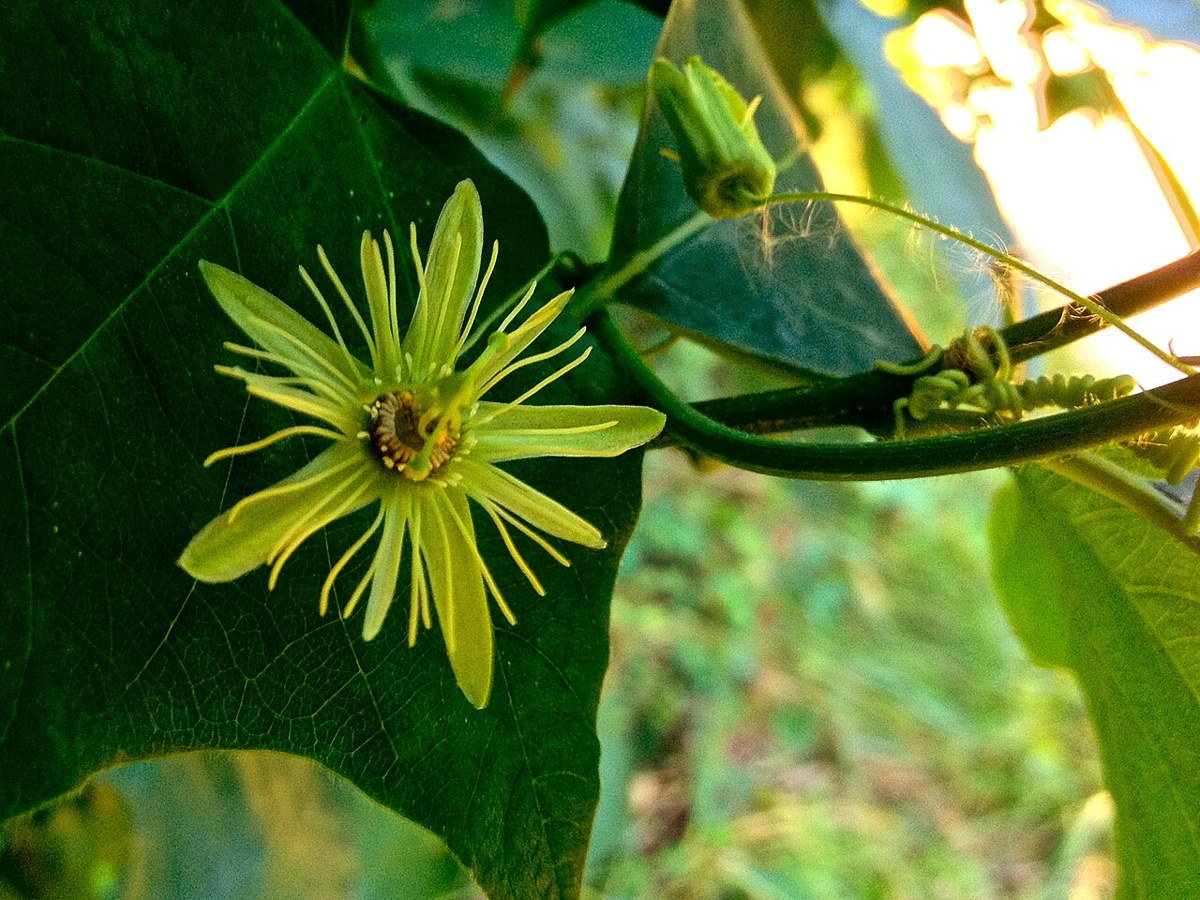
The flower has five sepals and usually five petals that look alike, spread flat like a star. Above them is the corona, one or more rings of colored filaments that give the flower its fringed look; in purple passionflower they are banded purple and white and longer than the petals. In the center a stalk called the androgynophore lifts five stamens and a three-branched style well above the petals. Native species range from showy 3-inch lavender blooms (maypop) to small, 1-inch greenish-yellow flowers (yellow and corkystem passionflower) that are easy to overlook. Each flower lasts about a day.
Leaves
Leaf shape separates the eastern natives quickly. Maypop has deeply three-lobed leaves with finely toothed edges, a little like a hand with three fingers. Yellow passionflower has leaves that are wider than long with three shallow, rounded lobes and smooth edges, often with pale mottling. Florida’s corkystem passionflower varies from unlobed to three-lobed on the same plant. Texas and New Mexico’s birdwing passionflower (P. tenuiloba) has leaves so wide and narrow-lobed they look like a bird in flight.
Fruit & Seeds
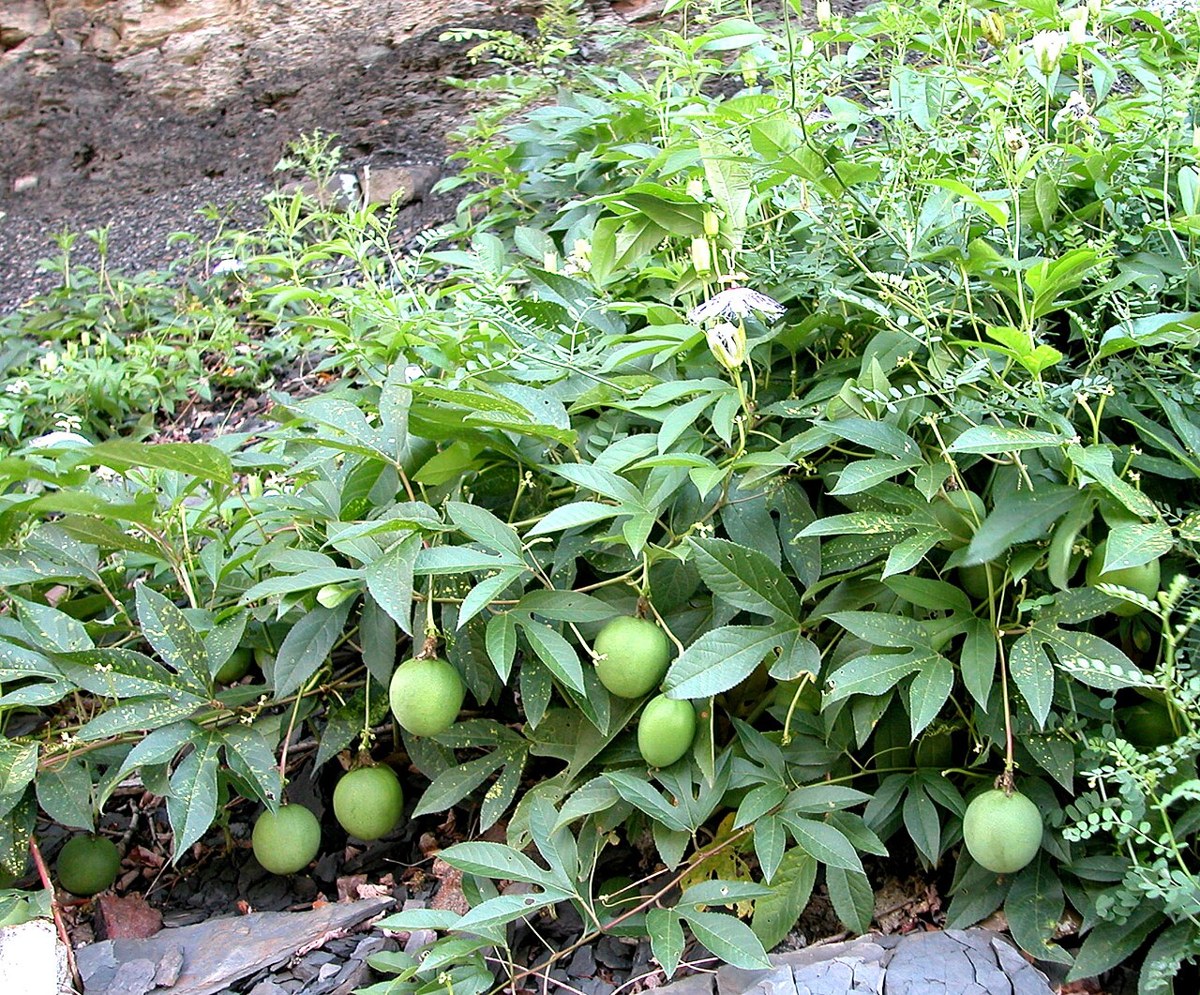
The fruit is a berry. Maypop makes an egg-sized, green fruit with a hollow sound when ripe that turns yellowish and wrinkles slightly; the seeds sit in sweet, aromatic pulp. Yellow, corkystem and most other small-flowered natives produce marble-sized, purple-black berries eaten by birds.
Growth Habit
Maypop is herbaceous in the North: the top dies back each winter and new shoots come up in late spring, often several feet from the original plant because it spreads by underground runners. Yellow passionflower is a thinner, more delicate vine. Several Florida and Texas natives are woody at the base where frost is rare.
Quick Facts
| Genus | Passiflora |
| Family | Passifloraceae (Passionflower) |
| U.S. Native Species | About 12 in the lower 48, plus a few more in Puerto Rico and the U.S. Virgin Islands |
| Growth Forms | Herbaceous to woody-based perennial vines climbing by tendrils |
| Vine Length | About 6–25 ft, depending on species and season length |
| Sun Exposure | Full Sun to Part Shade (maypop flowers best in sun; yellow passionflower takes more shade) |
| Water Needs | Average to dry; well-drained soil. Established maypop is drought tolerant |
| Soil Type | Sandy, loamy or rocky soils; tolerates poor soil |
| Bloom Time | Late spring through early fall; year-round in south Florida |
| Flower Color | Lavender and white (maypop); greenish-yellow or white in most other natives |
| Fruit | Egg-sized green to yellow berry (maypop); small purple-black berries (most others) |
| Wildlife Value | Host plant for gulf fritillary, variegated fritillary, zebra longwing and Julia butterflies; bee flowers |
| Deer Resistant | Moderately; deer browse young shoots in some areas |
| USDA Hardiness Zones | 5–10 (maypop and yellow passionflower); 9–11 for the Florida and south Texas species |
Native Range
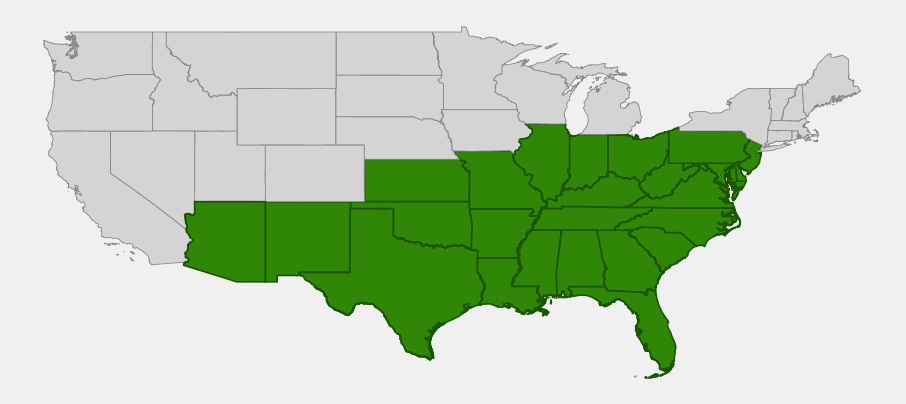
Native passionflowers are southern plants. Purple passionflower grows wild from Pennsylvania, New Jersey and Delaware west through Ohio, Indiana, Illinois and Missouri to southeastern Kansas and Oklahoma, and south to Florida and Texas. Yellow passionflower covers a similar area but reaches a little farther north in places, including southern Pennsylvania, southern Ohio and Indiana, and grows more often in woods than in open fields. In Ohio and Indiana both are at the northern edge of their range, mostly in the southern counties.
Florida has the largest number of native species. Corkystem passionflower is common in south and central Florida, and three rare species, pineland passionflower, whiteflower passionflower (P. multiflora) and goatsfoot passionflower (P. sexflora), are confined to the southern tip of the peninsula and the Keys. Texas has its own group: bracted passionflower (P. affinis) on the Edwards Plateau, birdwing passionflower (P. tenuiloba) in Texas and southern New Mexico, and slender passionflower (P. filipes) in the far south. Arizona has Arizona passionflower (P. arizonica) and Mexican passionflower (P. mexicana) in its southern canyons. Stinking passionflower (P. foetida) is a complex of many varieties, some native to Florida, Texas and Arizona and others introduced.
No passionflower is native to Utah, Colorado, the Pacific Northwest, the northern Plains, New England, New York or the upper Midwest. Passionflowers found growing wild in California and Hawaii are escaped garden plants. Hawaii has no native passionflower at all, and banana poka (P. tarminiana) and other introduced species are serious forest weeds there.
📋 Regional plant lists covering native passionflower range: NY, PA, NJ north · DE, NJ south, NY Long Island · MD, VA, WV · NC, SC · GA, AL, MS · KY, TN · OH, IN · IL, IA, MO · AR, LA, OK east, TX east · NE, KS, CO east · TX south/west/central · AZ, NM
Native Species
These are the passionflowers native to the United States. Species with a full Plant Native profile are linked.
Purple Passionflower (Passiflora incarnata)
Also called maypop, the hardiest and showiest native, found from Pennsylvania and Illinois to Florida and Texas. Its 2- to 3-inch lavender and white flowers appear from early summer into fall, followed by edible egg-sized fruit. The vine dies to the ground in cold winters, reappears late in spring, and spreads by underground runners into a patch. It is the native “passion flower” for southern Ohio and Indiana gardens and the one most nurseries carry.
Yellow Passionflower (Passiflora lutea)
A slender vine with small greenish-yellow flowers less than an inch across and broad, three-lobed leaves. It grows in moist woods and thickets from Pennsylvania, Ohio, Indiana and Illinois south to Florida and Texas and is the most shade-tolerant native passionflower. Its purple-black berries are eaten by birds, and it supports a specialist bee, Anthemurgus passiflorae, that collects pollen only from this vine.
Corkystem Passionflower (Passiflora suberosa)
A small-flowered Florida native named for the corky ridges that develop on older stems. The greenish flowers have no petals, and leaves can be unlobed or deeply three-lobed on the same vine. It is one of the best butterfly host vines for Florida gardens, feeding zebra longwing, gulf fritillary and Julia caterpillars. It is a weed in Hawaii, where it is introduced.
Pineland Passionflower (Passiflora pallens)
A rare vine of pine rocklands and hammock edges in Miami-Dade and Monroe counties, Florida, with pale greenish-white flowers and smooth, three-lobed leaves. It is listed as endangered by the state of Florida. Grow it only from nursery-propagated plants.
Stinking Passionflower (Passiflora foetida)
Named for the unpleasant smell of its crushed hairy leaves. Each flower and fruit is wrapped in a cage of finely divided, sticky bracts that trap small insects. White to pale lavender flowers are followed by small orange-red fruits inside the bracts. It is a variable complex: some varieties are native in Florida, Texas and Arizona, while others are weedy introductions in Hawaii and the tropics.
Red Passionflower (Passiflora rubra)
A Caribbean species native to Puerto Rico and the U.S. Virgin Islands, with white to cream flowers and red, ribbed fruit. Despite the name, the flowers are not red. It is not native to the mainland United States.
Whiteflower Passionflower (Passiflora multiflora)
A woody tropical vine native to hammocks in extreme south Florida, where it is rare and state-listed as endangered. It bears clusters of small white flowers and dark blue-black berries.
Goatsfoot Passionflower (Passiflora sexflora)
A rare south Florida vine whose two-lobed leaves resemble a goat’s hoof print. Small white flowers appear in clusters. It is listed as endangered in Florida.
Birdwing Passionflower (Passiflora tenuiloba)
A low, sprawling vine of rocky brushland in central and west Texas and southern New Mexico. Its leaves have two long, narrow side lobes that make each one look like a bird with outstretched wings. The flowers are small and greenish.
Bracted Passionflower (Passiflora affinis)
A Texas native of limestone woods and canyons on the Edwards Plateau, with small greenish-yellow flowers and three-lobed leaves. It is a good shade-tolerant host vine for gulf fritillaries in Hill Country gardens.
Arizona and Mexican Passionflowers (P. arizonica and P. mexicana)
The two native passionflowers of southern Arizona. Arizona passionflower, related to stinking passionflower, has white to pale purple flowers and feathery bracts. Mexican passionflower has distinctive two-lobed leaves and small maroon flowers. Both grow in canyons and washes near the Mexican border.
Slender Passionflower (Passiflora filipes)
A thin-stemmed vine of thickets in the Lower Rio Grande Valley of south Texas, with tiny greenish flowers and small dark berries.
Non-Native Look-Alikes
Most passionflowers sold at garden centers and as houseplants are not native to the United States. They are beautiful plants, but they are not the vines described in the Ohio, Indiana or Utah guides as hardy outdoor perennials, and most will not survive a northern winter outdoors.
Blue passionflower (Passiflora caerulea) is the classic “passion flower” of catalogs and patio pots. It comes from southern Brazil and Argentina and has white petals with a blue, white and purple banded corona and five- to seven-lobed leaves, more deeply divided than maypop’s three lobes. It is root-hardy only to about zone 7 and produces orange, egg-shaped fruit. It has escaped in parts of coastal California.
Passion fruit (Passiflora edulis), from South America, is grown for its purple or yellow fruit in Florida, Hawaii, southern California and greenhouses. It has glossy, three-lobed leaves and white flowers with a purple-banded corona, so it can look like maypop. It is tender to frost and has naturalized in Hawaii and Florida.
Passiflora × belotii (sold as ‘Imperatrice Eugenie’ and similar names) is a hybrid of two South American species, P. alata and P. caerulea, with large pink-and-lilac flowers. It is a container or greenhouse plant outside frost-free areas. Many other tropical hybrids and species, including red passionflowers such as P. coccinea and P. vitifolia, are sold for conservatories.
Hybrids with native parents do exist. ‘Incense’ is a cross of maypop with the South American P. cincinnata, with fragrant purple flowers; it is hardier than tropical types but is not a wild native plant. If you want a vine that local fritillary butterflies and bees have evolved with, choose straight maypop or yellow passionflower grown from regional seed.
Invasive passionflowers: banana poka (P. tarminiana) and wild passion fruit spread by birds and pigs through native forests in Hawaii, smothering trees, and are targeted for control there. Corkystem and stinking passionflower are also weedy in Hawaii, even though they are native in Florida.
Growing & Care Guide
Light
Maypop needs full sun or at least six hours of direct sun to flower heavily; in shade it makes leaves but few blooms. Yellow passionflower, bracted passionflower and corkystem passionflower bloom well in part shade and are good choices for woodland edges.
Soil & Water
All native passionflowers want well-drained soil. Maypop grows in sand, loam, clay-loam and gravel and is drought tolerant once established; rich, constantly wet soil leads to rank growth and root rot in winter. Water new plants weekly during their first summer, then only in long droughts. Fertilizer is rarely needed and pushes leaves at the expense of flowers.
Planting Tips
Plant in spring after the soil warms. Give the vine a fence, trellis, arbor or a shrub to scramble through; tendrils need thin supports such as wire or netting. Be patient in spring: maypop is one of the last perennials to emerge, often not until late May in Ohio and Indiana, so mark the spot so you do not dig it up. Plant it where its spreading runners are welcome, or edge the bed, because new shoots can come up several feet away.
Pruning & Maintenance
Cut maypop’s dead stems to the ground in late winter. In mild climates where stems survive, trim them back in early spring to keep the vine tidy. Pull unwanted suckers as they appear. Leave some foliage for caterpillars; a vine that has been chewed by fritillary larvae in late summer recovers quickly.
Propagation
Native passionflowers grow from seed, though germination is slow and erratic. Clean seeds from ripe fruit, soak them for a day, and sow in warm conditions; some sprout in two to four weeks and others take months. Cold, moist stratification over winter improves results for maypop. Root suckers and softwood cuttings taken in early summer are faster ways to get a blooming plant.
Landscape Uses
- Fences, mailboxes and trellises in pollinator and butterfly gardens
- Covering chain-link or a sunny slope in dry, poor soil (maypop)
- Woodland edges and shady fences (yellow passionflower)
- Edible landscaping: maypop’s ripe fruit
- Florida butterfly gardens (corkystem passionflower)
- Utah and the interior West: use native vines instead, such as western white clematis
Wildlife & Ecological Value
For Pollinators
Maypop’s large flowers are pollinated mainly by carpenter bees and bumble bees, which are heavy enough to brush the raised anthers and stigma as they walk around the nectar ring. Honey bees and many smaller bees visit as well. Yellow passionflower is pollinated by small bees, including the passionflower specialist Anthemurgus passiflorae, found nowhere except on this vine.
For Butterflies
Passionflowers are the larval host plants of the heliconian butterflies. The gulf fritillary lays its eggs on maypop and corkystem passionflower across the South; the variegated fritillary uses passionflowers and violets farther north; and the zebra longwing (Florida’s state butterfly) and Julia butterfly depend on passionflowers in Florida and south Texas. The orange-and-black spiny caterpillars can strip a vine in late summer, but it regrows.
For Birds & Mammals
Birds eat the small dark berries of yellow, corkystem and other small-fruited species. Maypop fruit is eaten by raccoons, opossums, foxes, deer and other mammals, which spread the seeds. Vines on fences give cover to small birds.
Ecosystem Role
Maypop is a pioneer of open, disturbed ground: old fields, roadsides and fencerows. Its leaf-stalk glands feed ants, which in turn may discourage some leaf-eating insects. The Florida species are part of the specialized pine rockland and hammock flora, and several are rare because so much of that habitat has been developed.
Cultural & Historical Uses
Purple passionflower was cultivated by Native peoples of the Southeast, and its fruit and young greens were part of their diets. Archaeologists have found maypop seeds at many prehistoric village sites. Early English colonists in Virginia described the fruit, and the name “maypop” may come from the popping sound the hollow fruits make when stepped on.
The name “passion flower” comes from Spanish missionaries in South America in the 1600s, who saw symbols of the Passion of Christ in the flower: the corona as the crown of thorns, the five stamens as the five wounds, the three styles as the nails, and the ten petals and sepals as the faithful apostles.
Maypop was also used in folk medicine and is still sold as an herbal product. That is history, not advice: consult a doctor before using any herbal preparation. Maypop is the state wildflower of Tennessee, and it remains a favorite of Southern gardeners who grow it for its flowers, its fruit and the butterflies it brings.
Frequently Asked Questions
Is passion flower native to Ohio and Indiana?
Yes, two species are: purple passionflower (maypop) and yellow passionflower, both mostly in the southern part of each state. Plant them in a warm, sunny, well-drained spot. The tropical blue passionflower sold in garden centers is not native and will not usually survive an Ohio or Indiana winter outdoors.
Is any passionflower native to Utah?
No. No species of Passiflora grows wild in Utah or the rest of the Great Basin and Rockies. Maypop can be grown in warmer Utah gardens with water, but as a non-native ornamental. For a native flowering vine in Utah, try western white clematis.
Is maypop fruit edible?
Yes, the ripe fruit of maypop is edible. Pick it when it turns yellowish, wrinkles slightly and comes off the vine easily, and eat the seedy pulp fresh or strained for juice. Do not eat unripe fruit or the leaves. If you are unsure of a passionflower’s identity, do not eat it.
Why didn’t my passionflower come back in spring?
Maypop emerges very late, often in late May or June in the North. Wait before assuming it died. Tropical species such as blue passionflower and passion fruit die in hard freezes and will not return in cold climates.
Why are caterpillars eating my passionflower?
Spiny orange caterpillars are gulf or variegated fritillary larvae, and that is the main reason to grow the vine. Let them feed; the plant recovers. Avoid pesticides if you want butterflies.

Looking for a nursery that carries native passionflowers?
Browse our native plant nursery directory: Alabama, Arizona & Arkansas · Delaware, Florida & Georgia · Illinois, Indiana & Kansas · Kentucky, Louisiana, Maryland, Mississippi & Missouri · New Jersey, New Mexico, North Carolina, Ohio & Oklahoma · Pennsylvania, South Carolina, Tennessee, Texas & Virginia · West Virginia

