
Smoke Trees (Cotinus): American vs European
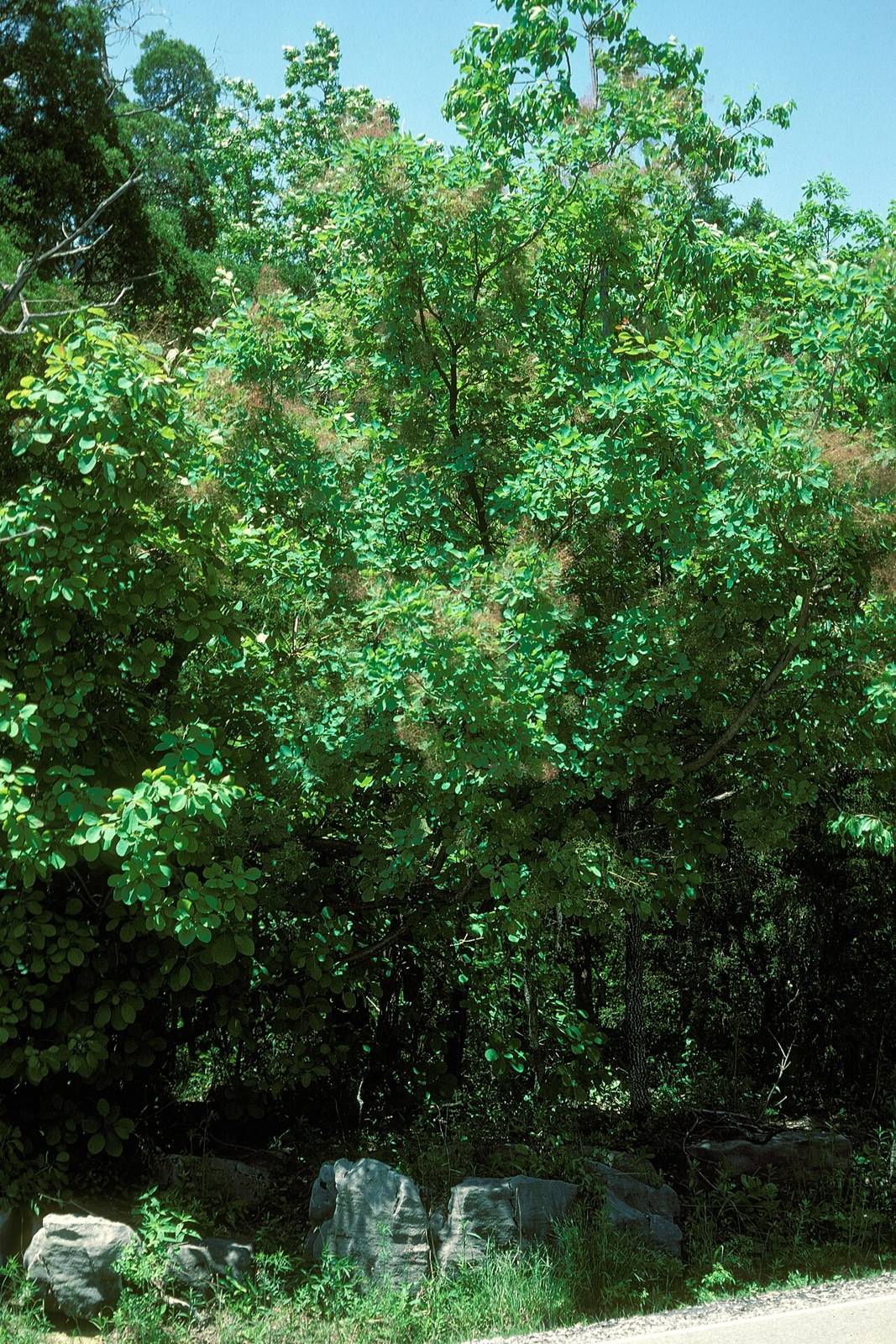
Smoke trees (genus Cotinus) are shrubs and small trees in the cashew and sumac family (Anacardiaceae), named for the clouds of fine, hairy flower stalks that surround them in early summer and look like puffs of pink or gray smoke. The genus is tiny: just two widely recognized species, one native to the United States and one from Europe and Asia. The two are often confused, and most “smoke trees” in American gardens are the Eurasian species.
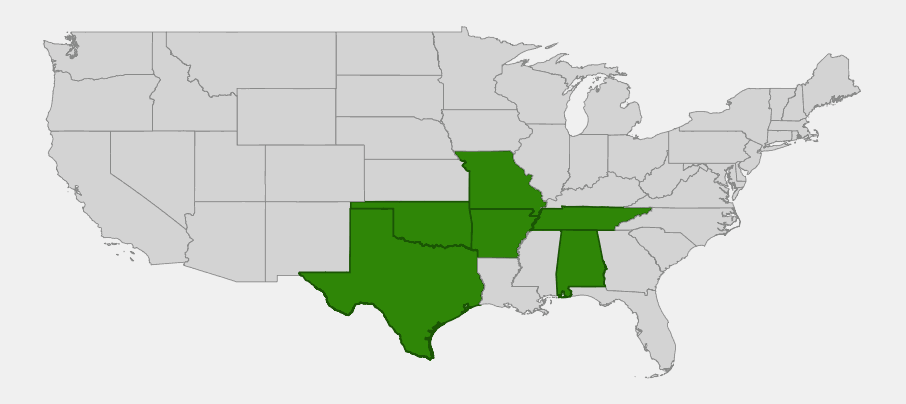
The native species is American smoketree (Cotinus obovatus), also called chittamwood or American smokewood. It is a rare small tree of limestone bluffs, glades and rocky hillsides in a handful of states: the Edwards Plateau of central Texas, the Ozarks and Arbuckle Mountains of Missouri, Arkansas and Oklahoma, and limestone areas of Tennessee and northern Alabama. Its smoke is modest, but its fall color, in brilliant orange, scarlet and purple, is among the finest of any North American tree.
The common garden smoke tree, or smoke bush (Cotinus coggygria), comes from southern Europe across Asia to central China. It is the plant behind popular purple-leaved cultivars such as ‘Royal Purple’ and the one described in many ornamental-tree lists, including our Tennessee guide. If you came here from that list: Tennessee is one of the few states where the native American smoketree grows wild, and it is an excellent, longer-lived alternative. This page explains how to tell the two apart and how to grow the native one.
Identification
The two smoke trees share the same smoky plumes and rounded leaves, but differ in size, leaf shape, fall color and how much “smoke” they produce.
Bark & Form
American smoketree grows into a small tree 20 to 30 feet tall, usually with one or a few trunks and a rounded, open crown. Its gray to gray-brown bark breaks into thin, scaly plates on older trunks, and the wood inside is bright yellow. European smoke bush is a multi-stemmed shrub, typically 10 to 15 feet tall and as wide, rarely trained into a small tree, with smoother brown bark.
Leaves
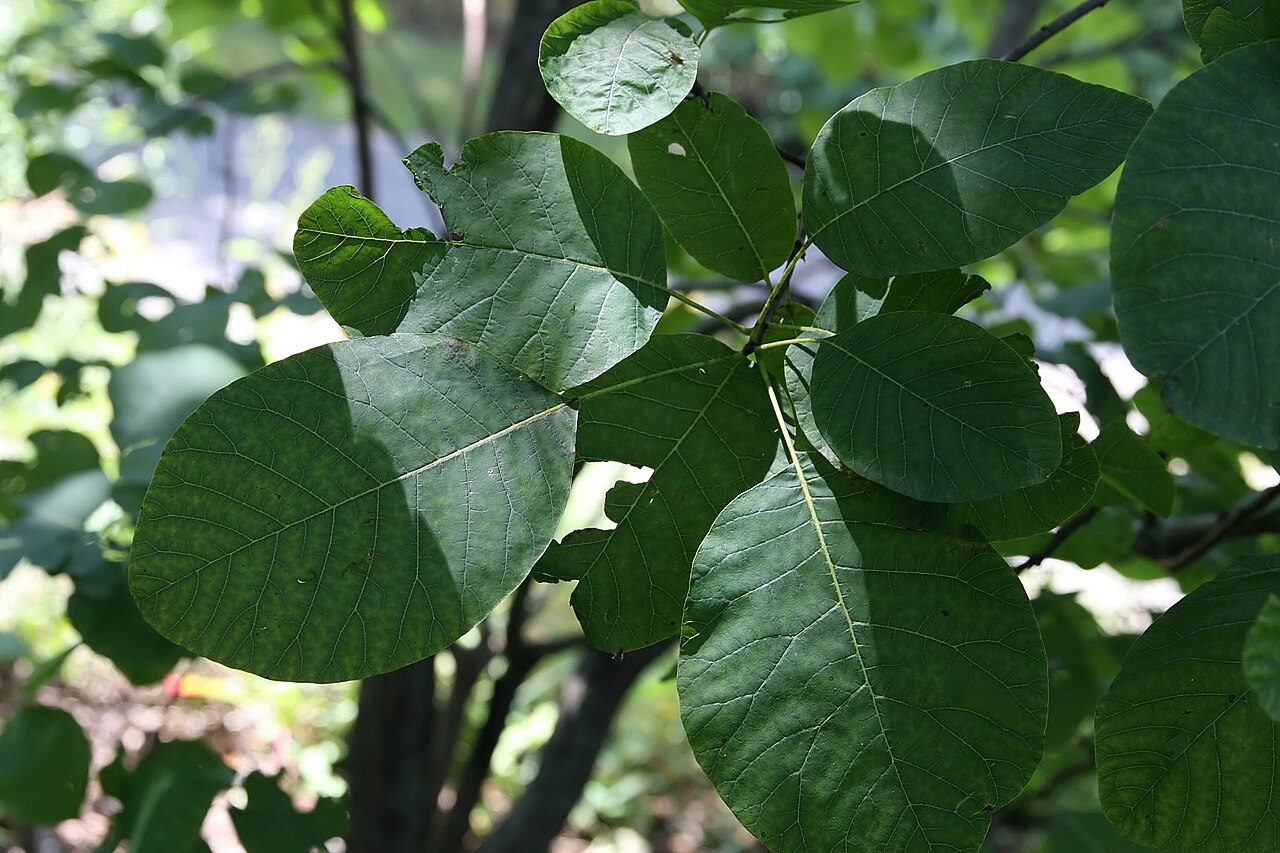
Both species have simple, alternate, smooth-edged leaves with long stalks, which smell faintly resinous when crushed. American smoketree leaves are larger, 2 to 6 inches long, and obovate (widest toward the tip, as the name obovatus says), blue-green above and paler below. European smoke bush leaves are smaller, 1 1/2 to 3 inches, and nearly round, green in the species and deep purple, burgundy or gold in many cultivars.
Flowers & “Smoke”
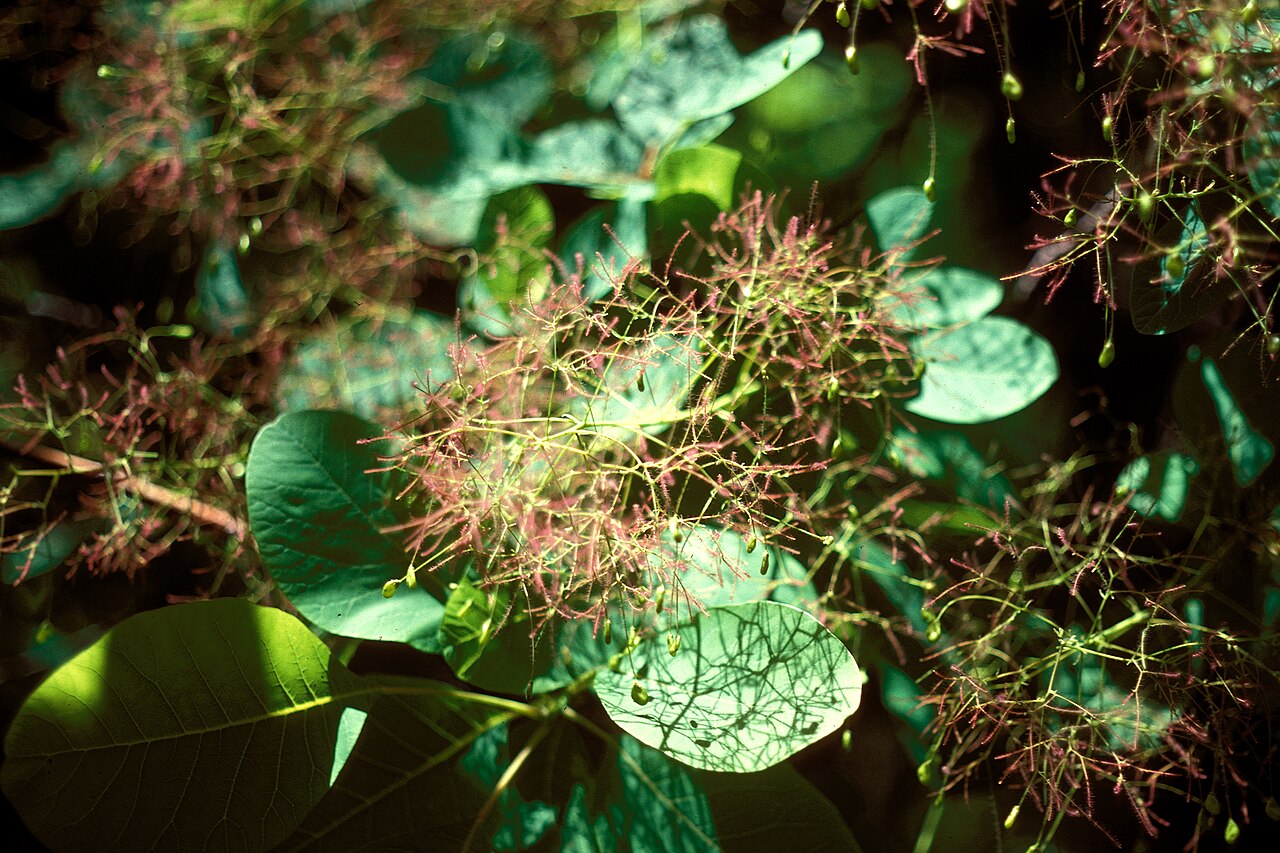
The true flowers are tiny and yellowish-green, borne in large, loose branched clusters (panicles) in late spring. The smoke appears afterward, when many of the flower stalks on sterile flowers lengthen and become covered with long, fine hairs. In European smoke bush the panicles are large and dense, so the plants look wrapped in pink, purple or gray mist from early summer into late summer. In American smoketree the panicles are fewer and thinner, so the smoke is lighter and shorter-lived, and plants are mostly male or female; female trees produce the showiest smoke.
Fruit & Seeds
Both species form small, dry, kidney-shaped drupes, about 1/8 inch long, scattered through the hairy panicles in summer. Seed set is often light in American smoketree.
Fall Color
This is the clearest difference. American smoketree turns vivid orange, red, scarlet and purple, often all on one tree, and is considered one of the best native trees for fall color. Green-leaved European smoke bush turns yellow to orange-red; purple-leaved cultivars turn red-purple.
Quick Facts
| Scientific Name | Cotinus (genus); native species Cotinus obovatus |
| Family | Anacardiaceae (Cashew/Sumac) |
| U.S. Native Species | One: American smoketree (C. obovatus) |
| Plant Type | Deciduous small tree (native) or large shrub (European) |
| Mature Height | 20–30 ft (American); 10–15 ft (European smoke bush) |
| Mature Spread | 15–25 ft (American); 10–15 ft (European) |
| Growth Rate | Slow to moderate |
| Sun Exposure | Full sun; tolerates light shade with fewer plumes and less fall color |
| Water Needs | Low once established; drought tolerant |
| Soil Type | Well-drained rocky, gravelly or loamy soil; dislikes wet ground |
| Soil pH | Neutral to alkaline preferred (about 6.5–8.0); tolerates slightly acidic soil |
| Bloom Time | Late spring (April–June); smoke lasts into summer |
| Flower Color | Yellowish-green flowers; pink to purplish-gray plumes |
| Fall Color | Orange, scarlet, red and purple (American) |
| Wildlife Value | Flowers visited by small bees and flies; dense cover for birds |
| Deer Resistant | Generally yes; deer seldom browse established plants |
| USDA Hardiness Zones | 4–8 (American); 5–8 (European) |
Native Range
American smoketree has one of the most scattered natural ranges of any American tree. It grows in separate, isolated pockets: on the limestone hills of the Edwards Plateau in central Texas; in the Arbuckle Mountains of south-central Oklahoma; in the Ozarks of northern Arkansas, southwestern Missouri and northeastern Oklahoma; and on limestone bluffs and cedar glades of central Tennessee and northern Alabama. Almost everywhere it grows on thin, rocky soils over limestone or dolomite, often alongside eastern red cedar, fragrant sumac, gum bumelia and Ashe juniper.
Even within these areas it is uncommon to rare, and several states list it as a species of conservation concern. Part of the reason is history: in the 1800s, its yellow heartwood was cut heavily to make dye, eliminating many populations. Today it is far more common in gardens and arboretums than in the wild, and it is planted successfully well north and east of its native range, into New England and the Great Lakes states, where it is not native.
European smoke bush (Cotinus coggygria) is native from southern Europe through Turkey, the Caucasus and the Himalayas to central China. In the United States it is a garden plant that occasionally escapes and persists near plantings in the Northeast, Midwest and Northwest, but it is not considered a significant invasive.
📋 Regional plant lists covering American smoketree’s native range: South & West Texas · Arkansas, Louisiana, Eastern Oklahoma & East Texas · Illinois, Iowa & Missouri · Kentucky & Tennessee · Georgia, Alabama & Mississippi
Native Species
Cotinus has only one species native to the United States. The genus has just one other widely recognized species, the Eurasian smoke bush, and a few Chinese plants sometimes treated as separate species, so there is no long list of native smoke trees to choose from. The native species, its hybrid and the native trees most often suggested as alternatives are below.
American Smoketree (Cotinus obovatus)
Native to: scattered limestone sites in central Texas, Oklahoma, Arkansas, Missouri, Tennessee and northern Alabama. A 20- to 30-foot small tree with blue-green obovate leaves, light pink summer smoke, scaly bark and spectacular orange-to-scarlet fall color. Very drought tolerant and happy on alkaline, rocky soil. Hardy to zone 4 despite its southern origin. Few nurseries carry it, but native-plant nurseries and arboretum sales often do. It is the only smoke tree native to North America.
‘Grace’ and ‘Flame’ hybrid smoke trees (Cotinus coggygria × C. obovatus)
Native to: garden origin; not native anywhere. Crosses between the European and American species, bred in England. ‘Grace’ grows into a vigorous, 15- to 20-foot shrub or small tree with wine-red leaves and huge pink plumes; ‘Flame’ has green leaves that turn brilliant orange-red. They are half native in parentage but are garden hybrids, not native plants.
Native alternatives with a similar effect
If you want the feathery look of a smoke tree, also consider fringetree (Chionanthus virginicus), whose fringe-like white flowers in late spring make a similar cloud, and smooth sumac (Rhus glabra), a native relative of the smoke trees with fuzzy red fruit clusters and equally fiery fall color. For a small native tree on dry, rocky, alkaline soil in Tennessee and the Ozarks, eastern redbud and fragrant sumac are dependable companions.
Non-Native Look-Alikes
European Smoke Bush (Cotinus coggygria)
This is the smoke tree of most garden centers, landscapes and ornamental-tree lists. It is a large, rounded shrub, 10 to 15 feet tall and wide, with small, round leaves and masses of pink to purple plumes from early to late summer. Popular cultivars include ‘Royal Purple’ and ‘Velvet Cloak’ (deep purple leaves), ‘Golden Spirit’ (yellow leaves), ‘Young Lady’ (a compact, heavy-blooming form) and ‘Winecraft Black’ (a dwarf purple form). It is native to southern Europe and Asia, not North America. It is not considered invasive, though it sometimes self-seeds near plantings. Compared with American smoketree, it is shrubbier and shorter, with smaller, rounder leaves, much heavier smoke and less intense fall color on green-leaved forms. Purple cultivars are prone to Verticillium wilt and are often cut back hard to keep them compact.
How to tell them apart at a glance
- Size and form: American smoketree is a small tree, 20 to 30 feet; European smoke bush is a shrub, 10 to 15 feet.
- Leaves: American leaves are 2 to 6 inches long, widest near the tip and blue-green; European leaves are 1 1/2 to 3 inches, round and often purple or gold in cultivars.
- Smoke: European smoke bush is heavily covered in plumes; American smoketree is lightly smoky.
- Fall: American smoketree turns brilliant orange, scarlet and purple.
Another “chittamwood”
The name chittamwood is also used for gum bumelia (Sideroxylon lanuginosum), a thorny native tree of the same southern region in an unrelated family. It has small, leathery leaves, thorns and black berries, and no smoke.
Growing & Care Guide
American smoketree is a tough, low-maintenance tree once established. It rewards a sunny, well-drained site with years of fall color and needs little care.
Light
Plant in full sun for the densest crown, the most smoke and the brightest fall color. It tolerates light afternoon shade, especially in hot southern summers, but becomes thin and leggy in heavier shade.
Soil & Water
American smoketree grows naturally on thin, rocky limestone soils and is at its best in well-drained, neutral to alkaline soil, though it tolerates slightly acidic loam. It cannot handle poorly drained or constantly wet ground. Water regularly through the first two growing seasons; after that it is highly drought tolerant and seldom needs watering. Rich soil and fertilizer encourage soft growth and weaker fall color.
Planting Tips
Plant small container-grown trees in spring or fall. Young plants can be slow to establish and somewhat open and gangly for the first few years before filling out. Give it room to reach 20 to 25 feet across. It is good for hot, dry spots such as south-facing slopes, parking-lot islands and rocky banks.
Pruning & Maintenance
Prune in late winter to shape young trees and to choose a single trunk or a few trunks. Remove crossing or damaged branches. Unlike European smoke bush, which is often cut back hard every year for its leaves, American smoketree is best left to grow naturally into a small tree; hard pruning removes the next season’s flowers.
Pests & Problems
American smoketree has few serious pests. Verticillium wilt, a soil-borne fungus that affects many trees, can kill branches or whole plants of both smoke tree species; avoid planting where wilt has killed maples or other susceptible trees. Leaf spots appear in humid summers but are minor. Like other members of the sumac family, its sap can irritate the skin of sensitive people.
Propagation
Seed set is often poor. Collect fruit from female trees in summer, then scarify and give it about two to three months of cold, moist stratification before sowing. Softwood cuttings taken in early summer and treated with rooting hormone can also root, but success varies.
Landscape Uses
- Small specimen tree for fall color
- Xeric, rocky and limestone gardens; hot, dry sites in full sun
- Native glade and savanna restorations in its home range
- Native replacement for European smoke bush in mixed borders and yards
- Street or patio tree where space is limited
Wildlife & Ecological Value
For Pollinators
The small greenish flowers of both smoke trees are visited by native bees, flies and other small insects for nectar and pollen in late spring. The flowers are not showy and are less important to pollinators than those of many other native trees.
For Birds
The tiny dry fruits are of minor food value. The dense, rounded crown provides nesting and perching cover for small birds on open, rocky sites where trees are scarce.
For Mammals
Deer seldom browse established smoke trees, though they may nibble young plants. The tree has little direct food value for mammals.
Ecosystem Role
American smoketree is a characteristic plant of limestone and dolomite glades and bluffs, which are among the most species-rich habitats in the south-central United States. Its rarity and scattered populations make each wild stand valuable. Because many glades are being overgrown by eastern red cedar in the absence of fire, controlled burns and cedar removal help keep open habitat for smoketree and the glade wildflowers that grow with it.
Cultural & Historical Uses
The bright yellow heartwood of American smoketree produces a yellow to orange dye. During the 1800s, and especially around the Civil War, the trees were cut in large numbers for dye, which nearly wiped out the species in parts of its range. The wood is also very durable in contact with soil and was used for fence posts.
The European smoke bush has a longer history in cultivation. Its wood, called young fustic, was used for yellow dye and its leaves for tanning leather in southern Europe. It has been grown in European gardens since at least the 1600s and in American gardens since colonial times.
Today, American smoketree is valued by horticulturists as a rare native with outstanding fall color. The largest known specimens, including champion trees, grow in gardens and arboretums rather than in the wild.
Frequently Asked Questions
Is the smoke tree native to the United States?
Only one smoke tree is native: American smoketree (Cotinus obovatus), found wild in a few areas of Texas, Oklahoma, Arkansas, Missouri, Tennessee and Alabama. The common garden smoke bush (Cotinus coggygria), including ‘Royal Purple’ and other purple-leaved forms, is from Europe and Asia.
Is smoke bush invasive?
European smoke bush is not considered invasive in the United States. It occasionally self-seeds near gardens but does not spread aggressively into natural areas. It is simply non-native, with less value for local ecosystems than native trees.
Does American smoketree grow in Tennessee?
Yes. American smoketree grows wild on limestone bluffs and glades in central Tennessee, although it is uncommon. It grows well in gardens across the state in sunny, well-drained sites and handles Tennessee’s hot summers and alkaline limestone soils.
Which smoke tree has better fall color?
American smoketree. Its fall color, in orange, scarlet, red and purple, is among the best of any native tree. European smoke bush turns yellow to orange-red on green forms, and purple forms turn dull red-purple.
Why doesn’t my smoke tree have any smoke?
Plants may be too young, growing in too much shade, or pruned hard in late winter, which removes the wood that flowers. In American smoketree, male plants produce much less smoke than female plants, and the smoke is lighter than in European smoke bush even on the best trees.
Are smoke trees poisonous?
Smoke trees are not considered seriously toxic, but like other members of the sumac and cashew family, their sap can cause skin irritation in sensitive people. Wear gloves when pruning if you react to sumacs.

Looking for a nursery that carries American Smoketree?
Browse our native plant nursery directory: Arkansas & Alabama · Missouri · Oklahoma · Texas & Tennessee

