
Common Butterwort (Pinguicula vulgaris)
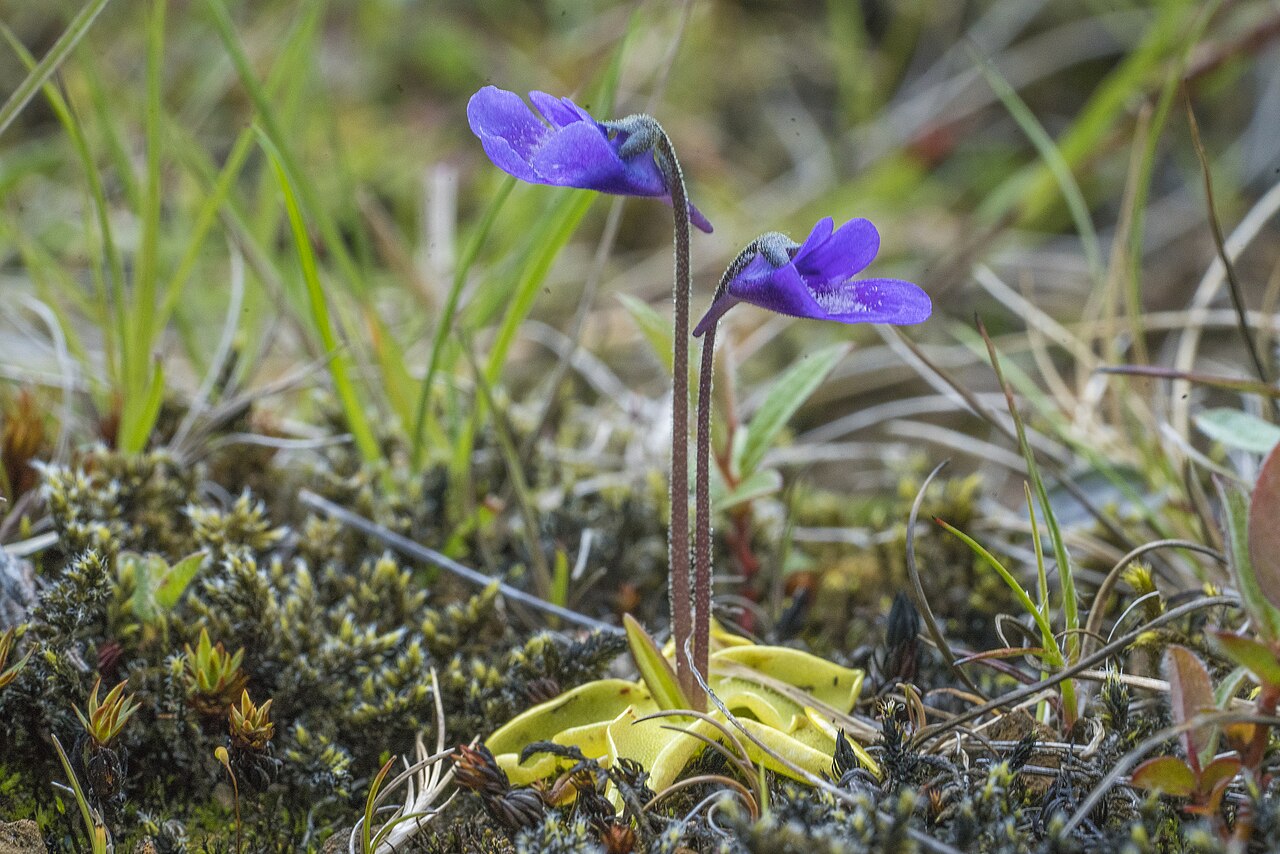
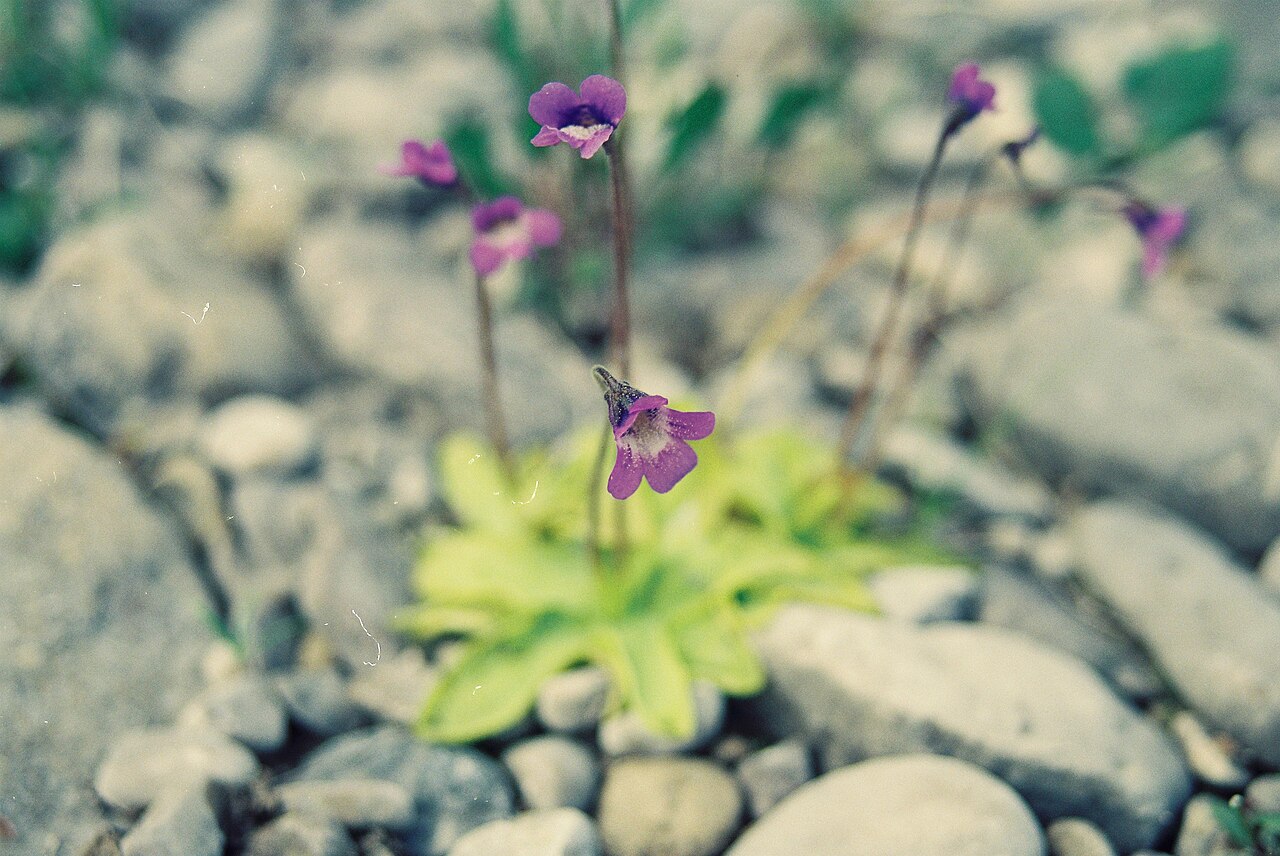
Pinguicula vulgaris, Common Butterwort, is a small carnivorous wildflower of cold, wet, mineral-rich places across the northern parts of North America and Eurasia. It forms a flat, starfish-like rosette of pale yellow-green leaves that feel greasy to the touch, and in early summer it sends up one or more slender stalks, each carrying a single violet flower that looks a little like a violet with a spur. The leaves are covered with sticky glands that catch gnats, springtails and other tiny insects and then digest them.
The name comes from that buttery feel: pinguis is Latin for “fat,” and the leaves look and feel as if they had been rubbed with butter. In the United States common butterwort is a plant of the far north. It grows in Alaska, Washington, the upper Great Lakes states and northern New York and New England, on wet cliffs, lakeshore rocks, fens and seepy gravel.
In the lower 48 states it is rare. NatureServe lists it as critically imperiled (S1) in Maine, New Hampshire, Vermont, New York and Wisconsin and as vulnerable (S3) in Michigan and Minnesota. This page is mainly an identification and appreciation guide. Common butterwort is difficult to grow, and wild plants must never be collected. If you want one, buy nursery-propagated plants.
Identification
Common butterwort is small but distinctive. No other plant in its northern habitats combines a flat rosette of sticky, yellow-green leaves with single violet, spurred flowers on leafless stalks.
Leaves
The leaves form a ground-hugging rosette 2 to 4 inches across. There are usually 5 to 11 leaves, each oblong to elliptic, about 3/4 to 2 inches long, pale yellow-green and soft, with slightly inrolled edges. The upper surface is covered with two kinds of microscopic glands. Stalked glands release droplets of sticky mucilage that trap insects, and flat, stalkless glands release digestive enzymes. Small dead insects are often visible stuck to the leaves.
Flowers
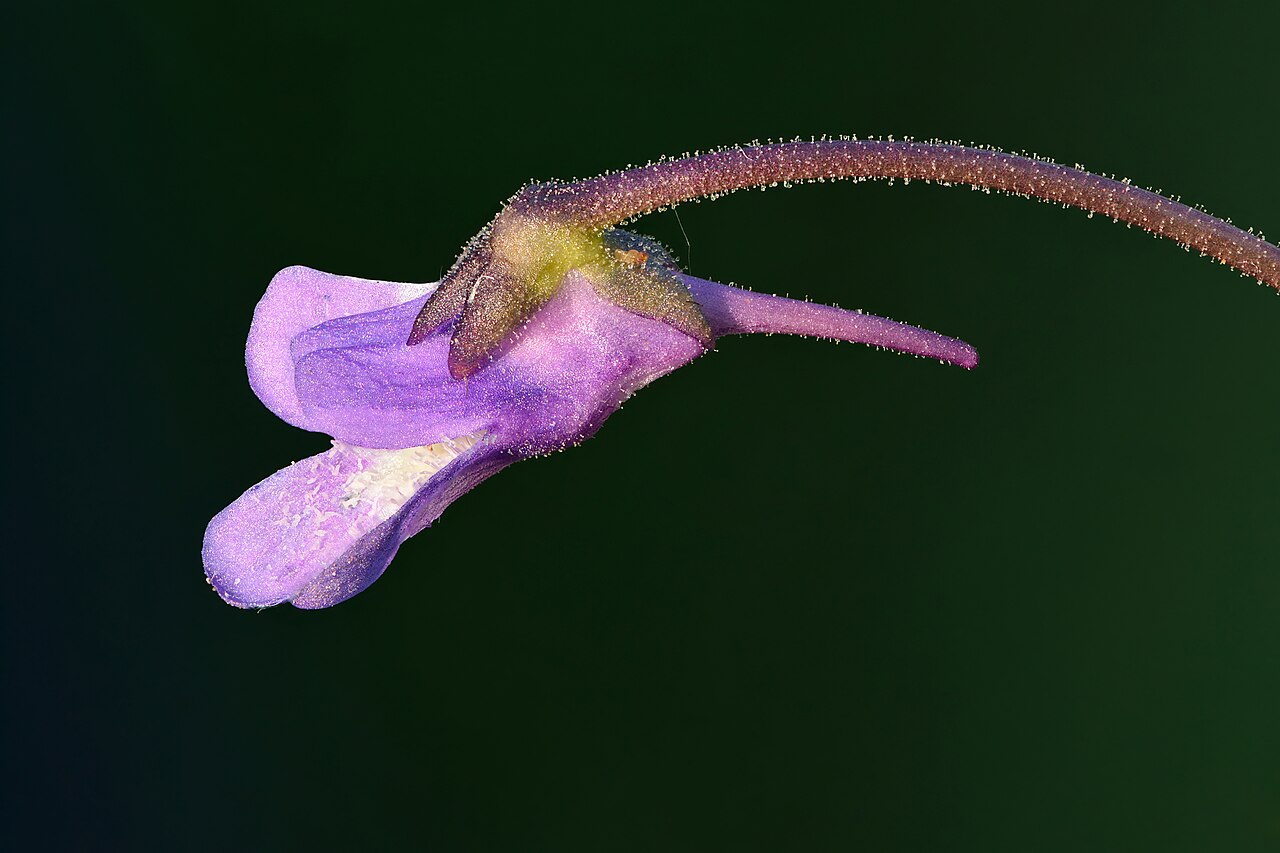
From about late May to July, each rosette sends up one or several leafless, finely glandular stalks 2 to 6 inches tall, each topped by a single nodding flower. The flower is about 1/2 to 3/4 inch long, two-lipped and violet to purple, with a white patch and fine hairs in the throat and a slender, straight or slightly curved spur pointing backward. It looks rather like a violet, but violets have five separate petals, while butterwort petals are fused into a two-lipped tube.
Fruit & Seeds
After flowering, the stalk straightens and carries a small, round capsule that splits to release many tiny seeds. The seeds are scattered by wind and water.
Winter Bud
In late summer the rosette withers back to a tight, scaly winter bud called a hibernaculum, which sits at the soil surface through winter. Small offset buds (gemmae) often form around it and can grow into new plants. In spring the bud unfurls a new rosette.
Look-alikes
Several other butterworts grow in North America. Hairy butterwort (P. villosa) of Alaskan bogs is tiny, with small pale flowers and hairy flower stalks. Large-spurred butterwort (P. macroceras), which grows in Alaska, the Pacific Northwest, northern California and the northern Rockies, has larger flowers with a longer spur; many botanists now treat it as a separate species from common butterwort, and the butterworts reported from Montana, Oregon and California belong to it. The southeastern Yellow Butterwort and Small Butterwort grow far to the south in the Coastal Plain. Violets have five separate petals and leaves that are not sticky.
Quick Facts
| Scientific Name | Pinguicula vulgaris |
| Family | Lentibulariaceae (bladderwort family) |
| Plant Type | Carnivorous herbaceous perennial forming a rosette |
| Mature Height | 2–6 in in flower; rosette flat to the ground |
| Mature Spread | 2–4 in per rosette |
| Growth Rate | Slow |
| Sun Exposure | Full sun to partial shade |
| Water Needs | High; constantly wet or seeping soil during the growing season |
| Soil Type | Wet, mineral-rich gravel, marl, moss and peat over or near limestone and other base-rich rock |
| Soil pH | About 6.0–8.0 (neutral to alkaline) |
| Bloom Time | Late May–July |
| Flower Color | Violet to purple with a white throat |
| Fall Color | None; the rosette retreats to a winter bud |
| Fruit | Small round capsule with tiny seeds |
| Deer Resistant | Rarely browsed |
| USDA Hardiness Zones | 2–6 |
Native Range
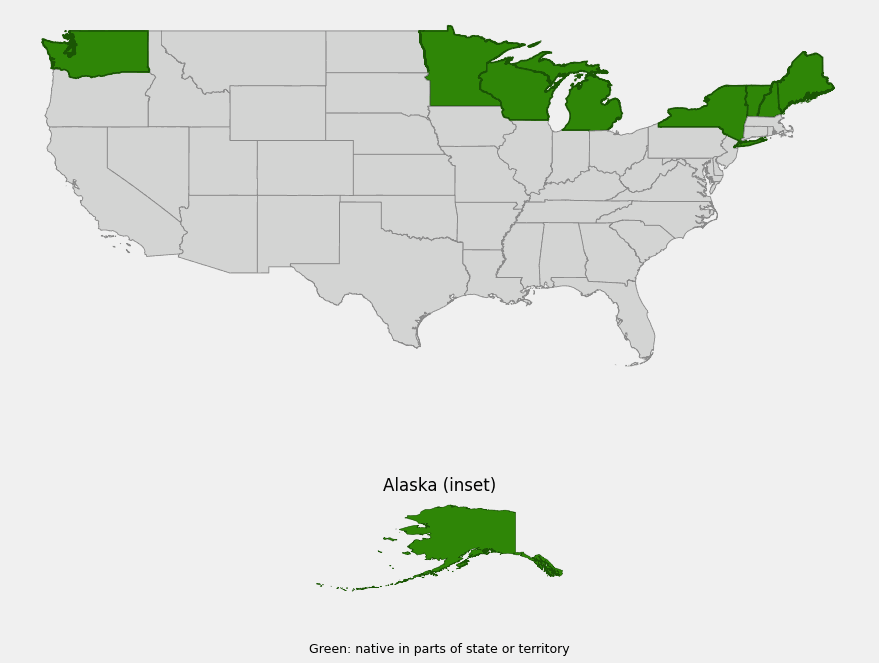
Common butterwort is circumboreal. It grows across northern and mountainous Europe, Iceland, Greenland and parts of northern Asia, and across Canada from Newfoundland and Labrador to British Columbia and Yukon. USDA PLANTS records it as native in nine U.S. states: Alaska and Washington in the West, Minnesota, Wisconsin and Michigan around the upper Great Lakes, and New York, Vermont, New Hampshire and Maine in the Northeast.
In the Great Lakes region it grows mainly on the wet rocks and gravel shores of Lake Superior and northern Lake Michigan and Lake Huron, and in some northern fens. In the Northeast it is found on wet calcareous cliffs, ledges and lakeshores. These southern-edge populations are small and scattered, and NatureServe ranks the species S1 (critically imperiled) in Maine, New Hampshire, Vermont, New York and Wisconsin and S3 (vulnerable) in Michigan and Minnesota. Check your state natural heritage program for its current status.
Butterworts reported from Montana, Oregon and California are usually treated as large-spurred butterwort (Pinguicula macroceras), so those states are not included on the map. In Alaska and Canada common butterwort is widespread in suitable wet, open habitats.
📋 Regional plant lists featuring Common Butterwort: Alaska · Western Oregon & Western Washington · Michigan, Wisconsin & Eastern Minnesota · New York, Pennsylvania & Northern New Jersey · Delaware, Southern New Jersey & Long Island · New Hampshire, Maine & Vermont
Growing & Care Guide
Common butterwort is one of the harder carnivorous plants to grow. It needs cool summers, cold winters, constant moisture and a mineral-rich, non-acidic growing medium, and it is short-lived in most gardens. Never collect plants from the wild: populations are small and ranked rare by natural heritage programs in several states, and wild plants rarely survive moving. A few carnivorous plant specialists sell propagated plants.
Light
Give it bright light, ideally full sun with some afternoon shade where summers are warm. In the wild it grows on open rock, gravel and fen where few plants shade it.
Soil & Water
Use a lean, open mix that stays wet but not stagnant, such as peat or sphagnum mixed with limestone grit, perlite and sand. Unlike most carnivorous plants, it likes neutral to slightly alkaline conditions. Keep it wet with rainwater or seep water through the growing season. Never fertilize the soil.
Planting Tips
It is best grown in a pot or trough that can sit in a tray of water, or in a cool, seepy spot in a rock garden or bog garden. It needs a cold winter dormancy below about 40°F as a winter bud. Warm winters and hot summers are usually fatal.
Pruning & Maintenance
There is little to do except keep it cool, wet and free of competition. Remove mosses and grasses that start to cover the rosettes. Don’t feed it insects or fertilizer; it catches what it needs.
Propagation
Specialists propagate it from the small gemmae (offset buds) that form around the winter bud, which can be separated and planted in late winter. Seed needs cold stratification and grows slowly.
Landscape Uses
- Natural areas: admire it on wet cliffs, lakeshores and fens; it is an indicator of high-quality, mineral-rich wetlands
- Carnivorous plant collections: for experienced growers in cool climates, using propagated plants only
- Cool rock and trough gardens: in a constantly moist, gritty, alkaline mix
- Education: a vivid example of plant carnivory and of rare northern plant communities
Wildlife & Ecological Value
Common butterwort is tiny, but it plays several roles in the cold, nutrient-poor wetlands where it lives.
For Pollinators
The violet flowers are pollinated mainly by small bees and flies, which crawl into the throat to reach nectar in the spur. The plant keeps its insect prey and its pollinators largely separate: the sticky traps are at ground level, while the flowers are held well above them on tall stalks.
For Birds
It has no direct food value for birds.
For Mammals
It is too small and sticky to be of value to mammals and is rarely browsed.
Ecosystem Role
Butterworts are carnivorous because their habitats are low in nitrogen and phosphorus. The sticky leaves catch small insects, especially gnats, midges and springtails, and digest them with enzymes, absorbing the nutrients. Some pollen grains and seeds that land on the leaves are also digested. The plant is a reliable indicator of open, base-rich wetlands, such as fens and wet calcareous cliffs, which are themselves rare in much of the United States.
Cultural & Historical Uses
Linnaeus named Pinguicula vulgaris in 1753. The plant was well known in northern Europe long before, and its leaves were used in Scandinavia to make a thick, ropy fermented milk (Swedish tätmjölk), because enzymes from the leaves change the texture of milk. In Britain it had many folk names and featured in local folklore.
Charles Darwin studied common butterwort in his 1875 book Insectivorous Plants. He showed that the leaves digest insects and also respond to them: the leaf edges curl slightly inward when prey is caught, and the glands secrete more fluid and digestive enzymes.
Today common butterwort is valued by botanists as a symbol of rare northern wetlands, and by carnivorous-plant growers as a challenging species. Because it is critically imperiled in several northeastern and Great Lakes states, the best thing any plant lover can do is to look, photograph and leave it in place.
Frequently Asked Questions
Is common butterwort really carnivorous?
Yes. The upper leaf surfaces are covered with glands that produce a sticky mucilage to trap tiny insects, and other glands that secrete enzymes to digest them. The plant absorbs nitrogen and other nutrients from its prey.
Can I dig up a wild butterwort for my garden?
No. Common butterwort is rare in the lower 48 states, and NatureServe ranks it as critically imperiled in several states. Wild plants seldom survive transplanting. Buy propagated plants from a reputable carnivorous plant nursery or enjoy it in the wild.
Where can I see common butterwort in the United States?
Look on wet, rocky shores of Lake Superior and the northern Great Lakes, on wet calcareous cliffs and fens in northern New England and New York, and widely in Alaska. Flowers appear mostly in June and early July.
How is it different from a violet?
Butterwort flowers look a little like violets, but their petals are fused into a two-lipped tube with a spur, and the leaves are flat, sticky and arranged in a rosette. Violets have five separate petals and non-sticky leaves.
Is common butterwort easy to grow?
No. It needs cool summers, a cold winter dormancy and a constantly wet, gritty, neutral to alkaline medium. Warm-climate butterworts from Mexico are much easier houseplants.

Looking for a nursery that carries Common Butterwort?
Browse our native plant nursery directory: Alaska · Maine, Michigan & Minnesota · New Hampshire & New York · Vermont · Washington · Wisconsin

