
Dwarf Horsetail (Equisetum scirpoides)
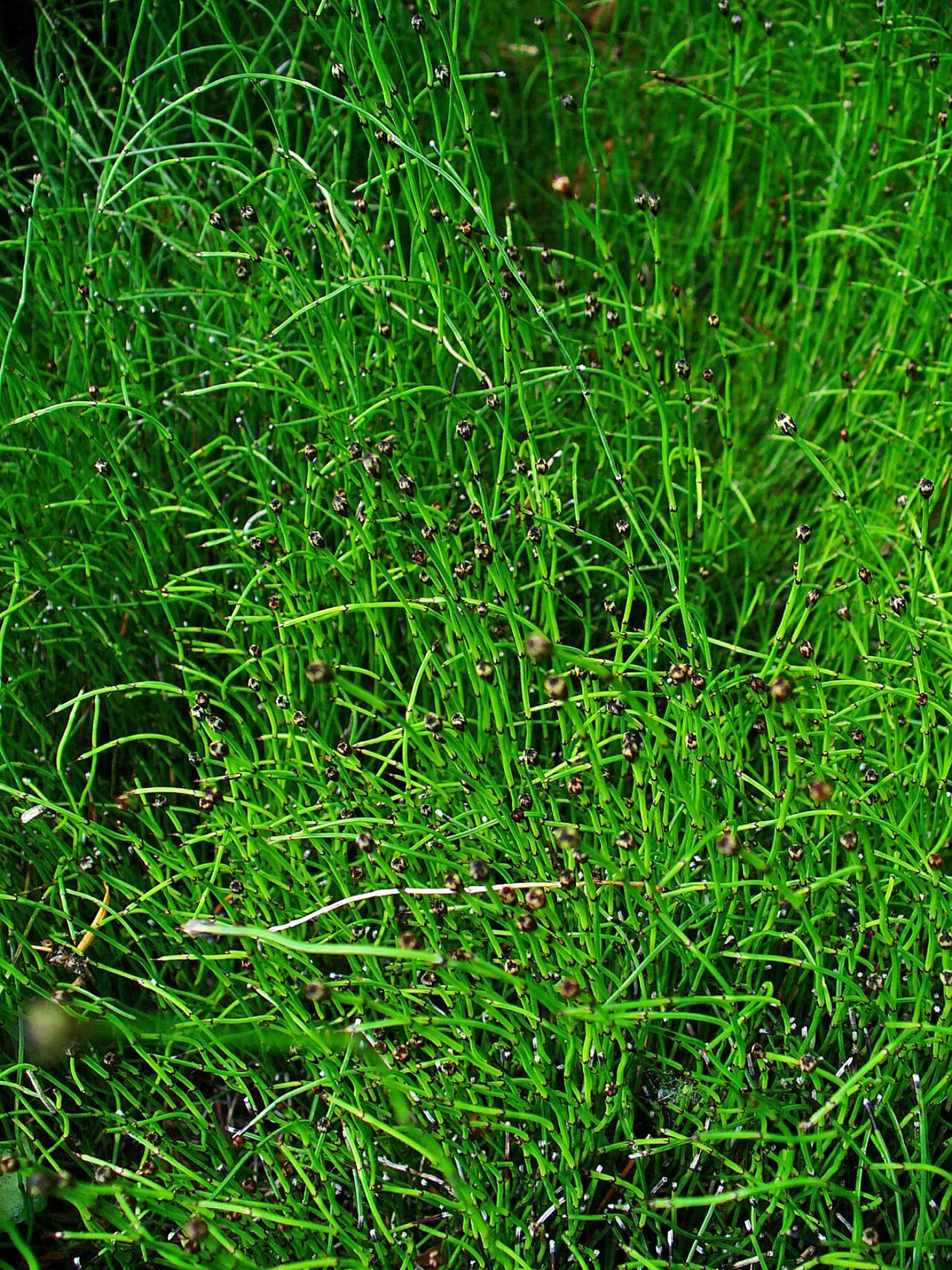
Equisetum scirpoides, known as Dwarf Horsetail or dwarf scouring-rush, is the smallest horsetail in the world. Its evergreen stems are only a few inches long and about as thick as a heavy thread, and they kink and curl into dense, springy tufts and mats on mossy forest floors, stream banks and fens across the northern part of the continent. Each fertile stem ends in a tiny, pointed black cone.
Horsetails are ancient, spore-producing plants related to ferns. Their ancestors included tree-sized relatives in the coal-age swamps, but dwarf horsetail has gone the other way: it is so small and fine that it is easy to mistake for a patch of moss or a sedge seedling. Up close, the jointed stems with their tiny toothed sheaths are unmistakably a horsetail.
It is a circumboreal species, found in the cool northern forests of North America, Europe and Asia. In the United States it grows in Alaska, the northern tier of states from New England to Washington, and south in the Rocky Mountains to Wyoming. This guide covers how to identify dwarf horsetail, where it grows, how to grow it as a miniature groundcover or container plant, and its role in northern forests.
Identification
Look for a low, tangled tuft of very fine, dark green, wiry stems that are jointed, curly or kinked, have no branches or leaves, and carry tiny black cones at their tips.
Growth Habit
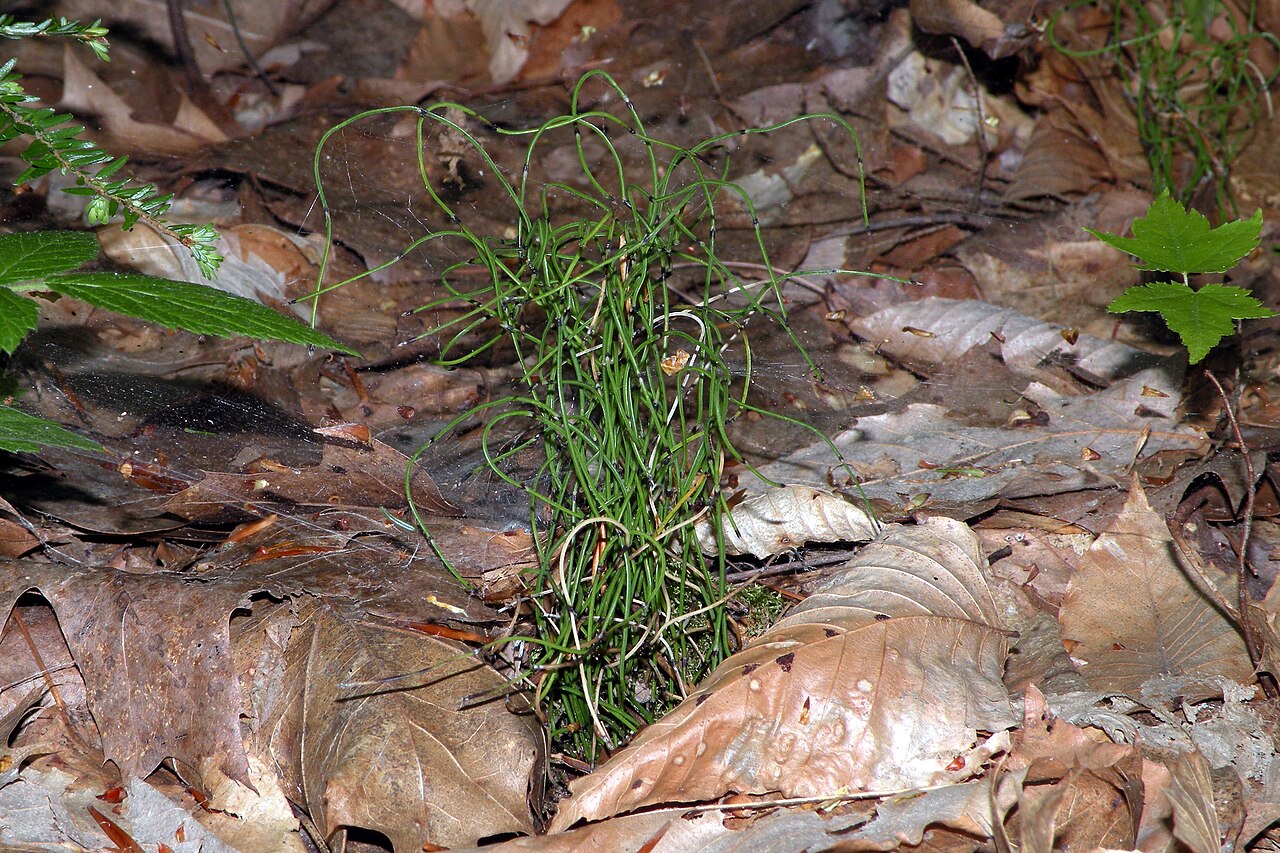
Dwarf horsetail is an evergreen perennial that spreads by slender creeping rhizomes, forming loose tufts or dense mats. The stems are usually 2 to 8 inches long and often lie partly on the ground or arch over, so a colony seldom stands more than a few inches tall.
Stems
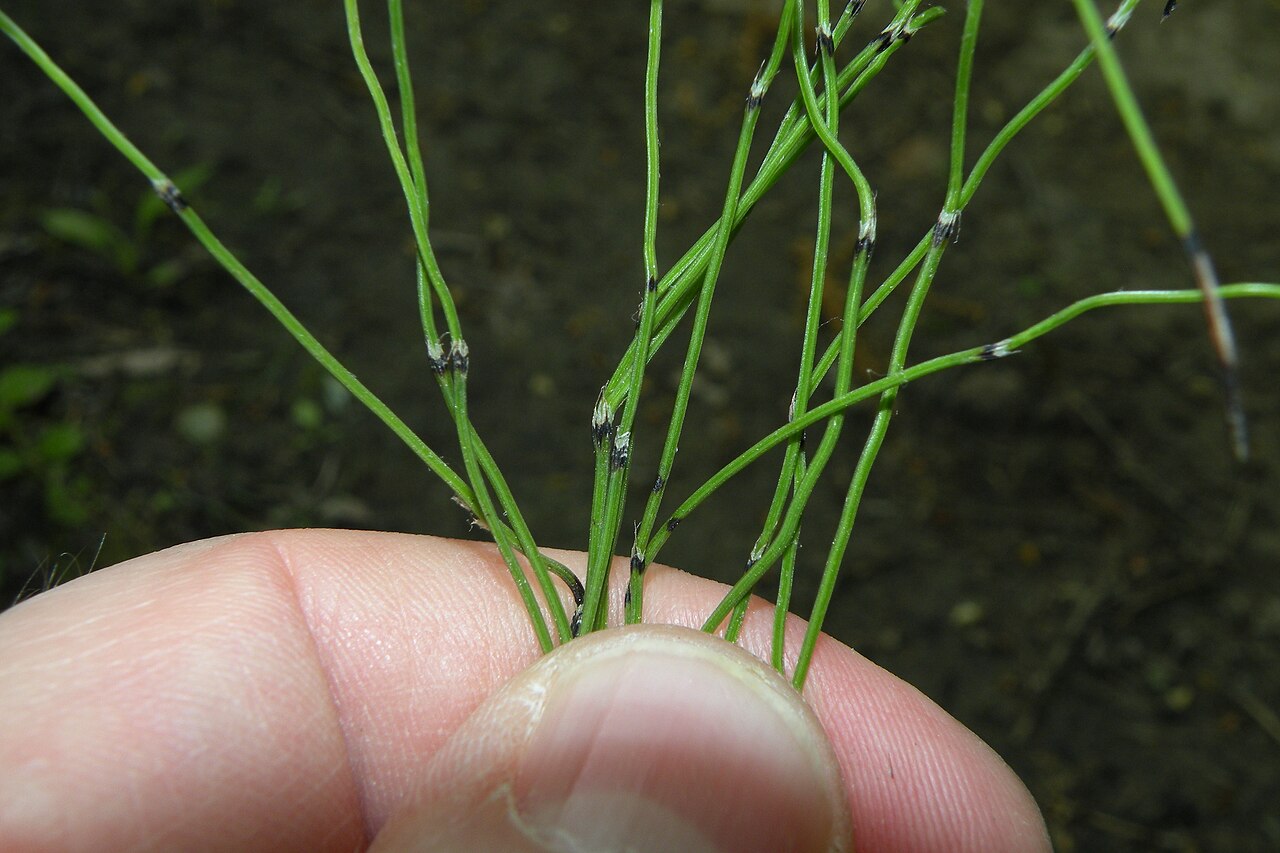
The stems are very slender, usually less than 1/25 inch (about 1 mm) across, dark green and rough to the touch because of silica in their tissues. They are unbranched and often twisted or curled. Each stem has about six ridges, and unlike most horsetails it has no central hollow; it is solid all the way through.
Sheaths & Teeth
Horsetails have no real green leaves; their leaves are reduced to small sheaths at each joint. In dwarf horsetail each sheath is short, green to black, with three small dark teeth that have pale, thin edges. The three-toothed sheath is one of the best ways to confirm the species.
Cones (Strobili)
Fertile stems end in a tiny cone (strobilus), only about 1/8 inch long, black and with a small sharp point. The cones release green spores, usually in spring or early summer, and often persist on the stems. Dwarf horsetail has no flowers or seeds.
Look-alikes
Variegated scouring-rush (Equisetum variegatum) is larger and straighter, with stems usually 6 to 20 inches tall, a central hollow and more ridges and sheath teeth. Scouring-rush (E. hyemale) is much taller and thicker. Wood horsetail and field horsetail have whorls of green branches. From a distance, dwarf horsetail mats can be mistaken for spikerushes or moss.
Quick Facts
| Scientific Name | Equisetum scirpoides Michx. |
| Family | Equisetaceae (horsetail family) |
| Plant Type | Evergreen, rhizomatous perennial horsetail (spore-bearing) |
| Mature Height | 2–8 in (stems often lying or arching) |
| Mature Spread | 6–12 in per clump; slowly forms mats |
| Growth Rate | Slow to moderate |
| Sun Exposure | Part shade to full shade |
| Water Needs | Moderate to high; consistently moist soil |
| Soil Type | Moist, mossy, organic or sandy soils, often over limestone |
| Soil pH | About 6.0–8.0 (often on calcareous sites) |
| Bloom Time | Does not flower; cones release spores in spring to early summer |
| Flower Color | None; tiny black cones |
| Fall Color | Evergreen; stays dark green through winter |
| Fruit | None; spores from tiny pointed cones |
| Deer Resistant | Yes; rarely browsed because of its silica-rich stems |
| USDA Hardiness Zones | 1–7 |
Native Range
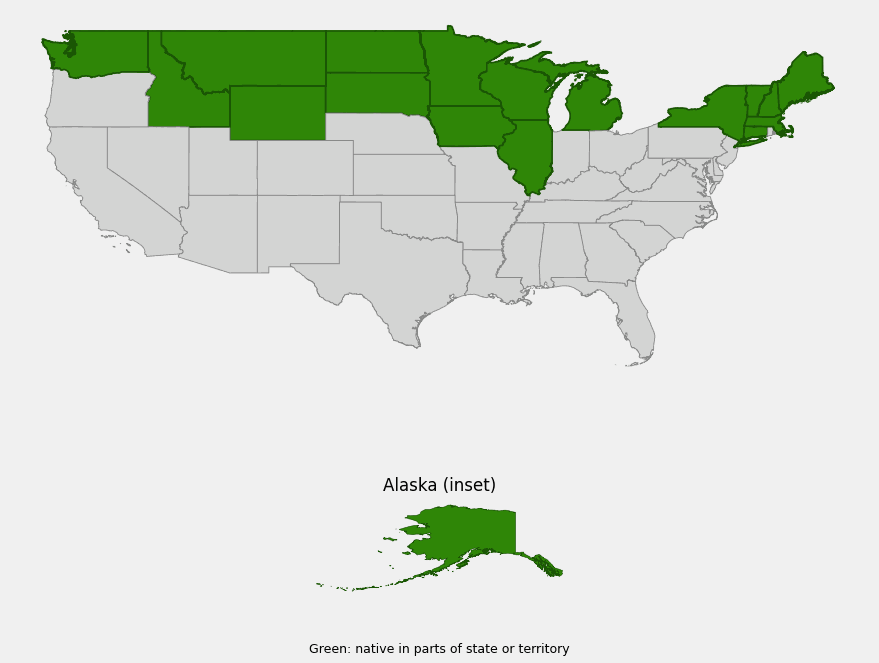
Dwarf horsetail is circumboreal, growing in the northern forests and tundra of North America, Europe and Asia. In North America it ranges across Canada from Newfoundland and Labrador to British Columbia and the Yukon and Nunavut, and through Alaska. USDA PLANTS lists it in 18 U.S. states: Alaska, Connecticut, Idaho, Illinois, Iowa, Maine, Massachusetts, Michigan, Minnesota, Montana, New Hampshire, New York, North Dakota, South Dakota, Vermont, Washington, Wisconsin and Wyoming.
In the Lower 48 it is mostly a plant of the northern border states and of cool pockets farther south. It is widespread in the northern Great Lakes region, northern New England and the Adirondacks, but rare at the southern edge of its range in states such as Connecticut, Massachusetts, Iowa and Illinois, where it survives in cold, shaded ravines, cedar swamps and fens. In the West it follows the Rocky Mountains from northeastern Washington, northern Idaho and Montana south to the Black Hills and Wyoming.
It grows in moist coniferous and mixed forests, especially under northern white cedar, spruce and fir, on mossy stream banks and lakeshores, in fens and cedar swamps, and on wet, often limy, gravelly or sandy soils. In the far north and in Alaska it also grows on open tundra. Many southern populations are small and of conservation concern in their states.
📋 Regional plant lists featuring Dwarf Horsetail: Alaska · New Hampshire, Maine & Vermont · Connecticut, Massachusetts & Rhode Island · New York, Pennsylvania & Northern New Jersey · Delaware, Southern New Jersey & Long Island · Michigan, Wisconsin & Eastern Minnesota · Illinois, Iowa & Missouri · North Dakota, South Dakota & Western Minnesota · Montana & Wyoming · Idaho, Eastern Oregon & Eastern Washington
Growing & Care Guide
Dwarf horsetail is a charming miniature for shady, moist spots, small water features, troughs and containers. It is sold by some water-garden, fern and alpine nurseries, usually as a pond-edge or tabletop plant. It is far less aggressive than the larger horsetails, but it still spreads by rhizomes in moist soil.
Light
Give it part to full shade, or morning sun with afternoon shade. In cool northern gardens it tolerates more sun if the soil stays moist.
Soil & Water
It needs soil that never dries out: moist, humus-rich or sandy-peaty soil, a mossy bank, the edge of a pond or stream, or a container standing in a shallow saucer of water. It tolerates neutral to limy conditions. Drought turns the stems brown.
Planting Tips
Plant divisions or container plants in spring or early fall. It looks best in small-scale settings where its texture can be seen up close: between stepping stones in a shady, damp path, in a trough with mosses and small ferns, along a recirculating stream, or as a fine “grass” in a container or bonsai planting.
Pruning & Maintenance
Very little care is needed. Pull out any brown stems in spring. In a mixed planting, check each spring that it is not creeping into neighboring plants, and lift any runners that stray. It is evergreen and stays attractive through winter under snow.
Propagation
Divide established clumps or mats in spring, keeping a piece of rhizome with each section. Horsetail spores are short-lived and seldom used for propagation. Buy nursery-propagated plants, and do not dig it from the wild, since many southern populations are small and rare.
Landscape Uses
- Shade and moss gardens: a fine-textured, evergreen miniature for damp, shady corners
- Pond and stream edges: grows in saturated soil at the water’s edge
- Troughs, containers and terrariums: a tidy, grass-like accent for small-scale plantings
- Northern woodland restoration: part of the native groundlayer of cedar swamps and boreal forests
- Year-round interest: its dark green stems stay evergreen through winter
Wildlife & Ecological Value
Dwarf horsetail is a small but persistent part of the mossy groundlayer in northern forests and fens, where it helps cover and hold wet soils.
For Pollinators
As a spore plant without flowers or nectar, dwarf horsetail offers nothing to pollinators directly. Its mats do shelter small insects, mites and other invertebrates on the forest floor.
For Birds
Ground-foraging birds of northern forests, such as thrushes and grouse, search for insects in the mossy mats where it grows. Horsetails are not an important bird food.
For Mammals
The silica-rich stems are tough and seldom eaten. Larger horsetails are eaten in small amounts by some northern mammals, but dwarf horsetail is too small to be a significant food source.
Ecosystem Role
Its creeping rhizomes help stabilize wet, mossy soils on stream banks and in fens. Its presence often indicates cool, moist, mineral-rich conditions, and it is one of the characteristic plants of northern white cedar swamps and calcareous fens.
Cultural & Historical Uses
The species was described by the French botanist André Michaux in 1803 from plants collected in North America. The name scirpoides means “like Scirpus“, the bulrush genus, a reference to its tufts of fine, rush-like stems. Equisetum comes from the Latin for “horse” and “bristle”.
Horsetails are one of the oldest living plant groups, with a fossil record reaching back more than 300 million years. Dwarf horsetail, the smallest member of the group, is sometimes called a “living fossil” in miniature, and it is popular with growers of bonsai and miniature gardens for its prehistoric look.
Safety note: horsetails contain an enzyme (thiaminase) and other compounds that can poison livestock, especially horses, if eaten in large amounts in hay, and they should not be eaten by people or pets. Dwarf horsetail is too small to be a common problem, but keep it away from animals that might graze it, and do not use it as an herbal remedy.
Frequently Asked Questions
How big does dwarf horsetail get?
Its stems are usually only 2 to 8 inches long and about 1 mm thick, and they often curl or lie along the ground, so a patch is usually just a few inches tall. It is the smallest horsetail in the world.
Is dwarf horsetail invasive?
It is native to the northern United States and Canada and is much less aggressive than larger horsetails. It does spread slowly by rhizomes in moist soil, so give it room or grow it in a container.
Where does dwarf horsetail grow?
It grows in cool, moist northern forests, cedar swamps, fens and on mossy stream banks across Canada and Alaska, the northern states from New England to Washington, and the Rocky Mountains south to Wyoming.
Can I grow dwarf horsetail in a pond or container?
Yes. It does well at the edge of a pond or stream, in a damp shady bed, or in a pot kept constantly moist, for example standing in a saucer of water.
Is dwarf horsetail poisonous?
Horsetails contain compounds that can harm livestock, especially horses, if eaten in quantity. Do not eat it or use it medicinally, and keep it away from grazing animals.

Looking for a nursery that carries Dwarf Horsetail?
Browse our native plant nursery directory: Alaska · Connecticut · Idaho, Illinois & Iowa · Maine, Massachusetts, Michigan, Minnesota & Montana · New Hampshire, New York & North Dakota · South Dakota & Vermont · Washington · Wisconsin & Wyoming

