
Great Sundew (Drosera anglica)
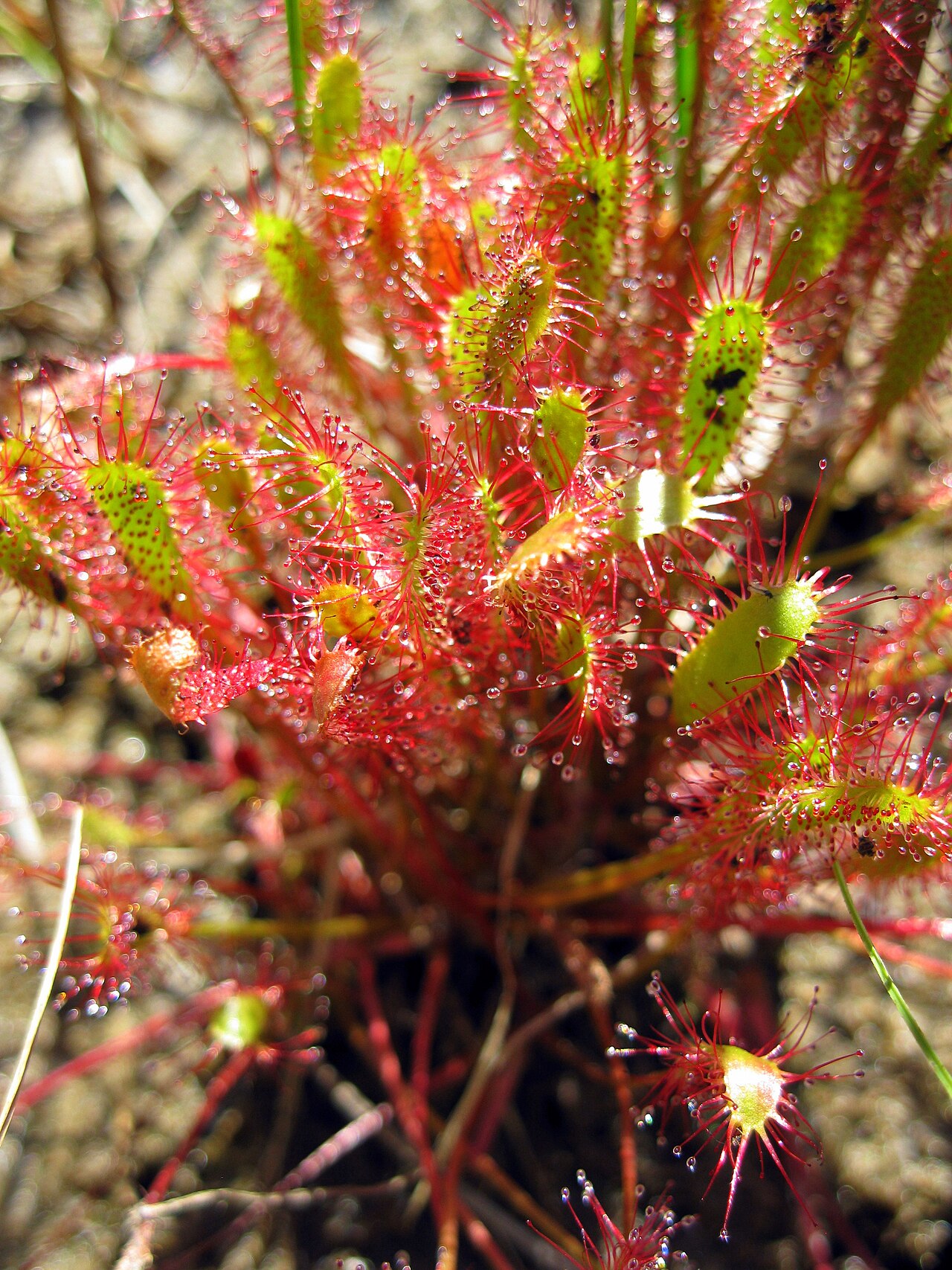
Drosera anglica, known as Great Sundew or English sundew, is a small carnivorous plant of bogs, fens and wet lakeshores across the cooler parts of the Northern Hemisphere. It forms an upright rosette of long, narrow, paddle-shaped leaves, 1 to 4 inches long, densely covered with red, gland-tipped hairs that glisten with sticky droplets. In midsummer it sends up a slender stalk of small white flowers. It belongs to the sundew family (Droseraceae).
It is the largest of the northern sundews, and also one of the most interesting. Great sundew arose as a hybrid between Round-leaved Sundew (Drosera rotundifolia) and slender-leaved sundew (Drosera linearis) that doubled its chromosomes and became a fertile, self-sustaining species. In the United States it grows from Alaska and the Pacific Northwest across the northern Rockies to the Great Lakes and Maine, and, remarkably, in the Alakaʻi Swamp on Kauaʻi, where it is Hawaii’s only native sundew.
This guide covers how to identify great sundew and tell it from its relatives, where it grows, how carnivorous plant growers keep it in cultivation, and its role in northern peatlands. Wild plants should never be dug: sundews grow only in fragile, slow-forming wetlands, and nursery-propagated plants are easy to find.
Identification
Sundews are easy to recognize as a group by their sticky, glistening leaves. Telling the species apart comes down mainly to leaf shape. Several sundews grow together in northern bogs, so look closely at the leaf blade and how it joins the stalk.
Leaves
The leaves stand erect or ascend from a basal rosette. Each has a long, nearly hairless green stalk (petiole) and a narrow, spoon-shaped to linear blade, roughly 2 to 3 times longer than the petiole is wide and typically ¾ to 1½ inches long, the whole leaf 1 to 4 inches. The upper surface and edges are covered with red, stalked glands (tentacles), each tipped with a droplet of sticky mucilage. In sun the whole plant turns deep red; in shade it stays greener.
Flowers
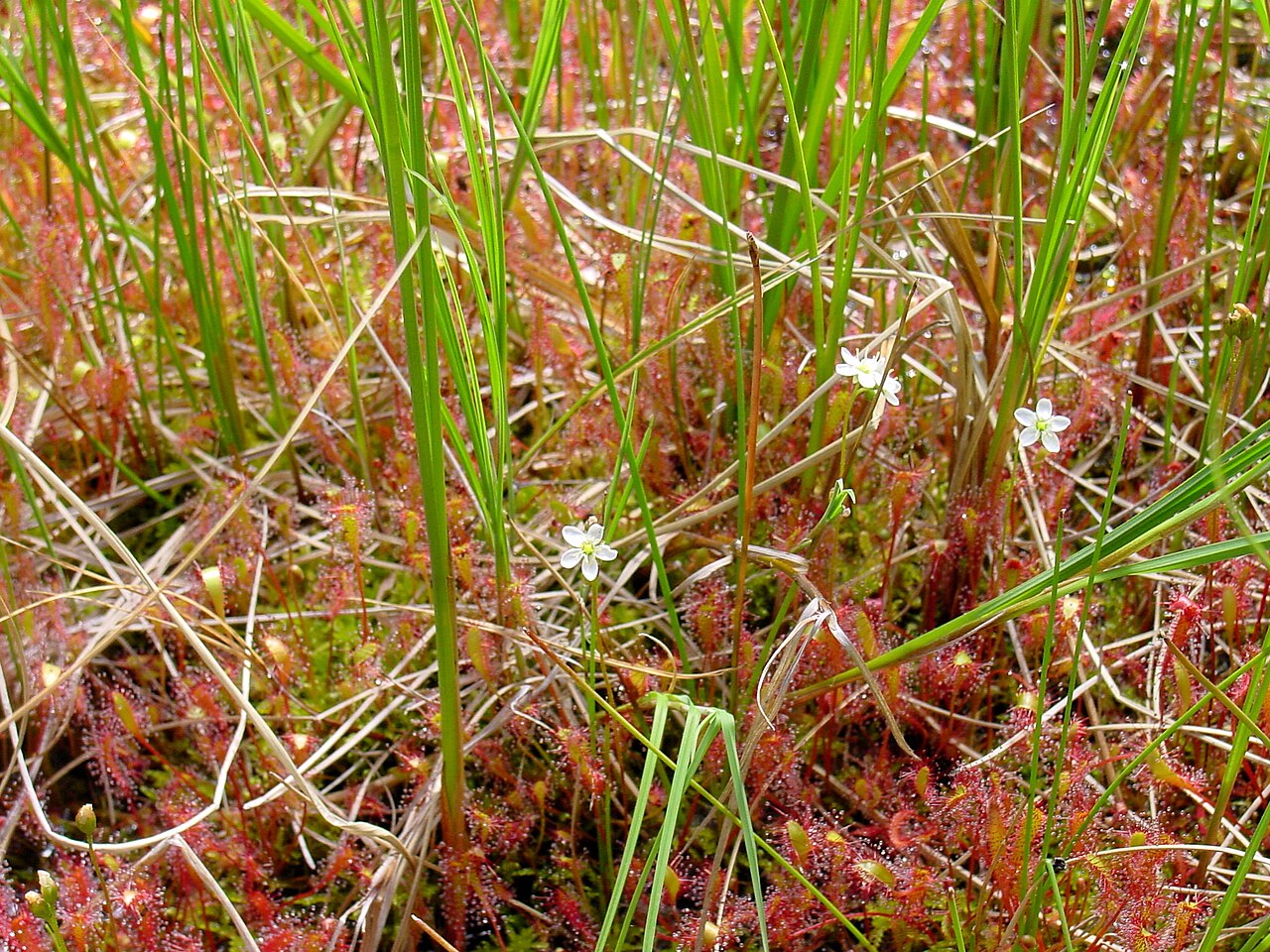
From about June to August, each rosette sends up one or more slender, leafless stalks, usually 4 to 10 inches tall, well above the leaves. The stalk carries a one-sided cluster of 1 to 10 white flowers, each about ⅜ inch across with five petals. Each flower opens only briefly, usually in sun, and many self-pollinate.
Fruit & Seeds
The fruit is a small capsule that splits to release many tiny, spindle-shaped black seeds, which fall onto wet moss nearby or are carried by water.
Winter Buds & Look-alikes
In cold climates, the plant dies back in fall to a tight winter bud (hibernaculum) at the moss surface, which sprouts again in spring. Round-leaved sundew has round leaf blades on flat, hairy petioles. Spoonleaf Sundew (D. intermedia) has smaller spoon-shaped blades and a flower stalk that curves up from beside the rosette rather than its center. Slender-leaved sundew has very narrow, nearly parallel-sided blades. Great sundew is intermediate in shape between its two parents, and sterile hybrids among these species also occur.
Quick Facts
| Scientific Name | Drosera anglica (syn. D. longifolia, in part) |
| Family | Droseraceae (sundew family) |
| Plant Type | Carnivorous herbaceous perennial; forms winter buds |
| Mature Height | Rosette 1–4 in; flower stalk 4–10 in |
| Mature Spread | 2–4 in per rosette |
| Growth Rate | Slow to moderate |
| Sun Exposure | Full sun |
| Water Needs | Wet; soil must stay saturated |
| Soil Type | Living sphagnum, peat, marl or wet sand in fens |
| Soil pH | About 4.5–8.0 (acid bogs to alkaline fens) |
| Bloom Time | June–August |
| Flower Color | White |
| Fall Color | Leaves redden, then die back to a winter bud |
| Fruit | Small capsule with tiny black seeds |
| Deer Resistant | Yes; rarely browsed |
| USDA Hardiness Zones | 2–7 (the Kauaʻi form is tropical) |
Native Range
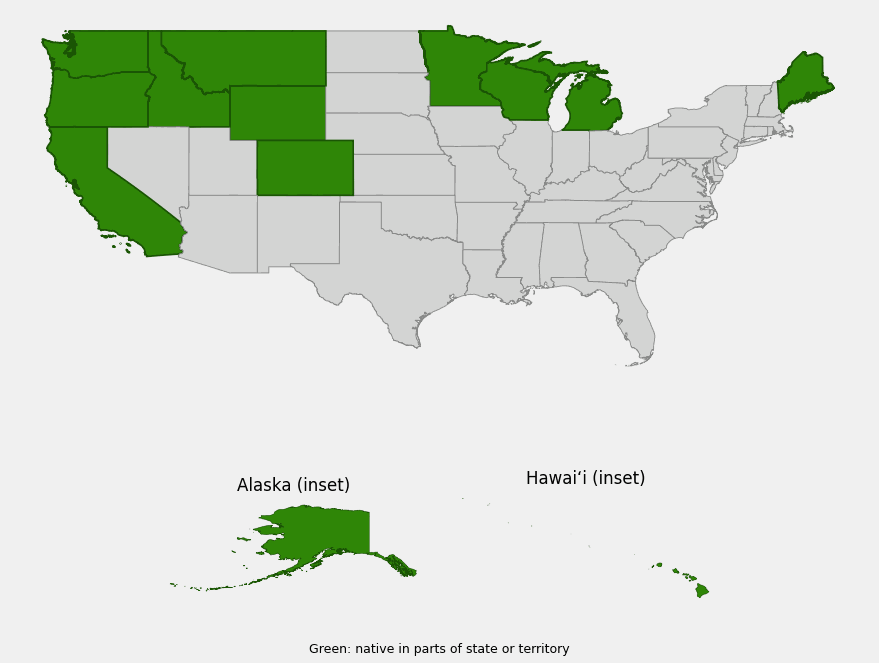
Great sundew is circumboreal, growing across northern North America, Europe and Asia, with outlying populations in Japan, southern Europe and Hawaii. In the United States, USDA PLANTS records it as native in Alaska, Hawaii, Washington, Oregon, California, Idaho, Montana, Wyoming, Colorado, Minnesota, Wisconsin, Michigan and Maine. In Canada it ranges from Newfoundland and Labrador and Quebec west through Ontario and the Prairie Provinces to British Columbia, Yukon and the Northwest Territories.
In the lower 48 states it is a plant of the northern tier and the mountains. It is most frequent in the peatlands of northern Minnesota, Wisconsin and Michigan, in Maine, and in mountain fens of the Pacific Northwest and northern Rockies. In California it is found in fens and bogs of the northern mountains and Sierra Nevada, and in Colorado and Wyoming it is rare, confined to a few mountain fens. It often grows in wetter spots than round-leaved sundew, such as flooded hollows, marl flats and floating mats.
The Hawaiian population is a famous botanical puzzle. Great sundew grows in the Alakaʻi Swamp, a cloud-forest bog high on Kauaʻi, thousands of miles from any other population. Its seeds were most likely carried there by migrating birds. Kauaʻi plants grow without winter dormancy, unlike their northern relatives.
📋 Regional plant lists featuring Great Sundew: Alaska · Hawaii · Idaho, Eastern Oregon & Eastern Washington · Western Oregon & Western Washington · California & Nevada · Montana & Wyoming · Michigan, Wisconsin & Eastern Minnesota · New Hampshire, Maine & Vermont
Growing & Care Guide
Great sundew is grown by carnivorous plant enthusiasts, both as a hardy bog garden plant in cold climates and in pots. Buy nursery-propagated plants or seed from carnivorous plant nurseries. Never dig sundews from bogs or fens: the habitats are slow to recover, and the species is rare in several states.
Light
Give it full sun outdoors or very bright light indoors. Strong light keeps plants compact and red and the dew abundant; in low light plants become pale and leggy and produce little dew.
Soil & Water
Grow it in live sphagnum or a mix of peat and lime-free sand or perlite, kept wet at all times. Stand pots in a tray of water. Use rainwater, distilled or reverse-osmosis water, because the minerals in most tap water build up and kill sundews over time. Do not fertilize the soil. The plants feed themselves on insects, and outdoors they catch plenty.
Planting Tips
In a bog garden, plant in spring at the moss surface among low companions such as pitcher plants and small sedges. In pots, use a deep container so the roots stay cool. Temperate plants are best kept outside year-round in zones where winters are reliably cold, which gives them the dormancy they need.
Pruning & Maintenance
Little care is needed beyond keeping the medium wet and clean. Remove dead leaves occasionally and pull grass or moss that threatens to bury the rosettes. Do not feed plants meat or hamburger, which rots on the leaves. In winter, plants form a tight bud; leave them in the cold (around 32–40 °F), or keep potted buds in a cold frame or refrigerator for 3 to 4 months. Kauaʻi-form plants sold by some nurseries do not go dormant and grow year-round indoors.
Propagation
Seed is the easiest method. Sow it on the surface of wet peat or sphagnum, give it a few weeks of cold, moist stratification, then keep it warm, bright and humid. Leaf cuttings laid on wet sphagnum also produce plantlets, and many winter buds divide naturally into several plants.
Landscape Uses
- Bog gardens: a hardy carnivorous plant for cold-climate bog gardens with pitcher plants
- Carnivorous plant collections: grown in pots or terrariums (with winter dormancy)
- Teaching: a striking way to show plant carnivory and hybrid speciation
- Fen and bog conservation: a sign of intact, undisturbed peatland
- Nature viewing: boardwalk bogs in the Great Lakes, Maine, Alaska and the Northwest
Wildlife & Ecological Value
Great sundew lives where nutrients are scarce. Bogs and fens are low in nitrogen and phosphorus, and sundews make up the difference by catching small insects, which places them in a food web of their own.
For Pollinators
The small white flowers are visited by small bees, flies and other insects, though most flowers self-pollinate. The flower stalks hold the blooms well above the sticky leaves, which may help keep pollinators from being caught.
For Birds
Great sundew provides no direct food for birds, but its dispersal is linked to them: the remote Kauaʻi population was almost certainly founded by seeds carried by migrating birds.
For Mammals
It has no significant value as food for mammals and is rarely browsed.
Ecosystem Role
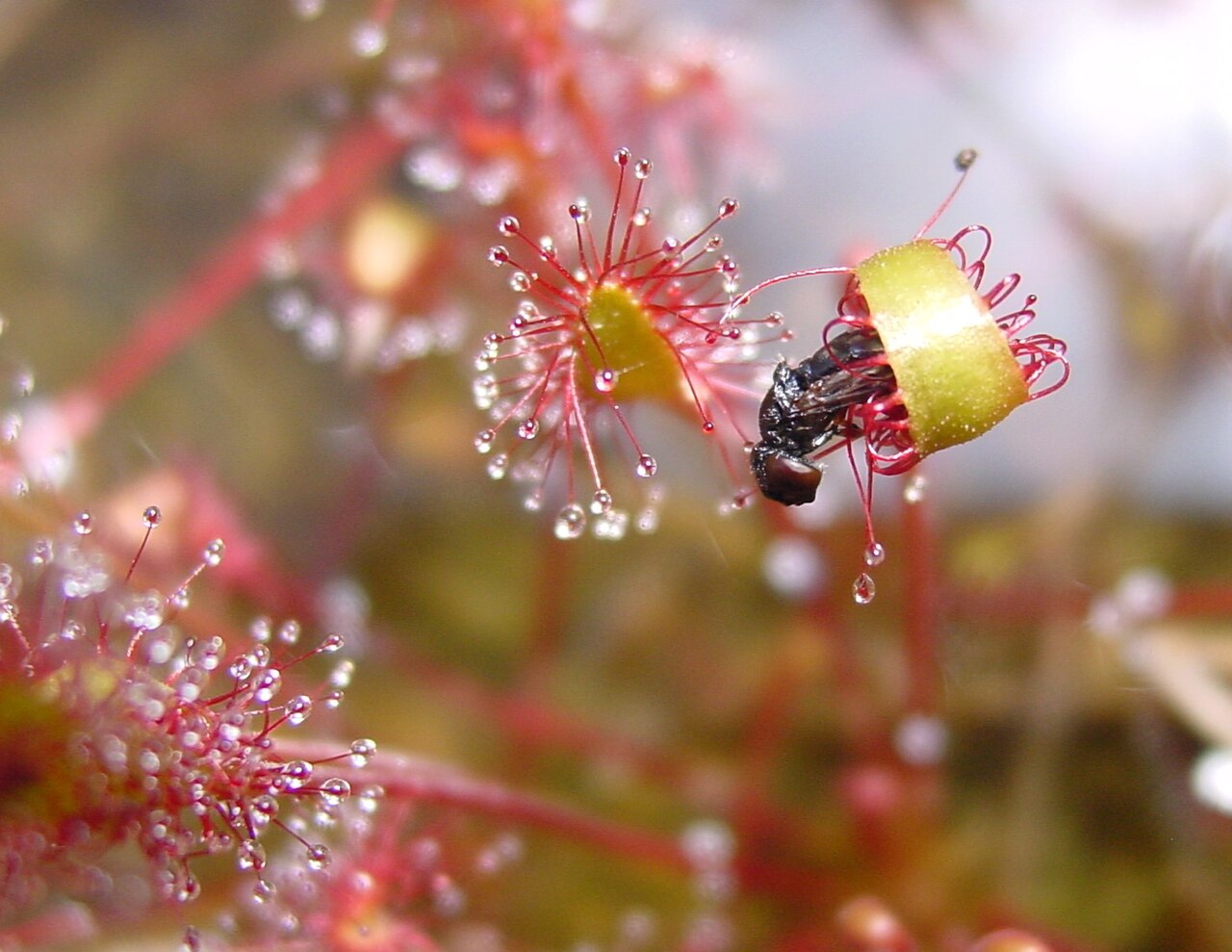
Each leaf catches midges, mosquitoes, small flies, gnats and even damselflies. When an insect touches the tentacles, they bend toward it, and the leaf blade itself slowly curls around the prey. Enzymes digest the soft parts, and the leaf absorbs the nitrogen and phosphorus. Some small insects, such as certain plant bugs and spiders, steal prey from the leaves. Because it is sensitive to changes in water chemistry and level, great sundew is a useful indicator of healthy fens and bogs.
Cultural & Historical Uses
The English botanist William Hudson named Drosera anglica (“English sundew”) in his Flora Anglica in 1778. The genus name comes from the Greek droseros, “dewy,” for the glistening droplets on the leaves. In older American books it is often called Drosera longifolia, a name that was applied inconsistently and has been abandoned.
Charles Darwin experimented on sundews for years and published his findings in Insectivorous Plants (1875). He showed that sundew leaves respond to tiny amounts of nitrogen-rich material and secrete digestive fluid, helping to establish that plants could truly be carnivorous. Most of his work was on round-leaved sundew, but he also observed great sundew.
In 1955, the botanist Carroll Wood showed that great sundew has double the chromosome number of other North American sundews and suggested that it formed from a hybrid between round-leaved and slender-leaved sundew. Later genetic studies supported this, making great sundew a textbook example of a species formed by hybridization and chromosome doubling.
Frequently Asked Questions
Why is it called English sundew if it grows in America?
William Hudson described it from English specimens in 1778, so the name stuck. The species is actually circumboreal and native across northern North America, Europe and Asia. “Great sundew” is the more descriptive name, since it is the largest northern sundew.
Does great sundew grow in Hawaii?
Yes. A small native population grows in the Alakaʻi Swamp on Kauaʻi, at high elevation in a cloud-forest bog. It is the only sundew native to Hawaii, and its seeds are thought to have been carried there by birds.
Can I grow great sundew as a houseplant?
It can be grown indoors under bright lights, but temperate plants need a cold winter rest of 3 to 4 months, so most growers keep them outdoors or in a cold frame. Nursery plants of the Kauaʻi form grow year-round without dormancy.
How is great sundew different from round-leaved sundew?
Round-leaved sundew has round leaf blades that usually lie flat on the moss. Great sundew has long, narrow, upright, paddle-shaped blades. They often grow together, and the two occasionally hybridize.
Can I collect great sundew from a bog?
No. Bogs and fens recover very slowly from trampling and digging, and great sundew is rare in several states and protected on many public lands. Buy nursery-propagated plants or seed from reputable carnivorous plant nurseries.

Looking for a nursery that carries Great Sundew?
Browse our native plant nursery directory: Alaska · California · Colorado & Hawaii · Idaho · Maine, Michigan, Minnesota & Montana · Oregon · Washington · Wisconsin & Wyoming

