
Birch-leaved Spirea (Spiraea betulifolia)
Spiraea betulifolia, known as Birch-leaved Spirea, birchleaf spirea or white spirea, is a low, suckering shrub with oval, birch-like leaves and flat-topped clusters of small white flowers in early summer. In the eastern United States it is a plant of rocky, open woods and dry ridges in the central and southern Appalachians, where it is known as Spiraea betulifolia var. corymbosa, or simply Spiraea corymbosa, corymbed or shinyleaf spirea. It belongs to the rose family (Rosaceae).
The name covers a group of closely related plants, and the taxonomy can be confusing. In the broad sense used by the Flora of North America, S. betulifolia is one species with an Asian form, an eastern North American variety (var. corymbosa) and a western variety (var. lucida). USDA PLANTS now treats the two North American varieties as separate species: the eastern Spiraea corymbosa and the western Spiraea lucida, which has its own page here as Shinyleaf Meadowsweet. This page focuses on the eastern plant, which is the one most gardeners in the East are looking for.
Eastern birch-leaved spirea is a tidy, adaptable native shrub for dry shade, rock gardens and woodland edges. It stays 1 to 3 feet tall, spreads slowly into small colonies, and feeds a wide range of small pollinators. This guide covers how to identify it, the range of each form, how to grow it, and its value to wildlife.
Identification
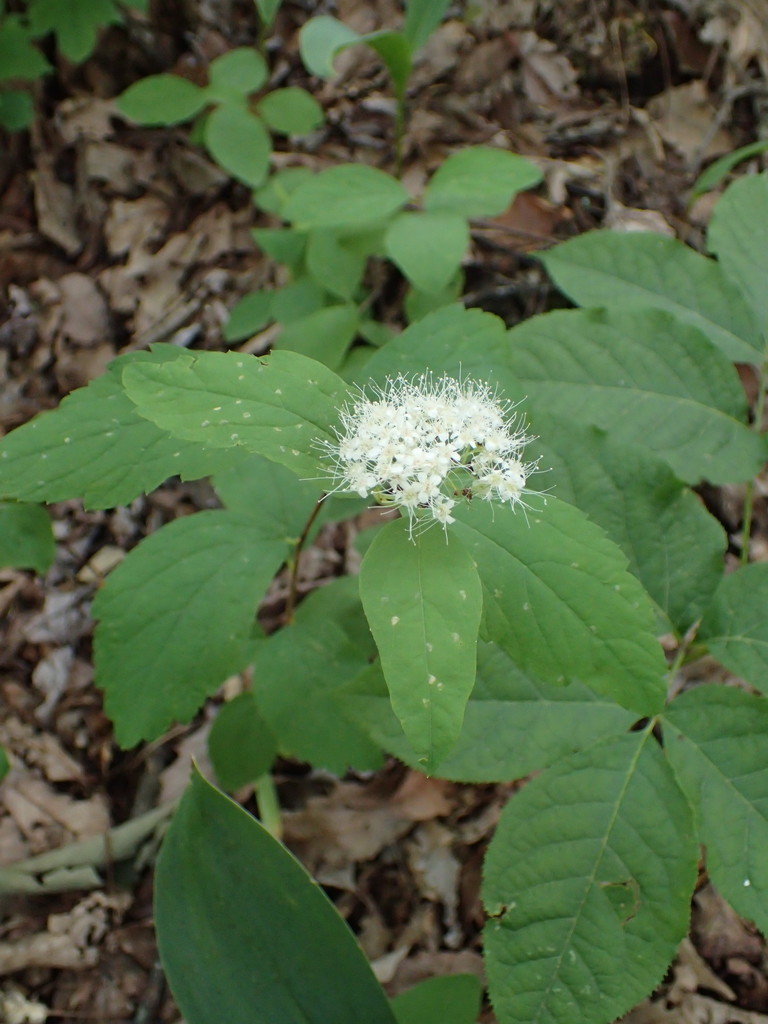
Birch-leaved spirea is recognized by its low, unbranched or few-branched stems, its broad, birch-like leaves, and its flat-topped, not pointed, clusters of white flowers.
Stems & Growth Habit
A deciduous shrub usually 1 to 3 feet tall, with mostly upright, slender, reddish-brown to purplish stems that branch little. It spreads by underground runners, forming loose colonies on rocky slopes and in open woods.
Leaves
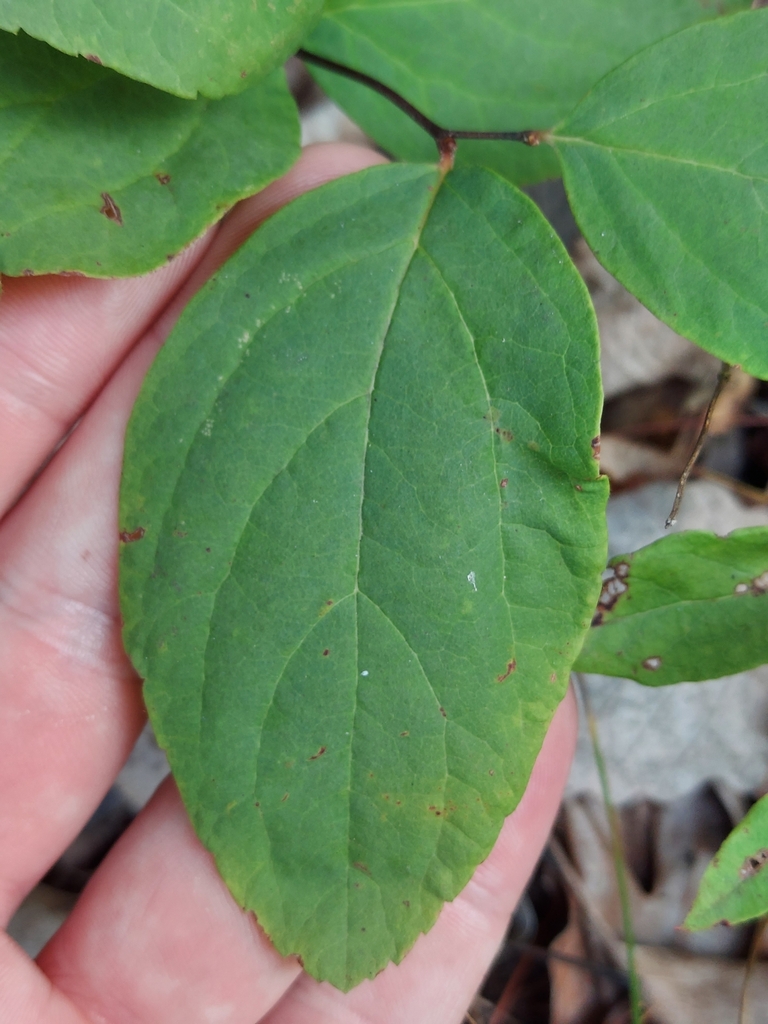
The leaves are alternate, oval to broadly elliptic, 1 to 3 inches long, rounded or blunt at the tip, and coarsely or doubly toothed mainly on the upper half, with smooth edges toward the base. They are dull to slightly shiny green above and paler, often bluish-white, beneath, and they resemble small birch leaves, which explains the name. In fall they turn yellow to reddish or purplish.
Flowers
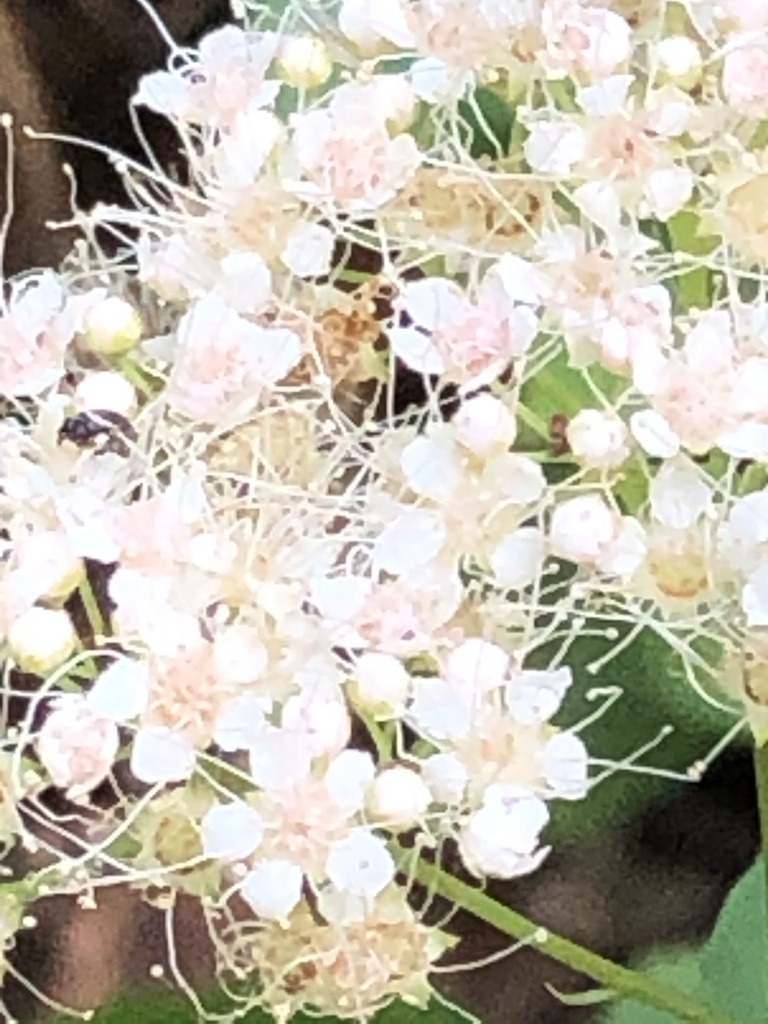
From late May to July, each stem ends in a broad, flat-topped or slightly rounded cluster (a corymb) 2 to 4 inches across, packed with tiny flowers about ¼ inch wide. The flowers are white, sometimes tinged pink in bud, with five petals and many long stamens that give the cluster a fuzzy look.
Fruit & Look-alikes
The flowers are followed by clusters of small, dry, shiny brown pods (follicles) that persist into winter. Meadowsweet (S. alba) and Steeplebush (S. tomentosa) have narrow, pointed or cone-shaped flower clusters and grow in wet meadows. Japanese spirea (S. japonica), an invasive shrub in the East, has pink to rose flowers and sharply pointed, evenly toothed leaves. In the West, Shinyleaf Meadowsweet (var. lucida) is very similar, with shinier leaves and a typical height of 1 to 2 feet.
Quick Facts
| Scientific Name | Spiraea betulifolia (eastern plants: var. corymbosa, syn. Spiraea corymbosa; western plants: var. lucida, syn. Spiraea lucida) |
| Family | Rosaceae (rose family) |
| Plant Type | Low, suckering deciduous shrub |
| Mature Height | 1–3 ft |
| Mature Spread | 2–4 ft, slowly colonizing |
| Growth Rate | Moderate |
| Sun Exposure | Full sun to part shade |
| Water Needs | Low to moderate; drought tolerant once established |
| Soil Type | Well-drained, rocky, sandy or loamy soil |
| Soil pH | About 4.5–7.0 |
| Bloom Time | Late May–July |
| Flower Color | White, sometimes pink-tinged in bud |
| Fall Color | Yellow to reddish-purple |
| Fruit | Small dry brown follicles in persistent clusters |
| Deer Resistant | No; browsed by deer |
| USDA Hardiness Zones | 4–8 (eastern var. corymbosa); 3–7 (western var. lucida) |
Native Range
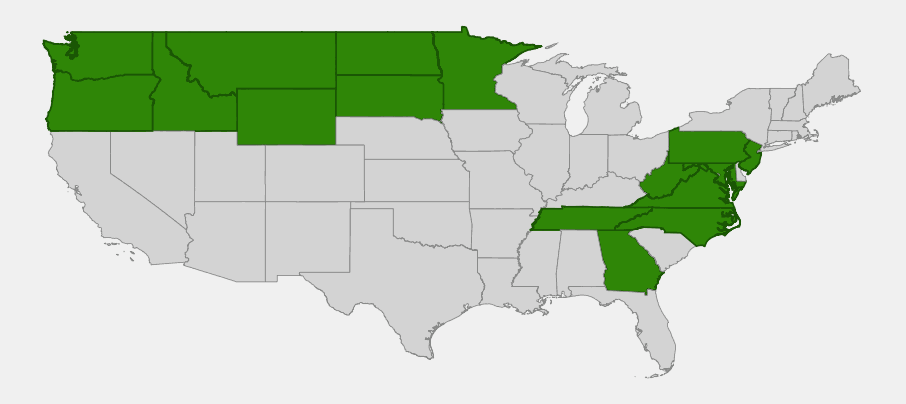
The eastern variety (var. corymbosa, listed by USDA PLANTS as Spiraea corymbosa) is native to the central and southern Appalachians. USDA PLANTS records it in Pennsylvania, New Jersey, Maryland, West Virginia, Virginia, North Carolina, Tennessee and Georgia. It is most frequent in the Ridge and Valley, the Blue Ridge and the Allegheny Mountains of Virginia, West Virginia, Maryland and Pennsylvania, and the records from New Jersey and Georgia are outlying, local populations. Plants in Nova Scotia and Ontario are considered introduced.
The western variety (var. lucida, USDA Spiraea lucida) grows in the northern Rocky Mountains and the interior Northwest: Washington and Oregon east of the Cascades, Idaho, Montana, Wyoming, the Black Hills and western North Dakota and South Dakota, and Minnesota, plus British Columbia, Alberta and Saskatchewan. USDA PLANTS also keeps a few older records under the species name for Idaho, Minnesota, Montana, Oregon and North Carolina. The true Asian S. betulifolia grows in northeastern Asia, including Japan and the Russian Far East.
In the East it grows on dry, rocky, open wooded slopes, ridge tops, shale and sandstone outcrops, roadbanks and the edges of oak and pine woods, usually in acidic soil and often where fire or thin soil keeps the canopy open. In the West, Shinyleaf Meadowsweet is a common understory shrub of ponderosa pine and Douglas-fir forests.
📋 Regional plant lists featuring Birch-leaved Spirea: Maryland, Virginia & West Virginia · North & South Carolina · Kentucky & Tennessee · Alabama, Georgia & Mississippi · New York, Pennsylvania & Northern New Jersey · Delaware, Southern New Jersey & Long Island · Idaho, Eastern Oregon & Eastern Washington · Montana & Wyoming · North Dakota, South Dakota & Western Minnesota · Michigan, Wisconsin & Eastern Minnesota
Growing & Care Guide
Eastern birch-leaved spirea is an easy, tough small shrub for dry or average soil in the Mid-Atlantic and Appalachian region. Look for plants labeled Spiraea corymbosa or S. betulifolia var. corymbosa at native plant nurseries. Plants sold simply as Spiraea betulifolia at garden centers, including compact cultivars such as ‘Tor’, are not necessarily the eastern native variety, so check the label if you want the regional native. In the Northwest and Rockies, plant Shinyleaf Meadowsweet instead.
Light
It flowers best in full sun to part shade and tolerates fairly dry shade under high-branched oaks and pines, though it blooms less in deep shade.
Soil & Water
It prefers well-drained, acidic, rocky, sandy or loamy soil and is drought tolerant once established. It does not like soggy, poorly drained clay. Water during its first summer, then little or not at all.
Planting Tips
Plant in spring or fall, 2 to 3 feet apart for a low mass or ground cover. It works well along dry slopes, at woodland edges, in rock gardens and in front of taller shrubs.
Pruning & Maintenance
It needs little care. Shear off spent flower clusters if you prefer a neater look, or leave them for winter interest. Every few years in late winter, cut the oldest stems to the ground to renew the plant; it flowers on the current year’s growth. Pull suckers if it spreads where you don’t want it.
Propagation
It is easily propagated by dividing rooted suckers in early spring or by softwood cuttings in early summer. Seed sown in fall or after a short cold stratification germinates readily.
Landscape Uses
- Dry shade and woodland edges: low native shrub under oaks and pines
- Rock gardens and slopes: holds thin, rocky soil with its spreading roots
- Pollinator gardens: abundant small flowers for bees, flies and beetles
- Native substitute for Japanese spirea: a regional alternative to an invasive ornamental
- Low mass plantings: a small-scale ground cover shrub
Wildlife & Ecological Value
Birch-leaved spirea’s many small flowers provide easy nectar and pollen in early summer, and its low thickets shelter wildlife on dry slopes.
For Pollinators
The open, flat flower clusters are visited by many small native bees, syrphid flies, beetles and butterflies, which can easily reach the nectar and pollen. Spireas are also larval host plants for several moths.
For Birds
The dry seed pods are of little food value, but the low thickets give cover to towhees and other ground-foraging birds on dry ridges and slopes.
For Mammals
White-tailed deer browse the leaves and twigs, and rabbits shelter in its colonies. In the West, elk and deer browse Shinyleaf Meadowsweet heavily.
Ecosystem Role
Its spreading, suckering roots stabilize thin, rocky soils on slopes and outcrops. It resprouts quickly after fire or cutting, which helps it persist in fire-adapted oak and pine woods.
Cultural & Historical Uses
Peter Simon Pallas described Spiraea betulifolia in 1784 from plants growing in Siberia. Constantine Rafinesque later named the eastern American plant Spiraea corymbosa, for its flat-topped flower clusters (corymbs), and the western plant was named Spiraea lucida, meaning “shining,” for its glossy leaves.
Botanists have long debated whether the Asian, eastern American and western American plants belong to one species. The Flora of North America treats them as varieties of S. betulifolia, while USDA PLANTS and several state floras treat the American plants as separate species. Both approaches are in current use, so you will find the same plants under different names in field guides and nursery catalogs.
The genus name Spiraea comes from the Greek speira, a wreath or garland. The drug aspirin also takes its name from the genus: it was named after Spiraea ulmaria (now Filipendula ulmaria), the European meadowsweet, a source of salicylic compounds.
Frequently Asked Questions
Is birch-leaved spirea native to the United States?
Yes. The eastern variety (var. corymbosa, also called Spiraea corymbosa) is native to the Appalachians from Pennsylvania and New Jersey to Georgia and Tennessee, and the western variety (var. lucida, Spiraea lucida) is native to the northern Rockies and interior Northwest. The typical form of the species is Asian.
What is the difference between Spiraea betulifolia, S. corymbosa and S. lucida?
They are closely related plants. Some botanists treat them as one species, S. betulifolia, with Asian, eastern and western varieties; USDA PLANTS treats the eastern plant as S. corymbosa and the western plant as S. lucida. See our Shinyleaf Meadowsweet page for the western plant.
Is ‘Tor’ birchleaf spirea a native plant?
‘Tor’ is a popular compact garden cultivar sold under the species name. Garden cultivars are not the same as local wild plants, and ‘Tor’ is not described as a selection of the eastern variety. For a regional native in the East, choose plants labeled S. corymbosa or var. corymbosa from a native nursery.
Does birch-leaved spirea grow in shade?
It tolerates part shade and fairly dry shade, but it flowers best with at least a few hours of sun.
Is birch-leaved spirea invasive?
No. It spreads slowly by suckers into small colonies but is not aggressive. It is a good native alternative to Japanese spirea, which is invasive in parts of the East.

Looking for a nursery that carries Birch-leaved Spirea?
Browse our native plant nursery directory: Georgia · Idaho · Maryland, Minnesota & Montana · New Jersey, North Carolina & North Dakota · Oregon · Pennsylvania, South Dakota, Tennessee & Virginia · Washington · West Virginia & Wyoming

