
Fourvalve Mimosa (Mimosa quadrivalvis)
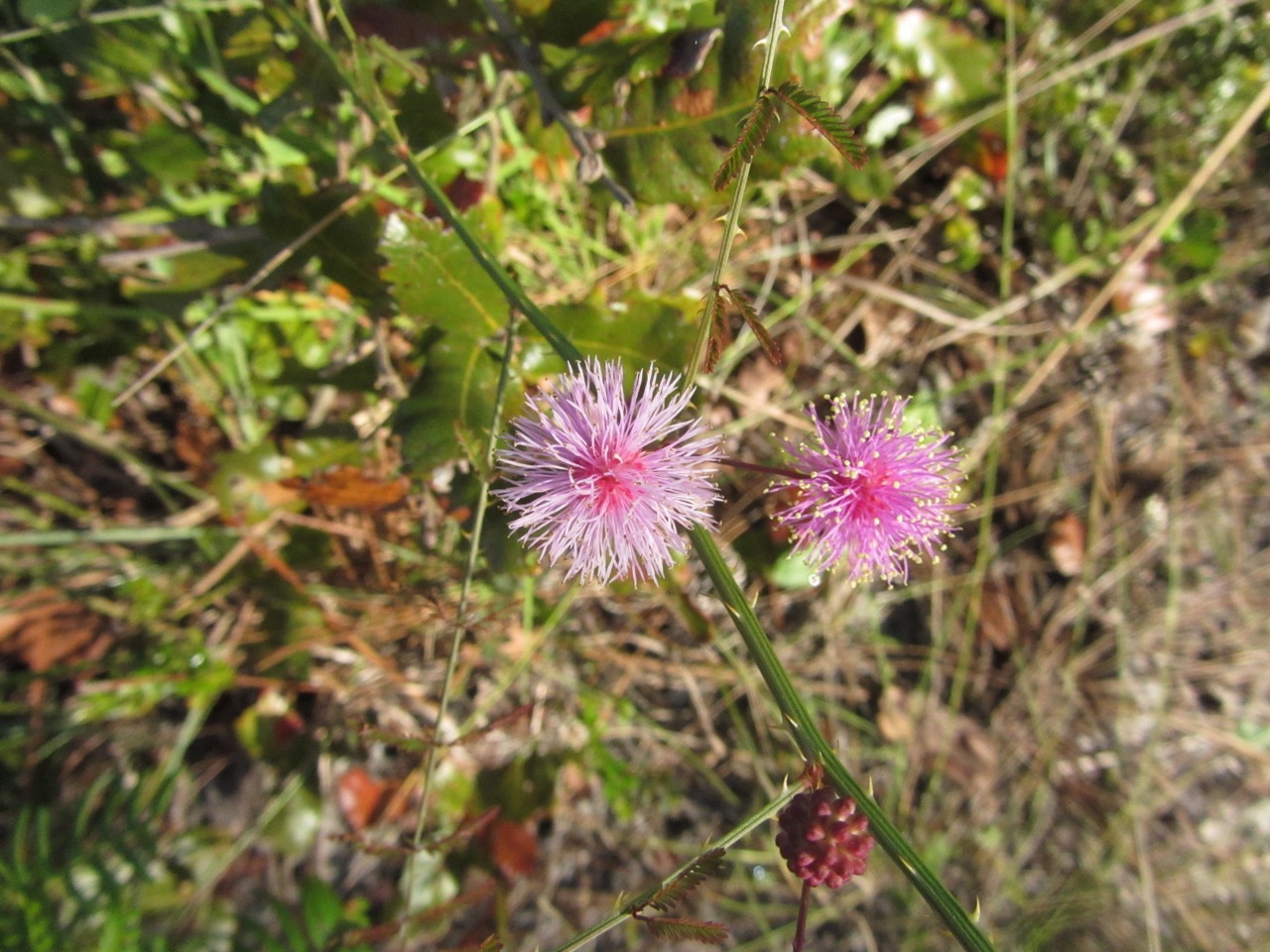
Mimosa quadrivalvis, known as Fourvalve Mimosa and often simply as sensitive briar, is a native perennial legume with sprawling, prickly stems, feathery leaves that fold up when touched, and round, bright pink “pompom” flower heads from spring into late summer. Its name comes from its narrow, prickly seed pods, which split lengthwise into four parts (valves) when ripe.
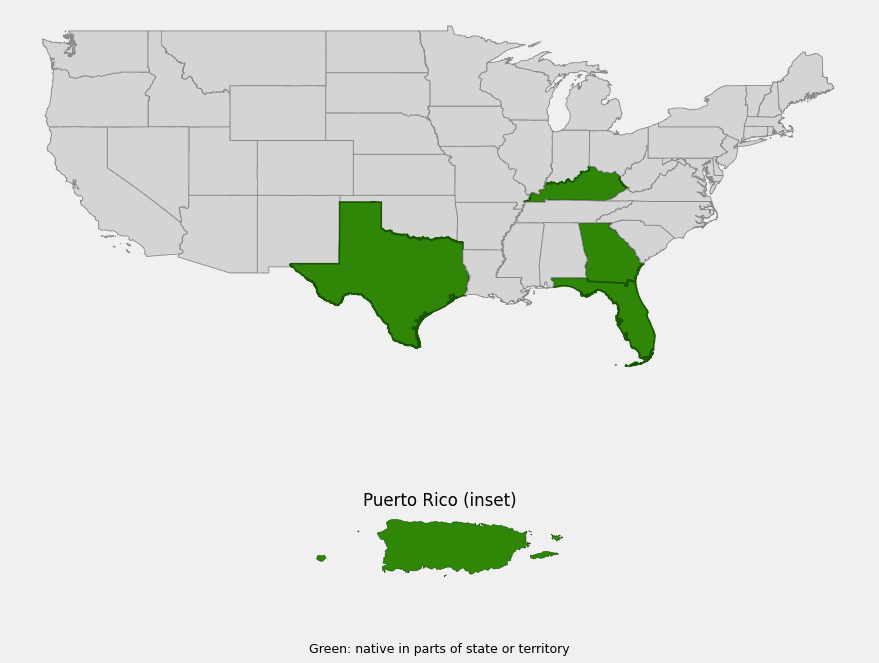
In the United States it grows in Florida and southern Georgia, in Texas and in Puerto Rico, on sandy, sunny ground such as sandhills, scrub, pine flatwoods, dry fields and roadsides, with an outlying record from Kentucky. The species also ranges through Mexico, Central America, the Caribbean and South America. Botanists have long debated how to divide it: in a broad sense it also includes the familiar sensitive briars of the Southeast and Great Plains, which USDA PLANTS now treats as separate species, Littleleaf Sensitive-briar (Mimosa microphylla) and Catclaw Briar (Mimosa nuttallii).
Fourvalve mimosa is a low-maintenance groundcover for hot, dry, sandy gardens, where its flowers attract bees and its nitrogen-fixing roots enrich poor soil. Safety note: the stems and pods are covered with small, hooked prickles that catch on skin and clothing, so wear gloves when handling it. It is not an edible plant, and some Mimosa species contain mimosine, an amino acid that is toxic to livestock in large amounts, so keep pets and children from chewing it.
Identification
Fourvalve mimosa is easy to recognize when it blooms: a low, sprawling plant with prickly stems, fern-like leaves that close when brushed, and pink ball-shaped flower heads on long stalks.
Growth Habit & Stems
A herbaceous perennial from a woody taproot. The stems trail along the ground or scramble over grasses and low shrubs, usually 2 to 4 feet long, and are four-angled and armed with many small, hooked prickles. Plants die back to the root in cold winters and stay partly evergreen in frost-free areas.
Leaves
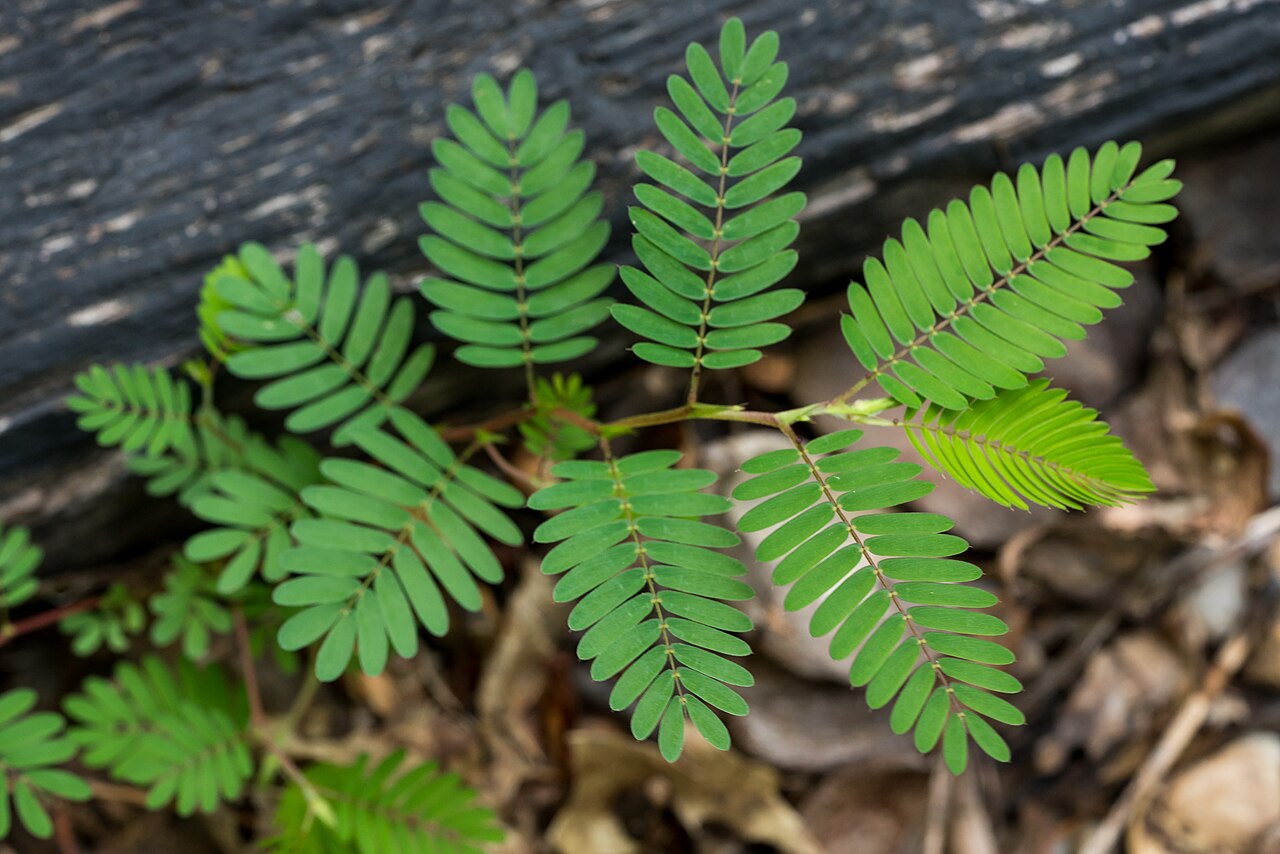
The leaves are alternate and twice-compound (bipinnate), with several pairs of side branches (pinnae), each bearing many pairs of small, oblong leaflets about ⅛ to ¼ inch long. The leaf stalks are prickly. Like the leaves of the sensitive plant, the leaflets fold together within seconds when touched, and they also close at night.
Flowers
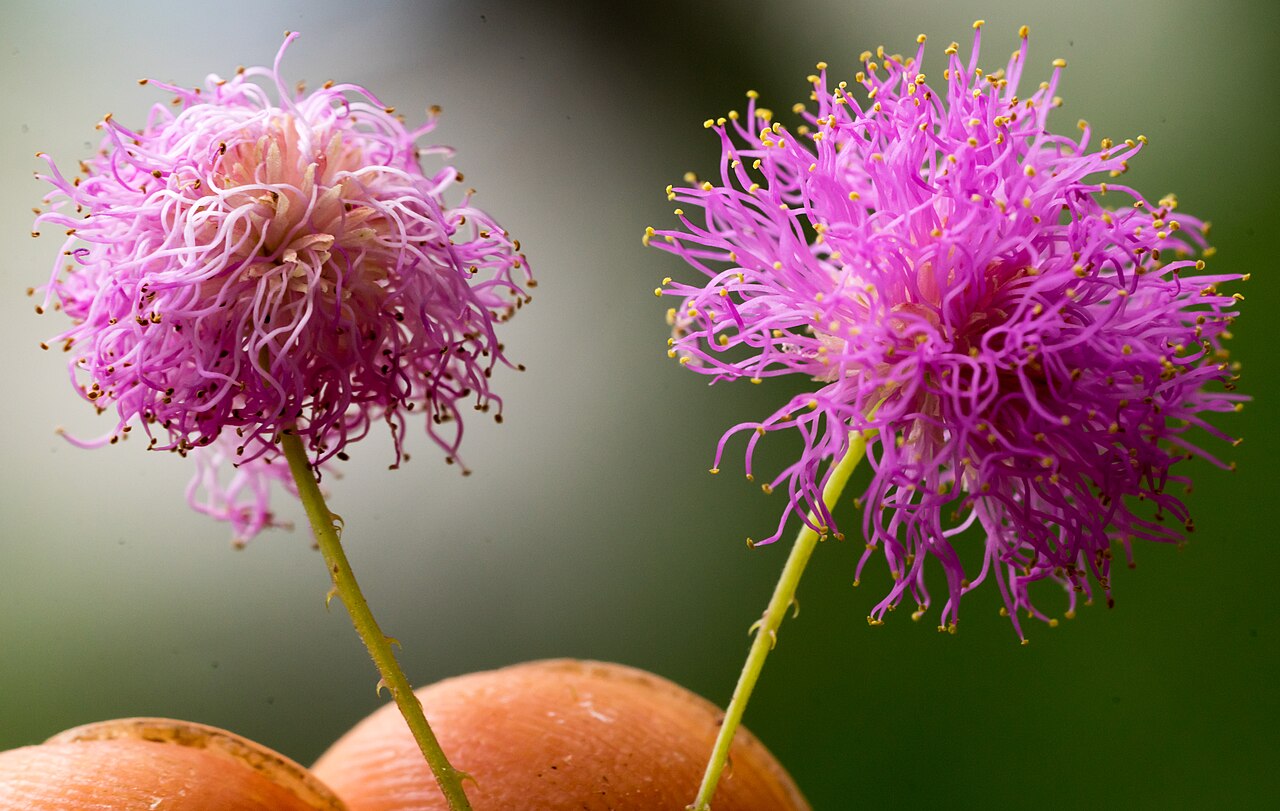
From about April to September, rounded flower heads about ¾ to 1 inch across appear on long stalks from the leaf axils. Each head is made of many tiny, tubular flowers with long pink stamens tipped by yellow anthers, which give the head its fluffy, pompom look. The heads are sweetly fragrant.
Fruit
The fruit is a slender, four-angled pod about 2 to 4 inches long, densely covered with prickles. When ripe it splits lengthwise into four narrow valves, releasing small, hard brown seeds. This four-valved pod is the source of the name quadrivalvis.
Look-alikes
The Sensitive Plant (Mimosa pudica) also has pink pompom flowers and touch-sensitive leaves, but its leaves have only one or two pairs of pinnae spread like fingers, and its pods are short and flat, breaking into one-seeded segments. Powderpuff (Mimosa strigillosa), a popular Florida groundcover, has similar flowers but no prickles and flat, bristly pods. Littleleaf Sensitive-briar and Catclaw Briar are very similar prickly sensitive briars; they differ in leaflet size and vein pattern and grow farther north and west.
Quick Facts
| Scientific Name | Mimosa quadrivalvis L. (syn. Schrankia quadrivalvis) |
| Family | Fabaceae (pea family) |
| Plant Type | Sprawling, prickly herbaceous perennial |
| Mature Height | About 1 ft (stems trail 2–4 ft) |
| Mature Spread | 2–4 ft |
| Growth Rate | Moderate |
| Sun Exposure | Full sun to light shade |
| Water Needs | Low; drought tolerant once established |
| Soil Type | Dry, well-drained sandy or gravelly soil |
| Soil pH | About 5.0–7.5 |
| Bloom Time | April–September |
| Flower Color | Pink to rose-purple |
| Fall Color | None; dies back in cold winters |
| Fruit | Prickly four-angled pod that splits into four valves |
| Deer Resistant | No; deer browse it |
| USDA Hardiness Zones | 8–11 |
Native Range
In the narrow sense used by USDA PLANTS today, fourvalve mimosa is native in Florida, Georgia, Texas and Puerto Rico. In Florida and southern Georgia it is represented by the Florida sensitive briar (var. floridana), a plant of the Florida peninsula and nearby Coastal Plain. Texas has the typical variety and Nelson’s mimosa (var. nelsonii), and Puerto Rico has Urban’s mimosa (var. urbaniana). USDA also lists an outlying record from Kentucky.
Beyond the United States, the species ranges through Mexico, Central America, the West Indies and much of South America, where several other varieties occur. Treatments differ: Rupert Barneby’s 1991 monograph of Mimosa placed most North American sensitive briars in this one species as varieties, while USDA PLANTS now recognizes several of them, including M. microphylla, M. nuttallii, M. latidens, M. rupertiana and M. roemeriana, as separate species.
It grows in open, sunny places with sandy or gravelly soil: sandhills, scrub, dry pine flatwoods and longleaf pine savannas, sandy old fields, coastal dunes and roadsides in Florida and Georgia; brushland, grassland and sandy openings in Texas; and dry thickets, pastures and roadsides in Puerto Rico. It often appears after fire or light disturbance.
📋 Regional plant lists featuring Fourvalve Mimosa: North & South Florida · Alabama, Georgia & Mississippi · Kentucky & Tennessee · South & West Texas · Puerto Rico
Growing & Care Guide
Fourvalve mimosa is rarely sold, but it is easy to grow from seed in warm, sunny, sandy gardens, and it is well suited to native meadows, sandhill restorations and dry slopes where few other plants thrive.
Light
Full sun is best. It tolerates light shade, as in open pine woods, but flowers less and becomes sparse in deep shade.
Soil & Water
It needs well-drained, sandy or gravelly soil and does not need fertilizer, because like most legumes it hosts nitrogen-fixing bacteria in its roots. Water new plants until they are established; after that it survives drought on its deep taproot. Avoid wet, poorly drained soil.
Planting Tips
Plant it where its sprawling, prickly stems can spread without catching passersby: on a slope, at the back of a dry meadow or among native bunchgrasses, not next to a path. Space plants 2 to 3 feet apart. In Florida and Texas it pairs well with partridge pea, blazing stars and other sandhill wildflowers.
Pruning & Maintenance
Little care is needed. Cut back the dead stems in late winter. Because of the prickles, wear gloves and long sleeves when working near it. Established plants have deep taproots and are hard to move, so choose the spot carefully.
Propagation
Grow it from seed. The seeds have hard coats, so nick them with a file or soak them in hot water overnight before sowing in warm weather. Sow directly where plants are to grow, or in deep pots to protect the taproot.
Landscape Uses
- Sandhill and scrub gardens: a tough native groundcover for dry, sandy soil
- Pollinator gardens: pink pompoms visited by many bees
- Native meadows and restorations: fixes nitrogen and fills gaps among bunchgrasses
- Wildlife plantings: browse for deer and seeds for quail
- Children’s and teaching gardens: its leaves fold when touched (with care around the prickles)
Wildlife & Ecological Value
Fourvalve mimosa feeds pollinators over a long season and, like other sensitive briars, provides forage and seeds for wildlife in dry, sandy habitats.
For Pollinators
The fragrant flower heads offer abundant pollen and are visited by honey bees, bumble bees, sweat bees and other native bees, as well as small butterflies.
For Birds
Northern bobwhite and other ground-feeding birds eat the hard seeds, and the low, prickly tangles give shelter to small birds and their young.
For Mammals
Deer browse the tender stems and leaves, which are rich in protein, despite the prickles. Small mammals eat the seeds.
Ecosystem Role
As a nitrogen-fixing legume, fourvalve mimosa adds nitrogen to poor, sandy soils. It resprouts from its deep taproot after fire, which helps it persist in fire-maintained sandhills and pine savannas.
Cultural & Historical Uses
Carl Linnaeus named Mimosa quadrivalvis in 1753 in his Species Plantarum, from a plant of tropical America. For much of the 19th and 20th centuries the prickly sensitive briars were placed in a separate genus, Schrankia, until Rupert Barneby returned them to Mimosa in his 1991 monograph of the genus.
The touch-sensitive leaves have long fascinated people. Folk names for the prickly sensitive briars include “shame-boy,” “sensitive briar” and “bashful briar,” all inspired by the way the leaflets close up when touched.
The leaf movement is caused by rapid changes in water pressure in cells at the base of each leaflet. It may help the plant reduce water loss and discourage insects and browsing animals.
Frequently Asked Questions
Why is it called fourvalve mimosa?
Its slender, prickly seed pods split lengthwise into four parts (valves) when ripe. Quadrivalvis means “four-valved” in Latin.
Is fourvalve mimosa the same as the sensitive plant?
No. The sensitive plant (Mimosa pudica) is a related tropical species. Both have pink pompom flowers and touch-sensitive leaves, but fourvalve mimosa has four-angled, prickly pods and more pairs of leaf branches.
Where is fourvalve mimosa native?
In the United States it is native in Florida, Georgia, Texas and Puerto Rico, with an outlying record in Kentucky. It also grows through Mexico, Central and South America and the Caribbean.
Is fourvalve mimosa poisonous?
It is not an edible plant. Some Mimosa species contain mimosine, which is toxic to livestock in large amounts, and the prickly stems can scratch skin. Keep pets and children from chewing it and wear gloves when handling it.
Is it the same plant as catclaw briar and littleleaf sensitive-briar?
They are close relatives. Some botanists treat them as varieties of Mimosa quadrivalvis, while USDA PLANTS treats them as separate species: Catclaw Briar (M. nuttallii) of the Great Plains and Littleleaf Sensitive-briar (M. microphylla) of the Southeast.

Looking for a nursery that carries Fourvalve Mimosa?
Browse our native plant nursery directory: Florida & Georgia · Kentucky · Texas

