
Yellow Mountain Saxifrage (Saxifraga aizoides)
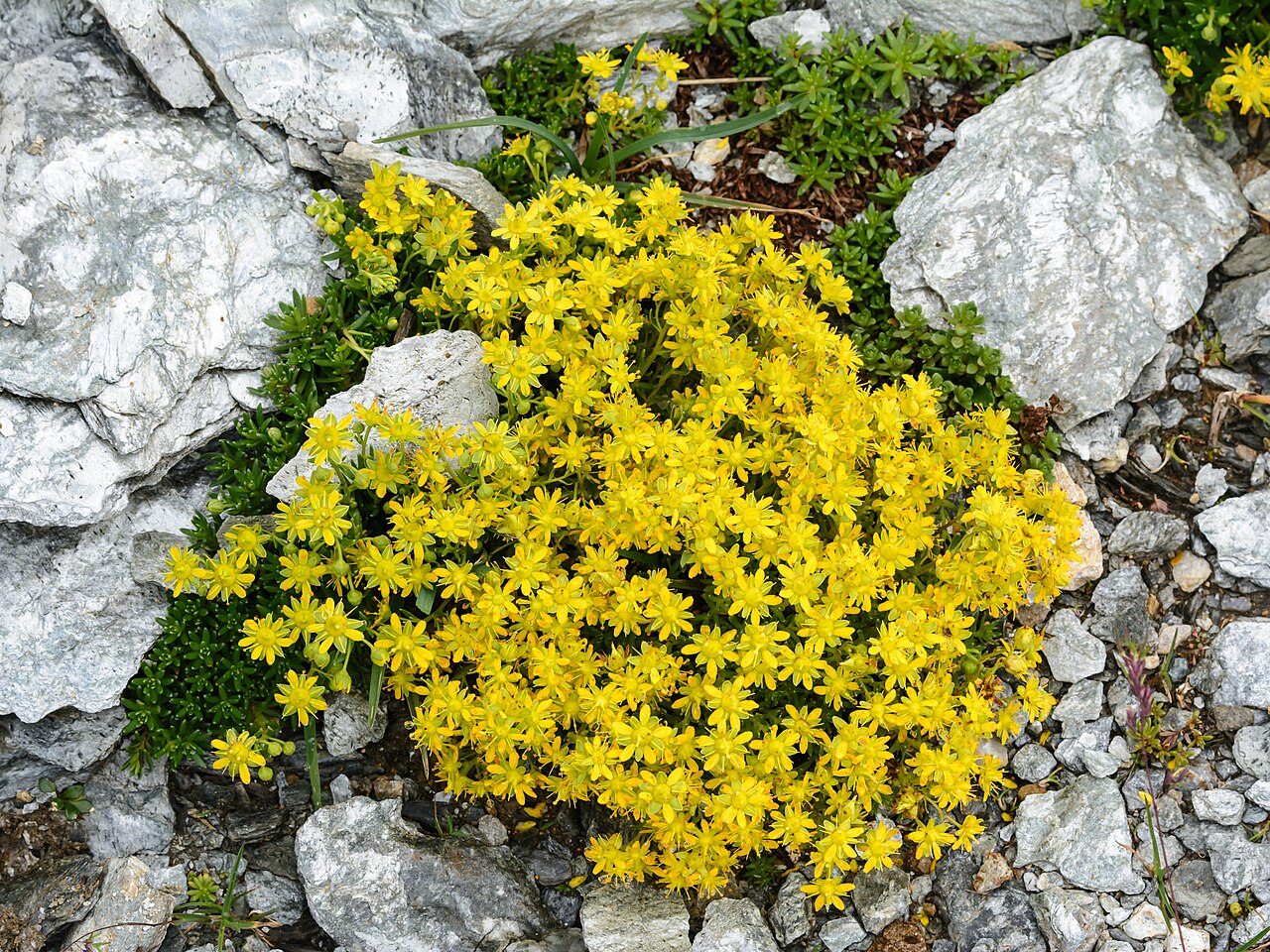
Saxifraga aizoides, known as Yellow Mountain Saxifrage or yellow saxifrage, is a low, mat-forming alpine and arctic wildflower that brightens wet gravel, seeps and streambanks with sheets of yellow, star-shaped flowers in summer. Its narrow, fleshy leaves crowd the short stems, and the petals are often freckled with orange.
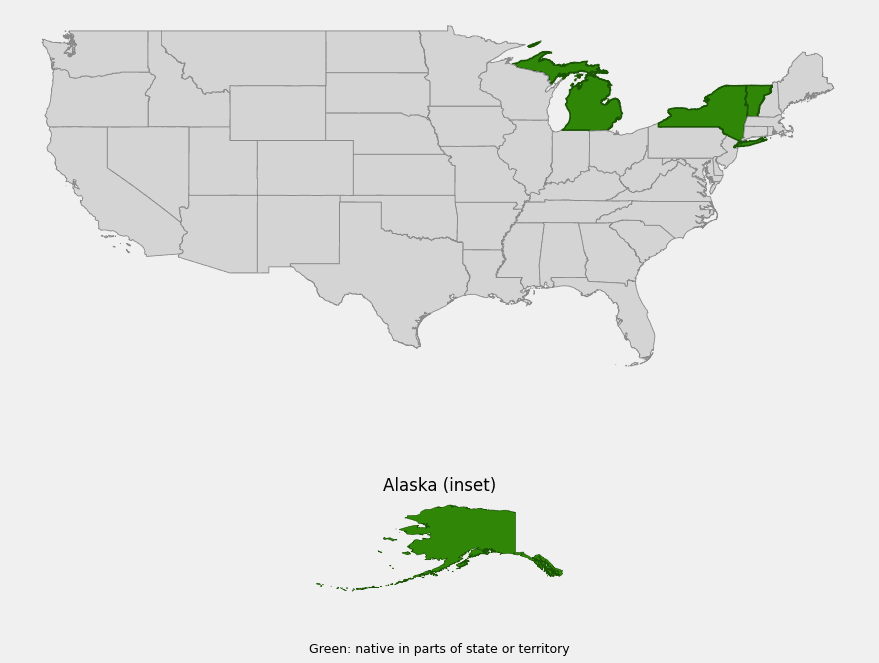
It has a wide circumpolar range across arctic and alpine North America, Greenland and Europe. In the United States it is native to Alaska and to a handful of cold, high-pH cliff and shoreline sites in Michigan, New York and Vermont, where it is very rare. Across Canada it grows from the Yukon and British Columbia to Newfoundland.
This page covers how to identify yellow mountain saxifrage, where it grows, how alpine gardeners grow it in cool climates, and its role in arctic and alpine ecosystems.
Identification
Yellow mountain saxifrage is easy to recognize in flower: low, loose mats of narrow, fleshy leaves topped with yellow to orange, five-petaled flowers, usually right beside running or seeping water.
Size & Form
It is an evergreen perennial that branches at or below ground and spreads by short rhizomes into loose mats or cushions. Flowering stems are usually 2 to 6 inches tall, occasionally up to 8 inches.
Leaves
The leaves are alternate, crowded along the stems, narrowly linear to lance-shaped and about 1/4 to 1 inch long. They are thick, fleshy and bright green, with a few stiff bristles along the margins. The species name aizoides means “like Aizoon,” an old name for succulent-leaved plants.
Flowers
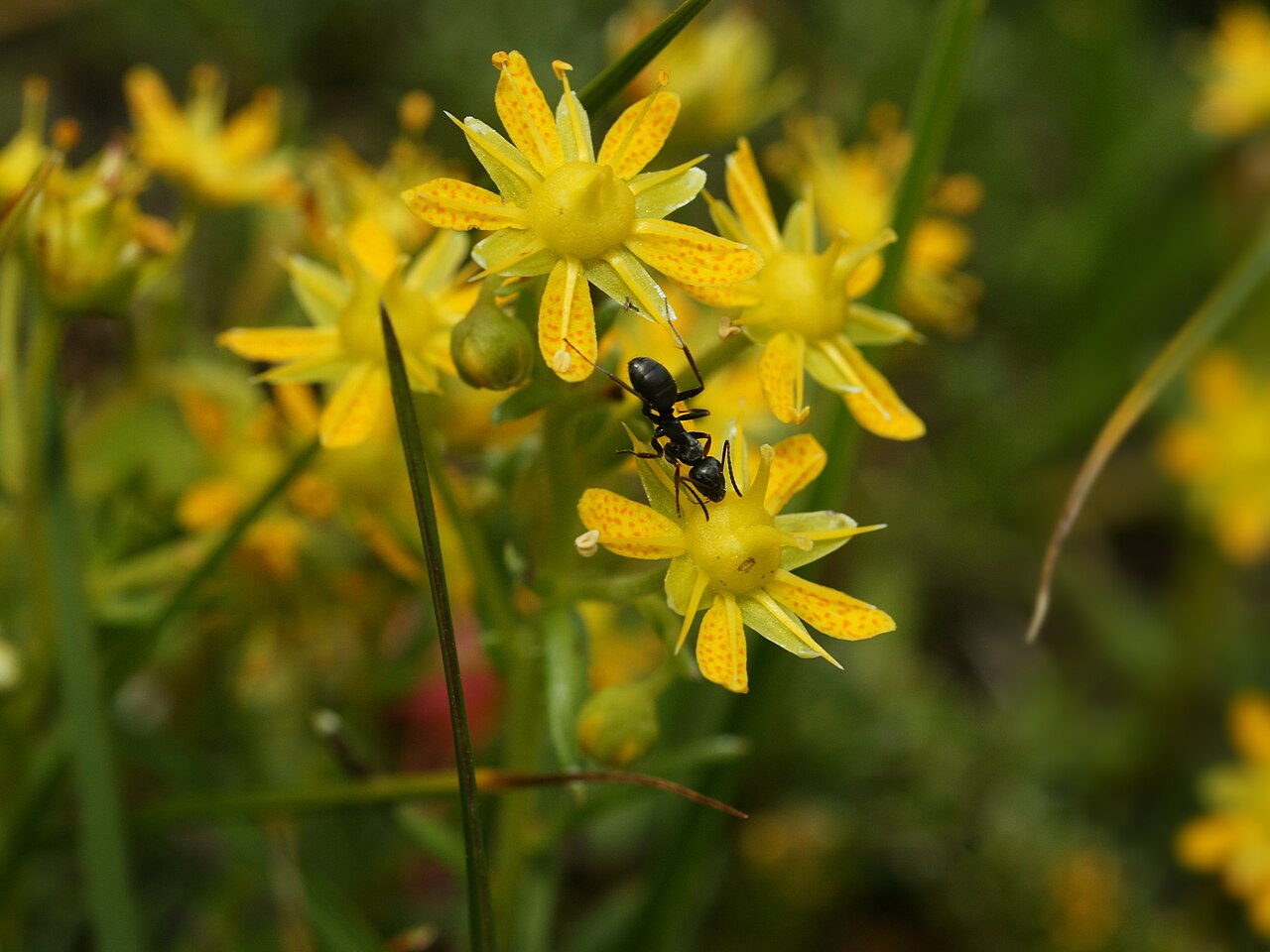
From about late June to August, each stem carries one to several (up to about 10) flowers about 1/2 inch across. They have five narrow, spreading petals, usually bright yellow but sometimes orange or even reddish, often with small orange dots, around a prominent yellow-green ovary and ten stamens.
Fruit
The flowers develop into small, two-beaked capsules that release many tiny seeds in late summer.
Similar Species
Other yellow-flowered saxifrages of the far north, such as yellow marsh saxifrage (Saxifraga hirculus), have broader, flat leaves and larger, single flowers. Mat saxifrage has white petals spotted with red or orange and stiff, spine-tipped leaves. Stonecrops (Sedum) have yellow, star-shaped flowers and fleshy leaves too, but grow on dry rock rather than at the water’s edge.
Quick Facts
| Scientific Name | Saxifraga aizoides L. (syn. Leptasea aizoides) |
| Family | Saxifragaceae (saxifrage family) |
| Plant Type | Evergreen, mat-forming alpine perennial |
| Mature Height | 2–6 in, occasionally to 8 in |
| Mature Spread | 6–12 in |
| Growth Rate | Slow to moderate |
| Sun Exposure | Full sun to light shade |
| Water Needs | High; constantly moist to wet, with moving water |
| Soil Type | Wet gravel, sand, moss or rock ledges over limestone or other high-pH rock |
| Soil pH | About 6.5–8.0 (neutral to alkaline) |
| Bloom Time | Late June–August |
| Flower Color | Bright yellow, sometimes orange or reddish |
| Fall Color | Evergreen; may redden in cold |
| Fruit | Small two-beaked capsule |
| Deer Resistant | Unknown |
| USDA Hardiness Zones | 1–6 |
Native Range
USDA PLANTS lists yellow mountain saxifrage as native in Alaska, Michigan, New York and Vermont. In Alaska it is widespread in mountains and tundra. Farther south, it is known only from a few cold, calcareous cliff, ledge and shoreline sites in Michigan, northern New York and northern Vermont. It is listed as threatened in New York and is extremely rare (S1) in Vermont.
In Canada it ranges from the Yukon, Northwest Territories, Nunavut and British Columbia east to Labrador, Newfoundland and Nova Scotia, and it grows in Greenland. In Europe it occurs in Iceland, Svalbard, Scandinavia, the British Isles and the high mountains from the Pyrenees and Alps to the Carpathians and the Balkans.
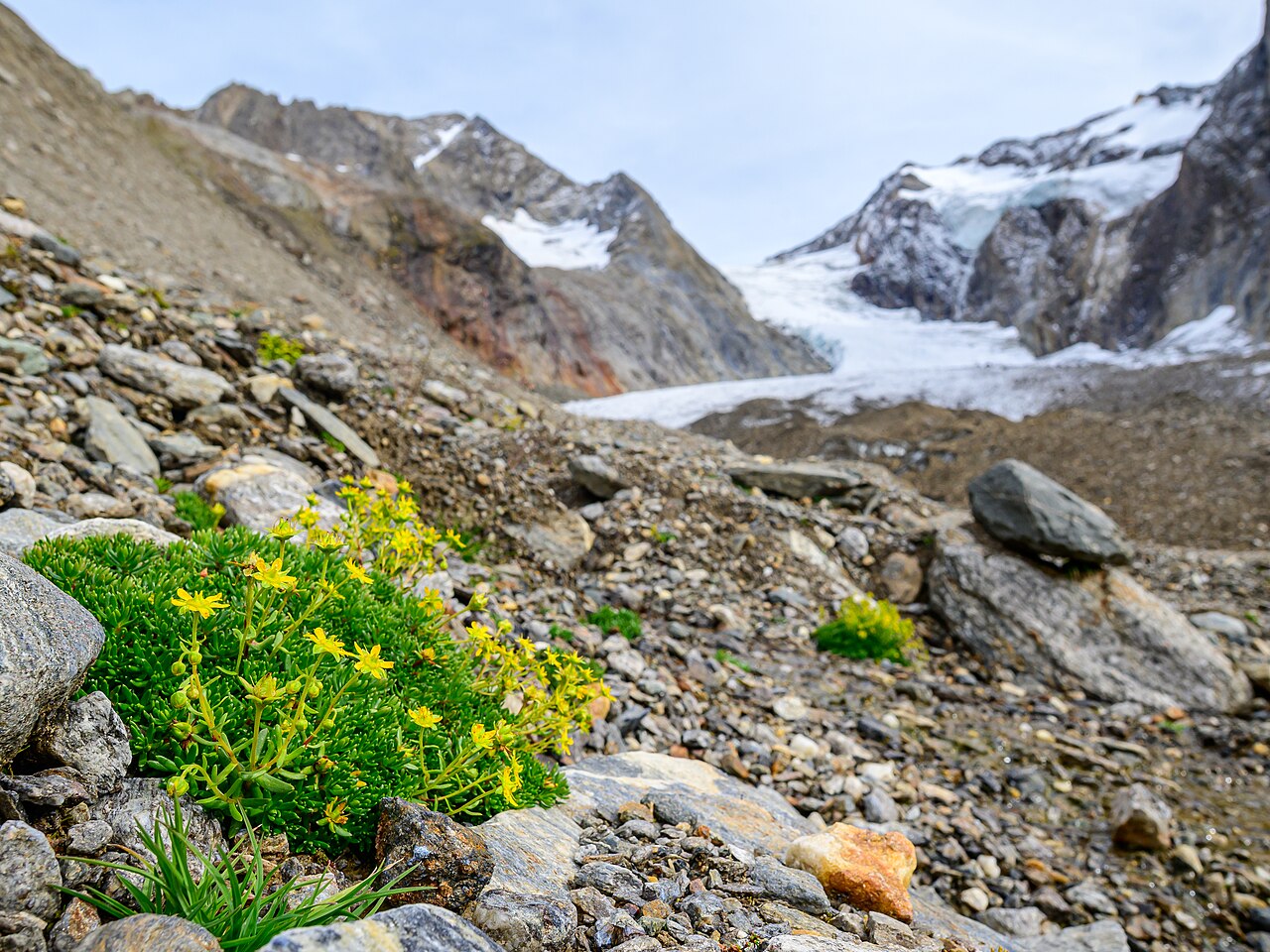
It grows in cold, wet places on neutral to alkaline bedrock: gravelly streambanks, glacial outwash, seeps, spray zones of waterfalls, wet cliffs and ledges, and lakeshores. It needs constant moisture and open conditions with little competition.
📋 Regional plant lists featuring Yellow Mountain Saxifrage: Alaska · Michigan, Wisconsin & Eastern Minnesota · New York, Pennsylvania & Northern New Jersey · Delaware, Southern New Jersey & Long Island · New Hampshire, Maine & Vermont
Growing & Care Guide
Yellow mountain saxifrage is grown by alpine and rock garden enthusiasts in cool climates, usually from seed exchanges or specialist nurseries. It is challenging in hot, humid summers. In the United States, never collect it from the wild: its few populations south of Alaska are rare and protected.
Light
Give it full sun in cool climates and light afternoon shade where summers are warmer. It flowers best with plenty of light but must not dry out.
Soil & Water
It needs constantly moist, gritty, well-aerated soil with lime, such as a mix of gravel, sand and a little loam, and ideally cool, moving water. A spot beside a small stream, a waterfall, a constantly damp trough or a bog garden edge with gravel works best. It rots in stagnant, warm, wet soil and dies quickly in drought.
Planting Tips
Plant it in spring in a cool, open spot with no taller plants crowding it. Topdress with fine gravel or limestone chips to keep the crown dry while the roots stay wet. It is best suited to zones 1 to 6 and areas with cool nights.
Pruning & Maintenance
Little pruning is needed; trim off spent flower stems if desired. Keep it free of weeds and fallen leaves, which smother small alpines.
Propagation
Sow seed in fall or winter on the surface of a gritty mix and leave it outdoors for natural cold stratification; seedlings appear in spring. Established mats can also be divided, or rooted rosettes detached, in spring.
Landscape Uses
- Alpine and rock gardens: a bright, low mat for wet scree and stream edges in cool climates
- Troughs: grows in constantly moist, gritty trough plantings
- Water features: plant beside small streams, waterfalls and seepage beds
- Arctic and alpine restoration: a pioneer of wet gravel and glacial outwash
- Pollinator support: summer nectar for flies and small bees in the far north
Wildlife & Ecological Value
In arctic and alpine landscapes, where the growing season is short, yellow mountain saxifrage is an important source of summer color and food for insects.
For Pollinators
The open, nectar-rich flowers are visited mainly by flies, including hoverflies, and by small bees, butterflies and ants. Flies are the most important pollinators of many arctic and alpine flowers.
For Birds
It offers little direct food for birds, but its streamside and tundra habitats support ptarmigan, shorebirds and songbirds.
For Mammals
Its leaves may be grazed lightly by caribou, sheep and other mammals in the north.
Ecosystem Role
As a pioneer of wet gravel and glacial outwash, it helps stabilize loose ground and starts the development of soil on newly exposed surfaces.
Cultural & Historical Uses
The genus name Saxifraga comes from the Latin saxum (rock) and frangere (to break), meaning “rock-breaker.” It may refer to the way many saxifrages grow in rock crevices, or to the old belief that they could dissolve kidney stones.
Yellow mountain saxifrage was named by Carl Linnaeus in 1753 and is one of the classic flowers of the European Alps. Orange- and red-flowered forms, sometimes called var. atrorubens or ‘Aurantia’, are prized by alpine gardeners.
Its rare outlying populations in Vermont, New York and Michigan are thought to be relicts of colder conditions after the last Ice Age, surviving on cold, wet, lime-rich cliffs where the climate stays cool. Protecting these cliffs and seeps is key to its survival south of Canada.
Frequently Asked Questions
Where does yellow mountain saxifrage grow in the United States?
It is native to Alaska, where it is widespread, and to a few cold, lime-rich cliff and shoreline sites in Michigan, New York and Vermont, where it is very rare. It also grows across Canada, Greenland and northern and mountainous Europe.
Is yellow mountain saxifrage rare?
It is common in the Arctic and in European mountains, but south of Canada it is very rare. It is listed as threatened in New York and is ranked extremely rare in Vermont. Never collect it from the wild.
Can I grow yellow mountain saxifrage?
Yes, in cool climates, with constant moisture and gritty, limey soil, such as beside a small stream or in a damp alpine trough. It struggles in hot, humid summers. Start from seed or buy nursery-grown plants.
When does yellow mountain saxifrage bloom?
It flowers from late June to August, depending on elevation and latitude, producing bright yellow to orange, star-shaped flowers.
What does saxifrage mean?
Saxifrage comes from Latin words meaning “rock-breaker,” a reference to how many saxifrages grow in rock crevices and to an old belief that they could break up kidney stones.


