
Small Whorled Pogonia (Isotria medeoloides)
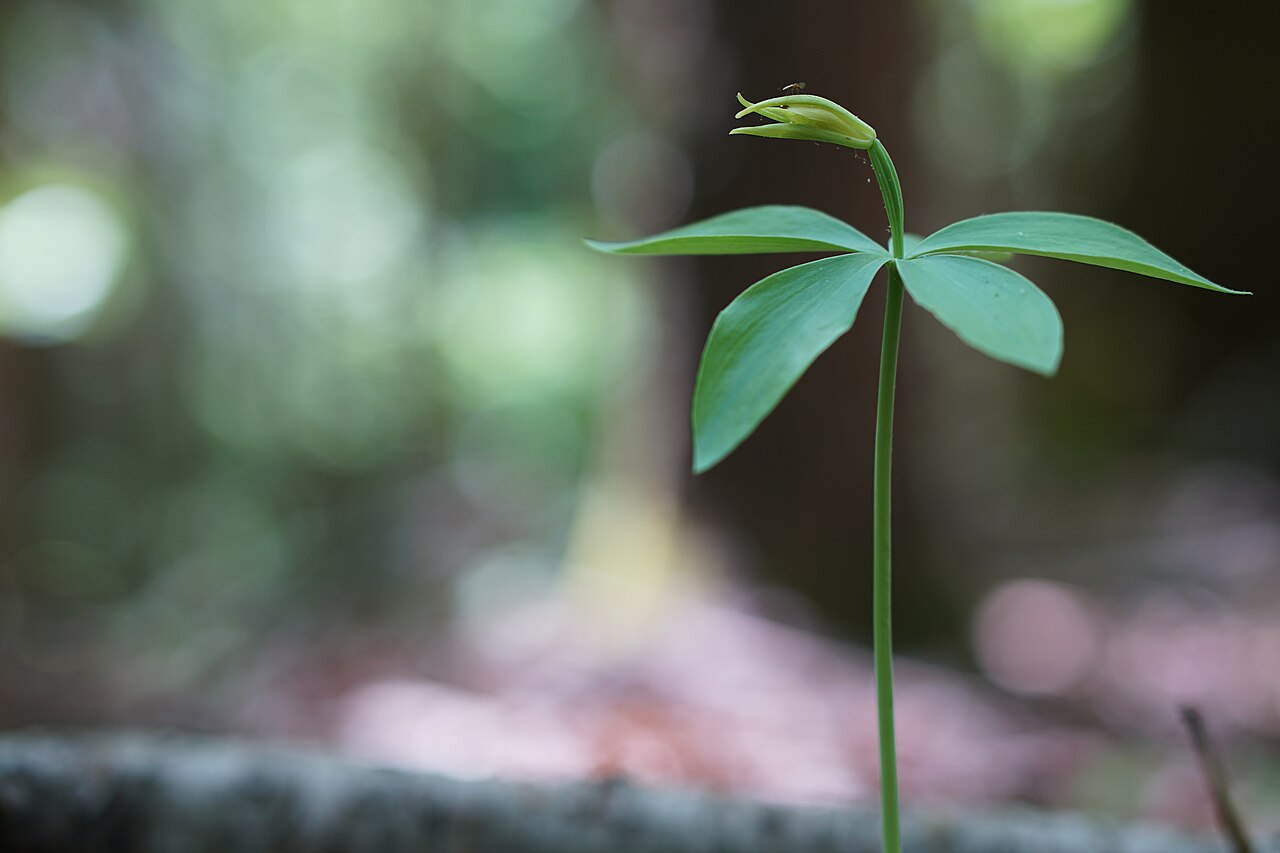
Isotria medeoloides, the Small Whorled Pogonia, is a small woodland orchid of eastern North America and one of the rarest orchids in the region. A single smooth, pale stem, usually 4 to 10 inches tall, carries a whorl of five or six blue-green leaves and, in late spring, one or two yellowish-green flowers. It is so inconspicuous that experienced botanists walk past it, and plants can stay dormant underground for years without sending up a stem.
It is federally listed as threatened under the U.S. Endangered Species Act. It was first listed as endangered in 1982 and reclassified to threatened in 1994 after new populations were found and others were protected. It is also listed as endangered or threatened in most of the states where it grows, and as endangered in Canada, where it is known from Ontario. Although it ranges from Maine to Georgia and west to Michigan, Illinois and Missouri, most populations are small, and the largest concentrations are in Maine and New Hampshire and in the Blue Ridge of Virginia.
This is an identification and appreciation page. Small whorled pogonia cannot be grown in gardens: it is not available as nursery-propagated stock, it depends on specific soil fungi, and dug plants die. Never dig, pick or disturb it; collecting a federally listed plant can be illegal, and every plant matters to its survival. If you find a plant you suspect is this orchid, photograph it, note the location privately and report it to your state natural heritage program.
Identification
Small whorled pogonia is easiest to recognize by its single whorl of pale, blue-green leaves at the top of a smooth, hollow stem, usually with one greenish flower above. The main challenge is telling it apart from two common look-alikes.
Stem & Leaves
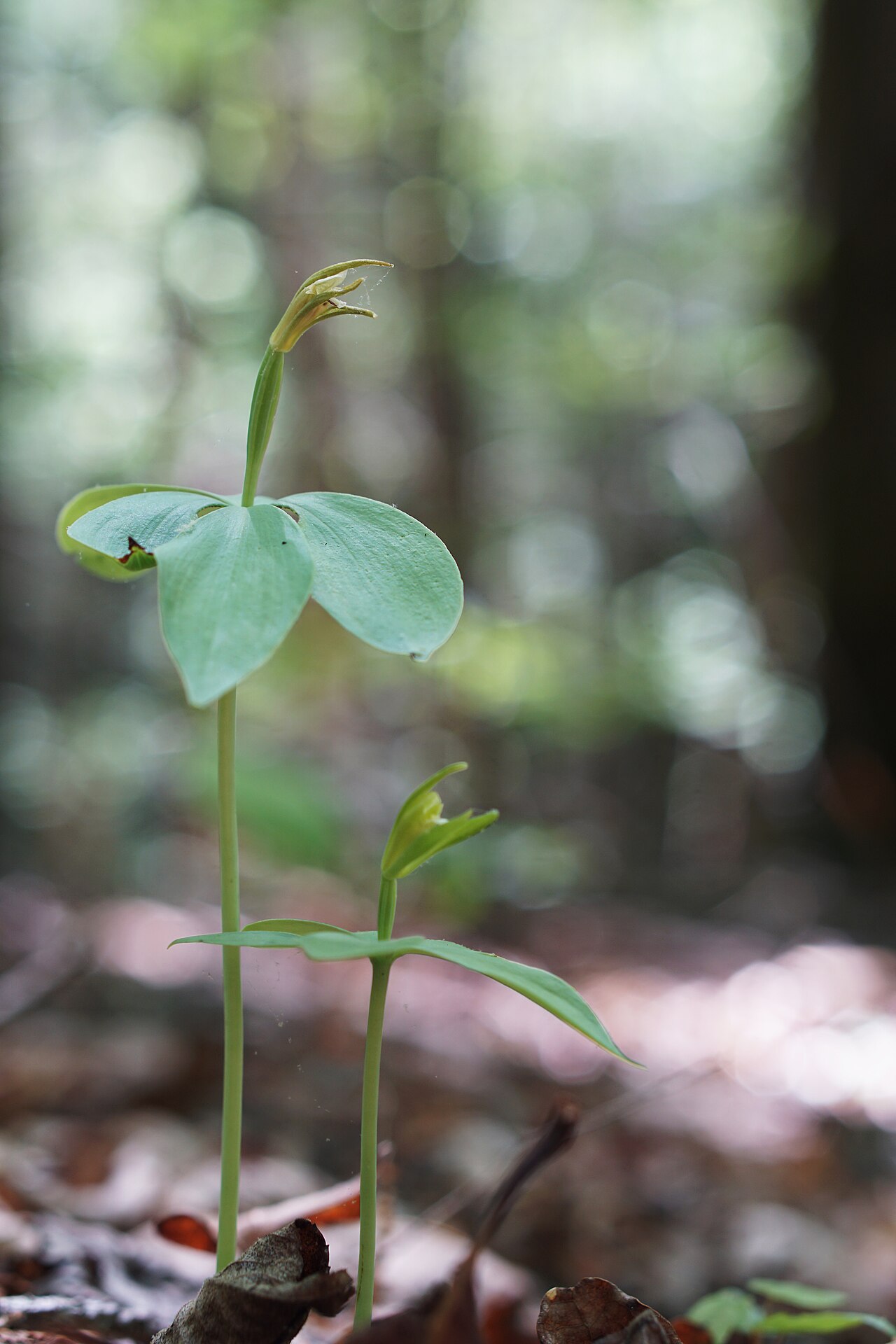
The stem is smooth, hollow, succulent and pale green to grayish green, often with a whitish bloom, usually 4 to 10 inches tall at flowering and somewhat taller in fruit. At its top is a single whorl of usually five or six leaves (sometimes four) that are elliptic to oblong, about 1 to 3 inches long, pale gray-green or blue-green and slightly drooping. Non-flowering plants produce only the stem and leaf whorl.
Flowers
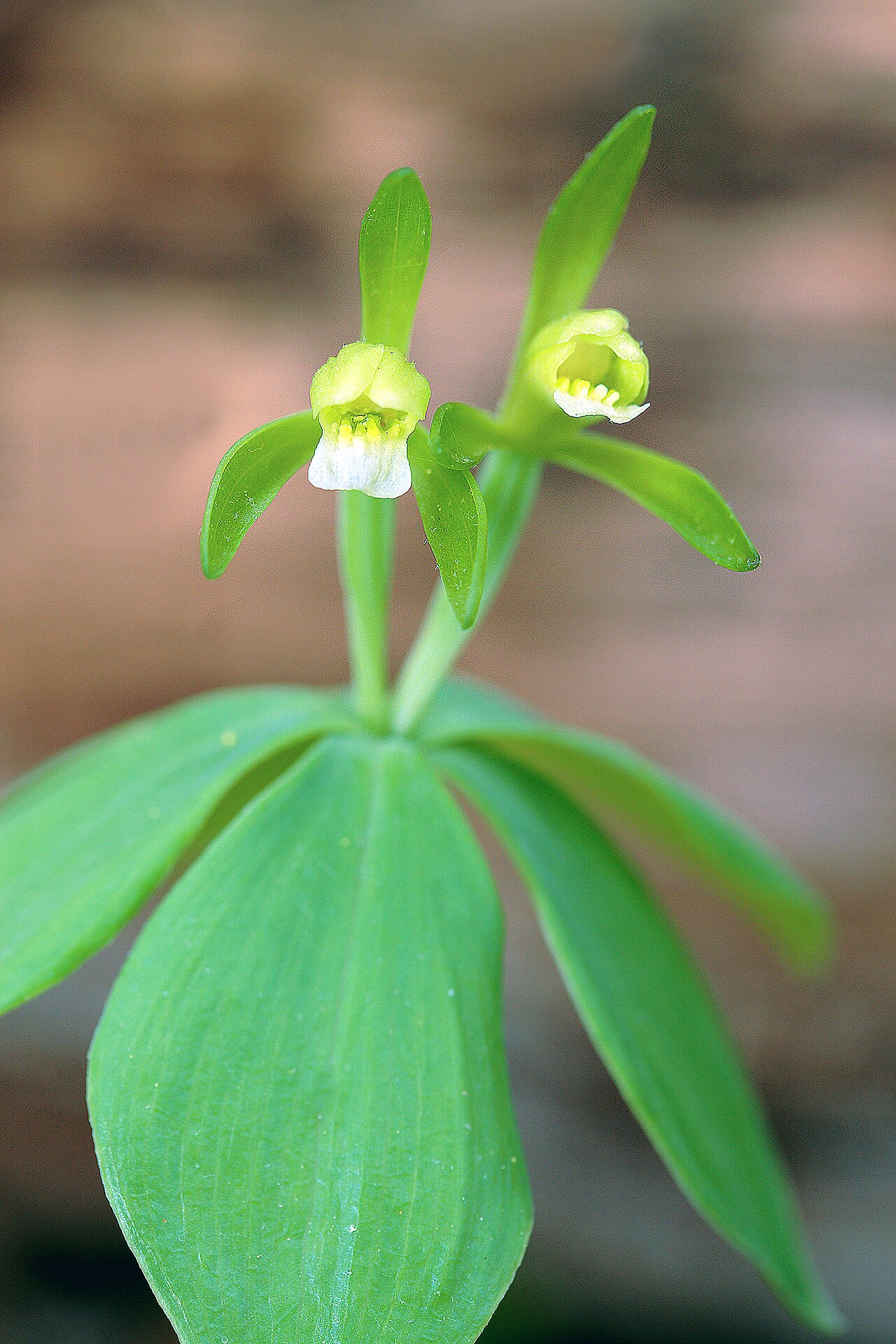
From about mid-May to mid-June, depending on latitude, one (sometimes two) flowers rise on a short stalk from the center of the leaf whorl. The flower is yellowish green, about ¾ inch long. The three narrow sepals are green and relatively short, about the same length as the petals, and the lip is greenish white with a green central ridge. The flowers usually last only a few days and are self-pollinating.
Fruit
A pollinated flower forms an upright, ribbed capsule about 1 inch long, which ripens in late summer and splits to release thousands of dust-like seeds. Like all orchid seeds, they can germinate only with help from specific soil fungi.
Look-alikes
Indian Cucumber Root (Medeola virginiana), whose name this orchid borrows (medeoloides means “like Medeola”), has a similar whorl of leaves but a wiry, woolly-hairy stem that is not hollow, usually a second, smaller whorl of leaves above the first on flowering plants, and nodding flowers with recurved yellow-green petals. Large whorled pogonia (Isotria verticillata), a more common relative, has a purplish stem and a flower with long, narrow, purple-brown sepals up to 2½ inches long, much longer than the petals. Young sprouts of other woodland plants can also be mistaken for it; a smooth, hollow, pale stem with a single whorl of pale leaves is the key combination.
Quick Facts
| Scientific Name | Isotria medeoloides (Pursh) Raf. |
| Family | Orchidaceae (orchid family) |
| Plant Type | Terrestrial woodland orchid; herbaceous perennial |
| Mature Height | 4–10 in (taller in fruit) |
| Mature Spread | 2–4 in (leaf whorl) |
| Growth Rate | Very slow; can remain dormant for years |
| Sun Exposure | Part shade to light shade under open forest canopy |
| Water Needs | Moderate; moist to dry-mesic forest soil |
| Soil Type | Acidic, nutrient-poor, sandy loam with thin leaf litter |
| Soil pH | Acidic |
| Bloom Time | Mid-May–June |
| Flower Color | Yellowish green; greenish-white lip |
| Fall Color | None; stem withers by late summer |
| Fruit | Upright capsule with dust-like seeds |
| Deer Resistant | No; deer browse the stems |
| USDA Hardiness Zones | 4–8 in the wild; not cultivated |
Native Range
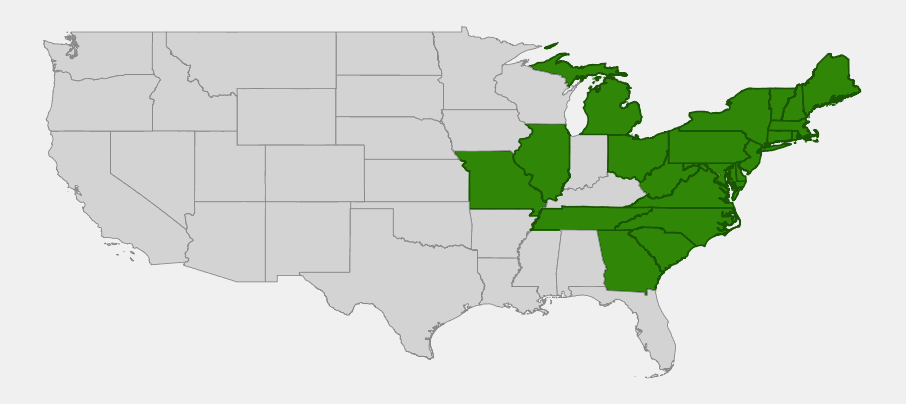
Small whorled pogonia is widely scattered across the eastern United States and southern Ontario. USDA PLANTS lists it as native in Maine, New Hampshire, Vermont, Massachusetts, Rhode Island, Connecticut, New York, New Jersey, Pennsylvania, Delaware, Maryland, Virginia, West Virginia, North Carolina, South Carolina, Georgia, Tennessee, Ohio, Michigan, Illinois and Missouri, and it has also been recorded in the District of Columbia. In many of these states it is known from only one or a few sites, and in some it has not been seen for decades.
The largest numbers of plants are in two areas: southern Maine and New Hampshire, and the Blue Ridge and Piedmont of Virginia and nearby states. Elsewhere it is very rare. It grows in second-growth or mature deciduous and mixed deciduous-conifer forests, often with oaks, American beech, red maple, white pine and hemlock. Typical sites have a fairly open understory and sparse ground cover, acidic, nutrient-poor soils with a thin layer of leaf litter, and gentle to moderate slopes, often near logs, small streams or the edges of old woods roads where light reaches the forest floor.
The main threats are habitat loss to development and logging that removes too much canopy, trampling, browsing by deer, invasive plants and collecting. Because the plant can stay dormant for years, populations are hard to count, and surveys are carried out over several seasons. Conservation focuses on protecting known sites, managing the forest canopy to keep moderate light gaps, and keeping locations confidential.
📋 Regional plant lists featuring Small Whorled Pogonia: New York, Pennsylvania & Northern New Jersey · Ohio & Indiana · Michigan, Wisconsin & Eastern Minnesota · Kentucky & Tennessee · Connecticut, Massachusetts & Rhode Island · New Hampshire, Maine & Vermont · Maryland, Virginia & West Virginia · Delaware, Southern New Jersey & Long Island · Illinois, Iowa & Missouri · Alabama, Georgia & Mississippi · North & South Carolina
Can You Grow It?
No. Small whorled pogonia is not a garden plant, and it is not available as nursery-propagated stock. It depends on fungi in the forest soil, does not survive transplanting, and is protected as a federally threatened species. Any plant offered for sale should be treated as suspect. The best way to enjoy it is to learn its look-alikes and see it, with care, in the wild.
Why It Can’t Be Grown
Like all orchids, it produces dust-like seeds with almost no food reserves. A seed germinates only after a compatible soil fungus colonizes it, and the young plant depends on the fungus for years before it produces leaves. Adult plants still rely on these fungal partners, and they can stay dormant underground, living off fungi, for one or more years. Those conditions cannot be reproduced in a garden.
Why You Should Never Dig It
Dug plants lose their fungal partners and almost always die. Small whorled pogonia is federally threatened, and removing or damaging it on federal land, or in violation of state law, is illegal. It is listed as endangered or threatened by most states in its range. Even picking the flower prevents the plant from setting seed.
If You Find One
Do not mark the spot with flagging or share exact locations online, since that can attract collectors. Take photos of the whole plant and the stem, note the location privately, and report it to your state natural heritage program or the U.S. Fish and Wildlife Service field office. Surveys by volunteers and botanists have discovered many of the populations known today.
How Landowners Can Help
Where the orchid grows on private land, landowners can work with state agencies and land trusts to protect it, for example by avoiding heavy logging and soil disturbance near plants, keeping trails and vehicles away, and controlling invasive plants. Light canopy thinning can help some populations, but only under professional guidance.
How Gardeners Can Help
Plant native woodland plants such as Indian cucumber root, partridgeberry, ferns and native wildflowers instead of invasive groundcovers, and support local land trusts and conservation programs that protect eastern forests.
Where to See It
- Guided field trips: native plant societies and botanical clubs in New England and Virginia sometimes lead trips to protected populations
- Protected forests in Maine and New Hampshire: home to the largest concentrations of the species, managed with state and federal partners
- Virginia’s Blue Ridge and Piedmont: the other major population center; ask local native plant society chapters about outings
- Timing: mid-May to mid-June; plants may not appear every year
- Viewing etiquette: stay on trails, never pick, dig or flag plants, and keep exact locations private
Wildlife & Ecological Value
Small whorled pogonia is a quiet member of eastern forest floor communities, linked to soil fungi and the trees above it.
For Pollinators
Unlike most orchids, small whorled pogonia is self-pollinating. The flower typically pollinates itself without visiting insects, which may help it set seed in small, isolated populations. Insects are rarely seen visiting the flowers.
For Birds
It has no known importance as food for birds. The forests where it grows support many woodland songbirds.
For Mammals
White-tailed deer browse the stems, and browsing can prevent plants from flowering or fruiting. Slugs and other invertebrates also damage the leaves.
Ecosystem Role
Through its root fungi, it is linked to the underground fungal networks of the forest. Its presence is often a sign of a mature, relatively undisturbed forest floor with acidic soils and moderate light. It is a flagship species for the conservation of eastern hardwood and mixed forests.
Cultural & Historical Uses
The genus name Isotria comes from Greek words meaning “equal” and “three,” referring to the three sepals, which are similar in size. The species name medeoloides means “resembling Medeola,” for its likeness to Indian cucumber root (Medeola virginiana). Frederick Pursh first described it, and Constantine Rafinesque placed it in Isotria. Older names include Pogonia affinis.
Small whorled pogonia has long been called one of the rarest orchids in eastern North America. Its tendency to skip years above ground, its small size and its green color make it easy to miss, and even dedicated orchid enthusiasts may never see one.
The species is also a recovery story in progress. When it was listed as endangered in 1982, only a few populations were known. Surveys found many more, protected sites were secured with landowners and agencies, and in 1994 it was reclassified as threatened. It still depends on habitat protection and careful forest management.
Frequently Asked Questions
Is small whorled pogonia endangered?
It is federally listed as threatened in the United States (listed as endangered in 1982 and reclassified as threatened in 1994). It is also listed as endangered or threatened by most states where it occurs and as endangered in Canada.
Can I grow small whorled pogonia?
No. It is not available as nursery-propagated stock, it depends on specific soil fungi, and dug plants die. It is also illegal to collect in many situations. Never dig or pick it.
How do I tell small whorled pogonia from Indian cucumber root?
Small whorled pogonia has a smooth, hollow, pale stem with one whorl of blue-green leaves. Indian cucumber root has a wiry, woolly-hairy stem and, on flowering plants, a second smaller whorl of leaves above the first.
How is it different from large whorled pogonia?
Large whorled pogonia has a purplish stem and long, narrow, purple-brown sepals that are much longer than the petals. Small whorled pogonia has a pale green stem and short green sepals.
What should I do if I find small whorled pogonia?
Leave it alone, take photos, note the location privately and report it to your state natural heritage program or the U.S. Fish and Wildlife Service. Don’t share the location publicly.

Looking for a nursery that carries Small Whorled Pogonia?
Browse our native plant nursery directory: Connecticut, Delaware & Georgia · Illinois · Maine, Maryland, Massachusetts, Michigan & Missouri · New Hampshire, New Jersey, New York, North Carolina & Ohio · Pennsylvania, Rhode Island, South Carolina, Tennessee, Vermont & Virginia · West Virginia

