
Turkey Beard (Xerophyllum asphodeloides)
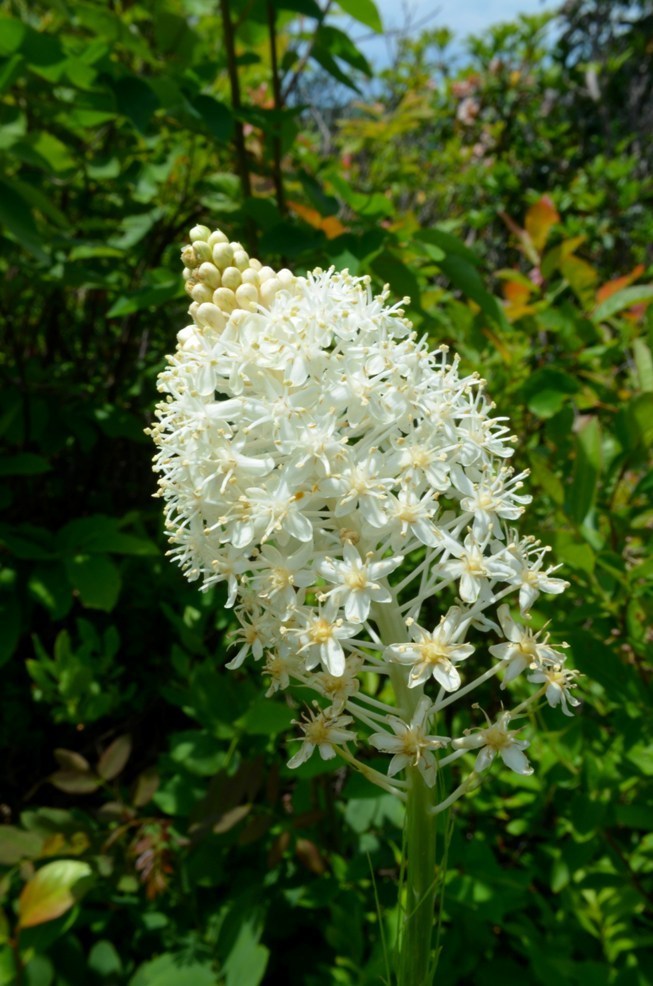
Xerophyllum asphodeloides, known as Turkey Beard, eastern turkeybeard, beargrass or mountain asphodel, is a clump-forming perennial wildflower of dry, sandy pinelands and rocky oak-pine ridges in the eastern United States. It is the eastern counterpart of the western Common Beargrass, and the only other species in its genus. It belongs to the bunchflower family (Melanthiaceae).
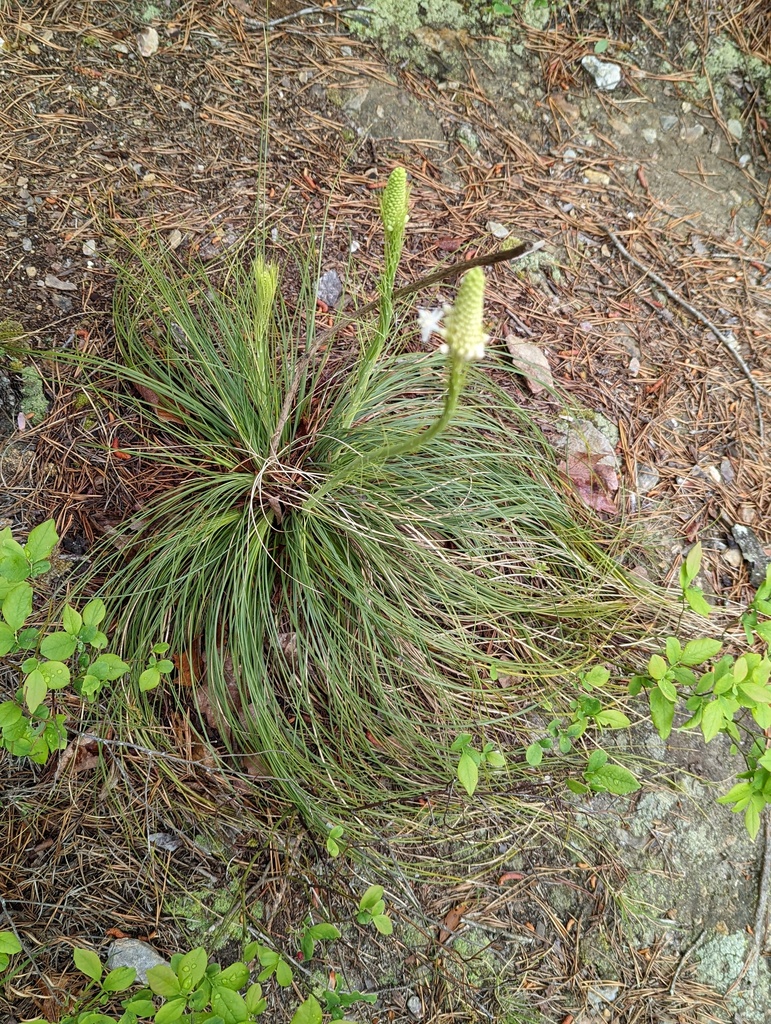
For most of the year it looks like a large tuft of wiry, grass-like evergreen leaves. In late spring and early summer, a stout stalk 2 to 5 feet tall rises from the clump, topped by a dense, rounded to cylindrical cluster of hundreds of small creamy white flowers. Individual clumps do not bloom every year, so a good flowering season on a pine barren or mountain ridge is a memorable sight.
Turkey beard grows in two very different landscapes: the sandy New Jersey Pine Barrens and the dry ridges of the Blue Ridge and southern Appalachians. It depends on periodic fire and is uncommon in much of its range. This guide covers how to identify it, where it grows, whether it can be grown in gardens, and its role in fire-adapted ecosystems.
Identification
Turkey beard is unmistakable in bloom. Out of flower, look for its large evergreen tuft of very narrow, stiff, finely toothed leaves.
Leaves & Growth Habit
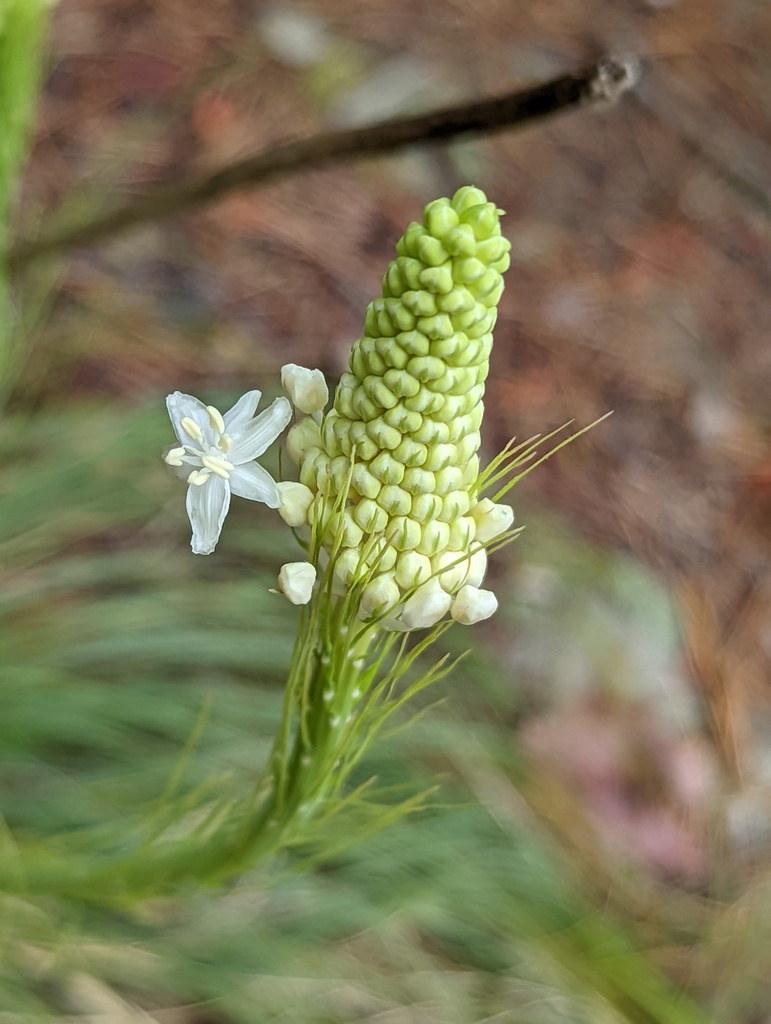
A perennial from a thick, woody rhizome, forming a dense basal clump of hundreds of narrow leaves. The leaves are wiry and grass-like, up to about 20 inches long and only 1 to 2 mm wide, with tiny teeth along the margins that make them rough to the touch. They are evergreen and arch outward like a fountain. The flowering stalk carries many much shorter, bristle-like leaves that become smaller toward the top.
Flowers
Flowers appear from May to June, a little later at higher elevations, on a stalk 2 to 5 feet tall. They are borne in a dense raceme that is cone-shaped and green in bud, becoming rounded and then cylindrical as the flowers open from the base upward. Each flower is about ¼ inch across, with six creamy white tepals, six stamens and a three-parted style, on a slender stalk that holds it out from the axis.
Fruit
The fruit is a small, three-lobed, rounded capsule, about ¼ inch long, that ripens in summer and splits to release a few seeds. After fruiting, the clump that flowered often rests for one or more years before blooming again.
Look-alikes
In bloom it can be confused with Fly Poison, a toxic relative of eastern woods that has broader, softer, strap-shaped leaves and a looser, shorter flower cluster. Devil’s Bit has a slender, wand-like spike above a rosette of broad leaves. Out of flower, turkey beard clumps can be mistaken for coarse grasses or sedges, but its leaves are stiffer, evergreen and rough-edged. Western Beargrass is very similar but grows only in the western mountains.
Quick Facts
| Scientific Name | Xerophyllum asphodeloides (syn. Helonias asphodeloides) |
| Family | Melanthiaceae (bunchflower family) |
| Plant Type | Evergreen clump-forming herbaceous perennial |
| Mature Height | 1–1½ ft foliage; 2–5 ft in bloom |
| Mature Spread | 1–2 ft |
| Growth Rate | Slow |
| Sun Exposure | Full sun to partial shade |
| Water Needs | Low; dry, sharply drained soil |
| Soil Type | Sand, gravel, rocky and shaly soils |
| Soil pH | Strongly acidic |
| Bloom Time | May–June |
| Flower Color | Creamy white |
| Fall Color | Evergreen |
| Fruit | Small three-lobed capsule |
| Deer Resistant | Moderately; tough, wiry foliage |
| USDA Hardiness Zones | 5–8 |
Native Range
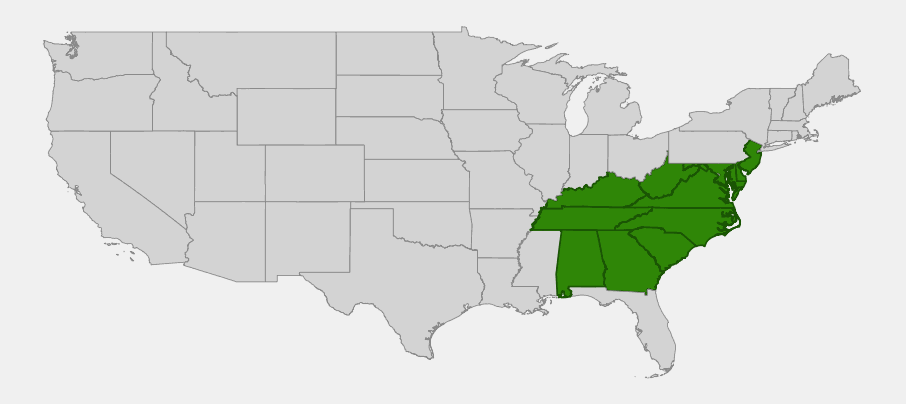
Turkey beard is endemic to the eastern United States. USDA PLANTS lists it in New Jersey, Delaware, Maryland, Virginia, West Virginia, Kentucky, Tennessee, North Carolina, South Carolina, Georgia and Alabama. It has two main centers: the New Jersey Pine Barrens on the Atlantic Coastal Plain, and the Blue Ridge and adjacent mountains from Virginia south to northern Georgia.
In the Pine Barrens it grows in dry, sandy pitch pine and oak woods and barrens. In the mountains it grows on dry, rocky ridgetops, south- and west-facing slopes, rock outcrops and open oak-pine woods, often with Table Mountain Pine and Chestnut Oak, and on scattered sites in the Piedmont, such as the monadnocks of the Carolinas.
It is most common in New Jersey and Virginia and uncommon to rare elsewhere, and it is tracked as a rare plant in several states at the edges of its range. It needs open, fire-maintained habitat, and the long-term suppression of wildfire has allowed shrubs and trees to shade it out in many places. Habitat loss and fragmentation have also reduced it.
📋 Regional plant lists featuring Turkey Beard: Alabama, Georgia & Mississippi · Delaware, Southern New Jersey & Long Island · Kentucky & Tennessee · Maryland, Virginia & West Virginia · North & South Carolina · New York, Pennsylvania & Northern New Jersey
Growing & Care Guide
Turkey beard is a beautiful but challenging garden plant. It is occasionally available from native plant nurseries that specialize in plants of the Southeast and Mid-Atlantic, and from seed. Because it is uncommon in much of its range, buy only nursery-propagated plants and never dig it from the wild: wild clumps rarely survive transplanting and the populations are slow to recover.
Light
Full sun to light, dappled shade, as under open pines. In deep shade it seldom blooms.
Soil & Water
It needs very well-drained, lean, strongly acidic soil: sand, gravel or a rocky, shaly mix low in organic matter. Water regularly the first season, then let it fend for itself; it is drought-tolerant once established but will rot in heavy clay or soil that stays wet. Do not lime or fertilize.
Planting Tips
Plant in spring or fall in a sandy, sunny bed, a dry slope or a rock garden, or under open pines and oaks with other acid-loving natives such as blueberries and mountain laurel. Disturb the roots as little as possible; small container-grown plants establish best.
Pruning & Maintenance
Remove the old flowering stalk after the seeds ripen and comb out any dead leaves in late winter. Keep the clump open to the sun: in the wild, fire clears competing shrubs, so in a garden you will need to keep neighbors from overtopping it. Expect blooms only every few years per clump.
Propagation
Sow fresh seed in fall in a gritty, acidic mix and leave it outdoors for winter cold, or give it about 2 months of cold-moist stratification. Seedlings are slow and may take several years to reach flowering size. Large clumps can be carefully divided in early spring, though divisions are slow to re-establish.
Landscape Uses
- Pine barrens and sandy gardens: a striking accent for dry, acidic, sunny sites
- Rock gardens and dry slopes: evergreen texture all year and tall white plumes in spring
- Fire-maintained habitat restoration: in pine barrens and Appalachian ridgetops
- Wildflower viewing: spring blooms in the New Jersey Pine Barrens and Blue Ridge
Wildlife & Ecological Value
Turkey beard is a characteristic plant of fire-adapted pine and oak communities in the East.
For Pollinators
The flowers attract many small bees, beetles, flies and other insects, which feed on their pollen and nectar. Mass blooms on a ridgetop or barren can be busy with pollinators.
For Birds
Its seeds are small and not a major bird food, but the dense, evergreen clumps give cover to ground-feeding birds such as towhees, and wild turkeys forage in the open, fire-maintained habitats where it grows.
For Mammals
Deer and other browsers occasionally nibble the flowering stalks and buds, but the stiff, rough leaves are rarely eaten.
Ecosystem Role
Turkey beard sprouts back vigorously from its rhizome after fire, and burning often triggers heavy flowering in the following year or two. It is part of the understory of pitch pine and Table Mountain pine woodlands, communities that depend on periodic fire, and its decline in many places is a sign that fire is missing from these ecosystems.
Cultural & Historical Uses
Linnaeus described the plant in 1753 as Helonias asphodeloides, and Thomas Nuttall moved it to the genus Xerophyllum in 1818. The genus name comes from the Greek xeros, “dry,” and phyllon, “leaf,” for its dry, wiry leaves. The species name means “like an asphodel,” the Old World lily-like plant.
The name “turkey beard” is usually explained by the resemblance of the dense tuft of wiry leaves to the bristly “beard” on a wild turkey’s breast. Other folk names include beargrass and mountain asphodel.
Turkey beard is a symbol of the New Jersey Pine Barrens, where its spring blooms appear along sandy roads and in recently burned woods. It is closely related to western beargrass, whose leaves Native American basket weavers gather; the two species are separated by the whole width of the continent.
Frequently Asked Questions
Why is it called turkey beard?
The dense tuft of thin, wiry leaves resembles the bristly “beard” that hangs from a wild turkey’s breast.
Does turkey beard bloom every year?
Not usually. Individual clumps often bloom only every few years, and flowering is heaviest in the year or two after a fire opens up the habitat.
Is it the same as beargrass?
It is the eastern relative of western Beargrass (Xerophyllum tenax), the only other species in the genus. They look very similar, but turkey beard is smaller and grows only in the eastern United States.
Where can I see it?
In the New Jersey Pine Barrens and on dry, rocky ridges of the Blue Ridge and southern Appalachians from Virginia to Georgia, usually blooming in May and June.
Can I grow turkey beard?
Yes, with patience, in full sun and sharply drained, sandy, strongly acidic soil. Buy nursery-propagated plants or grow it from seed; never dig it from the wild.

Looking for a nursery that carries Turkey Beard?
Browse our native plant nursery directory: Alabama · Delaware & Georgia · Kentucky & Maryland · New Jersey & North Carolina · South Carolina, Tennessee & Virginia · West Virginia

