
ʻAwapuhiakanaloa (Liparis hawaiensis)
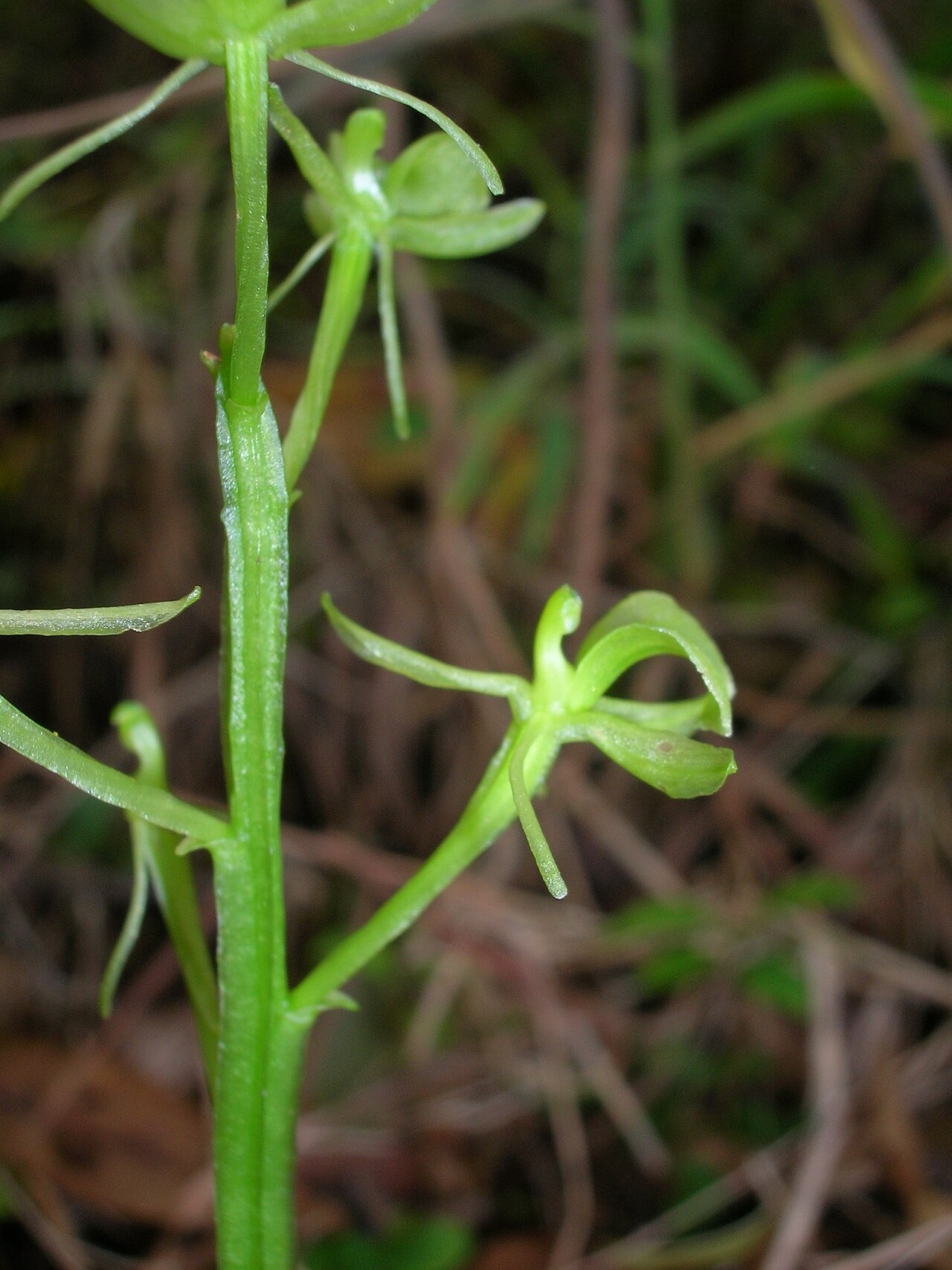
Liparis hawaiensis, known in Hawaiian as ʻAwapuhiakanaloa (also written ʻawapuhi a Kanaloa) and in English as the Hawaiʻi widelip orchid or Hawaiian twayblade, is one of only three orchids native to the Hawaiian Islands, and it grows nowhere else. It is a small plant with a pair of glossy leaves rising from a cone-shaped pseudobulb and a slender stalk of small, pale green flowers.
It is the only one of the three native orchids known to have a Hawaiian name, which means “the ginger of Kanaloa,” the god of the ocean. It grows on the forest floor, on wet banks and in bogs, and also as an epiphyte on mossy tree trunks, in mesic and wet forest from about 1,600 to over 5,000 feet on Kauaʻi, Oʻahu, Molokaʻi, Lānaʻi, Maui and Hawaiʻi Island.
ʻAwapuhiakanaloa is not federally listed under the Endangered Species Act, but it is uncommon and considered at risk. Honestly, it is very hard to grow outside its forest habitat and is almost never available from nurseries. Enjoy it in the wild, and never dig, pick or collect plants or seed capsules. This guide covers how to recognize it, where it grows, why it is difficult in cultivation, and its cultural meaning.
Identification
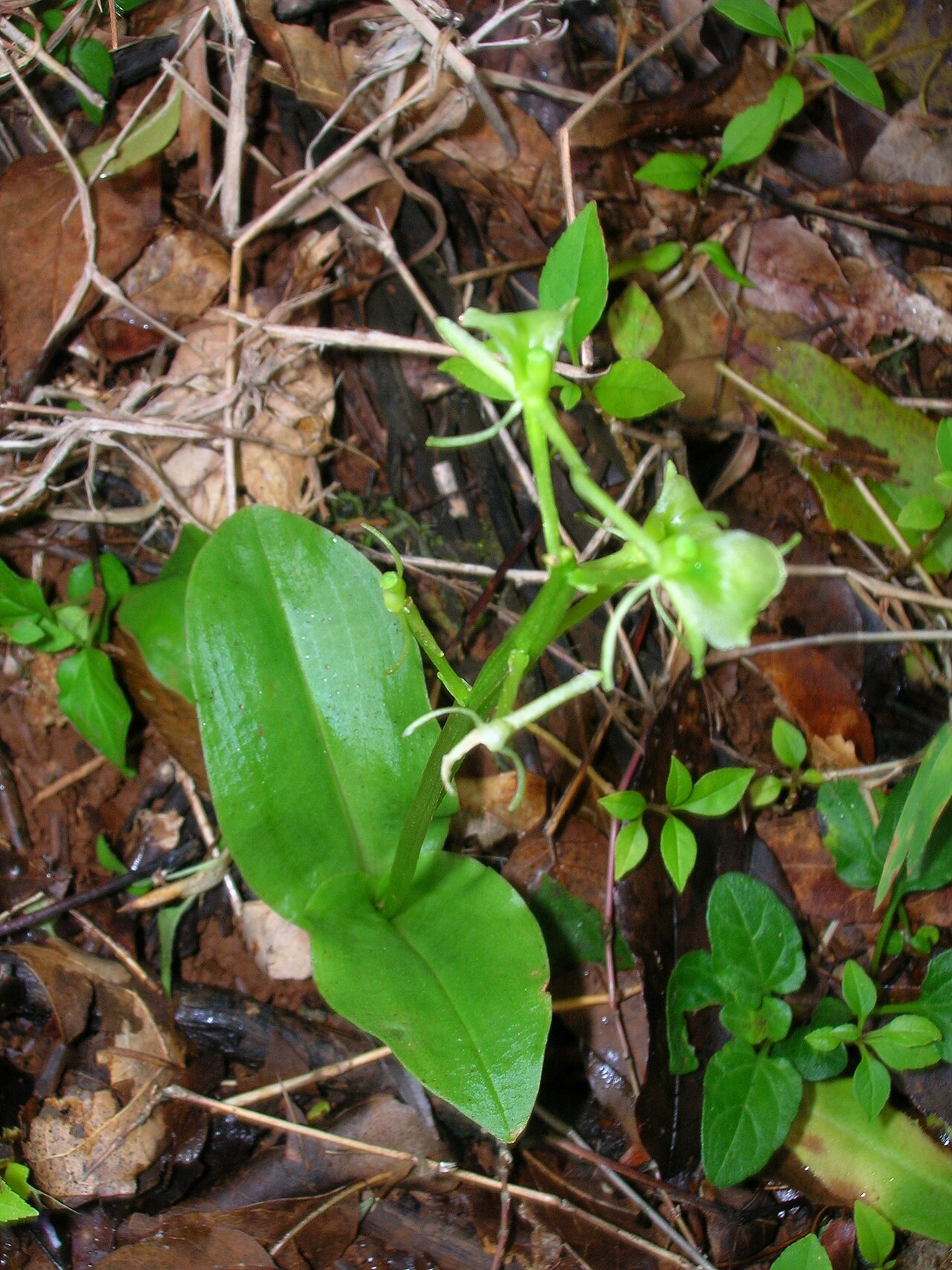
ʻAwapuhiakanaloa is easy to overlook: a small, green orchid with two leaves and green flowers among ferns and moss. Look for the pair of broad, shiny leaves and, in spring and summer, a slender spike of spidery green flowers.
Growth Habit
A small, clump-forming perennial herb, from a few inches up to about a foot tall in flower. Each shoot grows from a cone-shaped, green pseudobulb (a swollen stem base that stores water and food). Plants growing as epiphytes on mossy tree trunks are usually smaller than those on the ground.
Leaves
Each pseudobulb bears two leaves, broadly oval to elliptic, pale to light green, smooth and glossy, with a slightly wavy edge and fine parallel veins. The genus name Liparis comes from the Greek for “oily” or “smooth,” referring to the shiny leaves.
Flowers
A slender, upright stalk rises between the leaves, carrying a loose raceme of small, pale green flowers; larger plants can have a dozen or more. Each flower has narrow, curling sepals and thread-like petals and a broad, flat lip, which gives it the English name widelip orchid. It flowers mainly from spring into summer, with occasional flowers at other times of year.
Fruit & Look-alikes
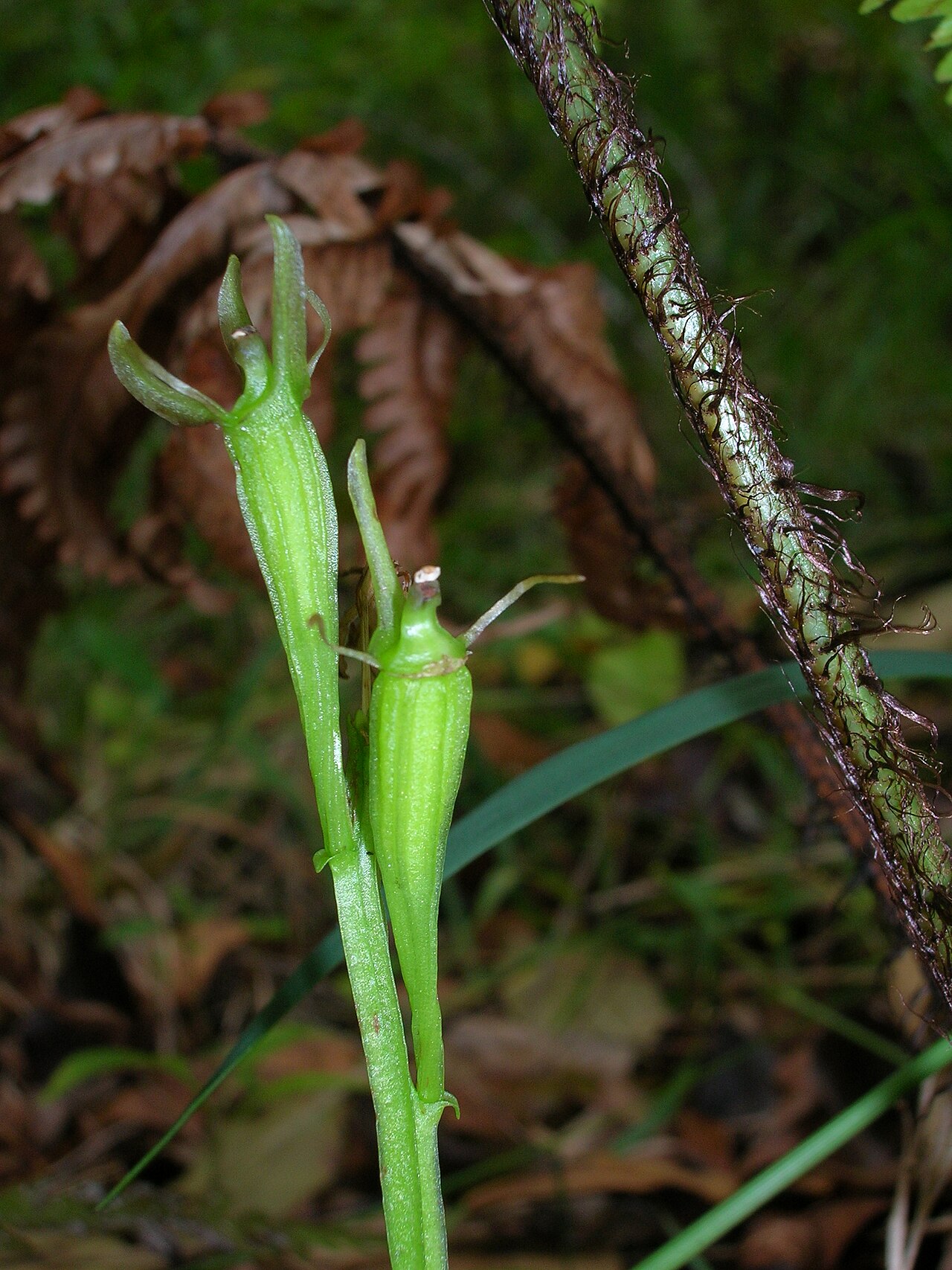
The fruits are ribbed, green capsules that ripen to brown and split open to release huge numbers of dust-like seeds. It resembles the Fen Orchid (Liparis loeselii) of eastern North America and Europe, but it is a larger plant with cone-shaped pseudobulbs and flowers nearly twice as large. The Hawaiʻi jewel orchid (Anoectochilus sandvicensis) grows from a creeping stem with several leaves and has a spike of small, hairy, whitish flowers, and the very rare Hawaiian bog orchid (Platanthera holochila) has a leafy stem and grows in bogs.
Quick Facts
| Scientific Name | Liparis hawaiensis H. Mann |
| Family | Orchidaceae (orchid family) |
| Plant Type | Terrestrial or epiphytic perennial orchid; Hawaiian endemic |
| Mature Height | 4–12 in (flower stalk sometimes over 1 ft) |
| Mature Spread | 3–8 in |
| Growth Rate | Slow |
| Sun Exposure | Shade |
| Water Needs | High; constantly moist to wet |
| Soil Type | Organic forest soil, moss and leaf litter; mossy tree trunks |
| Soil pH | Acidic |
| Bloom Time | Mainly spring to summer; occasionally other times |
| Flower Color | Pale green |
| Fall Color | None |
| Fruit | Ribbed capsule with dust-like seeds |
| Deer Resistant | No; eaten by slugs and damaged by feral pigs |
| USDA Hardiness Zones | 10–12 (cool, wet forests of Hawaiʻi) |
Native Range
ʻAwapuhiakanaloa is endemic to the Hawaiian Islands and grows nowhere else in the wild. USDA PLANTS lists it as native only in Hawaiʻi. It is known from all of the main islands except Niʻihau and Kahoʻolawe: Kauaʻi, Oʻahu, Molokaʻi, Lānaʻi, Maui and Hawaiʻi Island.
It grows from about 1,600 to over 5,000 feet in mesic to wet forest and in bogs. It is found on moss-covered trees, under shrubs, on wet or seasonally wet bare ground and on stream banks. On Maui, for example, it has been photographed in Makawao Forest Reserve and along Waikamoi Stream on the windward slopes of Haleakalā.
Like other small forest-floor plants, it is threatened by feral pigs, which root up the ground and spread invasive plants, by slugs that eat the leaves, and by invasive species that smother the forest floor. Its tiny, scattered populations are easy to miss, so it may be more widespread than records suggest, but it is generally uncommon.
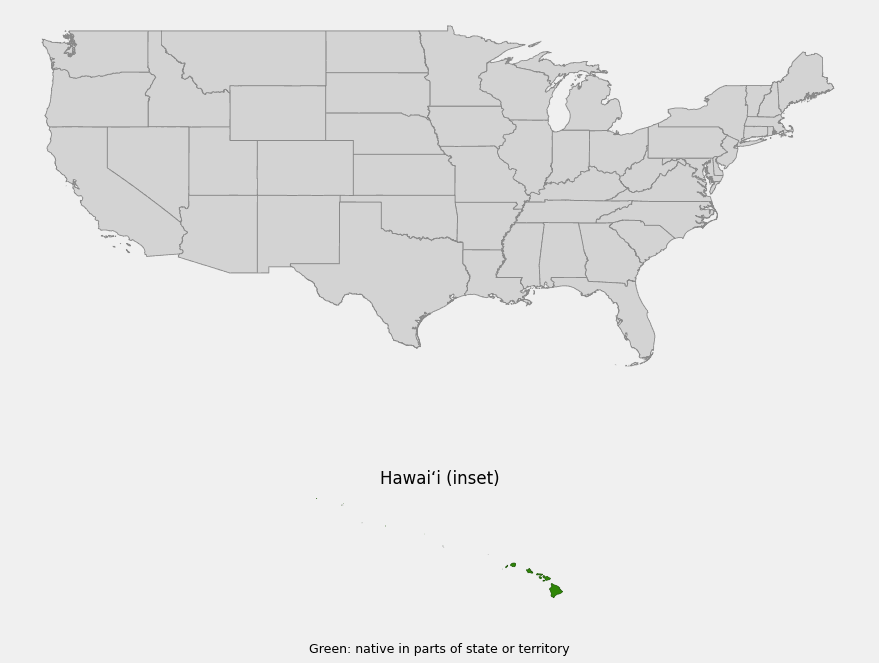
📋 Regional plant lists featuring ʻAwapuhiakanaloa: Hawaii
Growing & Care Guide
Honestly, ʻawapuhiakanaloa is very hard to grow outside its forest habitat, and it is not normally sold by nurseries. Like most orchids, its dust-like seeds need specific soil fungi to germinate, and the plants depend on the constant moisture, shade and cool temperatures of Hawaiian mesic and wet forest. It has not been used in landscapes; at most it could be kept as a potted plant by specialists. Never dig, pick or collect plants or seed capsules from the wild; wild orchids almost never survive being moved. If a plant is ever offered, buy it only if it is nursery- or laboratory-propagated and sold by a Hawaiʻi native plant grower. Hawaiʻi restricts bringing plants in from other states, so any plants in Hawaiʻi should come from local growers.
Light
Shade. In the wild it grows under the forest canopy, under shrubs and on mossy trunks, out of direct sun.
Soil & Water
It needs a constantly moist to wet, organic medium such as moss, leaf litter and humus, with very high humidity and frequent rain or mist. It tolerates waterlogged soil, but drying out is fatal.
Planting Tips
The best way to “grow” it is to protect its habitat: support fencing and pig control, remove invasive plants, and stay on trails so you do not trample the forest floor. Specialists who receive propagated plants keep them in pots of moss and humus in a cool, shady, humid shade house or terrarium.
Pruning & Maintenance
No pruning is needed; old leaves wither naturally. Slugs love to eat the leaves, so potted plants must be protected from slugs and snails.
Propagation
Orchid seed is propagated in laboratories by sowing it on sterile nutrient media, sometimes with a compatible fungus. Clumps of pseudobulbs can be divided. This is work for conservation programs and specialists; home gardeners should not attempt to propagate from wild plants.
Landscape Uses
- Nature appreciation: one of only three native Hawaiian orchids, best enjoyed in the forest
- Habitat protection: benefits from fencing, pig removal and weed control in wet forest
- Conservation collections: propagated by specialists and conservation programs
- Specialist potted plants: only from legally propagated stock, in cool, shady, humid conditions
Wildlife & Ecological Value
ʻAwapuhiakanaloa is a small but meaningful part of the Hawaiian wet forest floor.
For Pollinators
The small green flowers are pollinated by insects; the specific pollinators of this species are not well documented. Like many orchids, it may also be able to set seed with little or no help from pollinators.
For Birds
It has no fleshy fruit and is not an important food plant for birds, but it is part of the mossy understory where native birds forage for insects.
For Mammals
The Hawaiian hoary bat, Hawaiʻi’s only native land mammal, hunts over the forest. Introduced feral pigs uproot and trample forest-floor plants like this orchid and are among its main threats.
Ecosystem Role
As an orchid, it depends on soil fungi for germination and early growth, linking it to the hidden fungal network of the forest floor. Its presence is a sign of a mossy, intact native forest.
Cultural & Historical Uses
The name ʻawapuhiakanaloa means “the ginger of Kanaloa,” the Hawaiian god of the ocean. Ordinarily ʻawapuhi refers to ginger, and the orchid’s small flowers may have reminded people of the flowers of shampoo ginger (Zingiber zerumbet), which Polynesian voyagers brought to Hawaiʻi. It is the only one of the three native Hawaiian orchids known to have a Hawaiian name.
The species was described by the American botanist Horace Mann Jr., who studied the Hawaiian flora in the 1860s; the epithet hawaiensis refers to Hawaiʻi Island. It has also been placed in the genus Leptorchis. Liparis is a large genus of about 200 species worldwide, and this is its only Hawaiian member.
Hawaiʻi has only three native orchids, a tiny number for a tropical island group, probably because orchids need both their tiny seeds and their partner fungi to arrive across thousands of miles of ocean. By contrast, about a dozen introduced orchids now grow wild in Hawaiʻi, including the bamboo orchid and the Philippine ground orchid, which are sometimes mistaken for native plants.
Frequently Asked Questions
Is ʻawapuhiakanaloa a native Hawaiian orchid?
Yes. It is one of only three orchids native to Hawaiʻi, and it is endemic, found nowhere else. The other two are the Hawaiʻi jewel orchid and the Hawaiian bog orchid.
Can I grow it?
It is very hard to grow outside its wet forest habitat and is almost never sold. Never collect it from the wild. Only specialists with legally propagated plants and cool, shady, humid conditions should try.
What does the Hawaiian name mean?
ʻAwapuhiakanaloa means “the ginger of Kanaloa,” the god of the ocean.
Is it endangered?
It is not federally listed under the Endangered Species Act, but it is uncommon and considered at risk because of feral pigs, slugs and invasive plants.
Where can I see it?
In mesic and wet forest on the main Hawaiian Islands, on mossy trees, wet banks and the forest floor at about 1,600 to over 5,000 feet. It is small and green, so look carefully and stay on the trail.

Looking for a nursery that carries ʻAwapuhiakanaloa?
Browse our native plant nursery directory: Hawaii

