Blue Vervain in a Wet-Meadow Planting: Height, Repetition, and Companions
Last updated: November 6, 2026
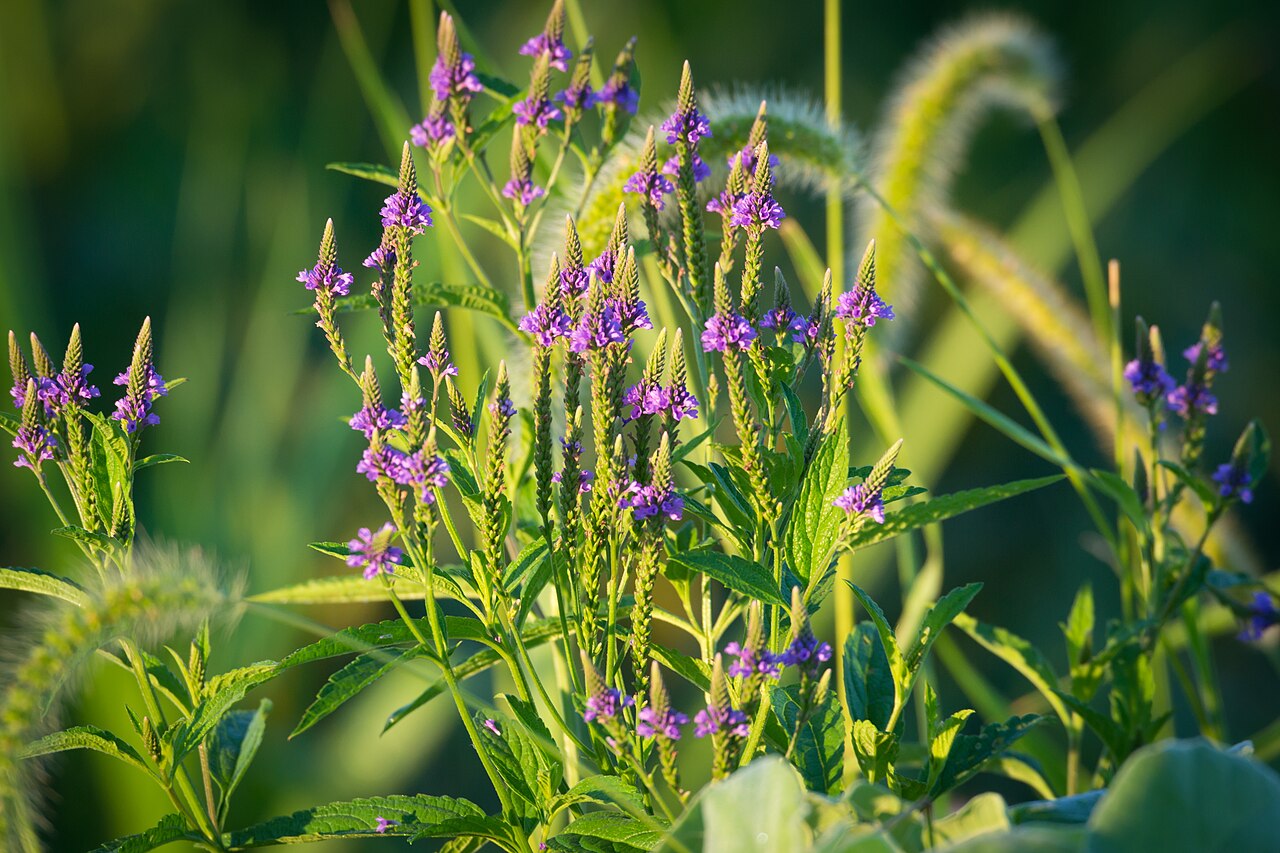
Blue vervain is one of the easiest wildflowers to fit into a damp, sunny spot. Its thin, branching flower spikes add height and a cool violet color without taking up much ground.
The catch is that one plant on its own looks sparse. Blue vervain is airy and upright, so it reads best when it is repeated and set among fuller companions.
This plan shows how to place it in a small wet-meadow planting: where it goes by height, how often to repeat it, which partners hold the space between plants, and how to keep the whole thing looking intentional for the first three years.
Plan at a Glance
| Site | Sunny low spot, swale, rain-garden basin, pond edge or ditch margin that stays moist and only floods briefly |
| Size | Works from about 8 × 12 feet up to large meadow areas; the plan below fits roughly 100 square feet |
| Sun | Full sun preferred; tolerates part shade with fewer flowers |
| Soil | Average to wet loam, clay or muck; temporary standing water is fine |
| Maintenance | Low: one spring cutback, seedling editing, and weeding while plants establish |
| Best regions | Most of the U.S. and southern Canada where blue vervain is native; check your state list and swap companions to match |
Read the Site Before You Buy Plants
A wet meadow is not a pond. It is ground that stays moist through most of the season, gets soaked after storms, and may hold shallow water for a short time before draining.
Blue vervain fits that pattern well. Illinois Wildflowers describes it in riverbottom prairies, moist meadows, soggy thickets, pond borders, marshes and ditches, and notes that it tolerates standing water if it is temporary.
Before planting, watch the spot after a heavy rain. Note where water collects, how long it stays, and which edges dry out first. Those observations decide where each plant goes.
- Wettest zone: the lowest point, where water sits longest. Use the most water-tolerant sedges and wetland species here.
- Moist middle: damp most of the season but rarely underwater for long. This is the main zone for blue vervain and its taller partners.
- Drier rim: the edges and upper slope, which dry out between storms. Place adaptable species here, not the true wetland plants.
Check light, too. NC State Extension lists full sun to part shade for blue vervain, and plants in more sun produce stronger stems and more flowers. A wet spot in deep shade calls for a different plan.
If you are building a new basin to catch roof or driveway runoff, size and grade it first. Our guide on how to start a rain garden covers siting and basin depth before plant selection.
How Blue Vervain Behaves in a Planting
NC State Extension lists blue vervain at 2 to 5 feet tall and 1 to 2½ feet wide. The Lady Bird Johnson Wildflower Center gives a range up to about 6 feet. Moisture, sun and soil fertility all push it toward one end of that range or the other.
The stems are stiff and square, and the top branches into a candelabra of narrow spikes. Each spike blooms from the bottom up, so only a ring of flowers is open at a time. Illinois Wildflowers puts the bloom season at about one to one and a half months in mid- to late summer.
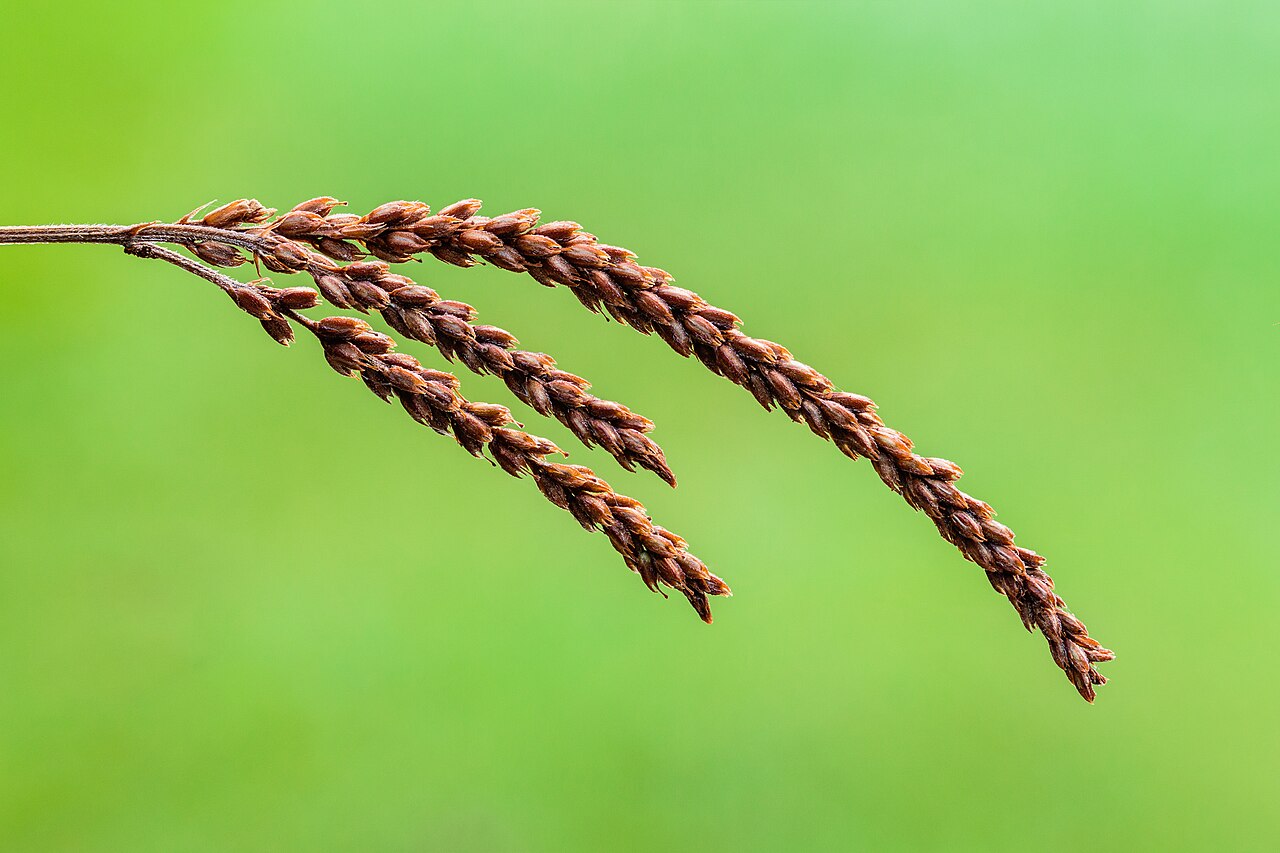
Most references, including NC State and Illinois Wildflowers, describe it as a perennial; the Wildflower Center lists it as biennial. In practice, it spreads slowly by short rhizomes and by seed, so a planting tends to shift a little from year to year rather than staying exactly where you put it.
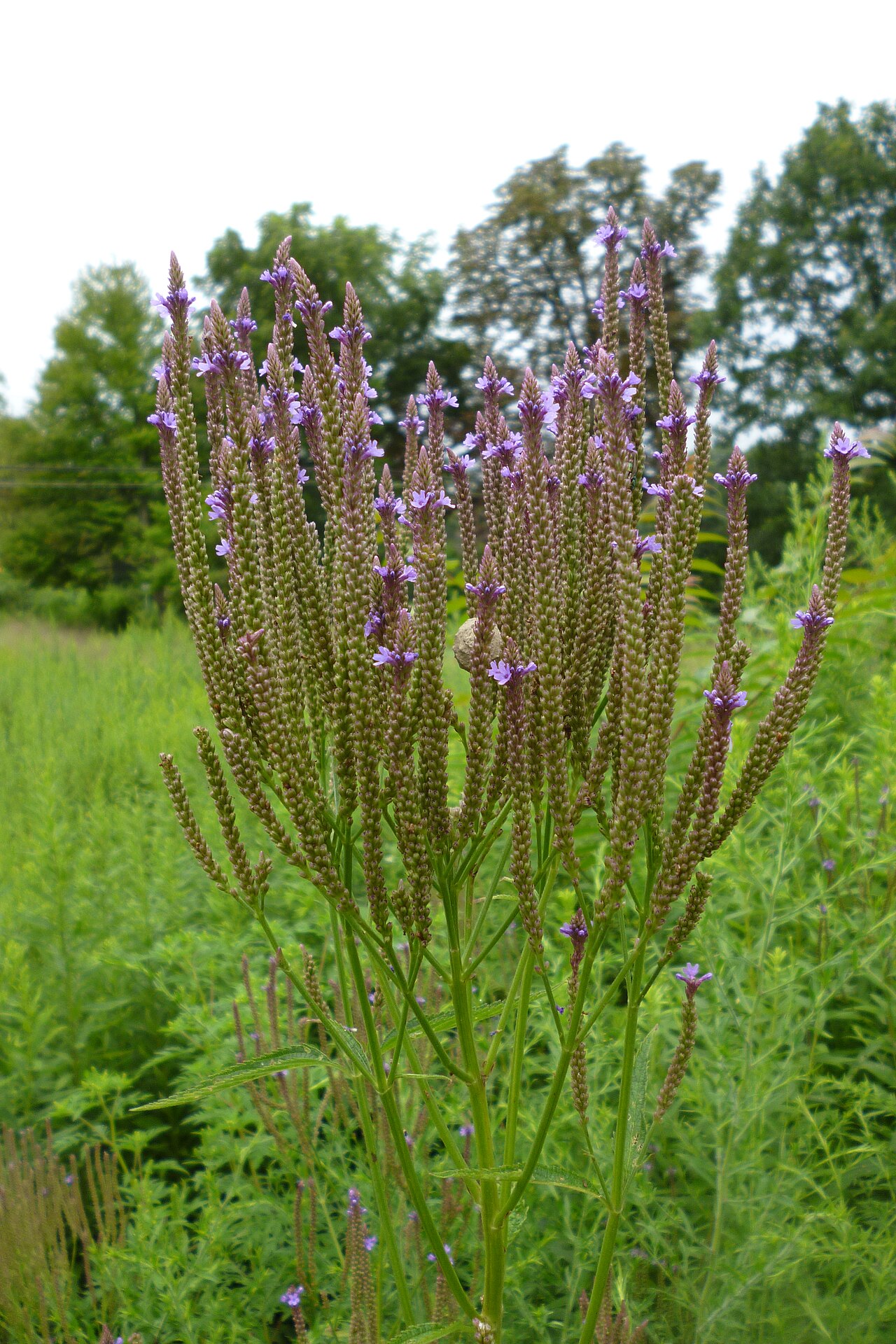
That open structure is the key design fact. Blue vervain is tall but not bulky. It adds vertical lines and color, while other plants provide the mass and the foliage that covers the ground.
Layering by Height
Think of the planting in three loose layers, arranged so the viewer sees over the shortest plants into the tallest. In a bed viewed from one side, the tallest plants go to the back. In an island viewed from all sides, they go to the middle.
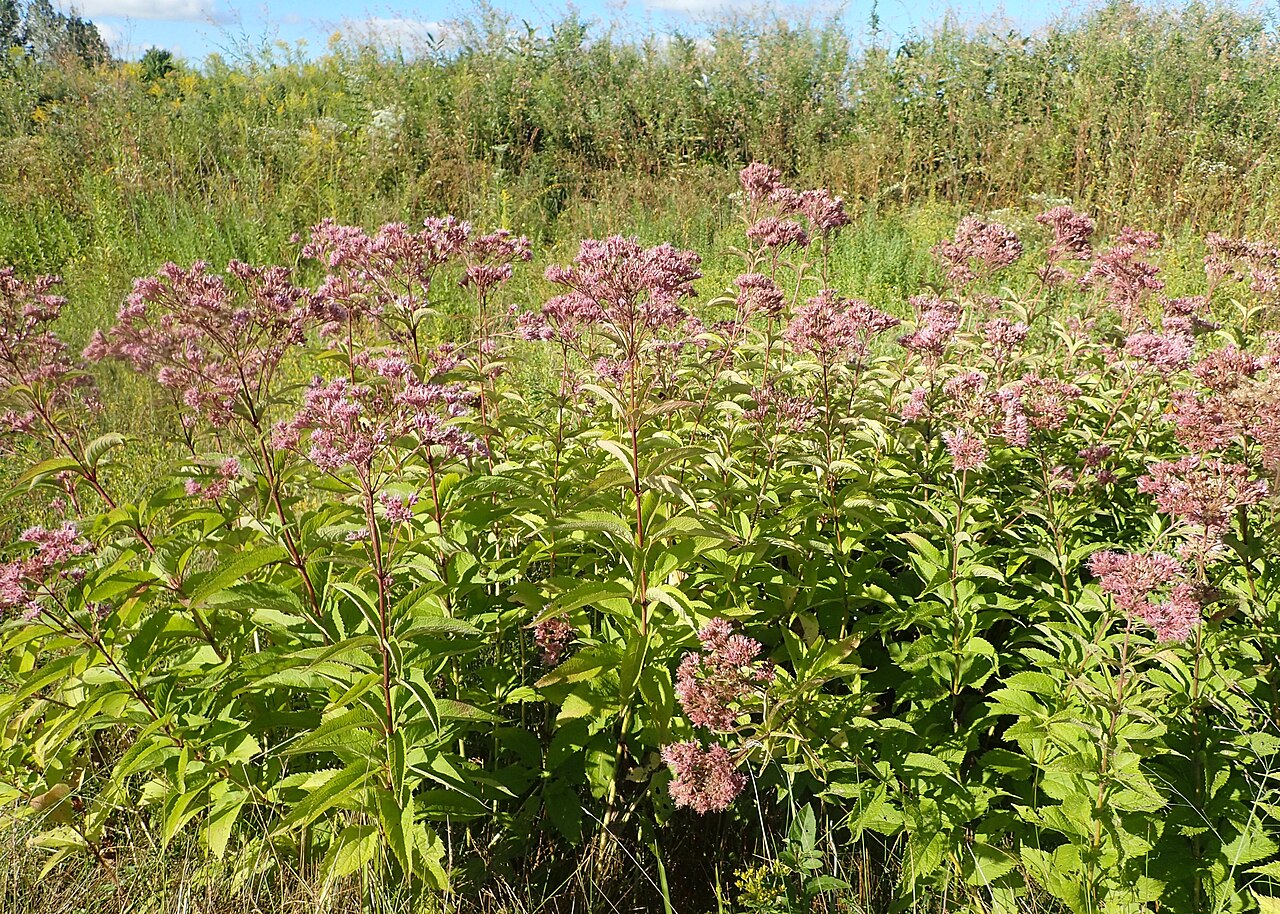
- Back or center (5 to 7 feet): big, heavy plants like spotted Joe-Pye weed. These form the backdrop.
- Middle (3 to 5 feet): blue vervain, swamp milkweed, boneset and great blue lobelia. This is where most of the summer color sits.
- Front and matrix (1 to 3 feet): sedges and lower plants that cover the soil, edge the bed and fill gaps between taller plants.
Blue vervain belongs in the middle layer, but it can drift forward. Because its stems are slender, you can see through them to the plants behind. A few vervain stems in front of a mass of Joe-Pye weed look natural rather than blocking.
Repetition: Groups, Drifts and Rhythm
A single blue vervain looks like a weed that wandered in. Three to five plants together look like a decision. That difference comes down to repetition.
Plant blue vervain in groups of three to seven, spaced in loose triangles instead of straight rows. Then repeat those groups two or three times across the planting, so the eye picks up the violet spikes in several places.
The PlantNative profile suggests spacing individual plants 18 to 24 inches apart, which fits NC State’s width range. Closer spacing within a group, at the lower end of that range, makes the spikes read as one mass sooner.
Repeat at least one ground-layer plant through the entire planting as well. A continuous sedge matrix ties the separate flower groups together and leaves less open soil for weeds.
Companions That Share the Same Conditions
The best partners like the same moist, sunny conditions, bloom at slightly different times, and offer a different shape: domes, flat clusters or grassy mounds next to vervain’s thin spikes.
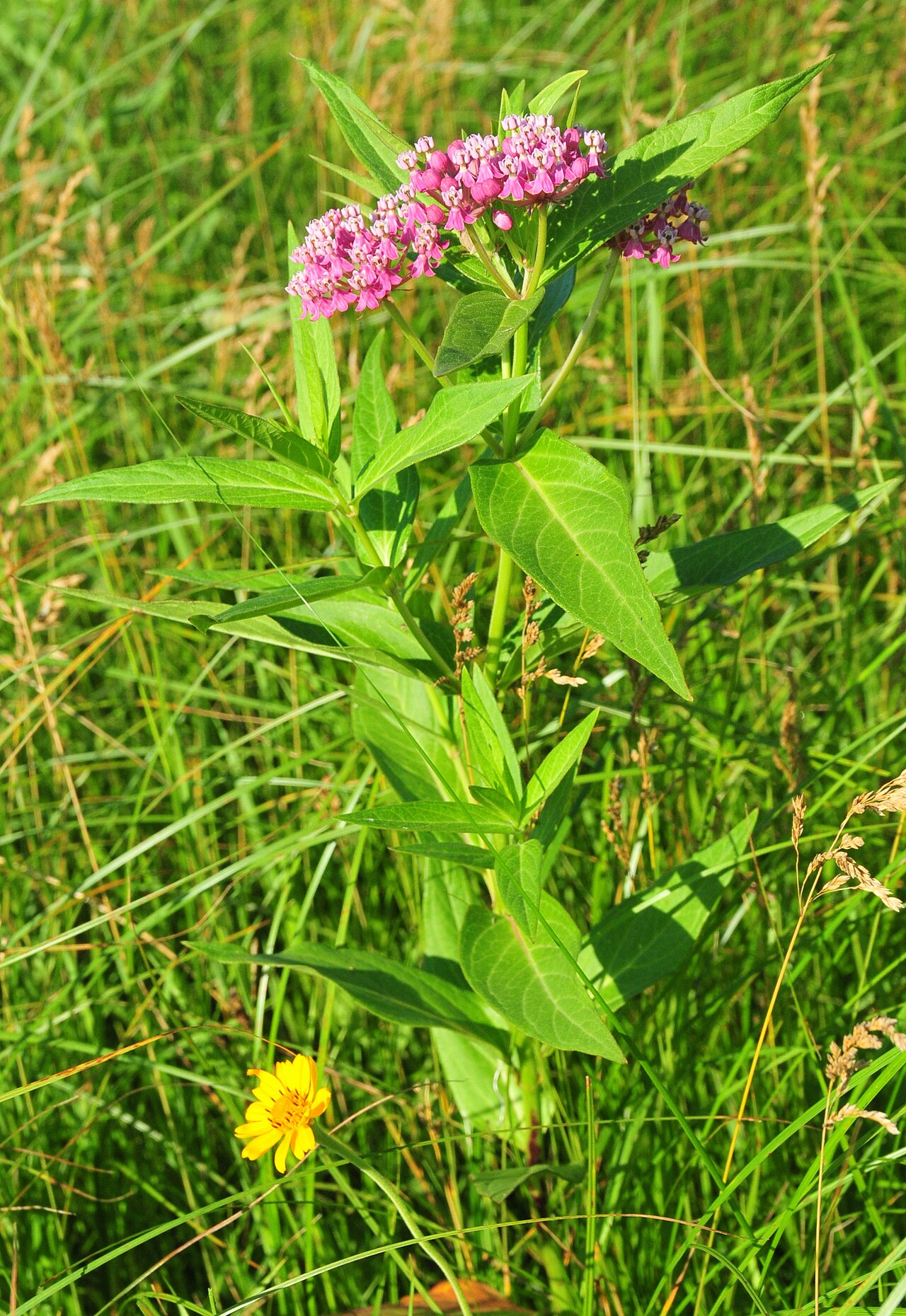
Swamp milkweed is a natural neighbor. The Wildflower Center lists it at up to about 5 feet in moist to wet soil, with pink flower clusters in summer. It needs steady moisture; if it struggles, our guide to swamp milkweed wilting in damp soil covers drainage and root checks.
Boneset adds flat white flower clusters in late summer and grows in damp prairies and bogs, according to the Wildflower Center. Its white flowers make vervain’s violet stand out.
Great blue lobelia blooms from July into fall and tolerates part shade. It works well along the front of the middle layer and in the slightly shadier corners of a site. For a shorter, shadier take on the same late-season palette, see our bottle gentian moist border plan.
For fall color, New England aster carries the planting past vervain’s bloom with purple daisies from August to October. Give it room; mature clumps get wide.
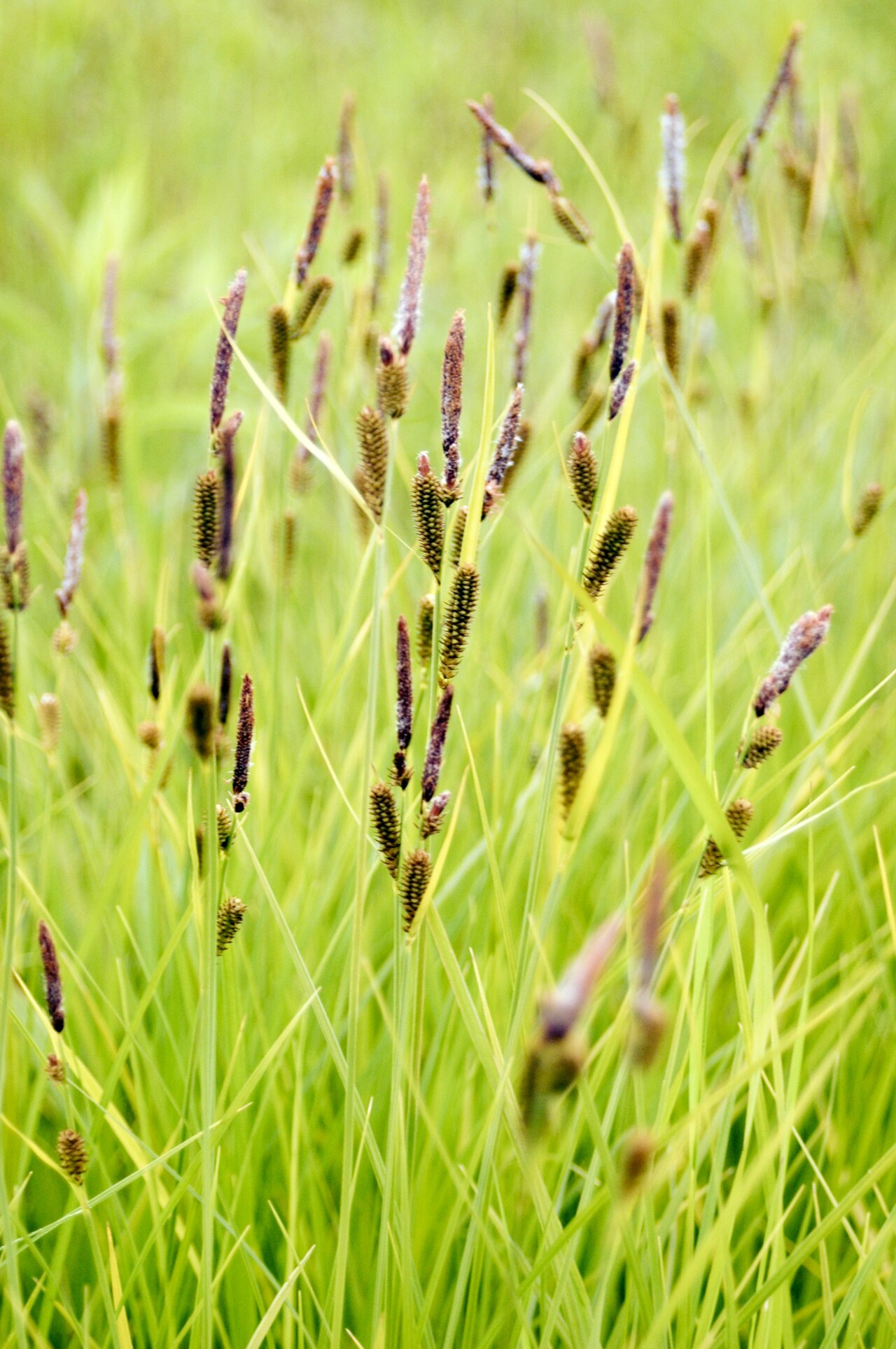
For the ground layer, tussock sedge handles the wettest zone. The Wildflower Center describes it in swamps, swales and low woods, and lists it for moist to wet soil in sun.
Plant Palette
Heights and ranges are from the Lady Bird Johnson Wildflower Center unless noted. Confirm each plant appears on your state’s native list before buying.
| Plant | Role | Height | Sun / moisture | Native range |
|---|---|---|---|---|
| Blue vervain (Verbena hastata) | Repeated vertical accent | 2–5 ft (NC State); up to about 6 ft | Sun to part shade / moist to wet | N.S. to B.C., south to FL, KS, NM and CA |
| Spotted Joe-Pye weed (Eutrochium maculatum) | Back-layer mass | To about 6 ft | Sun to part shade / moist to wet | Much of Canada and the northern U.S.; south to n. GA in the East (Wikipedia) |
| Swamp milkweed (Asclepias incarnata) | Mid-layer color, monarch host | Up to about 5 ft | Sun to part shade / moist to wet | Southern Canada and New England south to GA, west to TX and ND |
| Boneset (Eupatorium perfoliatum) | White late-summer contrast | Up to about 6 ft, often shorter | Sun to shade / moist to wet | E. Canada to FL, west to the e. Dakotas, KS and n. TX |
| Great blue lobelia (Lobelia siphilitica) | Front of middle layer | Up to about 5 ft | Sun to shade / moist to wet | CT to ND and WY, south to GA, TX and CO |
| New England aster (Symphyotrichum novae-angliae) | Fall bloom | Up to about 6 ft | Sun to part shade / moist | Que. and ME to SC, west to the e. Great Plains |
| Tussock sedge (Carex stricta) | Ground layer, wettest zone | Up to about 5 ft (often much shorter in leaf) | Sun / moist to wet | N.B. to Ont., south to NC, TN and KS |
Regional Alternates
Blue vervain itself has a very wide native range, but its companions do not. A wet-meadow planting in Georgia or Colorado should not copy a Wisconsin plant list. Use these swaps as starting points and confirm them on your regional list.
- Deep South and coastal plain: where tussock sedge and spotted Joe-Pye weed thin out or are absent, look at cardinal flower (native south to Florida and Texas per the Wildflower Center) and New York ironweed (Massachusetts to Ohio, south to Georgia and Mississippi) for the middle and back layers.
- Great Plains: switchgrass grows in moist prairies and along stream banks and handles poorly drained soils, so it can replace sedge as the matrix at the drier rim. Common sneezeweed adds yellow late-summer flowers in moist open sites.
- Interior West: western blue flag iris grows in marshes and wet meadows from British Columbia to southern California east to the Dakotas and New Mexico, and blooms in spring before vervain.
Spacing and Quantities for a 100-Square-Foot Planting
This sample uses an 8 × 12 foot bed viewed from one long side. Adjust counts up or down by area, and swap species for your region.
Sample Quantities
| Spotted Joe-Pye weed | 3 plants along the back, about 3 feet apart |
| Blue vervain | 9 plants in three groups of three, about 18 inches apart within each group |
| Swamp milkweed | 3 plants in one group, mid-bed |
| Boneset | 3 plants, mid-bed, between vervain groups |
| Great blue lobelia | 5 plants along the front of the middle layer |
| New England aster | 2 plants, toward one end where they have room to widen |
| Tussock sedge or other sedge | 15–20 plugs through the front and the wettest low spot |
Installation Steps
Step 1: Clear existing vegetation. Remove lawn grass and perennial weeds before planting. Wet sites are hard to weed once roots are tangled together, so the cleaner you start, the less you fight later.
Step 2: Mark zones and groups. Flag the wettest low spot, the moist middle and the drier rim. Then lay out pots on the soil surface in their groups before you dig a single hole.
Step 3: Plant in spring. The PlantNative profile recommends setting out transplants after the last frost. Plant at the same depth as the pot and firm the soil around each root ball.
Step 4: Water in and mulch lightly. Even a wet site can dry out at the surface in early summer. Water new plants in and keep them moist until roots grow. Use a thin layer of shredded leaves or wood mulch on the drier rim, and skip it where water flows, since it floats away.
Step 5: Sow seed if you want extra vervain. The Wildflower Center notes that blue vervain seed needs about 30 days of cold, moist stratification and germinates in light. Fall sowing on the soil surface lets winter handle the cold period.
The First Three Years
- Year one, spring and summer: water during dry spells, pull weeds every two to three weeks, and replace any losses. Expect modest growth above ground while roots establish.
- Year one, fall and winter: leave stems standing. The seed spikes feed birds; Illinois Wildflowers lists cardinals, sparrows and juncos among the seed eaters.
- Year two, spring: cut old stems down before new growth starts. Look for vervain seedlings and keep the ones that fit your groups; pull the rest while they are small.
- Year two, summer: if vervain gets taller than you like, NC State suggests pinching the tops to encourage branching. Do it early in the season so flowering is not lost.
- Year three: the planting should close in. Edit crowded clumps, divide asters if they swamp neighbors, and fill bare patches with more sedge.
Mistakes to Avoid
- Planting single specimens. One blue vervain in a bed looks accidental. Group and repeat it.
- Hiding it behind dense foliage. Its small flowers need open space or a contrasting backdrop to show.
- Treating a seasonal swale as permanent water. These plants tolerate brief flooding, not months underwater.
- Cutting everything back in fall. Standing stems shelter insects and feed birds; wait until early spring.
📋 Find plants for your region: see the full Blue Vervain (Verbena hastata) profile or our native plant lists for Connecticut, Massachusetts & Rhode Island, Maryland, Virginia & West Virginia, Michigan, Wisconsin & Eastern Minnesota, and the Dakotas & Western Minnesota.
Frequently Asked Questions
Can blue vervain grow in standing water?
Only briefly. Illinois Wildflowers notes that it tolerates standing water if it is temporary. Place it in the moist middle of a wet site, not in the lowest spot that stays flooded.
How tall does blue vervain get in a garden?
NC State Extension lists 2 to 5 feet, and the Wildflower Center says up to about 6 feet. Rich, wet soil and full sun tend to produce taller plants.
Will blue vervain spread and take over?
It spreads slowly by rhizomes and by seed. Seedlings are easy to pull in spring, so a little editing each year keeps it where you want it.
What blooms with blue vervain?
Swamp milkweed, boneset, great blue lobelia and Joe-Pye weed overlap its mid- to late-summer bloom. New England aster extends color into fall after vervain finishes.
Does blue vervain need full sun?
It grows in full sun to part shade, but it flowers more and stands straighter in full sun. In shadier spots, expect thinner stems and fewer spikes.
Sources
- NC State Extension Gardener Plant Toolbox, Verbena hastata: height and width, hardiness zones, sun and moisture, spread by rhizomes and seed, pinching, rain-garden and pond-edge use.
- Illinois Wildflowers, Blue Vervain: habitats, tolerance of temporary standing water, bloom length, rhizomes, bee visitors and seed-eating birds.
- Lady Bird Johnson Wildflower Center, Verbena hastata: size, bloom time, native distribution, seed stratification. Companion data from Wildflower Center pages for swamp milkweed, boneset, great blue lobelia, tussock sedge, New England aster, spotted Joe-Pye weed and western blue flag.
- Wikipedia, Eutrochium maculatum: range and varieties of spotted Joe-Pye weed.
- USDA PLANTS Database, Verbena hastata profile.