Black Chokeberry as a Low Hedge: A Layout That Allows for Suckering
Last updated: November 6, 2026
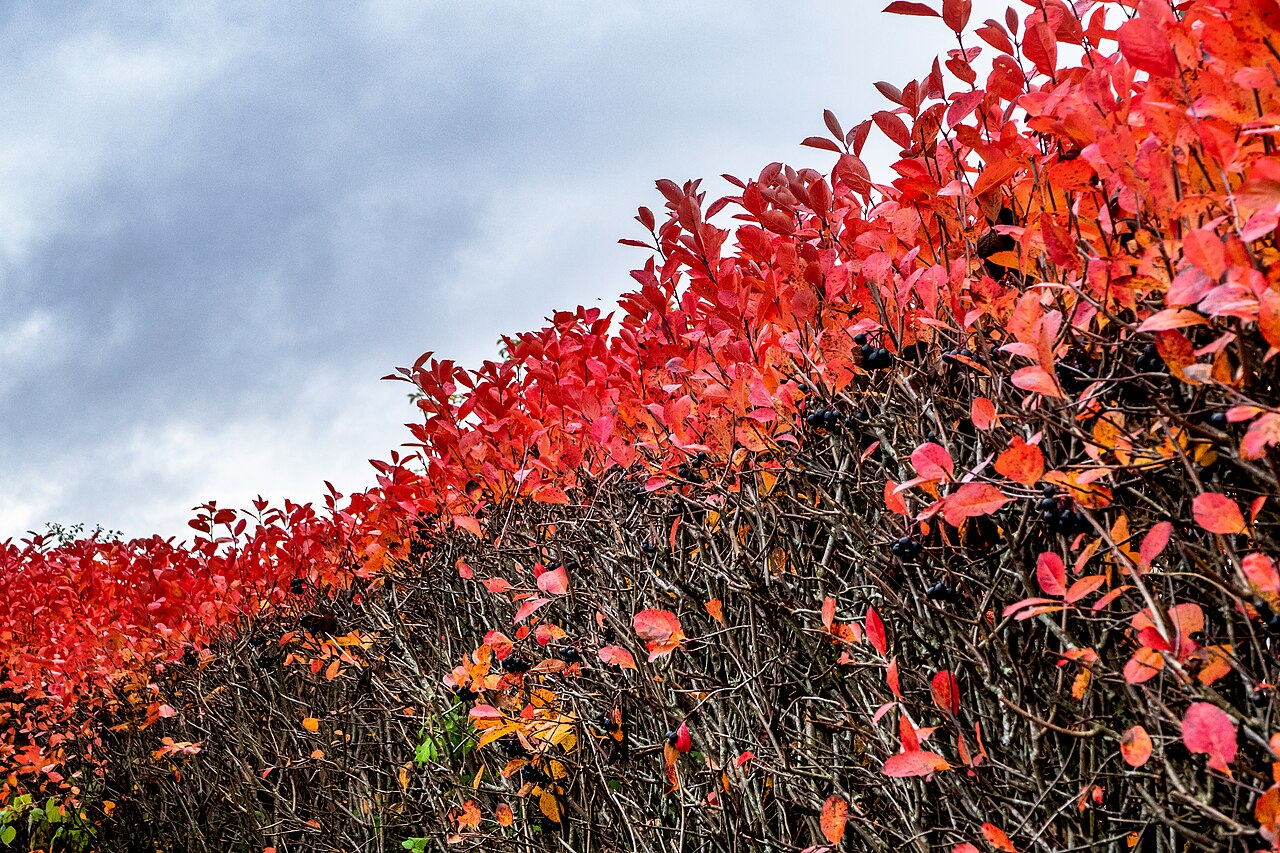
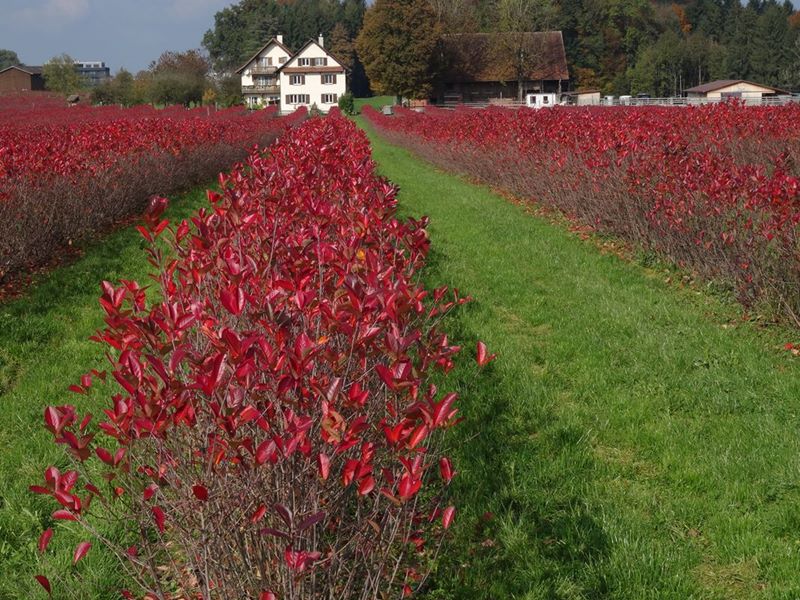
Black chokeberry makes a handsome low hedge. It flowers white in spring, carries glossy dark fruit in late summer, and turns red in fall.
It also spreads. The shrub sends up new shoots from its roots, and over a few years a row of single plants becomes a band of stems.
That habit is not a flaw to fight. It is something to design for. This plan shows how to lay out a chokeberry hedge so the spread fills the row instead of the lawn or the path.
Plan at a Glance
- Site: a property line, the edge of a patio, or a divider between lawn and a wilder planting.
- Size: a planting bed about 5 to 6 feet deep for a hedge kept near 3 to 5 feet tall, as long as you like.
- Sun: full sun to part shade. Flowering, fruit and fall color are best in sun.
- Soil: wide tolerance, from wet to fairly dry. Moist, well-drained ground gives the best growth.
- Maintenance: low. Pull or cut stray suckers a few times a year and thin old stems every few years.
- Best regions: where black chokeberry is native, from Newfoundland to Minnesota and south to the Georgia mountains, Tennessee and Arkansas. Elsewhere, use a regional alternate.
How a Chokeberry Hedge Grows
Black chokeberry is a multi-stemmed shrub in the rose family. It forms underground rhizomes and suckers into colonies, which the Arnoldia review of the genus describes as spreading in a non-aggressive manner.
Sources differ on size. The USDA plant guide gives 3 to 6 feet tall, The Morton Arboretum 3 to 8 feet tall and 3 to 6 feet wide, and the NC State plant toolbox notes it can reach 10 feet in good conditions.
The USDA guide also notes that new shoots come up around established plants and fill in the space between them “like a hedgerow.” That is the exact behavior a hedge wants. The work is deciding where the filling-in should stop.
Spread varies by site. The same USDA guide reports frequent suckering in some references but very little in windbreaks on the Northern Plains, so treat any spread estimate as a range, not a promise.
Step 1: Assess the Site Before You Mark the Row
Start with light. Chokeberry tolerates part shade, but NC State and Iowa State both note that fruiting is best in full sun. A hedge in heavy shade will be thinner and less colorful.
Next, check moisture. The Morton Arboretum lists tolerance of wet sites, occasional flooding, occasional drought and road salt. The Lady Bird Johnson Wildflower Center calls it very flood tolerant.
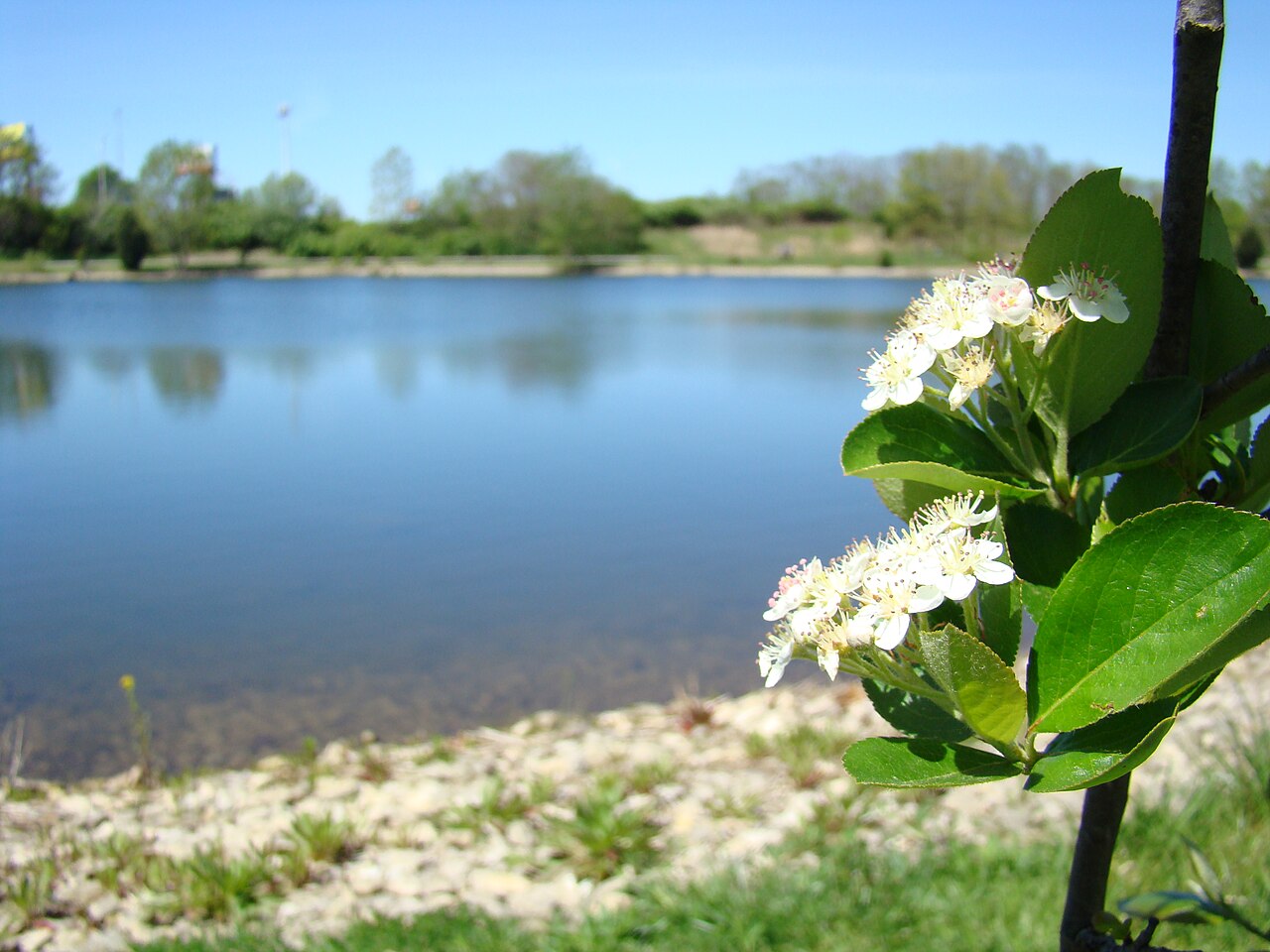
That makes it a good choice for a low, soggy property line where boxwood or yew would sulk. If you are weighing it against another wet-site shrub, see our comparison of black chokeberry vs. winterberry for a wet garden edge. If your ground is heavy clay, check drainage with a simple test first; our guide to planting black chokeberry in clay walks through it.
Finally, look at what borders each side of the row. Lawn, a gravel path, a fence, a vegetable bed and a neighbor’s yard each call for a different edge. Write them down before you design the layout.
Step 2: Design the Hedge Band, Not Just the Row
Most hedge plans show a single line of plants. For a suckering shrub, think in three parallel strips instead.
- The core: the planting line itself, where the original shrubs go.
- The fill zone: a mulched strip on each side, roughly 18 to 24 inches wide, where new shoots are welcome.
- The edge: the boundary where spread stops, such as a mown lawn line, a path edge, or a groundcover strip.
The fill zone is what makes the layout work. Suckers that come up there thicken the hedge. Shoots that cross the edge get removed.
Iowa State Extension warns that mowing or string-trimming under aronia damages canes and invites disease. A mulched fill zone keeps the mower and trimmer away from the stems you want to keep.
Spacing and Quantity
| Single row | Plants 4 to 6 feet apart, the USDA’s optimum range. Suckers close the gaps over several seasons. |
| Faster screen | Use the low end of that range, or a staggered double row with plants offset between the rows. |
| Fruit harvest | The USDA suggests about 10 feet between plants for more light and room per plant. |
| Plants per 30 feet | About 7 or 8 at 4 to 5 foot spacing in a single row. |
| Bed depth | Core plus fill zones: about 5 to 6 feet from edge to edge. |
Step 3: Choose the Edges for Each Side
Lawn side. Keep a clean, mown line at the outside of the fill zone. Shoots that pop up in turf are cut by regular mowing, while the mulched strip protects the main stems.
Path side. Give a walkway the widest fill zone you can. Arching stems lean outward, and a path that is too close forces you to cut back the face of the hedge every year. Our guide to managing black chokeberry suckers along a path or lawn covers the hands-on removal.
Fence or property line. Leave at least a couple of feet between the core and the fence so you can reach behind the hedge to pull suckers and thin stems. A hedge jammed against a fence is hard to maintain.
Garden bed side. Use a deep edging strip or plant a groundcover buffer. A low, dense planting of Pennsylvania sedge along the front makes stray shoots easy to spot and pull.
Step 4: Pick Plants and Cultivars That Fit the Height
For a true low hedge, pay attention to cultivar labels. The Morton Arboretum’s own selection, Iroquois Beauty™ (‘Morton’), stays about 2 to 3 feet tall and 4 to 5 feet wide.
Iowa State notes that some popular fruiting cultivars, including ‘Viking’ and ‘Nero’, are actually hybrids of aronia and mountain ash. They fruit well, but if your goal is a locally native hedge, look for the straight species or a selection of it.
Taller, leggier relatives can work in a different role. Red chokeberry grows 6 to 12 feet tall in a vase shape and, per NC State, is best used in mass plantings because it tends to become leggy with age.
Plant Palette
| Plant | Role | Height | Sun / moisture | Native range |
|---|---|---|---|---|
| Black chokeberry (Aronia melanocarpa) | Hedge core | 3–8 ft | Sun to part shade; wet to dry | Northeast, Great Lakes, Appalachians |
| Red chokeberry (Aronia arbutifolia) | Taller back row or wet corner | 6–12 ft | Sun to part shade; tolerates boggy soil | Eastern U.S. and Canada, south to Florida and Texas |
| Northern bush honeysuckle (Diervilla lonicera) | Northern alternate; dry, thin soil | 2–4 ft | Sun to part shade; well-drained | Northeast, Great Lakes, Appalachians |
| Virginia sweetspire (Itea virginica) | Southern alternate; wet sites | 3–8 ft | Sun to part shade; moist to wet | SE Pennsylvania to Florida, west to east Texas |
| Fragrant sumac (Rhus aromatica) | Dry-site alternate; slopes | 2–6 ft | Sun to part shade; dry to moist | Most of the U.S. east of the Rockies |
| Pennsylvania sedge (Carex pensylvanica) | Edging groundcover | Under 1 ft | Sun to shade; dry to moist | Nova Scotia to Georgia, west to Manitoba and Kansas |
Heights from NC State, The Morton Arboretum and our plant profiles. Ranges are broad summaries; confirm county-level status for your site.
Regional Alternates When Chokeberry Isn’t Local
Black chokeberry is native to eastern North America, centered on the Northeast, the Great Lakes and the Appalachians. If you garden outside that range, a different suckering shrub may serve the same role better.
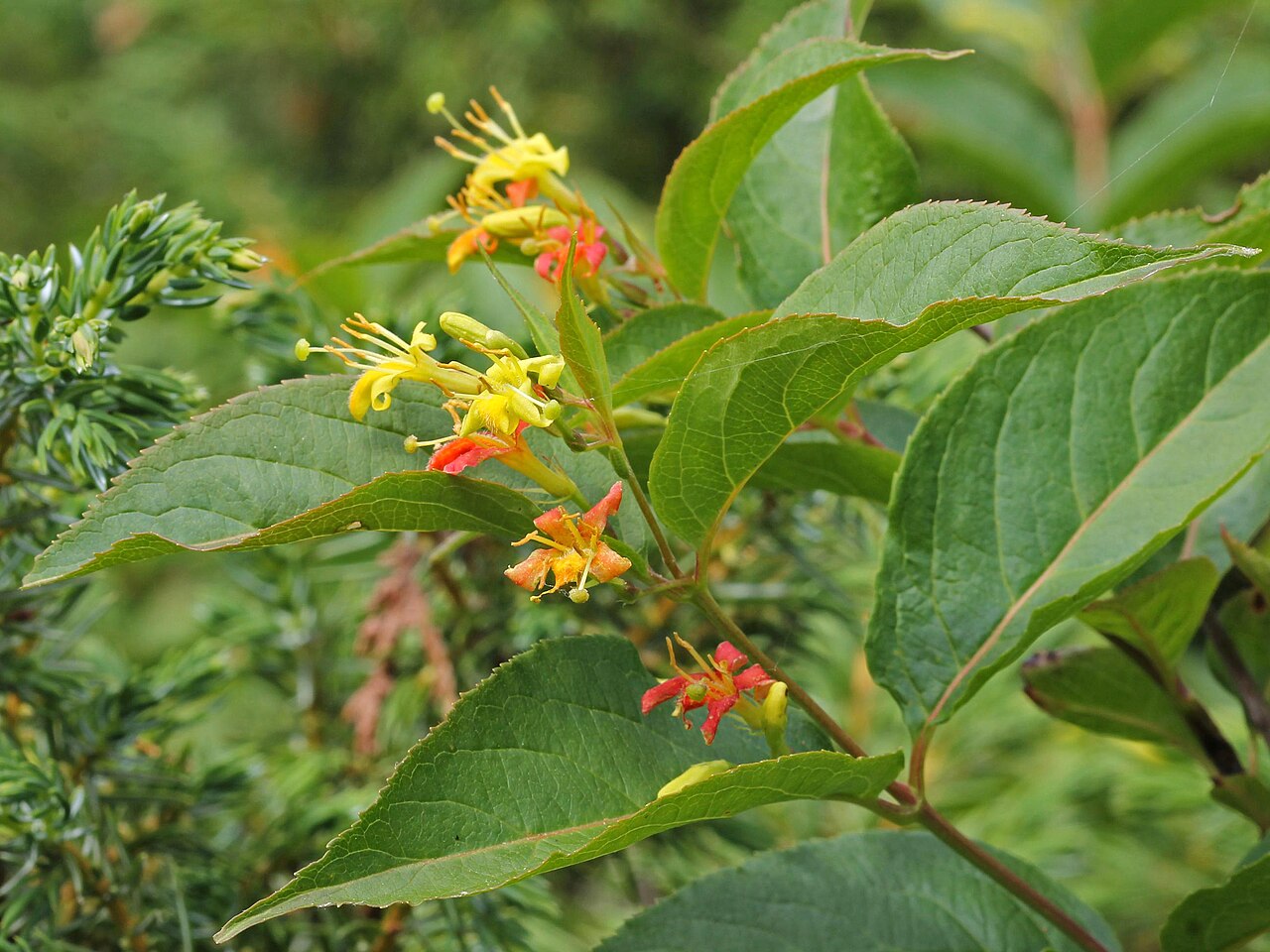
In the far North and on sandy or rocky ground, northern bush honeysuckle stays 2 to 4 feet tall and spreads by suckers into colonies. It handles drier sites than chokeberry.
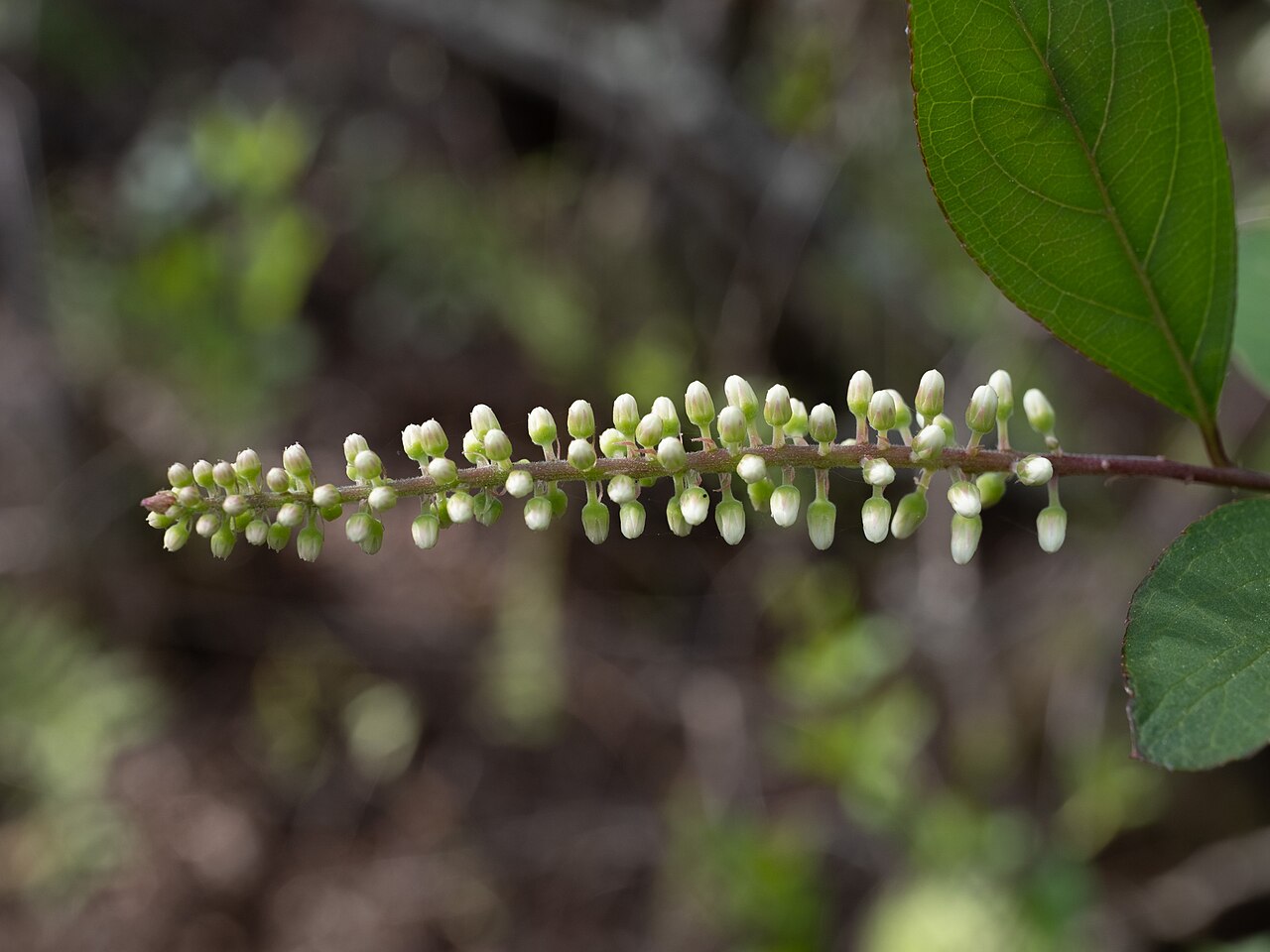
In the Southeast, Virginia sweetspire is a natural swap for wet ground. NC State notes it forms dense colonies by root suckering and tolerates periodic flooding.
On dry slopes across the Midwest and Plains, fragrant sumac forms a low, spreading thicket. NC State lists it at 2 to 6 feet tall and 6 to 10 feet wide, so give it an even wider fill zone.
West of the Plains, none of these is a safe default. Check your regional native plant list or a local native plant society for a suckering shrub that belongs where you live.
Step 5: Install the Hedge
- Time it right. The USDA guide recommends planting bareroot stock in spring once frost danger passes. Container plants can go in from spring to midsummer if you can water them.
- Mark three lines. Stake the core line, then the outer edge of each fill zone. String or marking paint keeps the bed straight.
- Clear competition. The USDA notes that chokeberry establishes readily when planted free of competing vegetation. Remove turf and weeds from the whole band, not just the planting holes.
- Space and plant. Set plants at your chosen spacing, at the same depth they grew in the nursery. Work soil around the roots and water well.
- Mulch the band. Spread about 3 inches of wood mulch across the core and fill zones, kept off the stems. Iowa State recommends mulch to control weeds and conserve moisture.
- Set the edge. Cut a clean lawn line or install path edging on the outside of each fill zone.
- Protect young plants. Iowa State notes deer and rabbits can damage aronia and that young plants may need a fence or barrier.
Maintenance Calendar: The First Three Years
- Year 1, spring–summer: water deeply during dry spells. The RHS advises keeping new hedges well watered for the first two years.
- Year 1, fall: top up mulch where it has thinned. Expect little suckering yet.
- Year 2, spring: let suckers fill gaps in the core and fill zones. Cut any that come up past the edge at or just below the soil.
- Year 2, early summer: if you shape the hedge, do it right after flowering, as The Morton Arboretum recommends.
- Year 3, late winter or after bloom: start thinning. The USDA recommends removing older stems every few years, and Iowa State notes canes are most productive at about three years old.
- Every year: walk both edges two or three times in the growing season and remove shoots that crossed the line.
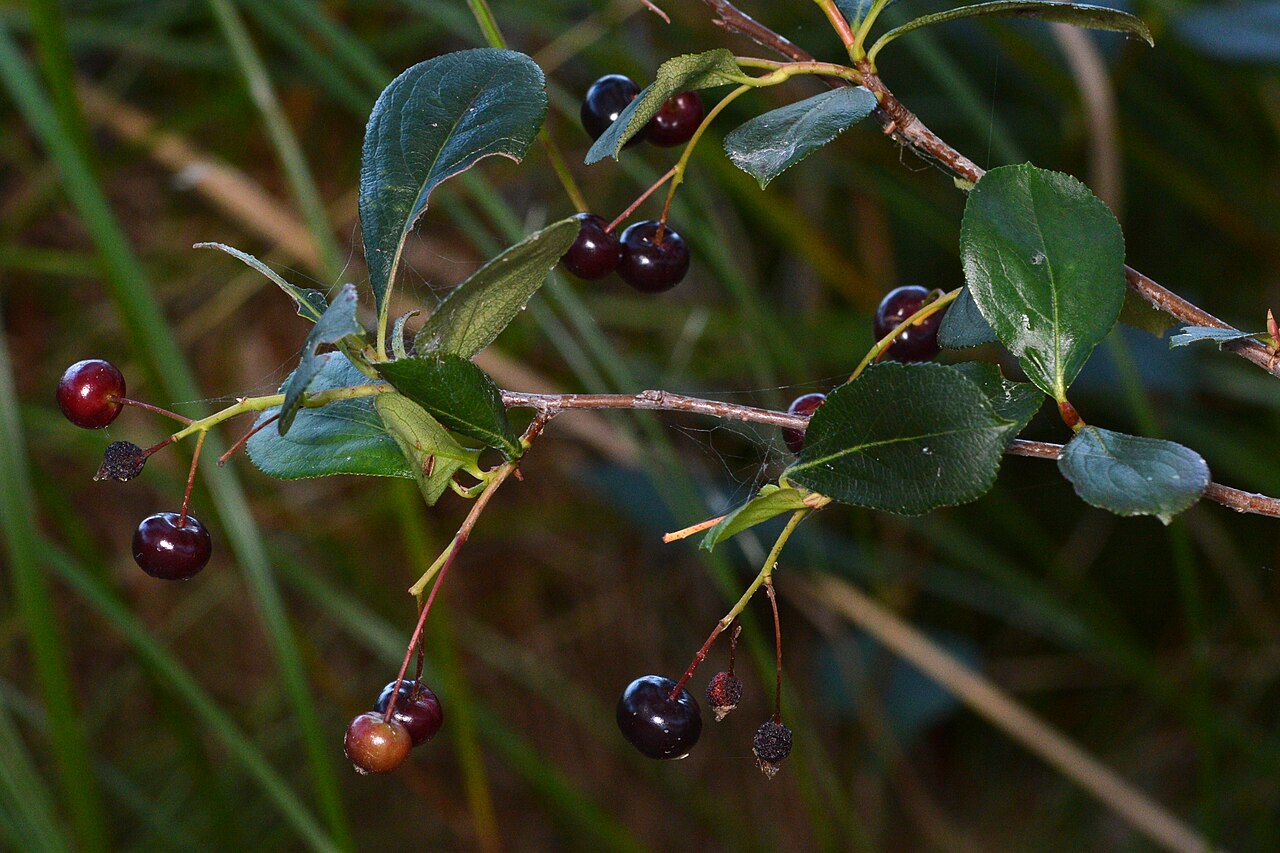
Avoid shearing the hedge into a box. Chokeberry is self-fruitful, but next year’s flower buds form while this year’s crop ripens, per Iowa State. Repeated shearing removes those buds and the fruit with them.
If an older hedge gets tall and bare at the base, renew it gradually rather than all at once. Our staged renovation plan for overgrown black chokeberry lays out the cuts year by year.
Mistakes to Avoid
- Planting the row right against a path or fence. Leave room for the fill zone and for your own access.
- Mowing or string-trimming into the base. Iowa State links this damage to lost canes and disease.
- Using weed killer on suckers. Suckers are connected to the parent plant. Cut or pull them instead.
- Planting in deep shade. The USDA notes that mildew becomes a problem when plants lack adequate sun and air circulation.
- Buying hybrids by accident. Read the label if a locally native hedge is the goal.
- Expecting a formal hedge. Chokeberry suits an informal, loosely shaped row, not a crisp sheared wall.
A chokeberry hedge also does double duty as wildlife habitat. For more ideas on mixing it with other berry shrubs, see our guide to native hedgerows for birds.
📋 Check your region: black chokeberry appears in our native plant lists for New Hampshire, Maine & Vermont, New York, Pennsylvania & Northern New Jersey, Maryland, Virginia & West Virginia, and North Carolina & South Carolina.
Frequently Asked Questions
How far apart should I plant black chokeberry for a hedge?
The USDA plant guide gives 4 to 6 feet as the optimum spacing. Use the closer end for a faster screen, and expect suckers to fill the gaps over a few seasons.
Will black chokeberry take over my lawn?
It suckers, but sources describe the spread as non-aggressive, and it varies by site. Regular mowing handles shoots in turf. Keep the mower out of the mulched fill zone so you don’t damage the hedge itself.
How tall will a black chokeberry hedge get?
Most sources put the species at 3 to 8 feet. Iowa State notes plants can be pruned to stay as small as about 3 feet across. For a truly low hedge, choose a compact selection such as Iroquois Beauty™.
Can I plant a chokeberry hedge in a wet spot?
Yes. The Morton Arboretum recommends it for low, wet locations, and the Lady Bird Johnson Wildflower Center calls it very flood tolerant. Avoid standing water that never drains.
When should I trim a black chokeberry hedge?
Shape it right after spring flowering, as The Morton Arboretum advises. Remove the oldest stems at the base every few years instead of shearing the outside.
Sources
- USDA NRCS, Black Chokeberry Plant Guide: height, hedgerow-like filling in, spacing, planting timing, cultivation to stop spread, regional variation in suckering, thinning, mildew.
- Mark Brand, Aronia: Native Shrubs With Untapped Potential, Arnoldia 67(3), 2010: rhizomes, non-aggressive colony formation, mature height.
- The Morton Arboretum, Black chokeberry: size, light, site tolerances, pruning after flowering, removing suckers, Iroquois Beauty™ size.
- Iowa State University Extension, Growing Aronia in Iowa: self-fruitfulness, bud formation, cane age, mulch, mower and trimmer damage, browsing, hybrid cultivars.
- NC State Extension Gardener Plant Toolbox: Aronia melanocarpa, Aronia arbutifolia, Itea virginica, Rhus aromatica: size, light, moisture, suckering and native range.
- Lady Bird Johnson Wildflower Center, Aronia melanocarpa: native distribution, flood tolerance, suckering.
- Royal Horticultural Society, Hedges: planting guide: staggered double rows, mulching and watering new hedges.