
Arkansas Yucca (Yucca arkansana)
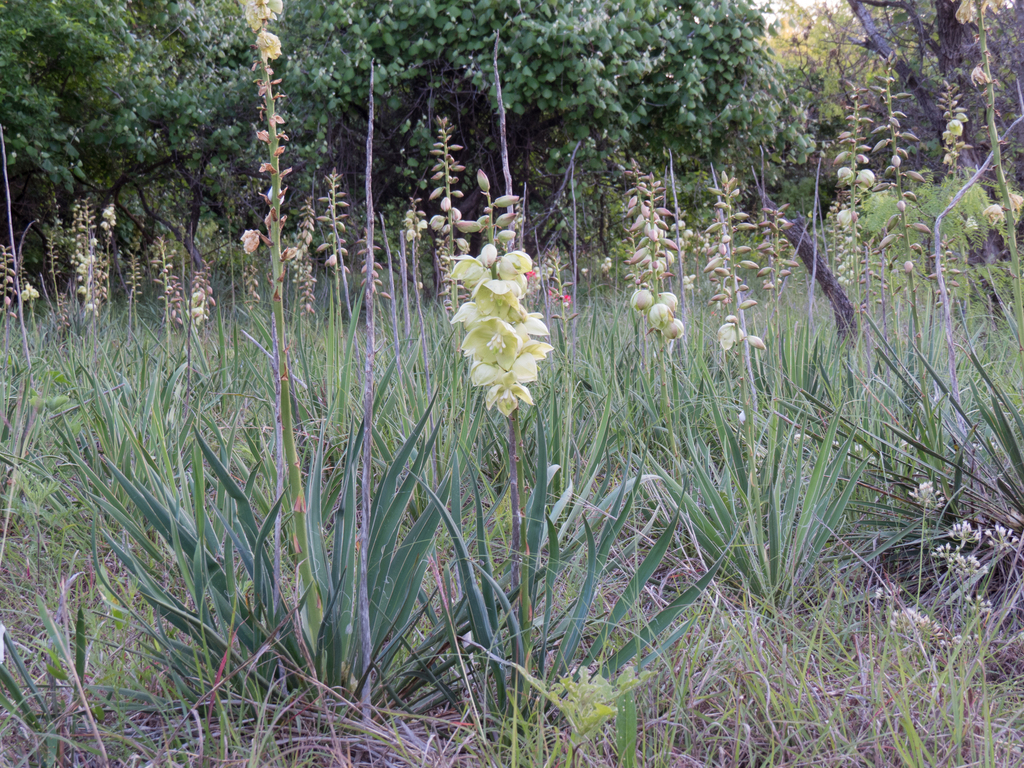
Yucca arkansana, known as Arkansas Yucca or soft yucca, is a low, stemless evergreen of the asparagus family (Asparagaceae) native to the southern Great Plains and the Ozark-Ouachita region. It forms rosettes of narrow, grayish-green leaves about 1 to 2 feet long, edged with curly white threads, and in mid-spring sends up a stalk 2 to 5 feet tall with dozens of nodding, creamy white, bell-shaped flowers.
Its leaves are thinner and more flexible than those of many yuccas, which is why it is sometimes called soft yucca, but they still end in a sharp point. It grows in rocky and sandy prairies, on limestone hills and in open oak woods, mainly in Texas, Oklahoma and Arkansas, with a few records in southern Kansas and southwestern Missouri. Some botanists include the Louisiana yucca and Freeman’s yucca of East Texas and Louisiana within this species.
Arkansas yucca is a tough, drought-tolerant accent plant for dry gardens, prairie plantings and rock gardens, and it is more compact and easier to place than larger yuccas. Caution: the leaf tips are sharp and can cause eye and skin injuries, so plant it away from paths and children’s play areas.
Identification
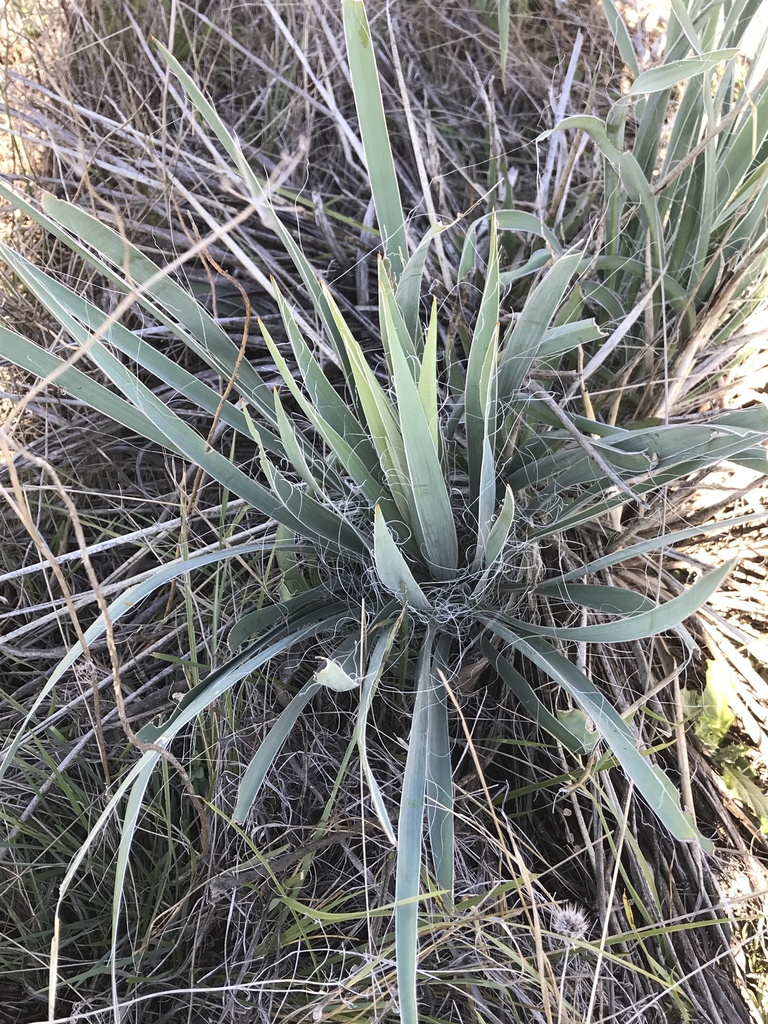
Look for a low, stemless rosette of narrow, flexible, grayish-green leaves with curly white edge fibers, and in spring a tall stalk of nodding, creamy white bells.
Growth Habit
Plants are evergreen and stemless or with a very short trunk, forming a rosette 1 to 2 feet tall and 2 to 3 feet wide. Over time a plant produces offsets from its rhizome-like base and forms small colonies.
Leaves
The leaves are linear to narrowly lance-shaped, about 1 to 2 feet long and 1/2 to 1 1/2 inches wide, flat to slightly concave, grayish to bluish green, and soft and flexible compared with most yuccas. They end in a short, sharp spine. The edges split into fine, curly white threads.
Flowers
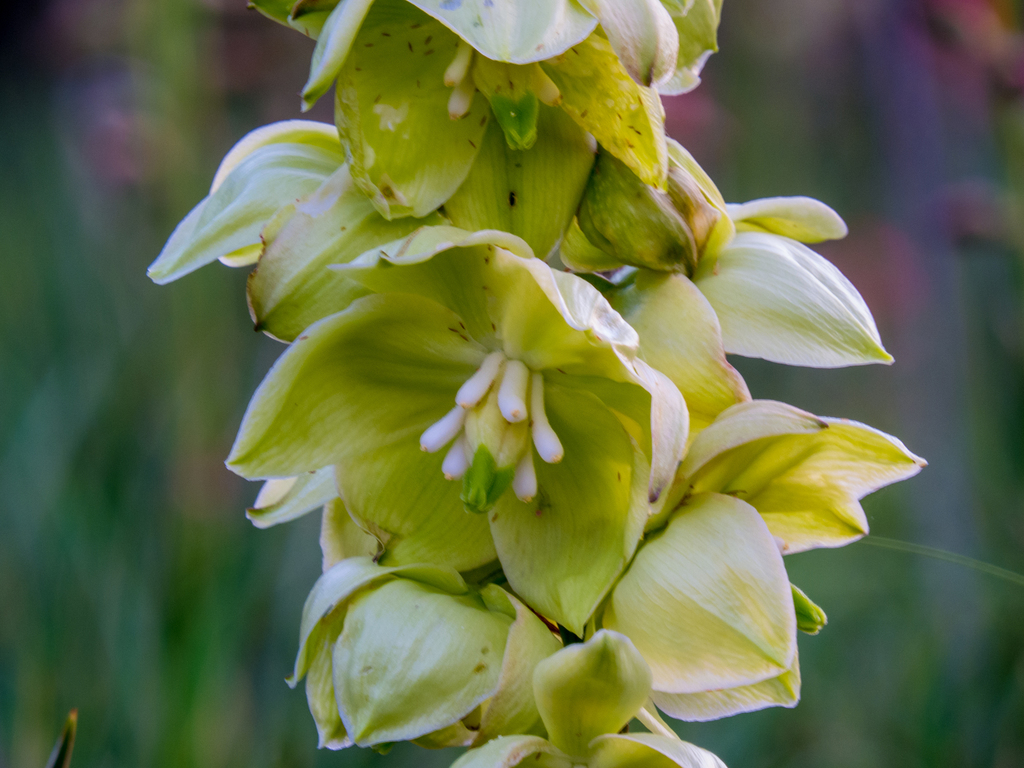
The flower stalk grows 2 to 5 feet tall from the center of the rosette in April to June. The upper part carries a narrow, usually unbranched raceme of many nodding, bell-shaped flowers, each 1 1/2 to 2 1/2 inches long, with six creamy white to greenish-white tepals.
Fruit
The fruit is an oblong, dry capsule about 1 1/2 to 2 inches long that splits open in summer to release flat, black seeds. Old fruit stalks with open capsules often remain into fall.
Look-alikes
Soapweed or narrowleaf yucca (Yucca glauca) has stiffer, narrower leaves less than 1/2 inch wide and grows farther north and west on the Plains. Twistleaf yucca (Y. rupicola) of the Edwards Plateau has twisted, wavy-edged leaves with yellow margins. Texas beargrass (Nolina texana) has grass-like leaves without spines and dense clusters of tiny flowers.
Quick Facts
| Scientific Name | Yucca arkansana |
| Family | Asparagaceae (asparagus family); formerly Agavaceae |
| Plant Type | Evergreen stemless shrub (rosette) |
| Mature Height | 1–2 ft (flower stalk 2–5 ft) |
| Mature Spread | 2–3 ft |
| Growth Rate | Slow |
| Sun Exposure | Full sun to part shade |
| Water Needs | Low; drought tolerant |
| Soil Type | Rocky, sandy, clay or limestone; well-drained |
| Soil pH | Slightly acidic to alkaline (about 6.0–8.5) |
| Bloom Time | April–June |
| Flower Color | Creamy white to greenish white |
| Fall Color | None; evergreen |
| Fruit | Dry capsule with flat black seeds |
| Deer Resistant | Moderately; flower stalks are often eaten |
| USDA Hardiness Zones | 6–9 |
Native Range
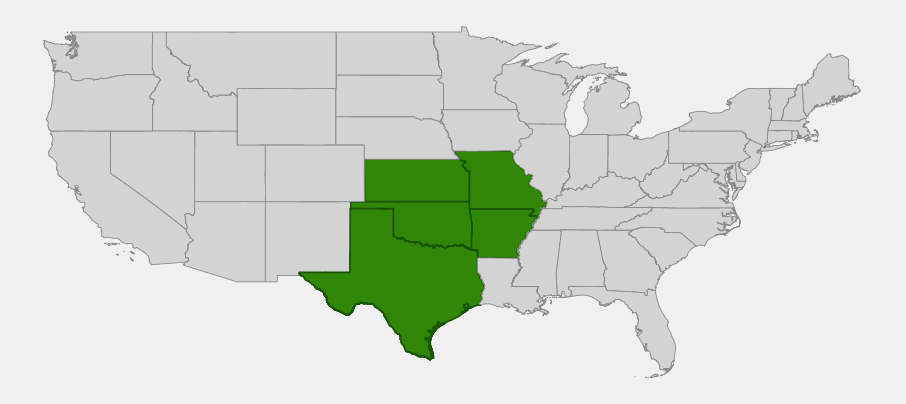
Arkansas yucca is native to the south-central United States. USDA PLANTS lists it as native in Arkansas, Kansas, Missouri, Oklahoma and Texas. It is most common in north-central and central Texas, including the Cross Timbers, the Blackland and Grand Prairies and the Edwards Plateau, and in central and eastern Oklahoma and western Arkansas.
In Arkansas it grows mainly in the Ouachita Mountains and the Arkansas Valley. It reaches southern Kansas and southwestern Missouri at the northern edge of its range, where records are few. In Texas it extends south into the South Texas Plains and west onto the Edwards Plateau.
It grows in rocky and sandy prairies, on limestone hills and ledges, in glades, in post oak and blackjack oak woods, and on roadsides, usually in well-drained soils, from about 300 to 2,500 feet.
📋 Regional plant lists featuring Arkansas Yucca: Nebraska, Kansas & Eastern Colorado · Illinois, Iowa & Missouri · Arkansas, Louisiana, Eastern Oklahoma & Eastern Texas · South & West Texas
Growing & Care Guide
Arkansas yucca is one of the easiest native yuccas for gardens in the southern Plains. It needs sun, good drainage and very little care once established.
Light
Full sun gives the most compact plants and best flowering. It tolerates part shade under open oaks, but blooms less.
Soil & Water
Plant in well-drained rocky, sandy or loam soil; it also tolerates clay on slopes. Water during the first season, then only in long droughts. Poor drainage and wet winters cause rot.
Planting Tips
Plant container-grown plants in spring or fall, 2 to 3 feet apart. Keep it away from walkways, patios and play areas because of the sharp leaf tips. It mixes well with native grasses such as little bluestem and with other dry-prairie wildflowers.
Pruning & Maintenance
Cut off the old flower stalk after the capsules open, if desired. Remove dead lower leaves with gloves and eye protection. No fertilizer is needed.
Propagation
Grow from seed sown in spring after soaking, or separate offsets from established clumps in spring. Seedlings grow slowly and may take several years to bloom.
Landscape Uses
- Dry gardens: a compact evergreen accent for xeric beds
- Prairie plantings: fits among bunchgrasses and wildflowers
- Rock gardens: suits rocky slopes and limestone outcrops
- Winter interest: evergreen rosettes with curly white threads
- Wildlife gardens: supports specialist yucca moths
Wildlife & Ecological Value
Like all yuccas, Arkansas yucca has a famous partnership with yucca moths, and it supports a range of other wildlife.
For Pollinators
Yuccas are pollinated by yucca moths (Tegeticula). A female moth collects pollen, carries it to another flower, pushes it onto the stigma and lays eggs in the ovary. Her larvae eat some of the developing seeds, but many seeds survive. Neither the plant nor the moth can reproduce well without the other. Bees and other insects also visit the flowers.
For Birds
The tall flower stalks are used as perches. Some birds eat the seeds, and the rosettes provide cover for ground-nesting birds such as quail.
For Mammals
Deer, cattle and rabbits eat the flower stalks and flowers, which are tender and sweet. The tough leaves are seldom eaten.
Ecosystem Role
Its deep roots help stabilize rocky and sandy soils, and its evergreen rosettes provide year-round shelter for insects, lizards and small animals in prairie communities.
Cultural & Historical Uses
Yucca leaves have been used for thousands of years by Indigenous peoples of North America for fiber to make cord, sandals, baskets and mats, and yucca roots contain saponins that were used as soap. The petals of many yuccas were eaten, but plants can be bitter and should only be eaten with reliable knowledge.
The species was described in 1902 by the American botanist William Trelease, a specialist in yuccas and agaves. The name arkansana refers to Arkansas, part of its native range.
Gardeners in Texas and Oklahoma value Arkansas yucca as a smaller, softer alternative to the large Southwest yuccas, and it is sold by some native plant nurseries. Its relationship with yucca moths is one of the best-known examples of mutualism in biology.
Frequently Asked Questions
Are Arkansas yucca leaves sharp?
Yes. Although they are softer and more flexible than many yuccas, the leaves end in a sharp spine. Plant it away from paths and wear eye protection when working around it.
How tall does Arkansas yucca get?
The leaf rosette is usually 1 to 2 feet tall; the flower stalk rises 2 to 5 feet in spring.
Does Arkansas yucca need water?
Very little once established. It is drought tolerant and rots in poorly drained, wet soil.
Does Arkansas yucca die after flowering?
No. The rosette that flowers may slow down, but the plant keeps growing and produces offsets.
How is it pollinated?
By yucca moths, which actively place pollen on the flowers and lay eggs in the ovaries. Their larvae eat some of the seeds.


