
Arrowleaf Ragwort (Senecio triangularis)
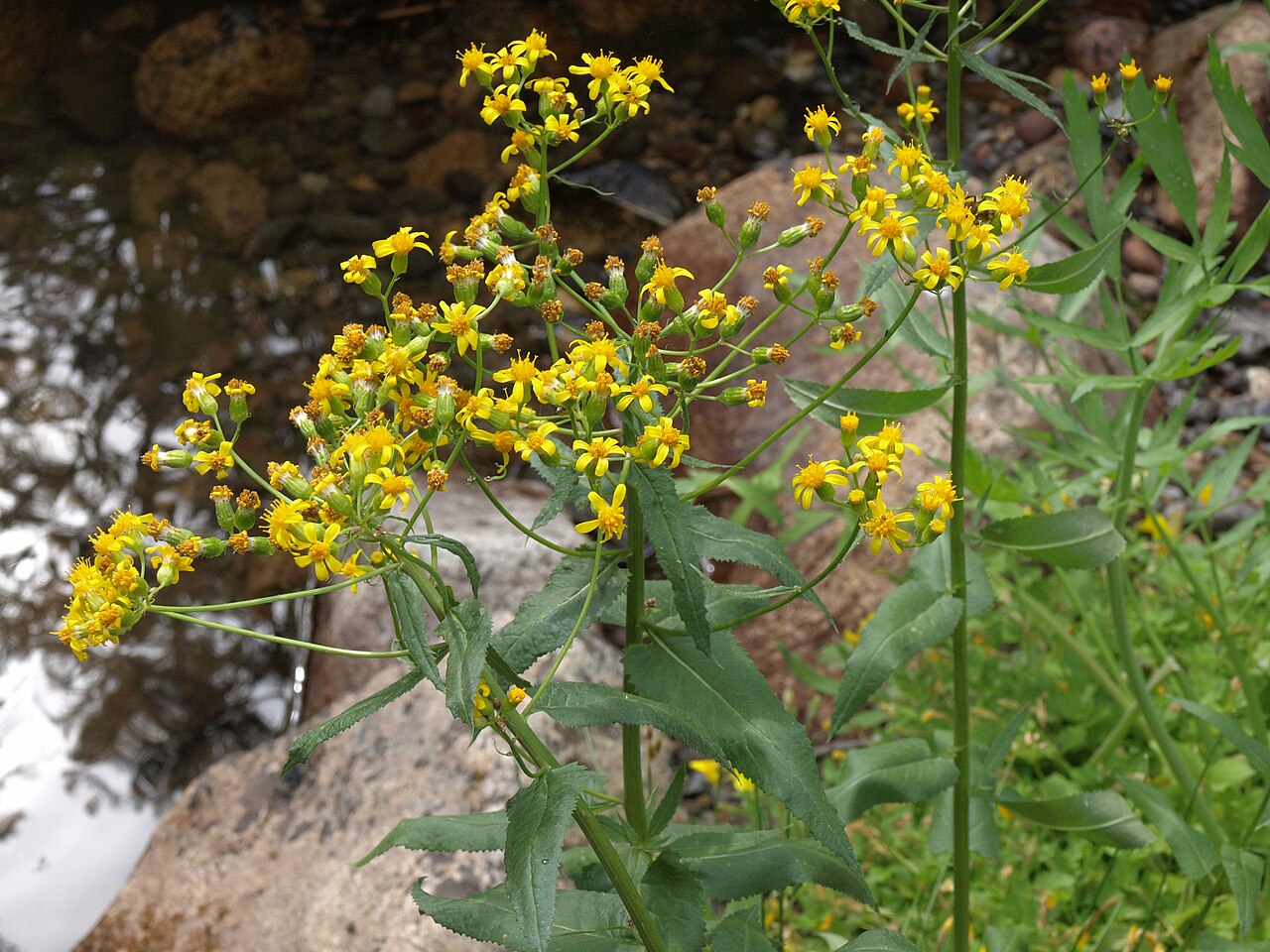
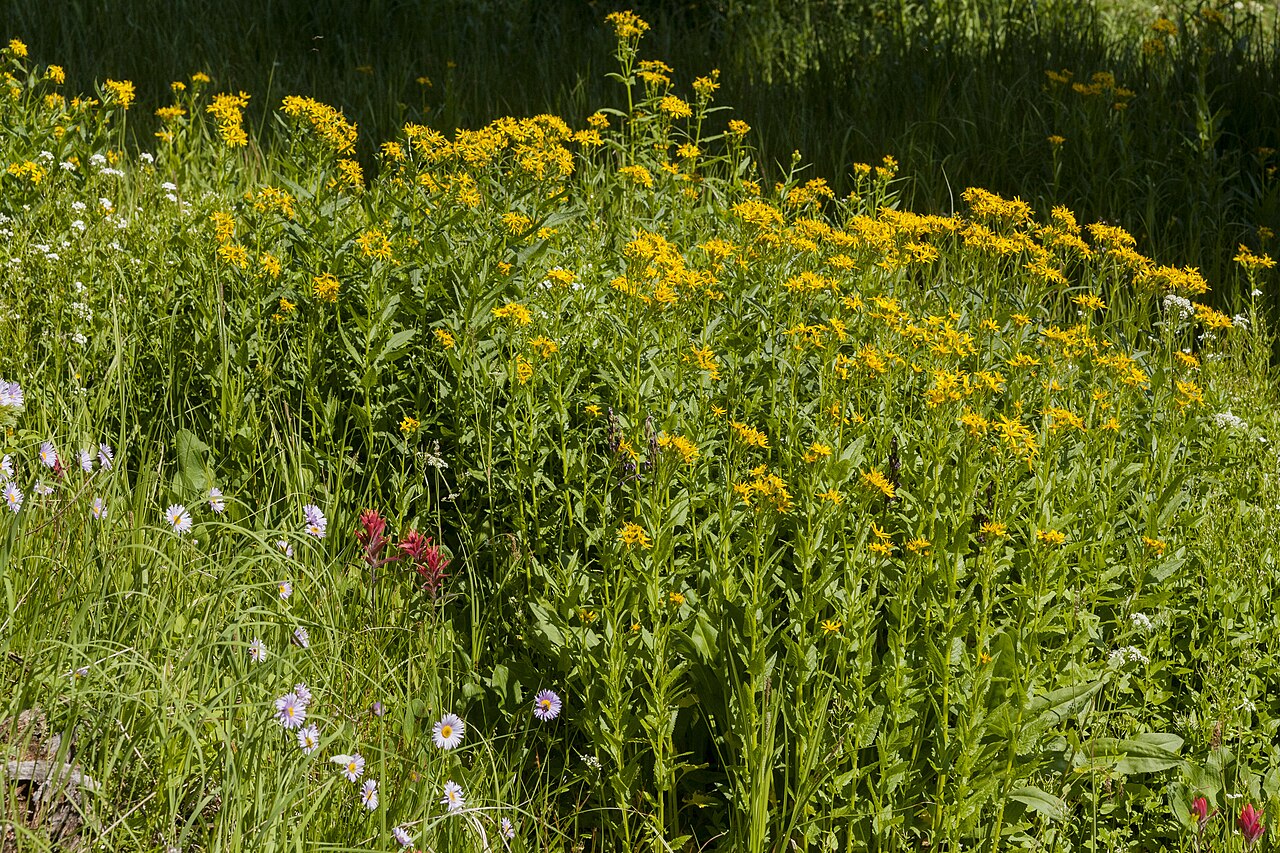
Senecio triangularis, Arrowleaf Ragwort, is one of the most common and showy wildflowers of wet places in the western mountains. Also called arrowleaf groundsel, arrowleaf butterweed or arrowleaf senecio, it is a tall, leafy perennial in the aster family (Asteraceae) that lines mountain streams, seeps and wet meadows from Alaska to New Mexico. In mid to late summer it forms lush stands 2 to 5 feet tall, crowned with flat-topped clusters of bright yellow, daisy-like flower heads.
Its leaves give it its name: they are long, sharply toothed and shaped like an arrowhead or a narrow triangle, a feature that sets it apart from the many other yellow-flowered groundsels of the West. Where water flows all summer, it can form almost continuous bands of yellow along creeks and below melting snowbanks.
Arrowleaf ragwort is a valuable plant for pollinators and for stabilizing wet mountain soils, and it can be grown in moist, cool gardens. Like other Senecio species, it contains pyrrolizidine alkaloids and is toxic if eaten. This guide covers identification, range, growing it in a garden, and its role in mountain ecosystems.
Identification
Look for a tall, leafy, clump-forming plant in wet ground with triangular, coarsely toothed leaves all the way up the stem and a flat-topped cluster of small yellow daisies at the top.
Stems & Growth Form
Arrowleaf ragwort grows from a short, stout rootstock with fibrous roots, sending up several to many unbranched, leafy stems that usually reach 2 to 5 feet tall. The stems are smooth or slightly hairy and are leafy all the way up, so a clump looks lush and bushy even before it blooms. The plant dies back to the ground each fall.
Leaves
The leaves are the key feature. They are alternate, thin, bright green, about 2 to 8 inches long, and triangular to narrowly arrowhead-shaped, with a flat or slightly heart-shaped base and a pointed tip. The edges are lined with sharp, irregular teeth. Lower leaves have stalks, while leaves higher on the stem are smaller, narrower and nearly stalkless.
Flowers
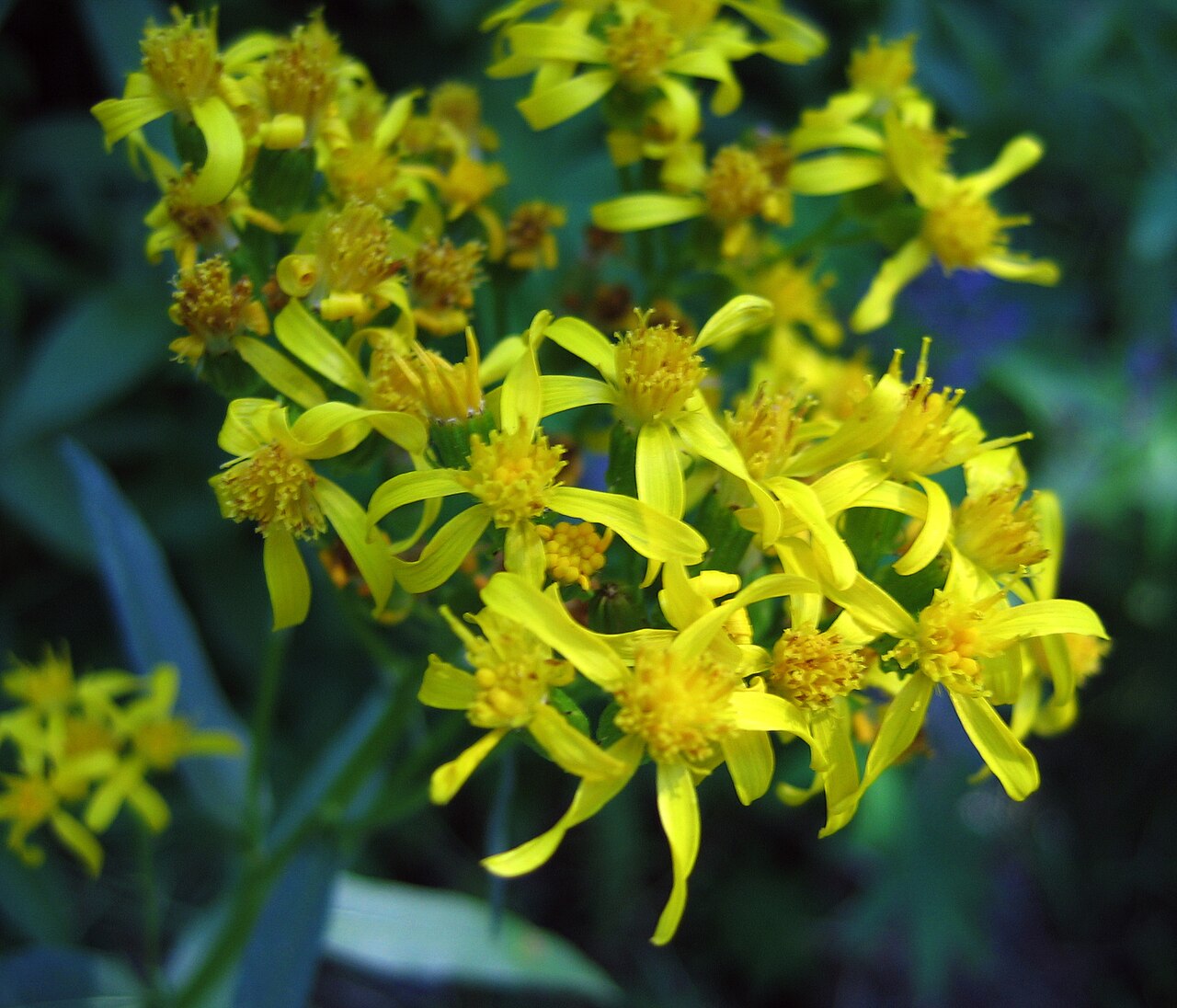
The flower heads are clustered in a flat-topped or slightly rounded, branched cluster at the top of each stem, often with 10 to 30 or more heads. Each head is about ¾ to 1 inch across, with about eight bright yellow ray flowers, which are often a little uneven, around a yellow to orange-yellow disk. The bracts around each head are green, often with darker tips. Flowering runs from June to September, depending on elevation and snowmelt.
Seeds & Look-alikes
The seeds are small, ribbed achenes topped with a tuft of soft white bristles that carry them on the wind. Tall western groundsel (S. integerrimus) grows in drier meadows and has mostly basal, untoothed or barely toothed leaves. Other groundsels, such as butterweed and golden ragwort, now placed in Packera, have lobed or rounded leaves. No other common western groundsel has the large, sharply toothed, triangular leaves of arrowleaf ragwort.
Quick Facts
| Scientific Name | Senecio triangularis |
| Family | Asteraceae (aster family) |
| Plant Type | Herbaceous perennial wildflower |
| Mature Height | 2–5 ft |
| Mature Spread | 1–3 ft |
| Growth Rate | Moderate |
| Sun Exposure | Full sun to part shade |
| Water Needs | High; needs consistently moist to wet soil |
| Soil Type | Moist to wet loam, gravel or rich organic soil |
| Soil pH | About 5.5–7.5 |
| Bloom Time | June–September |
| Flower Color | Bright yellow |
| Fall Color | None notable; dies back in fall |
| Fruit | Small achenes with white, fluffy bristles |
| Deer Resistant | Moderate; not a preferred food, and toxic to livestock |
| USDA Hardiness Zones | 3–8 |
Native Range
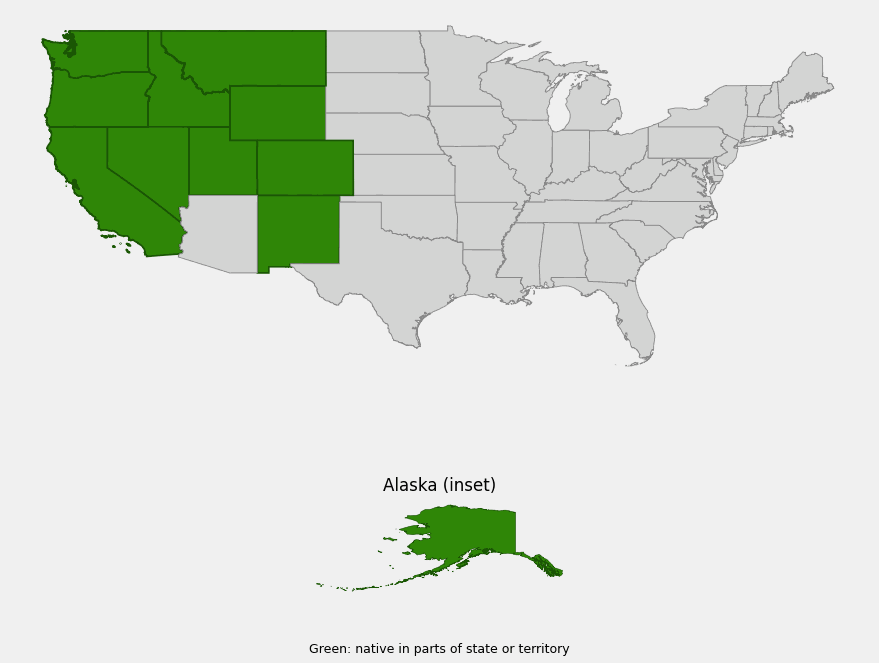
Arrowleaf ragwort is native to the mountains of western North America. USDA PLANTS lists it as native in eleven states: Alaska, Washington, Oregon, California, Idaho, Montana, Wyoming, Nevada, Utah, Colorado and New Mexico. In Canada it grows in British Columbia, Alberta, the Yukon and the Northwest Territories. The Lady Bird Johnson Wildflower Center summarizes its range as Alaska and western Canada south to southern California and New Mexico.
It is found in nearly every major western mountain range, including the Cascades, Olympics, Sierra Nevada, Klamath Mountains, northern and central Rockies, the Wasatch and the mountains of the Great Basin, and it reaches south to the high peaks of southern California and northern New Mexico. In Alaska it grows mainly in the south and southeast. In Oregon and Washington it grows on both sides of the Cascades.
Its habitat is almost always wet: streambanks, seeps, springs, wet meadows, avalanche chutes, moist openings in conifer forests and the edges of melting snowfields. It grows from fairly low elevations in the Pacific Northwest and Alaska to well above 11,000 feet in the southern Rockies and Sierra Nevada, and is especially common in the subalpine zone.
📋 Regional plant lists featuring Arrowleaf Ragwort: Idaho, Eastern Oregon & Eastern Washington · Montana & Wyoming · Utah & Western Colorado · Alaska · Western Oregon & Western Washington · California & Nevada
Growing & Care Guide
Arrowleaf ragwort is an easy, long-lived perennial where it gets what it needs: cool summers and soil that never dries out. It is best suited to gardens in or near the western mountains and the Pacific Northwest. Buy nursery-grown plants or seed, and leave wild plants in place.
Safety note: like other Senecio species, arrowleaf ragwort contains pyrrolizidine alkaloids, which can cause serious liver damage. Never eat any part of the plant or use it as an herbal remedy, keep it out of hay and pasture for horses and cattle, and keep pets and children from chewing it.
Light
Full sun to part shade. In cool mountain and coastal gardens it takes full sun as long as the soil stays wet. In warmer, lower-elevation gardens, give it afternoon shade.
Soil & Water
It needs consistently moist to wet soil and is classed as a facultative to obligate wetland plant. Rich loam, gravelly streambank soil or the edge of a pond or bog all suit it. It tolerates periodic flooding and saturated soil, but not drought: in dry soil the leaves scorch and the plant declines.
Planting Tips
Plant nursery-grown plants in spring or early fall along a stream, pond edge, rain garden or naturally wet spot, spacing them about 18 to 24 inches apart. It pairs well with monkeyflowers, monkshood, mountain bluebells and sedges in a wet meadow planting.
Pruning & Maintenance
Very little care is needed. Cut back the stems in late fall or early spring. Remove spent flower heads if you do not want it to self-seed. Tall plants in rich soil may lean; neighboring plants usually give them enough support.
Propagation
Grow it from seed or by dividing established clumps in early spring. Fresh seed sown outdoors in fall usually germinates the following spring after the cold of winter; for indoor sowing, give the seed a few weeks of cold, moist stratification first. Seedlings usually flower in their second or third year.
Landscape Uses
- Streambank and pond-edge plantings: tall summer color where the soil stays wet
- Rain gardens and wet meadows: in cool western climates
- Pollinator gardens: late-summer nectar and pollen for bees, flies and butterflies
- Riparian restoration: helps hold soil along mountain streams and seeps
- Mountain cabin and native gardens: a dependable perennial for high-elevation gardens
Wildlife & Ecological Value
Arrowleaf ragwort is a common part of the lush, flowery vegetation of mountain streams and wet meadows, where it blooms in the short, busy mountain summer.
For Pollinators
Its many flower heads offer easy-to-reach nectar and pollen, so they are visited by a wide variety of insects, including bumblebees and other native bees, syrphid flies and other flies, beetles and butterflies. In subalpine meadows it is often one of the most heavily visited flowers in late summer.
For Birds
Seed-eating finches and other small birds sometimes eat the seeds. The dense, leafy stands along streams also give cover to birds that nest and feed in mountain riparian thickets.
For Mammals
Pikas, marmots and other small mammals feed on many subalpine plants, and grazing animals sometimes eat it. Because of its alkaloids, it is a concern for cattle and horses and is not considered good forage.
Ecosystem Role
Its strong, fibrous roots and leafy clumps help stabilize streambanks, seeps and avalanche paths, and it recovers well from disturbance. Dense stands provide shade and moist microhabitats for insects, amphibians and smaller plants along mountain streams.
Cultural & Historical Uses
The genus name Senecio comes from the Latin senex, “old man,” referring to the white, hair-like bristles on the seeds. The species name triangularis describes the triangular leaves. “Ragwort” and “groundsel” are old English names for plants in this group, and western hikers and botanists use arrowleaf groundsel, arrowleaf butterweed and arrowleaf senecio as well.
For many mountain hikers, the yellow ribbons of arrowleaf ragwort along a creek are one of the signs of high summer in the backcountry. It is a characteristic plant of the wildflower displays of places like Mount Rainier, Yosemite and Rocky Mountain National Parks.
Like its relatives, it is not used as a food or home remedy today. The pyrrolizidine alkaloids found in Senecio species have caused livestock poisoning and human illness, so admire it in the field and in the garden, but never eat it.
Frequently Asked Questions
Why is it called arrowleaf ragwort?
Its long, sharply toothed leaves are shaped like an arrowhead or a narrow triangle. “Ragwort” is an old name for yellow-flowered plants in the Senecio group. It is also called arrowleaf groundsel, arrowleaf butterweed and arrowleaf senecio.
Is arrowleaf ragwort poisonous?
Yes. Like other Senecio species, it contains pyrrolizidine alkaloids that can damage the liver. People should never eat it, and it should be kept out of hay and pastures for horses and cattle.
When does arrowleaf ragwort bloom?
From June to September, depending on elevation and when the snow melts. At high elevations, peak bloom is usually July and August.
Can I grow arrowleaf ragwort in my garden?
Yes, if you can give it consistently moist or wet soil and a cool summer. It does best in mountain and Pacific Northwest gardens, beside streams, ponds or rain gardens. In hot, dry climates it struggles.
Is arrowleaf ragwort invasive?
No. It is a native wildflower of western North America. It can spread by seed in wet gardens, but it is not an aggressive weed like the non-native tansy ragwort (Jacobaea vulgaris).

Looking for a nursery that carries Arrowleaf Ragwort?
Browse our native plant nursery directory: Alaska · California · Colorado · Idaho · Montana · Nevada & New Mexico · Oregon · Utah · Washington · Wyoming