
Blackroot (Pterocaulon pycnostachyum)
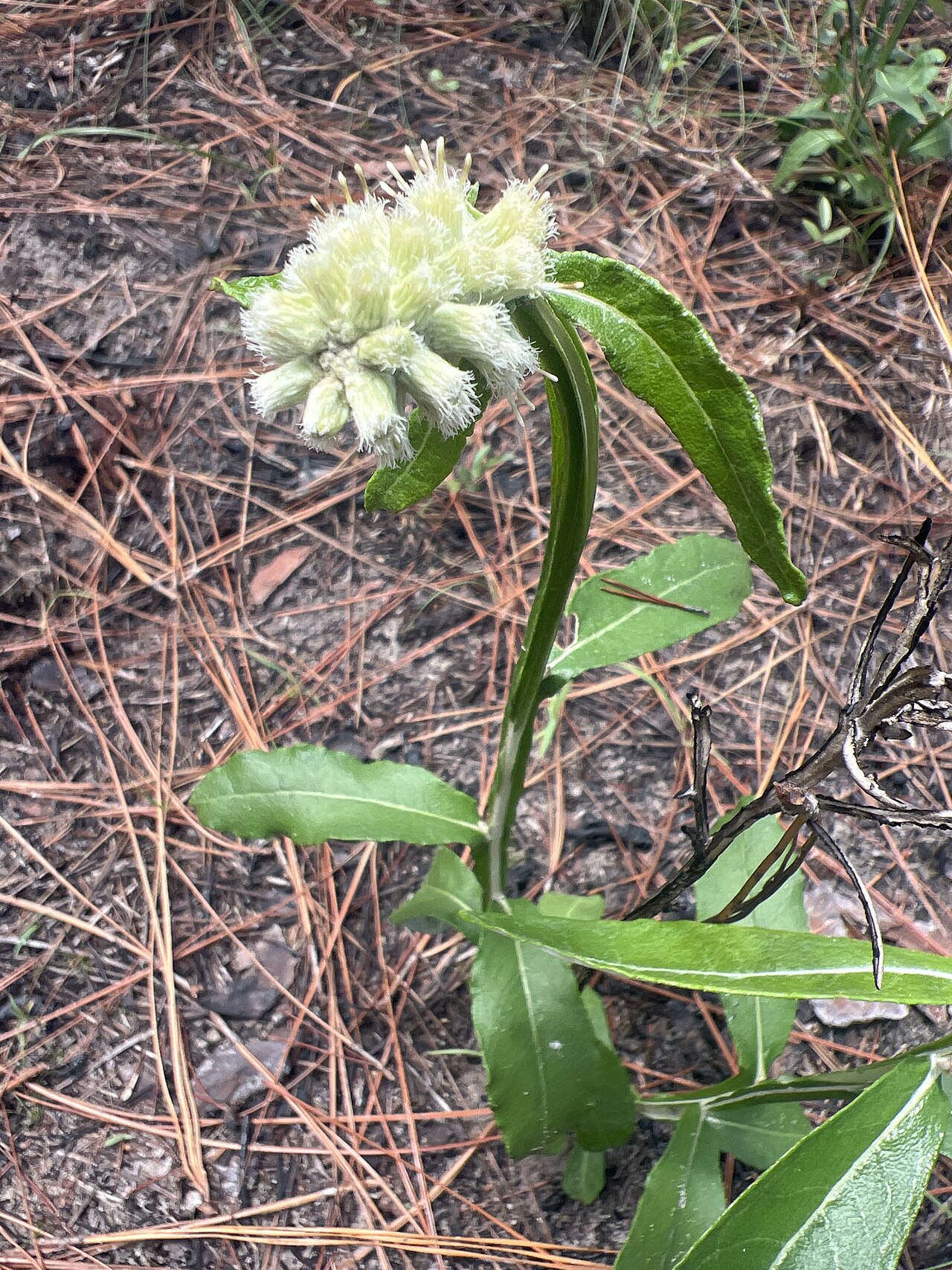
Pterocaulon pycnostachyum, known as Blackroot or dense-spike blackroot, is a perennial wildflower of sandy pinelands in the southeastern Coastal Plain. Its stems are lined with wavy green wings that run down from the base of each leaf, and its narrow leaves are dark green above and white with dense wool underneath. From late spring through summer, each stem ends in a dense, fuzzy, creamy white spike of tiny flower heads that looks a little like a cotton swab or a small woolly caterpillar.
Blackroot belongs to the aster family (Asteraceae). The name comes from its thick, dark, tuberous roots, which let it survive drought and the frequent fires that shape longleaf pine flatwoods and sandhills. It is a typical plant of these fire-maintained habitats from North Carolina to Florida and west to Mississippi. Older books often call it Pterocaulon virgatum or P. undulatum, names that were once applied to these plants; USDA PLANTS treats P. undulatum as a synonym, and P. virgatum is now considered a different, South American species.
In gardens it is an unusual, low-maintenance choice for dry, sunny, sandy sites. It is not showy in the way that blazing stars or goldenasters are, but its silvery-backed foliage, winged stems and woolly spikes add texture to a pineland or butterfly garden, and it is occasionally sold by native plant nurseries in Florida and the Southeast.
Identification
Blackroot is easy to recognize, even out of flower, by its combination of winged stems and white-woolly leaf undersides. No other common pineland wildflower in its range has quite the same look.
Stems
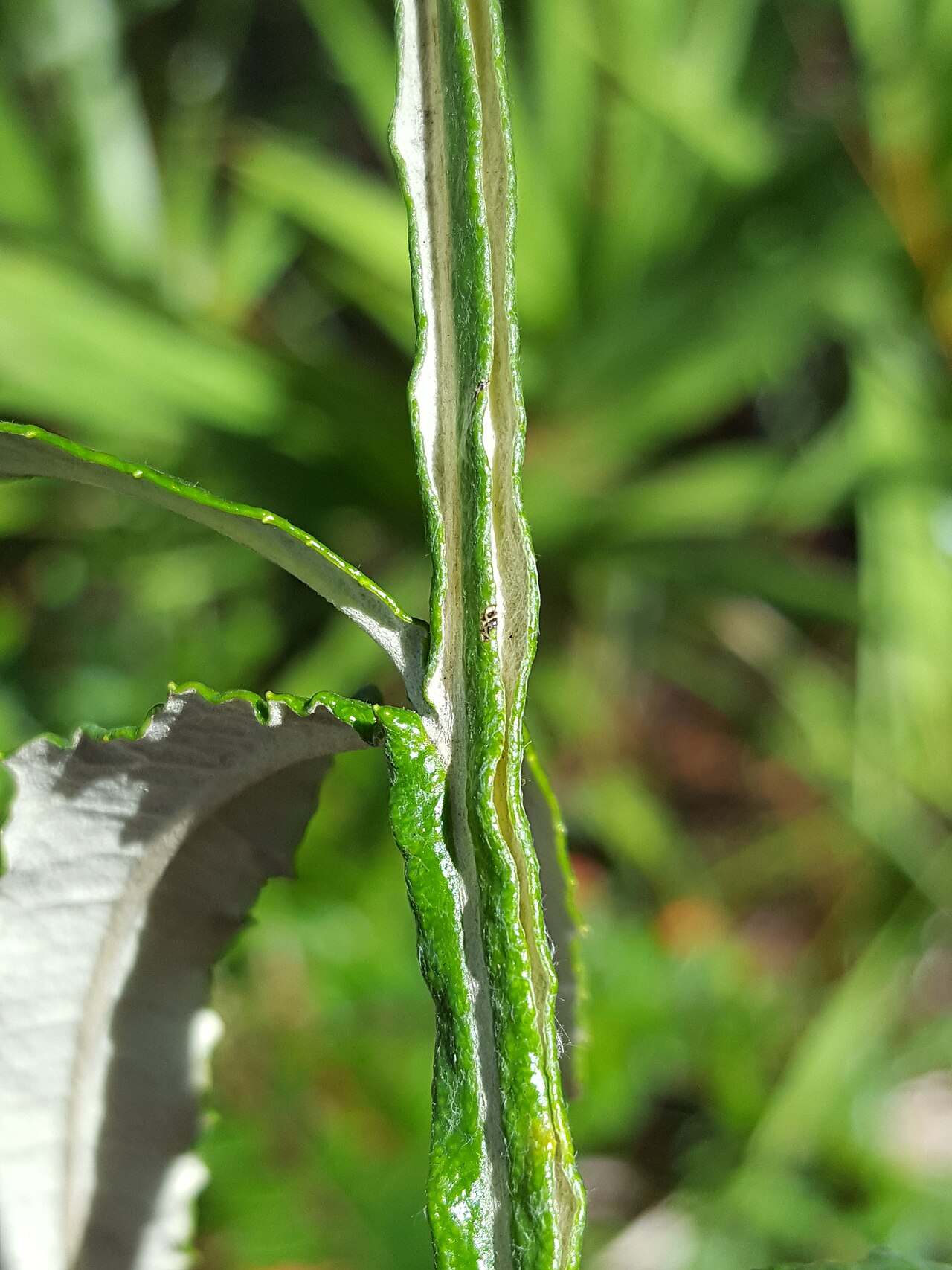
Plants have one to several upright stems, usually 1 to 2 feet tall and occasionally up to 3 feet, growing from thick, black, somewhat tuberous roots. The stems are woolly and are lined with narrow, wavy green wings formed by the leaf bases running down the stem. This feature gives the genus its name, from Greek words meaning “winged stem.”
Leaves
The leaves are alternate, narrowly lance-shaped to elliptical, about 2 to 5 inches long, with wavy or finely toothed edges. The upper surface is dark green and nearly smooth, and the lower surface is densely covered with white or grayish wool, so plants flash silver when the wind turns the leaves. Lower leaves are often withered by flowering time.
Flowers
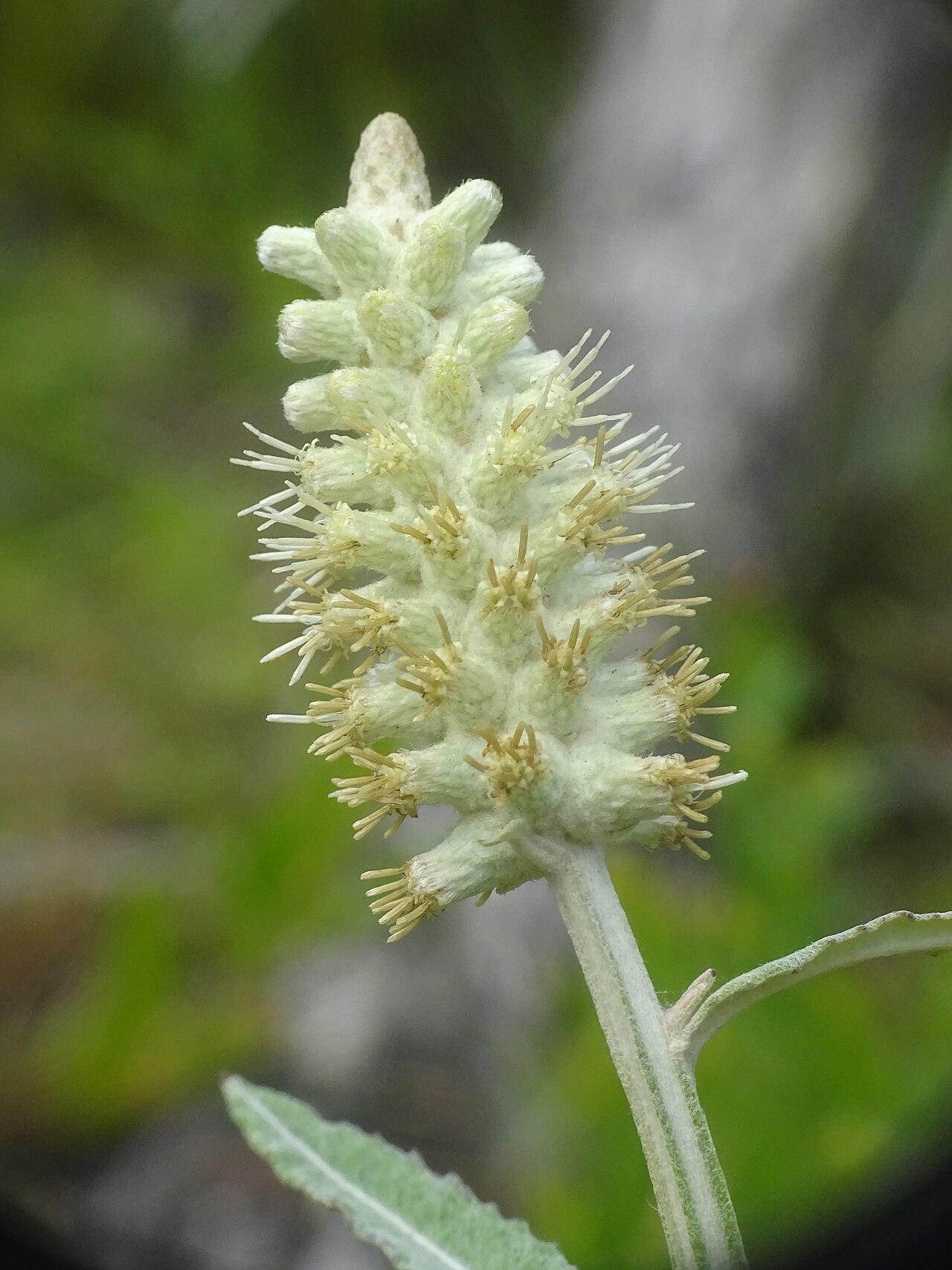
From about April to September, each stem ends in a dense, cylindrical, spike-like cluster 1 to 4 inches long, sometimes with smaller side spikes. The spike is made of many small flower heads packed tightly together. Each head contains tiny, threadlike, whitish to cream flowers with no petals in the usual sense. The buds may be pinkish, and the spikes age from white to greenish or tan. The whole spike is woolly, giving it a soft, fuzzy look.
Fruit & Seeds
After flowering, the spike turns brown and the small seeds (achenes) mature, each topped with a tuft of fine, whitish bristles that carry it on the wind. Old brown spikes, which look like small dried cattails, often remain on the plant into fall and are another clue to its identity.
Quick Facts
| Scientific Name | Pterocaulon pycnostachyum (Michx.) Elliott |
| Family | Asteraceae (aster family) |
| Plant Type | Herbaceous perennial (sometimes slightly woody at base) with tuberous roots |
| Mature Height | 1–2 ft (rarely to 3 ft) |
| Mature Spread | 6–12 in |
| Growth Rate | Moderate |
| Sun Exposure | Full sun to light shade |
| Water Needs | Low; very drought tolerant once established |
| Soil Type | Well-drained sand; low-fertility pineland soils |
| Soil pH | Acidic (about 4.5–6.5) |
| Bloom Time | April–September (peak May–July) |
| Flower Color | Creamy white, aging to greenish or tan |
| Fall Color | Not notable; brown seed spikes persist |
| Fruit | Small achenes with white bristles, wind-dispersed |
| Deer Resistant | Usually; the woolly, aromatic foliage is seldom browsed |
| USDA Hardiness Zones | 8–10 |
Native Range
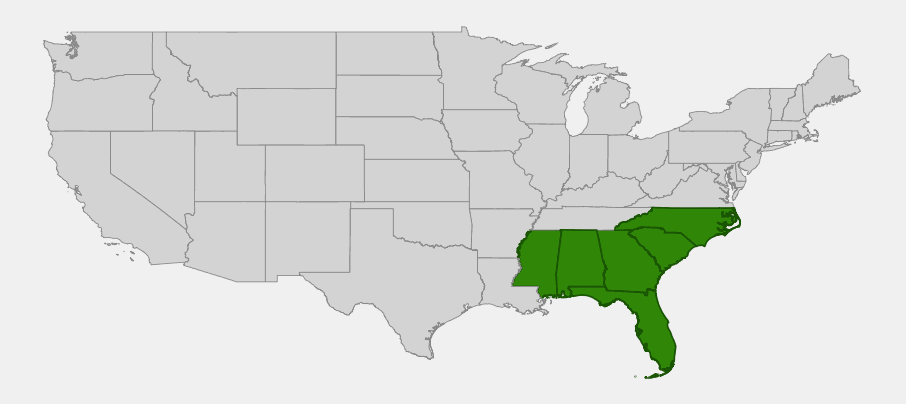
Blackroot is a plant of the southeastern Coastal Plain. USDA PLANTS lists it as native in North Carolina, South Carolina, Georgia, Florida, Alabama and Mississippi. It is found from the southeastern corner of North Carolina south through the Coastal Plain of South Carolina and Georgia and throughout most of Florida, including the pinelands of South Florida, and west along the Gulf Coast to southern Alabama and Mississippi.
It is most common in Florida, where it occurs in nearly every county. North of Florida it is mostly limited to the outer Coastal Plain, and it becomes scattered near the northern and western edges of its range in North Carolina and Mississippi.
Typical habitats are longleaf pine flatwoods and savannas, sandhills, scrubby flatwoods, pine rocklands in South Florida, coastal dunes and other open, sandy, fire-maintained places. It often grows among wiregrass and saw palmetto under scattered pines, and also turns up along sandy roadsides and firebreaks.
📋 Regional plant lists featuring Blackroot: Alabama, Georgia & Mississippi · North & South Florida · North & South Carolina
Growing & Care Guide
Blackroot is an easy plant for the right site: full sun, deep sand and no fuss. It is a good fit for pineland restorations, dry wildflower meadows and naturalistic butterfly gardens in the Coastal Plain, where it fills in among grasses and taller wildflowers.
Light
Full sun gives the best growth and flowering. It tolerates light shade under scattered pines, but in heavier shade it becomes thin and flowers poorly.
Soil & Water
Plant it in well-drained, sandy, acidic soil of low fertility. It is very drought tolerant once its tuberous roots are established, and it needs no irrigation in most of its range after the first season. It dislikes rich, heavy or constantly wet soil, and too much fertilizer or water makes it floppy and short-lived.
Planting Tips
Set out container plants in spring or during the summer rainy season, spacing them about a foot apart, and water them until new growth appears. Group several plants among native grasses such as wiregrass or little bluestem and other pineland wildflowers, where the woolly white spikes stand out against the green. Use nursery-propagated plants and do not dig them from the wild.
Pruning & Maintenance
Little care is needed. Leave the seed spikes standing for interest and to let them self-sow, or cut stems back in late winter. In larger plantings, a periodic burn or a hard mowing in late winter mimics the natural fire cycle, and blackroot resprouts vigorously from its roots.
Propagation
Grow it from fresh seed sown on the surface of a sandy mix in spring or summer, keeping it lightly moist until seedlings appear. Established clumps can also be divided carefully in early spring, keeping a section of the dark root with each division.
Landscape Uses
- Pineland and sandhill restorations: a characteristic wildflower of fire-maintained longleaf ecosystems
- Dry, sandy wildflower meadows: thrives where other plants struggle with drought and poor soil
- Butterfly and pollinator gardens: long bloom season for small bees, wasps and butterflies
- Coastal gardens: tolerates sandy soil and some salt spray near the shore
- Textural accent: silvery leaf undersides and woolly spikes contrast with grasses
Wildlife & Ecological Value
Blackroot is a modest but reliable member of the pineland wildflower community, flowering steadily through the hottest months of the year.
For Pollinators
The small flowers are visited by a variety of small native bees, wasps, flies and occasionally butterflies. Because it blooms over a long period, from spring into late summer, it helps fill the gap between spring and fall wildflowers in pinelands.
For Birds
The small seeds may be eaten by sparrows and other seed-eating birds, and the open, grassy habitats where blackroot grows support Bachman’s sparrows, northern bobwhite and other birds that depend on frequent fire.
For Mammals
The woolly, aromatic foliage is seldom eaten by deer or rabbits. Gopher tortoises, which share its sandhill and flatwoods habitat, graze many low plants and may nibble it occasionally.
Ecosystem Role
Blackroot is adapted to frequent, low-intensity fire. Its deep, tuberous roots survive burns and send up new shoots quickly afterward, and flowering is often vigorous in the season after a fire. Where fire is excluded and pinelands grow dense with shrubs, it declines, so it is a helpful indicator of well-managed, open pine habitat.
Cultural & Historical Uses
The genus name Pterocaulon combines the Greek pteron (wing) and kaulos (stem), for the winged stems. The species name pycnostachyum means “dense spike.” The French botanist André Michaux, who explored the Southeast in the 1780s and 1790s, first described the plant, and Stephen Elliott, a South Carolina botanist, placed it in Pterocaulon.
Blackroot belongs to a genus of roughly twenty species. It is the one most often seen in the southeastern United States, and its relatives are found mainly in South America, with others in Australia and Southeast Asia, and several of them share its winged stems and woolly flower spikes.
The name blackroot comes from the plant’s very dark, swollen roots, which are rarely seen. For most visitors to Florida pinelands, though, its fuzzy white spikes and winged stems are the memorable features.
Frequently Asked Questions
Why is it called blackroot?
The plant grows from thick, dark, tuberous roots that are nearly black. These roots store water and energy and help it survive drought and fire.
Is blackroot the same as Pterocaulon virgatum?
Not quite. Older Florida books sometimes used P. virgatum or P. undulatum for this plant. Current treatments call the southeastern U.S. plant P. pycnostachyum; P. undulatum is a synonym, and P. virgatum is a separate South American species.
Can I grow blackroot in my garden?
Yes, if you have a sunny, well-drained, sandy site in the Coastal Plain. It is drought tolerant and needs little care. Look for it at native plant nurseries, and do not dig it from the wild.
How do I recognize it out of flower?
Look for stems lined with wavy green wings and leaves that are dark green above and white-woolly below. Old brown seed spikes often remain on the plant into fall.
Does it need fire?
It does not need fire in a garden, but it is adapted to it. In the wild it resprouts quickly after burns and flowers well afterward. In a garden, cutting it back in late winter has a similar refreshing effect.

Looking for a nursery that carries Blackroot?
Browse our native plant nursery directory: Alabama · Florida & Georgia · Mississippi · North Carolina · South Carolina