
Buckthorn Bumelia (Sideroxylon lycioides)
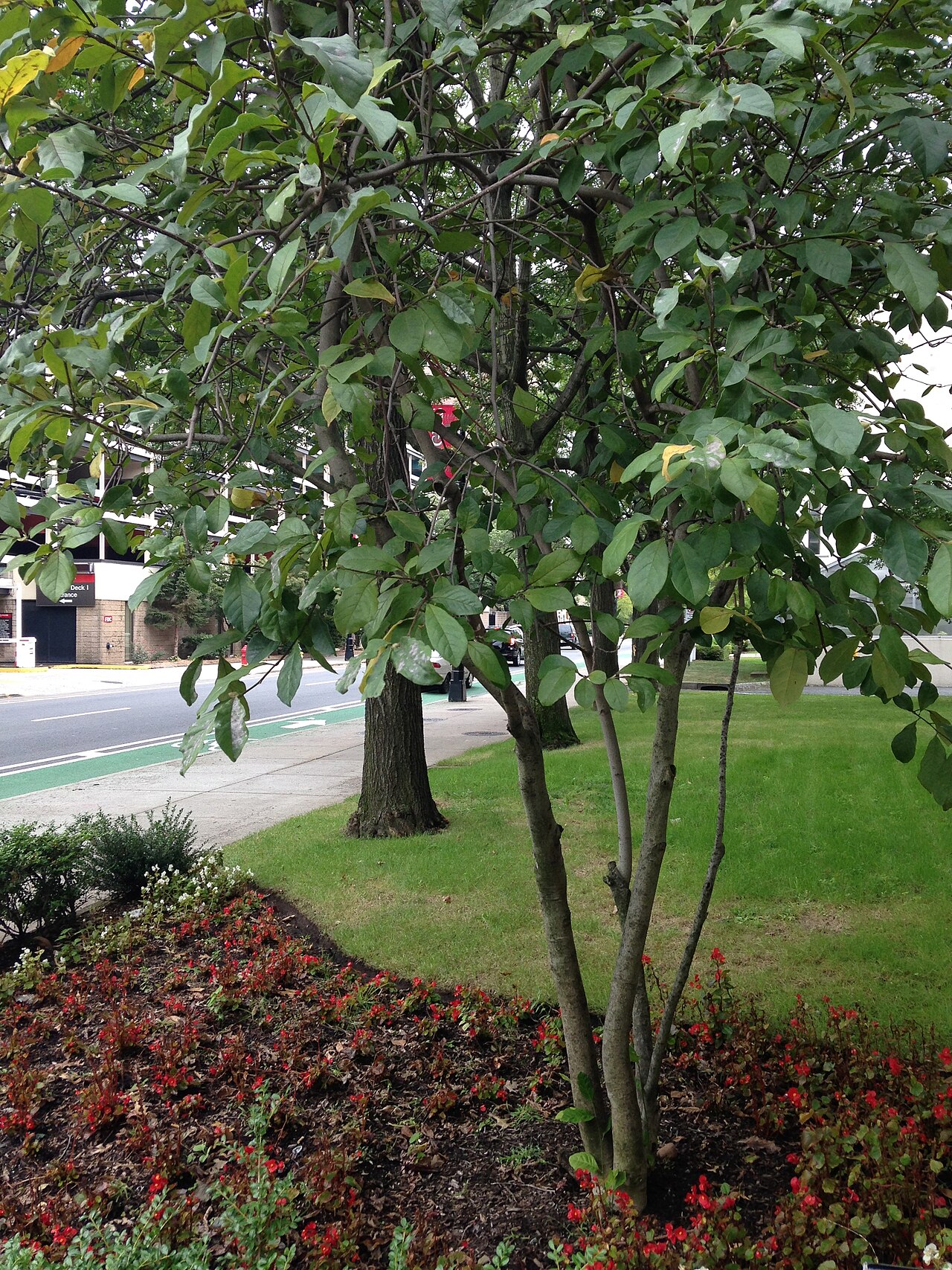
Sideroxylon lycioides (long known as Bumelia lycioides), commonly called Buckthorn Bumelia or buckthorn bully, is a thorny, glossy-leaved small tree or large shrub of the southeastern United States. A member of the Sapotaceae (sapodilla family) — a mostly tropical family with few temperate representatives — it stands out among native Southeastern trees for its leathery, mirror-glossy evergreen-to-semi-evergreen foliage and stout, straight thorns along the branches.
Growing 15 to 30 feet tall, often as a dense, rounded, multi-trunked small tree, Buckthorn Bumelia is most at home on the margins of swamps, river bluffs, and rich bottomland forests across the Coastal Plain, with a separate inland presence on limestone soils in Kentucky and Tennessee. Its small, fragrant white flowers in late summer are a magnet for bees and other pollinators at a time when few other woody plants are blooming, and its small black fruits feed birds through fall and winter.
Rarely sold in the nursery trade, Buckthorn Bumelia is an excellent, under-planted choice for wildlife gardens, naturalized hedgerows, and woodland-edge restoration throughout its native range, valued for its glossy year-round foliage, late-season pollinator value, and persistence on difficult sites from wet swamp margins to dry limestone bluffs.
Identification
Buckthorn Bumelia is a small deciduous to semi-evergreen tree or large shrub, typically 15 to 30 feet tall, frequently multi-trunked with a dense, rounded crown. In the Deep South it may hold much of its glossy foliage well into winter; farther north it behaves as a true deciduous shrub-tree.
Bark & Stems
Bark is light gray and relatively smooth when young, becoming scaly and furrowed with age. Branches and twigs typically bear stout, straight, sharp thorns — a modified branchlet rather than a true spine — giving the plant its “buckthorn” common name, though it is unrelated to the true buckthorns (Rhamnus).
Leaves
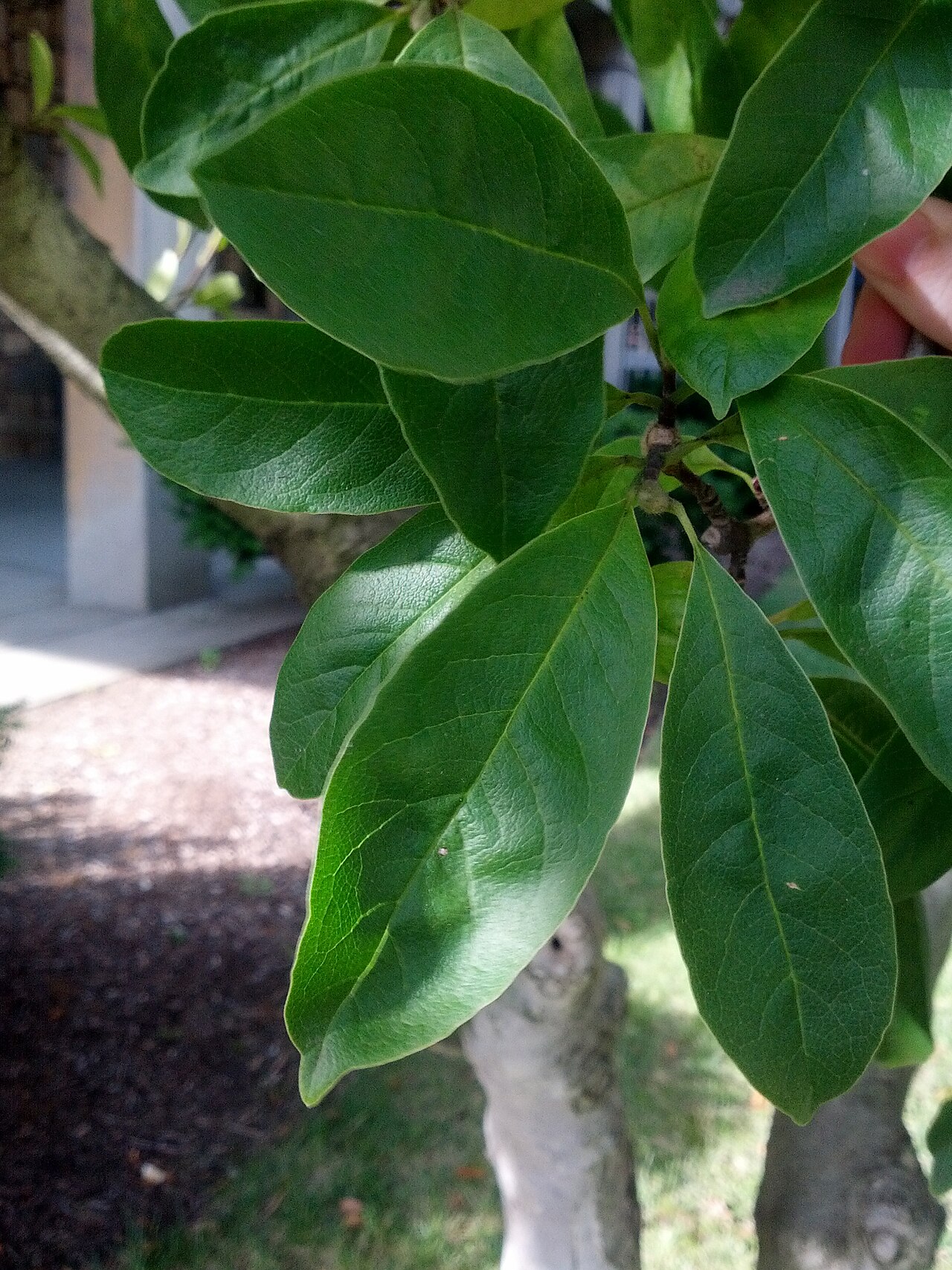
Leaves are simple, alternate (often clustered on short spur shoots), 2 to 5 inches long, elliptic to oblanceolate, with smooth margins and a notably glossy, leathery dark-green upper surface that is one of the species’ most attractive features. The underside is paler and may show fine rust-colored hairs when young, aging to smooth.
Flowers
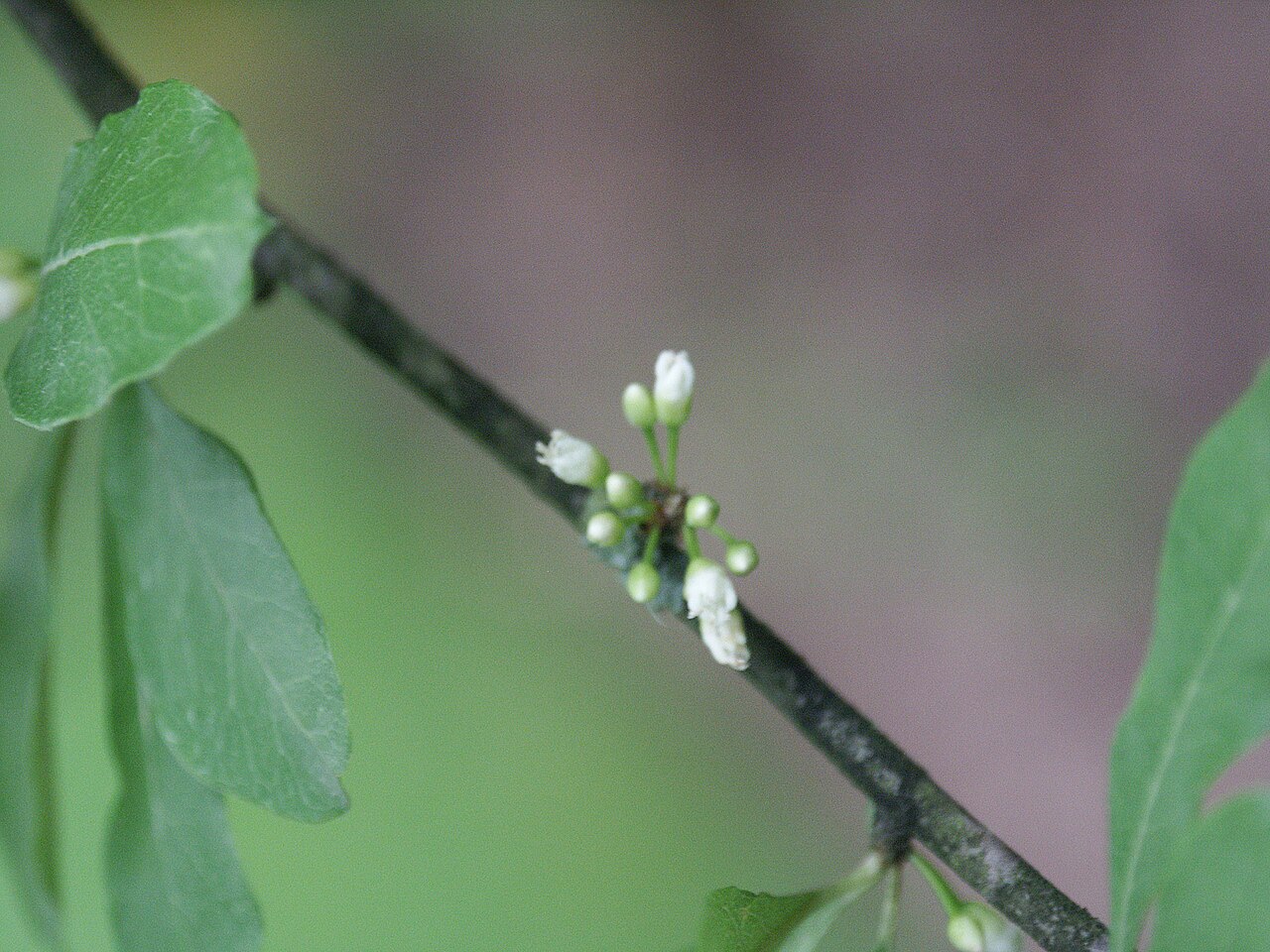
Small, fragrant, creamy-white flowers appear in dense axillary clusters in mid-to-late summer, considerably later in the season than most native trees bloom. Though individually tiny, the clustered flowers produce a noticeable sweet scent that draws large numbers of bees and other pollinators.
Fruit & Seeds
The fruit is a small, oval, blue-black drupe about ⅓ to ½ inch long, ripening in fall and often persisting into winter. Each fruit contains a single hard seed. Despite the Sapotaceae family’s tropical fruit relatives (including sapodilla), the fruit of Buckthorn Bumelia is primarily a wildlife food rather than a human food source.
Quick Facts
| Scientific Name | Sideroxylon lycioides (syn. Bumelia lycioides) |
| Family | Sapotaceae (Sapodilla) |
| Plant Type | Deciduous to Semi-Evergreen Small Tree / Large Shrub |
| Mature Height | 15–30 ft |
| Mature Spread | 12–20 ft |
| Growth Rate | Slow to Moderate |
| Sun Exposure | Full Sun to Part Shade |
| Water Needs | Average to Wet; tolerates swamp margins and seasonal flooding |
| Soil Type | Adaptable; moist bottomland soils to dry limestone bluffs |
| Soil pH | 5.5–7.5 (tolerates alkaline/limestone soils) |
| Bloom Time | July – September |
| Flower Color | Creamy white, fragrant |
| Fall Color | Yellow-green; often semi-evergreen in the Deep South |
| Fruit | Blue-black drupe, ⅓–½ in, wildlife food |
| Deer Resistant | Yes (thorny branches discourage browsing) |
| USDA Hardiness Zones | 6–9 |
Native Range
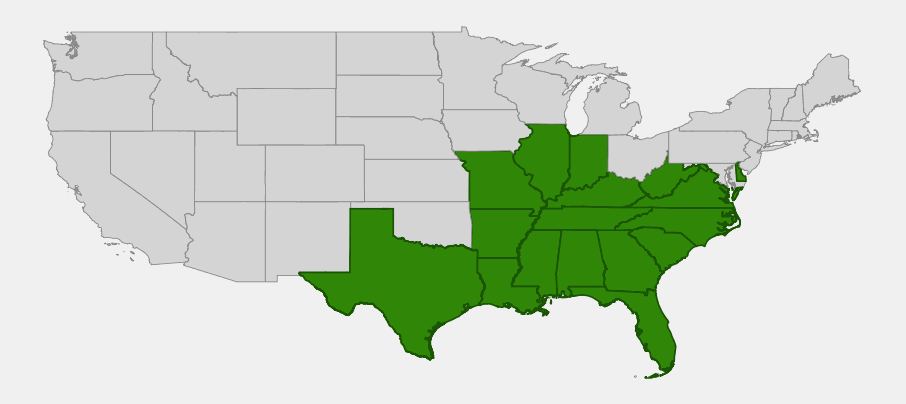
Buckthorn Bumelia is native to the southeastern United States, ranging from southeastern Virginia south through the Carolinas, Georgia, and Florida, west along the Gulf Coast through Alabama, Mississippi, and Louisiana, into eastern Texas, and north through Arkansas and Missouri. A distinct inland population occurs on limestone soils in Kentucky and Tennessee, with scattered populations also recorded in southern Illinois, Indiana, and West Virginia. It is found mostly on the Coastal Plain, with more scattered inland occurrences in the Piedmont and mountains on rich, often limestone-influenced soils.
Within this range, Buckthorn Bumelia occupies a wider range of habitats than many of its swamp-forest associates — it grows on moist floodplain and swamp margins, maritime forests, and river bluffs on the Coastal Plain, but also tolerates drier, calcium-rich upland sites in its inland Kentucky-Tennessee populations. This habitat flexibility makes it more adaptable in cultivation than true wetland obligates like Water Locust or Carolina Ash.
Populations at the edges of this range — particularly in Illinois, Indiana, and West Virginia — are more local and scattered; confirm suitability against county-level BONAP or state natural heritage data before planting in those areas.
📋 Regional plant lists featuring Buckthorn Bumelia: Georgia, Alabama & Mississippi · Arkansas, Louisiana, Eastern Oklahoma & Eastern Texas · North Carolina & South Carolina · Maryland, Virginia & West Virginia (not native in Maryland) · Kentucky & Tennessee · Ohio & Indiana (Indiana only) · Illinois, Iowa & Missouri (not native in Iowa) · Delaware, Southern New Jersey & Long Island, New York (Delaware only; no dedicated Florida list exists on this site, though Buckthorn Bumelia is also native there)
Growing & Care Guide
Buckthorn Bumelia is more adaptable in the garden than most of its swamp-forest associates, able to handle both moist bottomland soils and drier, well-drained upland sites, making it a flexible choice for wildlife gardens and naturalized plantings throughout the Southeast.
Light
Performs best in full sun to light shade, flowering and fruiting most heavily with good sun exposure. It tolerates the partial shade of a woodland edge, where its glossy foliage and rounded form still read well as an understory accent.
Soil & Water
Adaptable to a wide range of soils, from moist, periodically flooded bottomland soils to drier, calcium-rich limestone sites in its inland Kentucky-Tennessee populations. This flexibility makes it more forgiving than strict wetland species, though it still appreciates consistent moisture during establishment.
Planting Tips
Plant container stock in fall or early spring. Because of its thorny branches, site it away from walkways, patios, and areas with foot traffic. Allow 12 to 20 feet for mature spread if used as a specimen, or plant more closely in a naturalized hedgerow or thicket planting for wildlife.
Pruning & Maintenance
Minimal pruning is needed. Remove dead or crossing branches in late winter. Wear heavy gloves when working near the thorny branches. The multi-trunked habit can be encouraged for a dense screening shrub or selectively thinned to favor a more tree-like single-trunk form.
Propagation
Propagated from seed, which benefits from cold-moist stratification. Cuttings can also be used, though germination and rooting rates are generally slower than for many other native trees, consistent with the species’ overall slow-to-moderate growth rate.
Landscape Uses
Buckthorn Bumelia’s glossy foliage and adaptability support several uses:
- Wildlife hedgerow or thicket planting — thorny branches and berries provide cover and food
- Late-season pollinator gardens — one of few woody plants blooming in mid-to-late summer
- Woodland edge and naturalized screen plantings
- Swamp margin and bottomland restoration, alongside Carolina Ash and Persimmon
- Limestone or alkaline-soil plantings in its inland Kentucky-Tennessee range
Wildlife & Ecological Value
Buckthorn Bumelia’s unusual late-summer bloom time and persistent winter fruit make it a valuable, if under-recognized, addition to a wildlife-friendly native landscape.
For Pollinators
The fragrant white flowers bloom in July through September, a period when most spring-flowering native trees and shrubs have finished, making Buckthorn Bumelia an important late-season nectar source for bees and other pollinating insects building up resources before fall.
For Birds
The small blue-black drupes ripen in fall and often persist into winter, providing a food source for migrating and overwintering songbirds when many other fruits have already been consumed or dropped.
For Mammals
The dense, thorny branching discourages deer browsing, making Buckthorn Bumelia naturally deer-resistant, while the cover it provides benefits small mammals using it as part of a hedgerow or thicket habitat.
Ecosystem Role
As a habitat generalist able to grow on both wet swamp margins and dry limestone bluffs, Buckthorn Bumelia fills ecological niches that many of its more specialized swamp-forest neighbors cannot, contributing structural diversity to the shrub and small-tree layer across a range of Southeastern forest types.
Cultural & Historical Uses
Buckthorn Bumelia has little commercial timber or ethnobotanical history recorded; its small size and scattered, thorny growth have limited practical use. The genus name Sideroxylon (“iron wood”) reflects the characteristically hard, dense wood common to the genus, though it has seen little commercial exploitation compared to other hardwoods.
The species has historically been classified in the segregate genus Bumelia, and much of the older botanical and horticultural literature still refers to it as Bumelia lycioides — a naming convention gardeners and foresters researching the species in older references should be aware of.
Modern interest in Buckthorn Bumelia centers on its wildlife and pollinator value, particularly its unusual late-summer bloom period, which has drawn growing attention from native plant gardeners seeking to extend blooming season diversity for pollinators beyond the spring rush most native trees provide.
Frequently Asked Questions
Is Buckthorn Bumelia related to true buckthorns?
No. Despite the common name, Buckthorn Bumelia belongs to the Sapotaceae (sapodilla family), unrelated to true buckthorns (Rhamnus species) in the Rhamnaceae family. The name likely comes from a general resemblance in thorny branching habit.
Why does it sometimes get called Bumelia lycioides?
Bumelia was long treated as a separate genus before taxonomic revisions merged it into the broader genus Sideroxylon. Both names refer to the same plant, and older references commonly use Bumelia lycioides.
Is Buckthorn Bumelia evergreen?
It is semi-evergreen to deciduous depending on location — trees in the Deep South often retain much of their glossy foliage well into winter, while populations at the colder, northern edge of the range are more fully deciduous.
Can it grow on dry, alkaline soil?
Yes — unlike most of its swamp-forest associates, Buckthorn Bumelia is notably adaptable, growing naturally on both wet Coastal Plain swamp margins and dry, calcium-rich limestone sites in its inland Kentucky-Tennessee populations.
Are the thorns a safety concern?
The stout, straight thorns on the branches can cause injury, so site the plant away from walkways and areas with regular foot traffic, and wear heavy gloves when pruning or working near it.

Looking for a nursery that carries Buckthorn Bumelia?
Browse our native plant nursery directory: Alabama & Arkansas · Delaware, Florida & Georgia · Illinois & Indiana · Kentucky, Louisiana & Mississippi · North Carolina · South Carolina, Tennessee, Texas & Virginia · West Virginia
For other Coastal Plain associates, see our pages on Persimmon, Sugarberry, and American Holly. For more on native tree planting, see our overview of the benefits of planting native trees and tips on attracting songbirds with native plants.

