
Clammy Locust (Robinia viscosa)
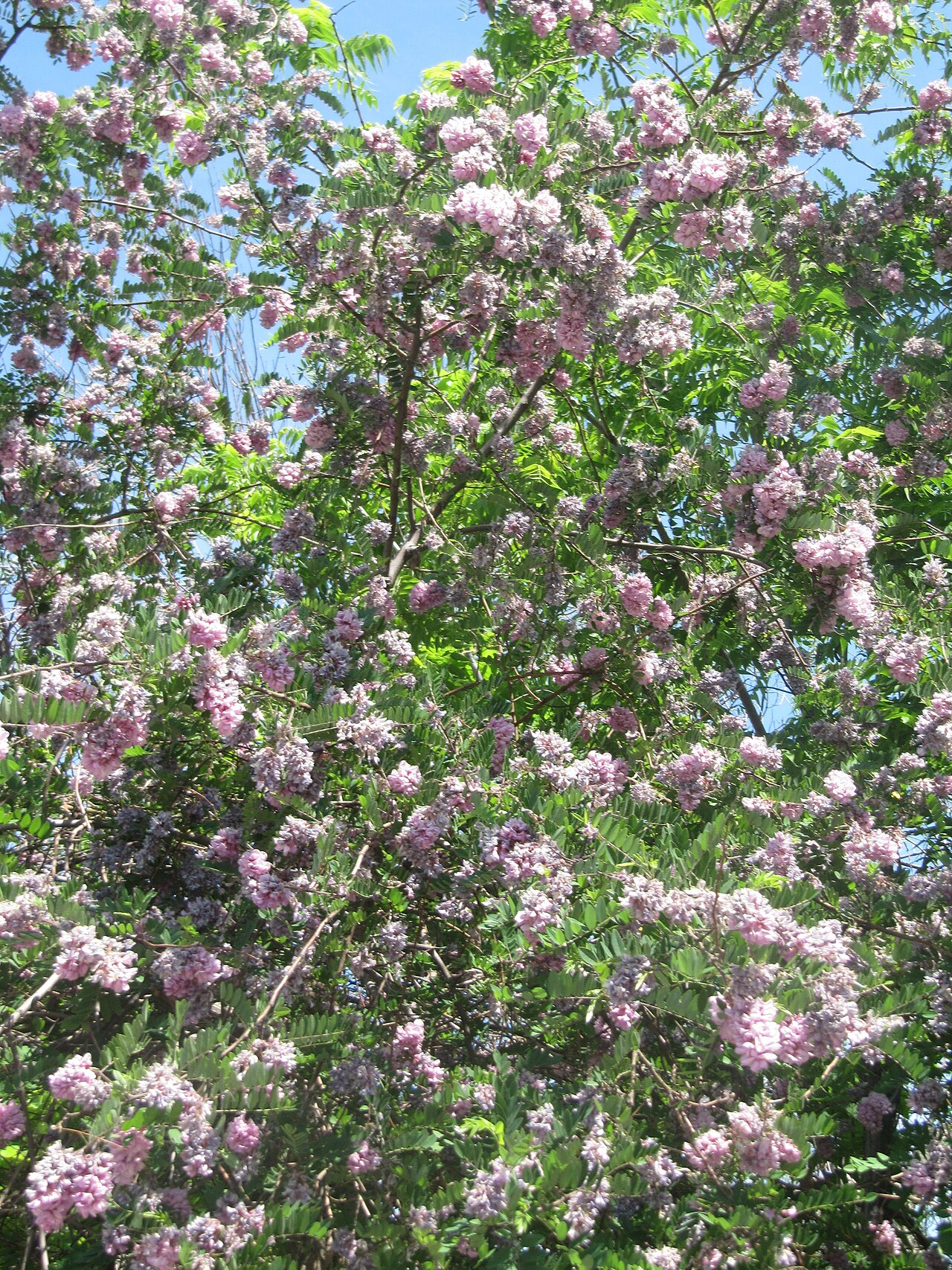
Robinia viscosa, the Clammy Locust, is a shrub or small tree of the southern Appalachian Mountains with showy clusters of pink, pea-like flowers in late spring. It is a close relative of Black Locust, with similar compound leaves and drooping flower clusters, but its flowers are rosy pink instead of white. Its most distinctive feature is in the name: the young twigs, leaf stalks, flower stalks and seed pods are covered with sticky, gland-tipped hairs that feel clammy to the touch.
Clammy locust is native to open woods, forest edges, clearings and rocky slopes in the mountains and upper Piedmont from West Virginia and Virginia south to Georgia and Alabama. Its natural range is small, but it has been planted as an ornamental since the late 1700s and has escaped and naturalized widely in the northeastern United States, eastern Canada and parts of Europe. In the field, plants far outside the Appalachians are almost always escapes from cultivation.
Safety note: like black locust, clammy locust contains toxic compounds, especially in the bark, seeds, pods and leaves. These can cause serious illness if eaten by people, particularly children, and by livestock, especially horses. The flowers of some locusts are eaten in some regions, but do not eat any part of clammy locust. This guide covers identification, native range, care and the plant’s value to pollinators.
Identification
Three native locusts are commonly grown in the East: black locust, Bristly Locust and clammy locust. They share pinnately compound leaves and pea-like flowers, and they all spread by root suckers. Flower color and the type of hairs on the twigs are the easiest ways to tell them apart.
Growth Habit & Bark
Clammy locust is usually a large shrub or small tree 10 to 30 feet tall, sometimes up to about 40 feet, with a spreading, open crown of slender branches. It spreads by root suckers and often forms thickets. The bark is smooth and dark reddish-brown on young stems and becomes slightly furrowed on older trunks. Most stems have only small spines at the nodes, or none, unlike the stout thorns of black locust.
Twigs & Glands
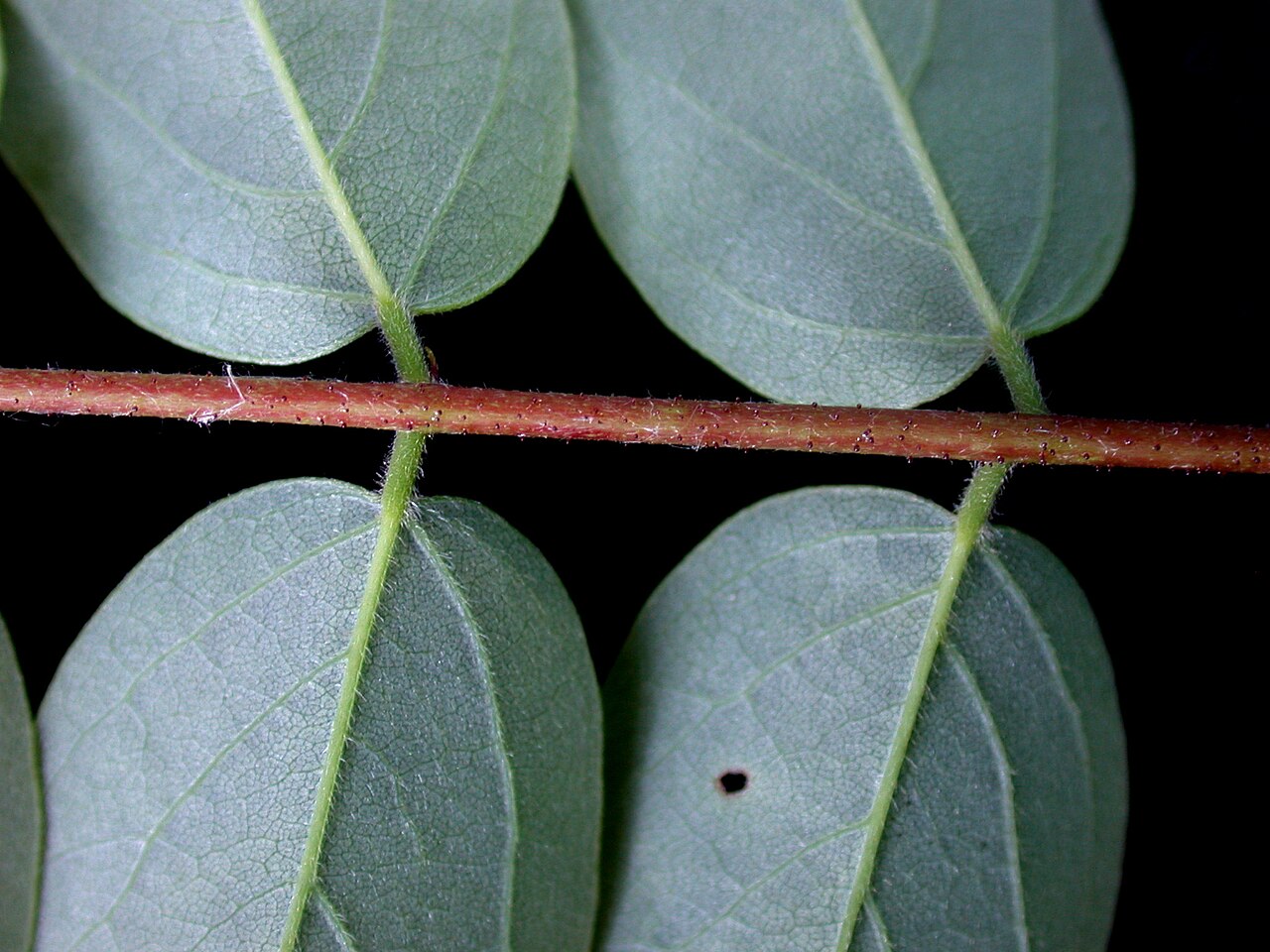
The young twigs, leaf stalks, flower stalks and pods are densely covered with short, dark, gland-tipped hairs that produce a sticky resin. Touch a new twig and it will feel tacky. This feature distinguishes clammy locust from black locust, which has smooth twigs, and from bristly locust, which has long, stiff, non-sticky bristles.
Leaves
The leaves are alternate and pinnately compound, 6 to 12 inches long, with about 13 to 25 oval leaflets, each about 1 to 2 inches long. They are dull green above and paler below, and they turn yellow before dropping in fall.
Flowers
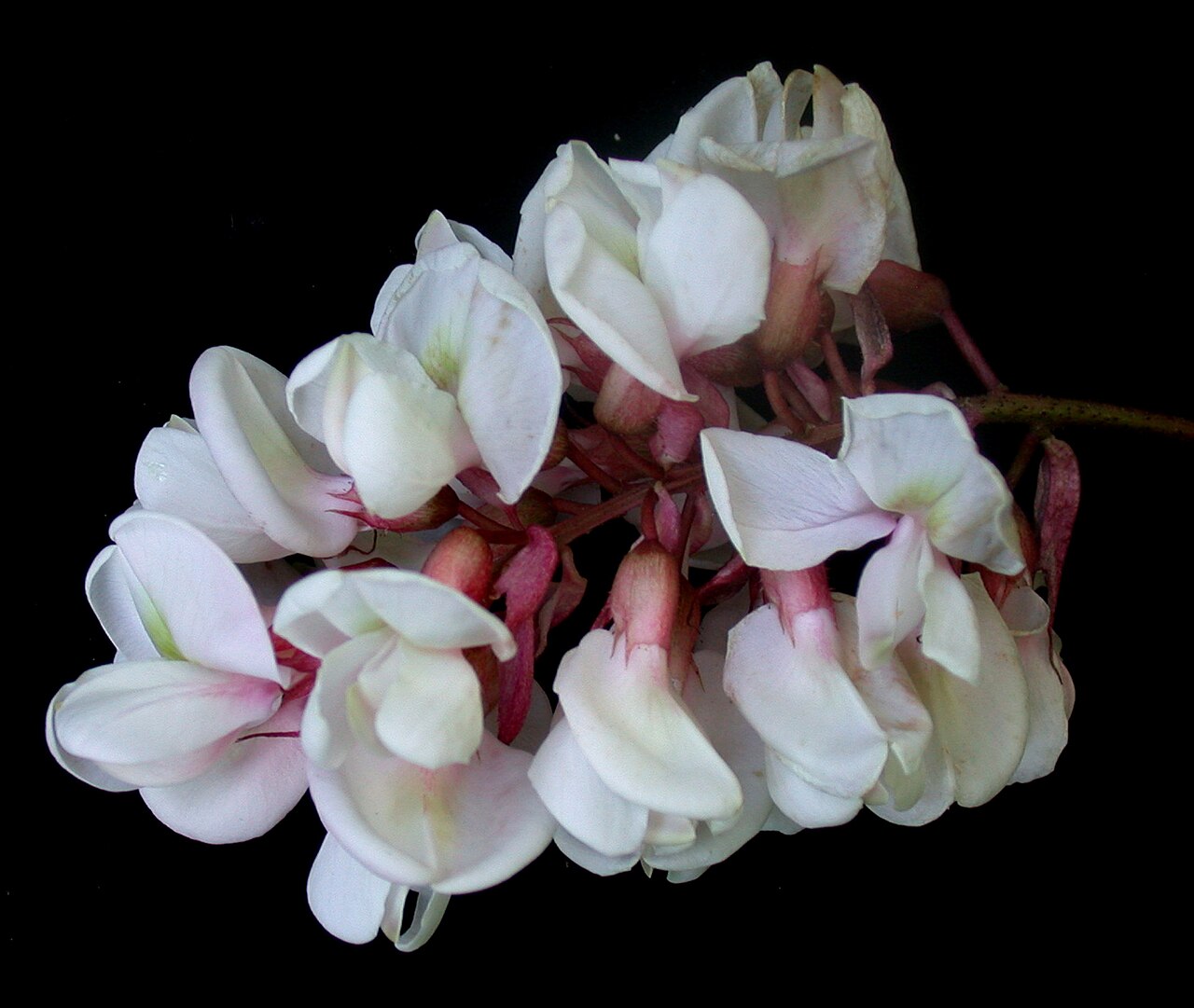
Flowering occurs in late spring, mostly in May and June, a little after black locust. The flowers are pea-like, about three-quarters of an inch long, in dense, drooping clusters 2 to 3 inches long. They are pale pink to rose, often with a yellowish blotch on the upper petal (banner), and lightly fragrant.
Fruit
The seed pods are flat, 2 to 3½ inches long, and covered with sticky glandular bristles. They ripen in late summer and fall, split open and release several small, hard, dark seeds.
Quick Facts
| Scientific Name | Robinia viscosa Vent. |
| Family | Fabaceae (pea family) |
| Plant Type | Deciduous shrub or small tree; suckering |
| Mature Height | 10–30 ft (occasionally to 40 ft) |
| Mature Spread | 10–20 ft; forms thickets by suckers |
| Growth Rate | Fast |
| Sun Exposure | Full sun to light shade |
| Water Needs | Low to medium; drought-tolerant once established |
| Soil Type | Well-drained, rocky, sandy or loamy soils; tolerates poor soil |
| Soil pH | About 5.0–7.5 |
| Bloom Time | May–June |
| Flower Color | Pale pink to rose |
| Fall Color | Yellow |
| Fruit | Flat, sticky-bristly pod with several seeds (toxic) |
| Deer Resistant | Moderate |
| USDA Hardiness Zones | 5–8 |
Native Range
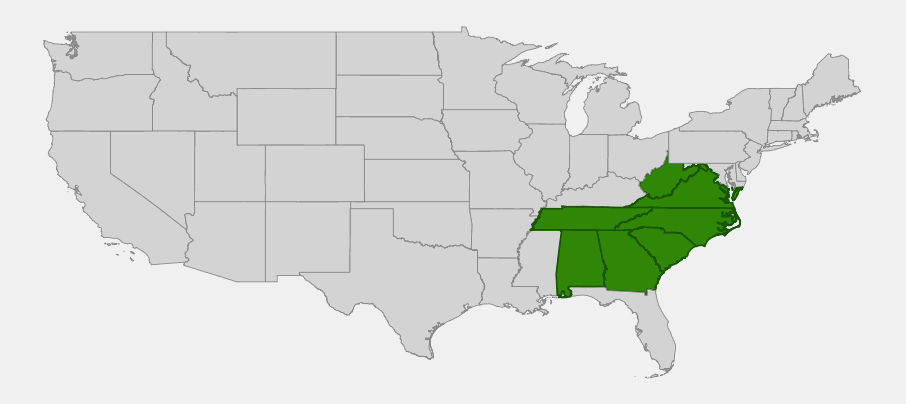
The native range of clammy locust is the southern Appalachian region. The Flora of North America describes it as native from West Virginia southwest to central Alabama, at about 500 to 4,000 feet in elevation. On this page, its native states are Alabama, Georgia, North Carolina, South Carolina, Tennessee, Virginia and West Virginia. Two varieties are often recognized: the typical var. viscosa, and var. hartwegii, which has hairier, less sticky twigs and paler flowers and grows mainly in the southern part of the range.
USDA PLANTS lists clammy locust from many more states, including Kentucky, Pennsylvania, Ohio, Indiana, Illinois, Michigan, Wisconsin, Minnesota, New York, New Jersey and the New England states. Those records mostly represent plants that escaped from cultivation and naturalized along roadsides, old homesites and woodland edges. USDA also notes that it is introduced in Canada.
In its native range it grows in dry to moist open woods, forest edges, clearings, rocky slopes, ridges and roadsides. Like other locusts, it fixes nitrogen with the help of root bacteria, which lets it grow on thin, poor soils and colonize disturbed ground quickly.
📋 Regional plant lists featuring Clammy Locust: Alabama, Georgia & Mississippi · North & South Carolina · Kentucky & Tennessee · Maryland, Virginia & West Virginia
Growing & Care Guide
Clammy locust is easy to grow, fast and tolerant of poor, dry soils. Within its southern Appalachian range it is a good choice for naturalistic plantings, wildlife hedges and stabilizing rough slopes. Its suckering habit is the main drawback: in a small garden it can spread beyond where you want it, and outside its native range it can escape, so plant it thoughtfully.
Light
Plant in full sun for the best flowering. It tolerates light shade, but flowers less and becomes leggy in shade.
Soil & Water
Clammy locust grows in almost any well-drained soil, including rocky, sandy and nutrient-poor soils, because it fixes its own nitrogen. Avoid heavy, wet soils. Water young plants during their first summer; after that it is quite drought-tolerant.
Planting Tips
Plant in spring or fall. Give it space, at least 10 to 15 feet, and site it where root suckers won’t be a problem, such as a slope, a hedgerow or a large naturalized area. Avoid planting it where children or horses and other livestock might chew the bark, seeds or pods. Its branches are somewhat brittle, so avoid very windy, exposed spots near buildings.
Pruning & Maintenance
Prune in late winter to remove dead, damaged or crossing branches. Remove unwanted suckers by cutting them at ground level as they appear. Like black locust, clammy locust can be attacked by locust borers and locust leafminers, which weaken or disfigure trees; healthy, vigorous plants in full sun cope best. Wear gloves when pruning, both for the sticky twigs and to avoid handling the toxic bark.
Propagation
The easiest method is to dig and replant rooted suckers in late winter or early spring. Seeds have hard coats and germinate best after nicking or soaking in hot water before sowing. Root cuttings taken in late winter also root well.
Landscape Uses
- Pollinator gardens: abundant pink spring flowers that are highly attractive to bees
- Slope and bank stabilization: its suckering roots and nitrogen fixation help it hold dry, eroded ground
- Wildlife hedgerows: fast-growing thickets give cover to birds and small mammals
- Naturalistic plantings: a showy small tree for woodland edges within its native range
- Specimen tree: a small flowering tree for large, sunny gardens where suckers can be managed
Wildlife & Ecological Value
Clammy locust is a valuable plant for pollinators, and like other locusts it improves poor soils for the plants around it.
For Pollinators
The Xerces Society notes clammy locust as being of special value to native bees and honeybees. Its pink flowers attract bumblebees, mason bees, other native bees and butterflies, and they are a good source of nectar for honey. Locusts are also larval host plants for the silver-spotted skipper, a common butterfly whose caterpillars fold locust leaflets into shelters.
For Birds
The thickets provide nesting and escape cover for many songbirds. Some birds eat the seeds, although they are not a major food source.
For Mammals
Rabbits and small mammals use the thickets for cover. Deer browse young growth to some extent. The bark, seeds and leaves contain toxic proteins and are dangerous to horses and other livestock if eaten in quantity.
Ecosystem Role
Clammy locust forms a partnership with nitrogen-fixing bacteria in root nodules, adding nitrogen to the soil. As a pioneer of clearings, slopes and disturbed ground in the southern Appalachians, it helps stabilize soil and prepares the way for other woody plants.
Cultural & Historical Uses
The genus Robinia honors Jean Robin and his son Vespasien Robin, gardeners to the French kings, who first grew black locust in Europe in the early 1600s. The naturalist William Bartram is credited with discovering clammy locust in the southern Appalachians during his travels in 1776, and it was formally named by the French botanist Étienne Pierre Ventenat from plants growing in a Paris garden.
Clammy locust quickly became a popular ornamental in Europe and in the northeastern United States because of its pink flowers and fast growth. It was painted by the renowned botanical artist Pierre-Joseph Redouté, and it appears among the plates of François André Michaux’s The North American Sylva. Its long history in cultivation is the reason it now grows wild well beyond its native range.
The pink-flowered ornamental locusts sold today include clammy locust selections and hybrids with black locust and bristly locust. Some hybrids, such as Robinia × ambigua, combine features of clammy and black locust.
Frequently Asked Questions
Is clammy locust poisonous?
Yes. As with black locust, the bark, seeds, pods and leaves of clammy locust contain toxic proteins and other compounds that can cause nausea, vomiting, weakness and more serious effects if eaten. Horses are especially sensitive. Keep children and livestock from eating any part of the plant.
Why is it called clammy locust?
Its young twigs, leaf stalks, flower stalks and seed pods are covered with sticky, gland-tipped hairs that feel clammy or tacky when touched. Viscosa means “sticky.”
How is clammy locust different from black locust?
Clammy locust has pink flowers, sticky glandular twigs and pods, and usually small or no spines, and it is typically a shrub or small tree. Black locust has white flowers, smooth twigs, paired thorns and grows into a larger tree.
Does clammy locust spread?
Yes. It spreads by root suckers and can form thickets, and it has naturalized in many areas outside its native range. Plant it where suckers can be mowed or managed, and avoid planting it outside its native region in natural areas.
Is clammy locust good for bees?
Yes. Its abundant late-spring flowers are highly attractive to native bees and honeybees, and the Xerces Society lists it as being of special value to both.

Looking for a nursery that carries Clammy Locust?
Browse our native plant nursery directory: Alabama · Georgia · North Carolina · South Carolina, Tennessee & Virginia · West Virginia

