
Common Devil’s-Claw (Proboscidea louisianica)
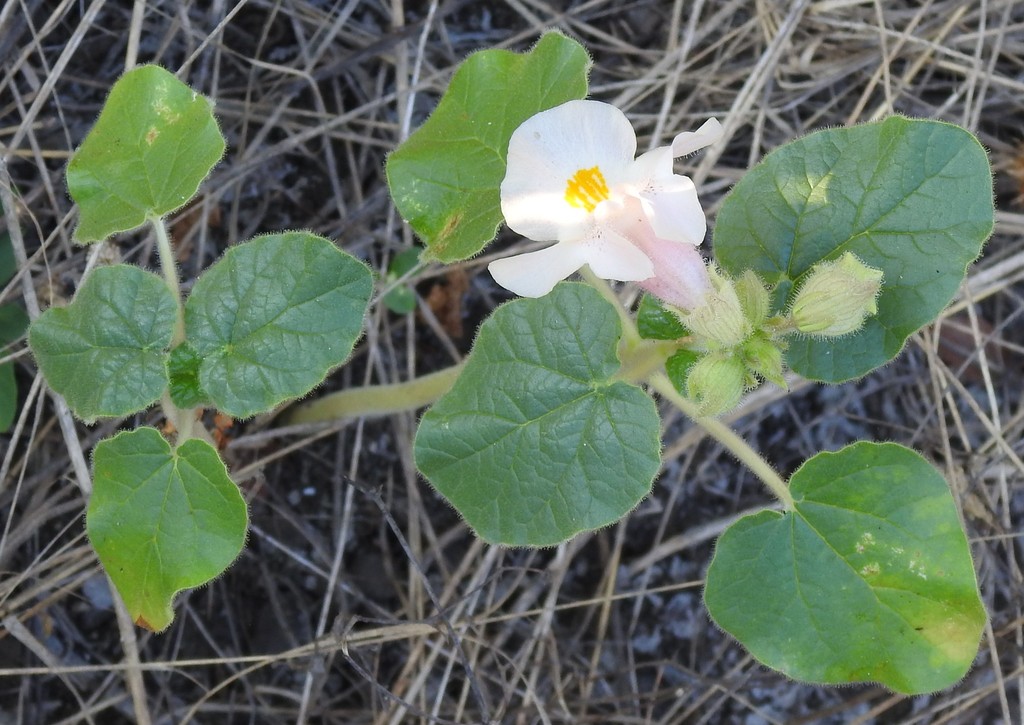
Proboscidea louisianica, known as Common Devil’s-Claw, ram’s horn or unicorn-plant, is a sprawling annual of the unicorn-plant family (Martyniaceae) best known for its extraordinary fruit. Green, curved pods up to 6 inches long ripen into woody, black husks that split into two long, sharply hooked horns. In summer the plant carries big, foxglove-like flowers, white to pink or pale lavender, with yellow stripes and purple spots in the throat, above large, rounded, sticky leaves.
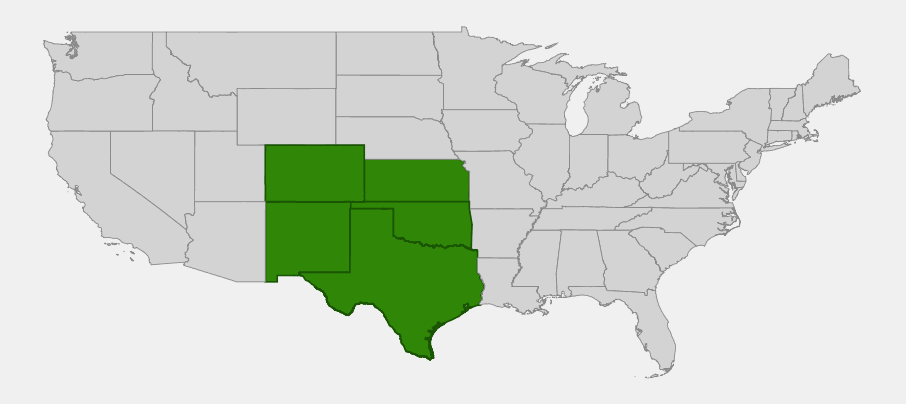
Its true native range is uncertain because people have carried it around for centuries. Most sources consider it native to the southern Great Plains and the Southwest, especially Texas, Oklahoma, Kansas, New Mexico and eastern Colorado, and to northern Mexico. Lady Bird Johnson Wildflower Center describes it as native to Texas and Mexico and possibly Louisiana. USDA PLANTS records it in more than 40 states, but in most of the East, the Midwest and the Far West it is a naturalized plant that escaped from gardens and farms. This page treats it as native in Colorado, Kansas, New Mexico, Oklahoma and Texas.
It is an interesting plant for children’s gardens, dry wildflower areas and native plant collections in the southern Plains, and its claws are prized for crafts. It self-sows freely in disturbed soil, so grow it where volunteers are welcome, and do not plant it near livestock pastures, where the claws can catch on animals.
Identification
Look for a low, spreading, strong-smelling annual with big rounded, sticky leaves, large pale pink to lavender trumpet flowers with yellow and purple markings, and curved green pods with a long beak.
Growth Habit
Plants are annuals with thick, branching stems that spread over the ground or curve upward, forming a mound usually 1 to 3 feet tall and 2 to 3 feet or more across. The whole plant is covered with glandular hairs that feel sticky and oily and give it a strong, musky smell. Small insects often get stuck to the hairs, which is why it is sometimes called aphid trap.
Leaves
The leaves are large, long-stalked, opposite on the lower stem and often alternate above, with rounded to heart-shaped blades 4 to 12 inches across and wavy or shallowly lobed edges. They are thick, soft and sticky.
Flowers
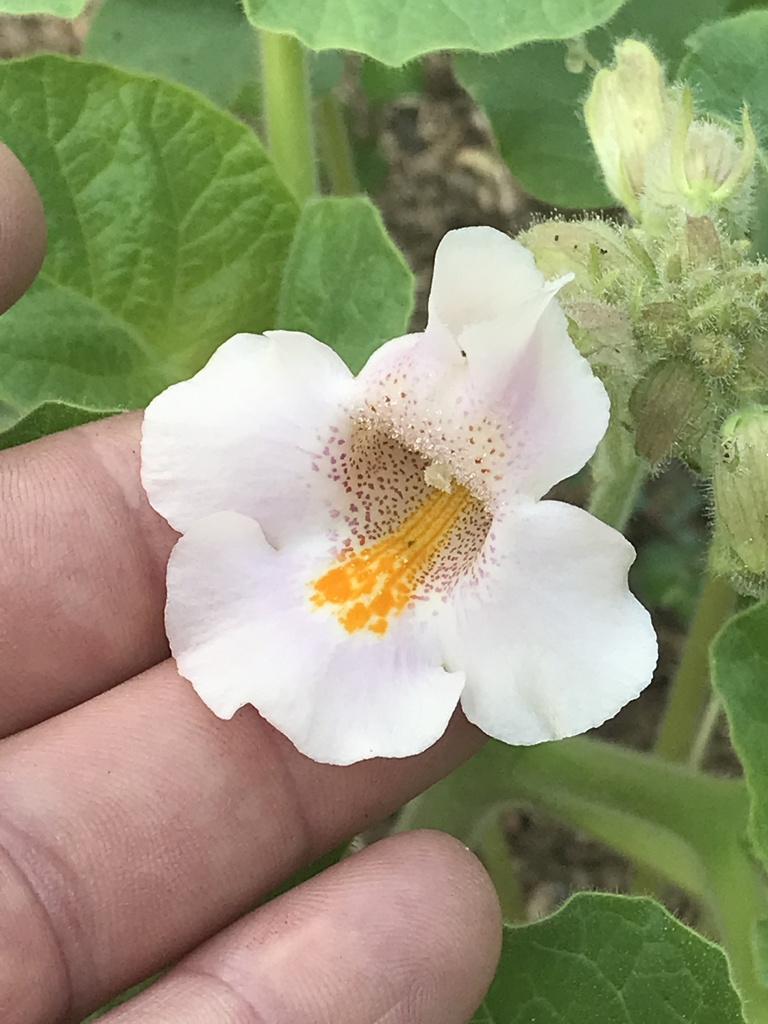
The flowers are carried in short clusters above the leaves from about June to September. Each is 1 1/2 to 2 inches long, with a broad, bell-shaped tube and five rounded lobes. They are creamy white to pink or pale lavender, with yellow lines (nectar guides) and purple spots or blotches inside. Subspecies fragrans of West Texas and Mexico has fragrant, deeper reddish-purple flowers.
Fruit
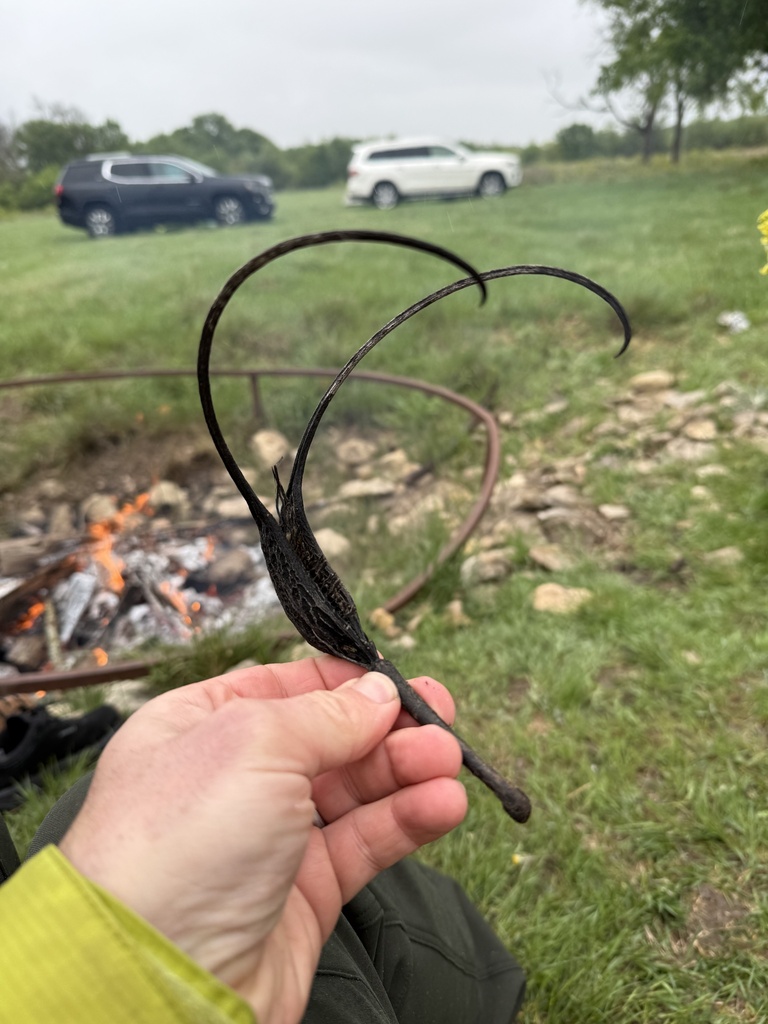
The fruit is the most distinctive feature. It starts as a green, fleshy, curved pod 3 to 6 inches long with a long, tapering beak, so the whole fruit can be close to a foot long. As it dries, the outer flesh falls away and the woody inner husk splits along the beak into two curved, sharp-tipped horns. The black dry claws hook onto the legs and hooves of passing animals, which carry the seeds away. Each fruit contains many black, rough seeds.
Look-alikes
Desert unicorn-plant or double claw (Proboscidea parviflora) of Arizona and the Southwest has smaller, reddish-purple to pink flowers and is the species most used in Southwestern basketry. Yellow unicorn-plant (Ibicella lutea), a South American species sometimes naturalized in the U.S., has yellow flowers. Before the pods form, the sticky, rounded leaves might be mistaken for a squash or sacred datura, but those plants are not sticky and have different flowers.
Quick Facts
| Scientific Name | Proboscidea louisianica |
| Family | Martyniaceae (unicorn-plant family) |
| Plant Type | Annual herb, sprawling |
| Mature Height | 1–3 ft |
| Mature Spread | 2–3 ft or more |
| Growth Rate | Fast |
| Sun Exposure | Full sun |
| Water Needs | Low; drought tolerant |
| Soil Type | Sandy, loamy or clay; disturbed ground |
| Soil pH | Neutral to alkaline (about 6.5–8.5) |
| Bloom Time | June–September |
| Flower Color | White, pink or pale lavender with yellow and purple markings |
| Fall Color | None (annual) |
| Fruit | Curved pod that dries into a two-horned, hooked claw |
| Deer Resistant | Yes; the sticky, strong-smelling leaves are rarely eaten |
| USDA Hardiness Zones | Annual; grows in summer heat (about zones 5–10) |
Native Range
Common devil’s-claw is most likely native to the southern Great Plains, the southwestern United States and northern Mexico. On this page it is treated as native in Texas, Oklahoma, Kansas, New Mexico and Colorado, where it is a familiar plant of prairies, pastures, sandy flats and roadsides. In Texas it grows over most of the state, from the Panhandle and the Rolling Plains through the Cross Timbers, Blackland Prairie and Edwards Plateau to the Trans-Pecos, where subspecies fragrans also occurs.
USDA PLANTS lists the species in over 40 states, from California, Oregon and Washington east to Maine and Florida. Lady Bird Johnson Wildflower Center and most regional floras describe these eastern, northern and Pacific populations as naturalized, spread by people who grew the plant for its edible pods and curious claws or carried in crop seed and livestock feed. Its native status in Louisiana is uncertain despite the species name, and it is generally considered introduced in Nebraska and farther north and east.
It grows in open, sunny, disturbed ground: overgrazed pastures, prairie dog towns, sandy and gravelly stream beds, the margins of playa lakes, field edges, feedlots and roadsides. It favors spots where the soil has been disturbed and competition is low, usually below about 6,000 feet.
📋 Regional plant lists featuring Common Devil’s-Claw: Nebraska, Kansas & Eastern Colorado · Arkansas, Louisiana, Eastern Oklahoma & Eastern Texas · South & West Texas
Growing & Care Guide
Common devil’s-claw is easy to grow from seed in hot, sunny places. It needs warm soil to germinate and grows fast in summer heat. Give it room to sprawl and plan for its self-sowing habit.
Light
Full sun. It grows poorly in shade.
Soil & Water
Any well-drained soil works, including sand, gravel and clay loam. Water seedlings until they are established; after that it is very drought tolerant, although occasional deep watering in long dry spells produces more pods. Rich, heavily watered soil gives huge leafy plants with fewer flowers.
Planting Tips
Sow seed directly outdoors in late spring after the soil is warm, about 1/2 inch deep. Germination can be slow and uneven; soaking seed overnight or carefully nicking the hard coat helps. Thin to 2 to 3 feet apart. It needs plenty of space and is best at the edge of a dry garden or in a wild area.
Pruning & Maintenance
No pruning is needed. Pick green pods for eating when they are 3 to 4 inches long. To prevent heavy reseeding and to avoid hooked claws in paths and pet fur, collect dry claws in fall before they split and scatter seed. Wear gloves when handling dry claws; the tips are sharp.
Propagation
Grow from seed. Collect dry claws in fall and shake or pry the seeds out. Store dry until spring sowing. White-seeded strains grown by Southwestern farmers germinate more readily than wild black-seeded plants.
Landscape Uses
- Children’s gardens: curious, claw-shaped fruit that kids love
- Dry wildflower areas: summer flowers in hot, poor soil
- Edible gardens: young pods can be cooked or pickled like okra
- Crafts: dry claws are used in basketry, ornaments and dried arrangements
- Pollinator gardens: large flowers visited by bumblebees and other native bees
Wildlife & Ecological Value
Common devil’s-claw is an important summer flower for native bees on the southern Plains, and its seeds and hooked fruit play a role in the prairie ecosystem.
For Pollinators
The large flowers are pollinated by bees. Bumblebees, long-horned bees such as Melissodes and Svastra, digger bees and small sweat bees have all been recorded visiting them. The plant rarely pollinates itself, so it depends on these insects for fruit.
For Birds
The oily seeds are eaten by some birds, and the sticky leaves trap small insects that birds may glean. Quail and other ground birds use the dense, sprawling plants for shade and cover.
For Mammals
Livestock and deer rarely eat the strong-smelling foliage. The dry claws clamp onto the legs and hooves of large animals, and probably did so on bison before cattle, carrying the seeds long distances. Rodents eat the seeds.
Ecosystem Role
It is a pioneer of disturbed ground, colonizing bare soil around bison wallows, prairie dog towns, flood-scoured stream beds and other openings, and adding diversity to the summer flora of the Plains.
Cultural & Historical Uses
Devil’s-claws have been used by Indigenous peoples of the Southwest for centuries. The long black fibers of the dry claws were split and woven into baskets to create dark patterns. The use of this species in basketry has been recorded among the Hopi, Apache and Havasupai and other peoples, although the related desert unicorn-plant (P. parviflora) was the main species domesticated by the Tohono O’odham.
The young green pods are edible and have long been cooked or pickled, much like okra, and the oily seeds were eaten as well. In the nineteenth century, the plant was grown in American gardens as a curiosity and a pickling vegetable, which helped spread it far beyond its native range.
The genus name Proboscidea means “snout-like,” for the long beak of the fruit, and names such as unicorn-plant, ram’s horn and elephant tusks all describe the same feature. The dry claws can hook onto the feet and noses of livestock, causing injury and lowering the value of wool, so ranchers in some areas consider it a pest.
Frequently Asked Questions
Is common devil’s-claw native?
It is generally considered native to the southern Great Plains and Southwest, including Texas, Oklahoma, Kansas, New Mexico and Colorado, and to northern Mexico. In most other states it is naturalized from cultivation.
Can you eat devil’s-claw pods?
Yes. Young green pods, about 3 to 4 inches long, can be cooked or pickled like okra. Older pods become tough and woody.
Is devil’s-claw dangerous?
It is not known to be poisonous, but the dry claws have sharp, hooked tips that can injure pets and livestock and are painful to step on. Collect dry claws before they scatter.
How do I grow devil’s-claw from seed?
Sow seed outdoors in warm late-spring soil in full sun. Soaking or nicking the seed helps germination. Water until established, then let it grow with little care.
Why are the leaves so sticky?
The leaves and stems are covered with glandular hairs that produce oily droplets. They give the plant its strong smell and trap small insects.

Looking for a nursery that carries Common Devil’s-Claw?
Browse our native plant nursery directory: Colorado · Kansas · New Mexico & Oklahoma · Texas

